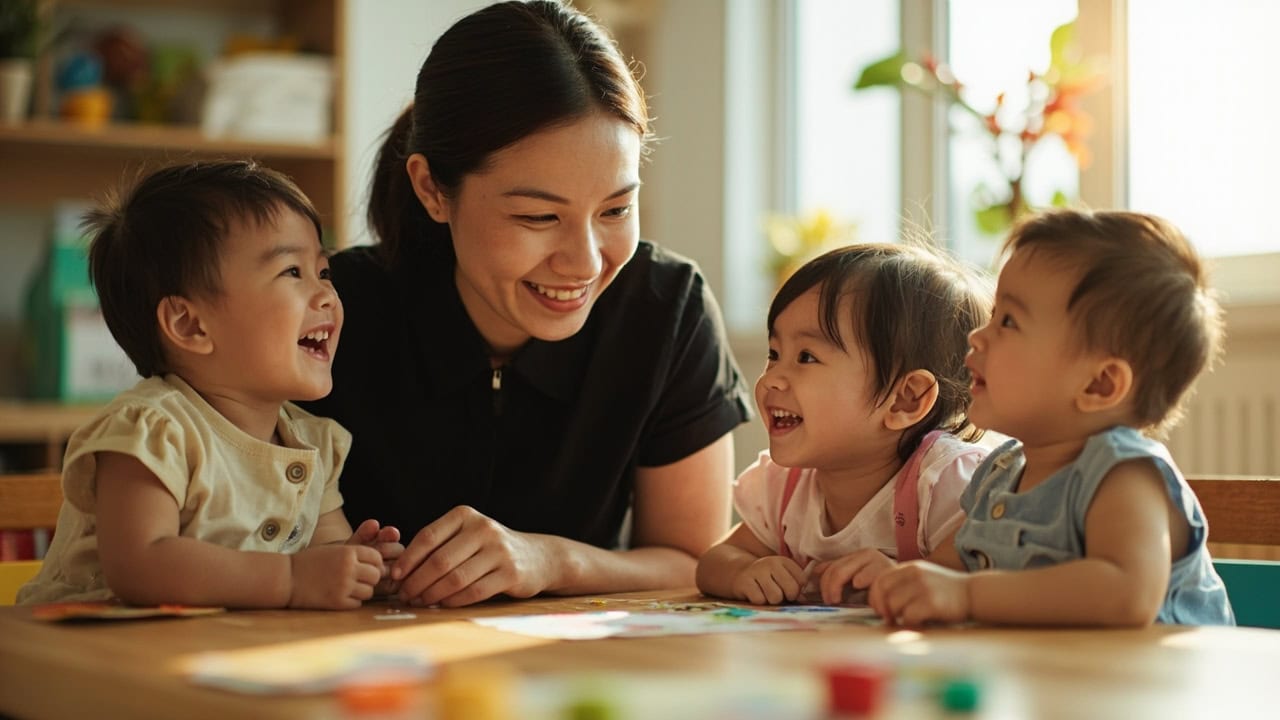
Beyond the Worksheet: Real School Readiness for Singapore Children
What Singapore Parents Actually Need to Know
Before we go further, here is the core message in plain terms:
- Academic skills matter — but they can be taught once your child is in school
- Self-regulation, social confidence, independence, language confidence, curiosity, emotional security, and physical coordination are the foundations that schools actually need — and these take years to build through everyday experience
- The best place to build these foundations is in warm, responsive, relationship-based care — not in enrichment centres
- Singapore parents are spending money and emotional energy on the things that matter least, while the things that matter most are built at home and in quality childcare, one day at a time
Read on to understand exactly what these foundations are, how to recognise whether your child’s care is building them, and what you can do — starting today — to give your child something far more valuable than a head start.
The Paradox at the Heart of School Readiness
Walk into any parenting talk in Singapore and you will hear about phonics, mathematics readiness, whether your four-year-old should already be reading chapter books. The message, however subtle, is clear: your child needs to arrive at Primary One with academic skills or they will fall behind. There is an entire industry built on this anxiety, and it is remarkably effective at making parents feel that without early worksheets and enrichment classes, their child is somehow deficient.
Now walk into a conversation with experienced Primary One teachers — the ones who have taught for a decade, who have seen thousands of children begin their school journey — and ask them what they actually need from incoming students. Watch their faces. They will tell you, with a weariness that borders on frustration, that what they need are children who can manage their emotions when things do not go their way. Children who know how to ask for help. Children who can sit in a group and listen, not because they have been drilled, but because they are genuinely curious. Children who can navigate social conflict with their peers without a teacher mediating every interaction. Children who are secure enough to be away from home for six hours and still feel that they belong.
Academic skills matter, of course. But the teachers will tell you that academic skills can be taught. What cannot be easily taught — what takes years to develop in a child’s emotional and social architecture — are the foundations that allow learning to happen at all.
This is the paradox. Singapore parents are pressured to invest heavily in the things that schools can easily teach, while the things schools desperately need are being built or neglected in the everyday environments where children spend their early years.
The Seven Competencies That Determine School Readiness
So what are these real competencies? The ones that determine whether a child arrives at Primary One capable, curious, and secure? There are seven, and understanding them changes how you evaluate every decision you make about your child’s care.
1. Self-Regulation
This is not obedience. A child who sits still because they are afraid of consequences has not developed self-regulation — they have learned compliance. Self-regulation is the capacity to modulate your own emotional and physical responses: the ability to manage an impulse to grab a toy, to wait their turn, to recognise that frustration is building and use words instead of actions.
Self-regulation is the single greatest predictor of academic success in the early primary years. It is built not through telling a child to calm down, but through environments where children experience consistent, warm responses to their emotions over and over again, until the neural pathways for calm become familiar.
You cannot lecture a child into self-regulation. You create it through a thousand small moments of being seen and soothed. In a Primary One classroom, the child with self-regulation can manage the transition between activities, tolerate the frustration of a hard problem, and settle after recess. The child without it struggles with every transition and finds the entire school day overwhelming.
2. Social Problem-Solving
Your child will not have a teacher for every disagreement on the playground. They will need to navigate sharing, exclusion, disappointment, and shifting friendship dynamics with a sophistication that surprises many parents.
A child who can identify a problem, express how they feel, listen to another perspective, and generate solutions is a child who will not be chronically distressed at school. This skill is not taught in worksheets. It is developed through supervised peer interaction, through guided conflicts, through adults who model how to resolve disagreement with respect.
Think of a four-year-old at the childcare sandpit watching another child take their bucket. A child with social problem-solving skills might pause, feel the flash of anger, name it to themselves (“I am angry”), and then approach the other child: “I was using that. Can I have it back?” A child without these skills might hit, cry, or simply retreat — and then feel the same helplessness repeated again and again at school.
3. Independence in Daily Tasks
This sounds simple, but its importance cannot be overstated. Can your child eat their lunch within a reasonable time, manage their own cutlery, open their own food containers? Can they use the toilet independently, manage their own hygiene? Can they put on and take off their own jacket, organise their own belongings?
These are not trivial matters for a five or six-year-old entering a structured school environment. Children who are still dependent on adults for basic tasks arrive at school feeling less capable than their peers, and that feeling of inadequacy colours their entire experience. The child who can confidently unpack their own lunchbox feels like they belong at school. That feeling is irreplaceable.
Independence in daily living is a direct and measurable contributor to a child’s sense of school readiness. It is built one small struggle at a time — a button, a zipper, a lid that requires patience — with adults who resist the urge to do it for them.
4. Language Confidence
Not vocabulary size — though that matters — but the willingness and ability to express oneself verbally. Your child needs to be able to narrate their experience, ask questions, explain when something is wrong. They need to engage in back-and-forth conversation with adults and peers.
Language confidence is built through rich, responsive interaction: adults who listen carefully, who extend children’s sentences, who introduce new words in meaningful contexts, who engage in unhurried verbal exchange that tells a child their thoughts are worth hearing.
A child with language confidence can say “I fell and my knee hurts” or “Shawn took my book and I want it back.” A child without it may be unable to clearly communicate physical pain, social distress, or confusion — and in a classroom of thirty children, the child who can articulate their needs will be the one who gets help. The child who cannot may struggle unseen.
5. Curiosity and Cognitive Flexibility
This is the willingness to approach new situations as opportunities rather than threats. A curious child asks questions. A cognitively flexible child can shift their attention when asked, approach a problem from multiple angles, and tolerate not knowing the answer immediately.
These dispositions are fragile. They can be nurtured or extinguished. A child who has spent their early years in an environment where learning is associated with joy, discovery, and gentle challenge will arrive at school eager to learn. A child who has been pushed toward performance, toward right answers and measurable outcomes, may arrive at school anxious, risk-averse, and wary of the learning process itself.
I have seen both. I have seen the child who enters Primary One “ahead” academically and crumbles at the first sign of difficulty. And I have seen the child who enters “behind” and thrives, because they are genuinely curious — they want to understand the world, and school is the place to do it.
6. Emotional Security
I mention this last not because it is least important, but because it underlies everything else. A child who feels securely attached, who trusts that the adults in their life will respond to them consistently and warmly, who believes that they are worthy of care and attention — that child has the emotional foundation to explore the world, to take social risks, to tolerate the frustration of learning.
Emotional security is not developed through grand gestures. It is developed through thousands of small, reliable interactions: the caregiver who greets your child by name each morning, who notices when they are tired, who soothes them when they cry, who celebrates their small victories as though they were great ones.
When a child feels emotionally secure, they can separate from their parent at the school gate without prolonged distress. They trust that the adults on the other side are safe. That trust is the invisible foundation upon which everything else is built.
7. Physical Coordination
This matters more than many parents realise. A child who struggles with gross motor tasks — running, climbing, balancing — may feel less capable than their peers, and may avoid physical play, which is also where much of social learning happens. Fine motor coordination affects a child’s ability to write, to use scissors, to manage classroom materials.
Physical competence contributes directly to a child’s overall sense of agency and confidence in the school environment. It develops naturally through active play — climbing structures, sand and water play, ball games, drawing and arts — in environments that prioritise movement over seated desk work.
How to Build These Foundations — and What Quality Care Looks Like
Every single one of these competencies is built through everyday experience in responsive, thoughtfully designed care environments. Not through worksheets. Not through flashcards. Not through academic drilling. Through the texture of daily life with attentive caregivers who understand how children develop.
So when you choose how your child spends their early years, you are not simply choosing who watches them while you work. You are choosing the environment in which their capacity for school readiness is being constructed, one day at a time.
The best childcare environments share qualities that are immediately visible if you know what to look for:
- Play is the primary medium of learning. Children are engaged in self-directed play for substantial portions of the day, with adults nearby to observe, extend, and support — not simply to manage. Play is not a reward for finishing “work.” It is the work.
- Mealtimes and transitions are unhurried. Children have time to eat at their own pace, manage their own containers, navigate the natural rhythm of the day. Independence is supported through patient adults who allow children to struggle with a button or a zipper long enough to figure it out, only intervening when truly needed.
- Emotional support is consistent and warm. Adults notice when a child is frustrated or overwhelmed and help them articulate what they are feeling. Problems are not solved for children — they are solved with children. Conflicts are learning opportunities, not disruptions to be suppressed.
- Relationships are stable and consistent. The same caregiver tends to the same children over time, enabling genuine bonds to form and the deep knowledge of each child that makes responsive care possible.
How to Observe Whether Your Child’s Care Is Building the Right Foundations
Notice how your child responds to small frustrations in their care setting. Do the adults help them name their emotions and find ways to manage them, or do they simply intervene and solve the problem? Watch how children interact with each other. Is there adult presence that guides rather than controls? Is conflict treated as a learning opportunity or something to be quickly suppressed?
Notice whether your child seems genuinely comfortable asking their caregiver for help, or whether there is a hesitancy that suggests the relationship is not fully secure. Does your child light up when their caregiver arrives in the morning, or are they indifferent?
Ask the caregiver what a typical day looks like — not in terms of curriculum, but in terms of how children spend their time. How much of the day is child-directed play versus structured instruction? What happens when a child is struggling emotionally? How do they support children in developing independence with daily tasks like dressing and toileting?
Ask specifically: if a four-year-old is eating their lunch, does an adult feed them, or does the child manage independently? If a child is struggling with their jacket or school bag, does an adult do it for them, or do they allow a little struggle before helping? These questions will tell you far more than a prospectus ever could.
Warning Signs to Watch For
- Children seated at tables for extended periods doing work that looks academic but lacks the playfulness and interaction that makes learning meaningful
- Emphasis on what children can produce — drawings, worksheets, performances — rather than on how children are developing as people
- Behaviour management that relies on fear or isolation rather than relationship and guidance
- A daily rhythm that feels rigid and stressful
- Children who are rarely given time for free play
- Caregivers who change frequently so that no stable relationships can form
Your Role as the Bridge Between Home and School
You are not passive in this process. You are the consistent thread in your child’s life, the adult who knows them most deeply, who can reinforce at home what is being built during the day.
When your child tells you about their day, listen with genuine interest — not to extract data, but to understand their experience. When they come home tired and cranky, know that this is information, not misbehaviour. When they show you a new skill or a new way of relating, celebrate it, because you are confirming that what they are learning matters.
At home, you can reinforce these foundations in practical ways:
- Give your child opportunities to manage small disappointments without rushing to fix everything
- Let them struggle a little with buttons and zippers, with opening containers, with putting on their shoes — these are not cruelties, they are gifts of competence
- Read with them, but also listen to them tell you stories; ask them questions that have no right answer; build the habit of curiosity
- When they are dysregulated, stay calm and present — not to allow bad behaviour, but to show them that big feelings can be survived and managed
The partnership between you and your child’s caregivers should be built on transparency and trust. You should feel that you know what is happening during the day. You should feel that your observations and concerns are taken seriously. And you should feel that the people caring for your child share your understanding of what matters most — not just that your child is safe, but that your child is being prepared for the world they will step into with confidence and security.
How EduNanny Builds These Foundations
EduNanny by BUTLER operates within Singapore’s ECDA Childminding Pilot, a framework designed to offer families the kind of personalised, relationship-based care that builds these real foundations — not a curriculum checklist, but the daily architecture of emotional and social development.
Our approach is built around small ratios — up to three infants per caregiver — because we know that responsiveness is not possible in ratios designed for efficiency. When a caregiver can truly know your child, notice their patterns, and respond to their individual rhythms, the conditions for emotional security and developmental readiness are present in ways that large group settings simply cannot replicate.
We offer both home-based care and community pathways, understanding that families have different needs and different contexts. Whether your child is cared for in their own home by a trained childminder or within a community-based setting, the principles remain the same: warm, consistent, responsive care that prioritises your child’s social and emotional development as the true foundation for everything that follows.
Eligible families can utilise their Child Development Account and Baby Bonus contributions for care within the pilot framework. We believe that thoughtful, development-oriented childcare should be accessible — not reserved only for families who can navigate a premium market.
Parents tell us, consistently, that what they value most is not elaborate reporting systems but the simple knowledge that they are connected to their child’s day. Depending on the service arrangement, we offer transparency measures including regular updates and practical tools that allow you to feel present in your child’s experience even when you are apart.
The caregivers within our programme are trained professionals who understand child development, equipped to support the competencies that matter, and recognise that their role is not merely supervisory but formative. In our model, the childminder is a professional — a person of dignity and purpose whose work shapes the lives of children in ways that extend far beyond their early years.
Reimagining Readiness: A State of Being, Not a Checklist
I want to return to the question I posed at the beginning. Is your child ready for Primary One?
I want to suggest that we have been asking the wrong question. We ask whether children can read, whether they know their numbers, whether they can sit still and follow instructions. But readiness is not a checklist of acquired skills. Readiness is a state of being.
A ready child arrives at school feeling capable. Not perfect, not ahead of every other child — capable. They believe, based on experience, that they can manage challenges, that adults will help them, that they belong.
A ready child arrives curious. They want to learn, not because they have been trained to perform, but because learning has always felt like something worth doing.
A ready child arrives secure. They know, in their bones, that they are loved and that the world is generally a place where their needs will be met.
This is what we are building at EduNanny. Not children who are academically ahead. Not children who will top their cohort. Children who are genuinely, durably ready — in the ways that matter most, in the ways that will carry them through the challenges of formal schooling and beyond.
The years before Primary One are not a race. They are a foundation. And foundations are not built by rushing or by demanding performance. They are built by showing up, day after day, with patience, with warmth, and with a deep understanding of what children actually need to flourish.
You are already doing so much. The very fact that you are thinking carefully about this — that you are reading this, that you are willing to question the assumptions around you, that you care enough to want the right things for your child — tells me that you are exactly the kind of parent your child needs.
Trust that. Trust yourself. And know that when you choose care that prioritises the real foundations of readiness — the emotional security, the social confidence, the independence, the curiosity — you are giving your child something far more valuable than a head start. You are giving them the capacity to meet whatever comes next with strength and with grace.
That is what school readiness truly means. And that is what EduNanny is here to help you build.
If you would like to learn more about how EduNanny approaches thoughtful, development-oriented childminding, explore our approach or connect with our team to discuss your family’s needs.