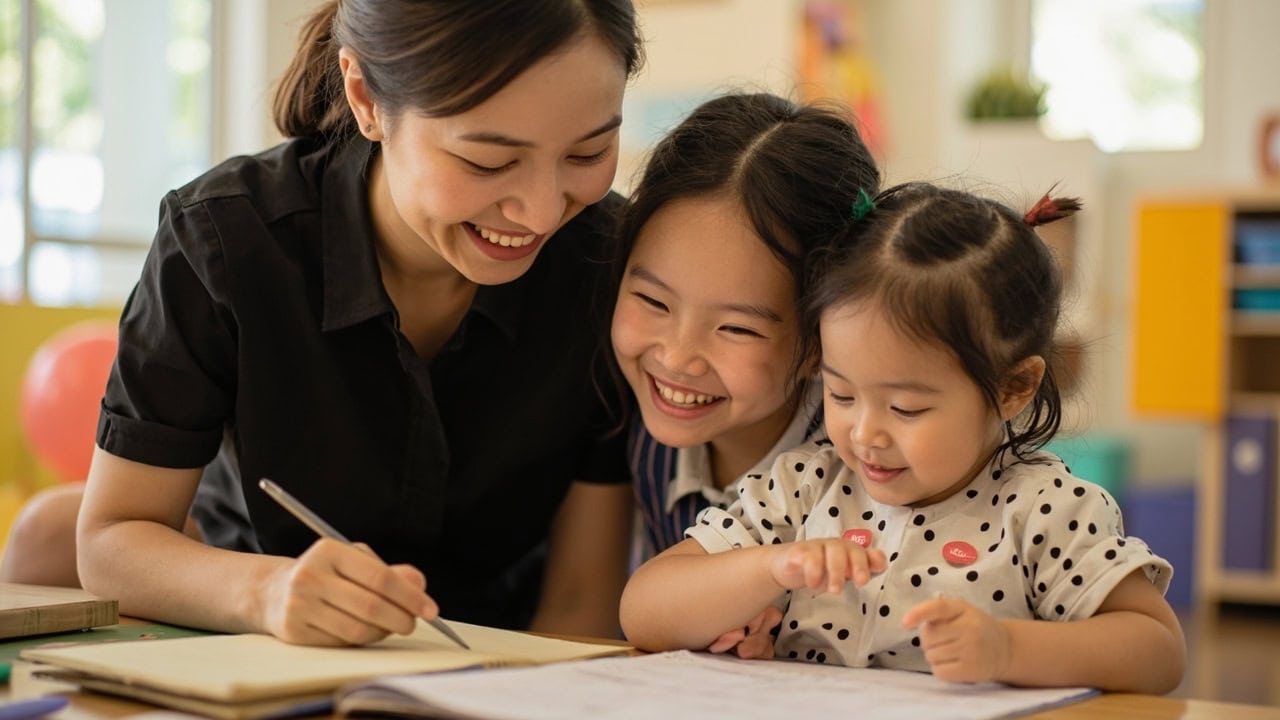
Beyond the Gate: The Hidden Development in Quality Singapore Childcare
The Hours You Cannot See: What Your Child Is Actually Building in Quality Childcare
There is a moment every working parent in Singapore knows. It happens at the gate, or the classroom door, or the bottom of the stairs outside the infant care centre. Your child is holding someone else’s hand. Your child is turning away from you.
And the thought arrives quietly, the way these things do — What happens after I leave? What is my child doing right now? Who is she becoming while I am not there to see it?
You chose this. You made this choice out of love and out of necessity and sometimes out of both at the same time, and that combination sits in your chest like something you cannot name. You tell yourself it is the right decision. You know it is the right decision. But knowing does not stop the wondering.
And so the wondering continues — throughout your morning meeting, during your commute, while you eat lunch at your desk and check the messages from the caregiver and scroll through photographs of your child’s morning snack and wonder whether that photograph tells you anything real about the hours that are passing.
This is not a feeling you need to be ashamed of. It is, in fact, one of the most honest expressions of parental love there is. You are not wondering because you do not trust the people caring for your child. You are wondering because you love your child so completely that every hour spent apart feels like a question.
And the cruelest part of that question is that you cannot answer it yourself. You were not there. You cannot see it. And so the hours that matter most to your child’s development become, for you, a kind of darkness — a black box you are asked to trust without being invited inside.
Today, we want to invite you inside. Not into a sales presentation, not into a list of features and credentials, but into something every parent in Singapore deserves to understand: what your child is actually building during the hours you are away.
Quick Summary: What Quality Childcare Provides
- Social development: Peer interaction is not a byproduct of childcare — it is one of its most essential developmental gifts, where children first learn that other people have inner lives, needs, and feelings different from their own.
- Language growth: Rich caregiver-child conversation, narration of activities, songs, and story time create a language-rich environment where new words and communication skills develop constantly.
- Emotional regulation: The moments between structured activities — transitions, conflicts over toys, waiting — are where children build resilience, learn to manage frustration, and discover that feelings are manageable.
- Confidence through capability: In a prepared environment, children persist at tasks, reach for words, and discover their own competence because no one is there to do it for them.
- A trusted partner: Quality childcare does not replace what you do at home. It adds something your child cannot get elsewhere — the experience of being a member of a community, navigating the world alongside peers and skilled, attentive adults.
Inside Quality Childcare: What Your Child Is Actually Doing
When you drop your child at infant care or hand her to a childminder in the morning, you are not just handing over physical care. You are handing over the hours your child is awake, the hours your child is learning, the hours your child’s brain is making the most extraordinary number of connections it will ever make. Understanding this is not about guilt — it is about clarity. And clarity is what allows trust to grow.
The Prepared Environment: A Space That Belongs to Your Child
In a quality childcare environment, the space itself is a teacher. The materials on the shelves are chosen not randomly but intentionally — at a height the child can reach, in colours and textures that invite touch and curiosity, arranged in a way that allows the child to make meaningful choices.
This is what educators call a prepared environment, and what it really means is this: the room believes your child is capable. It expects your child to wonder, to experiment, to fail, and to try again. It offers not answers but invitations.
Your child, alone in this environment for a few hours, will do things she would not do in your presence. She will persist at a puzzle longer because no one is there to do it for her. She will reach for a word she has only heard but never spoken because the silence of the room makes room for her voice. She will sit with a book she has seen a hundred times and suddenly, quietly, say the name of the picture she has been pointing to for weeks.
These moments look small from the outside. They are not small. They are the architecture of confidence.
Peer Interaction: Where Social Intelligence Begins
Consider what it means for a toddler to share a space with other toddlers. Not beside them. Not near them. With them.
In that space, your child encounters other people who want the same red truck, who make sounds that are not your family’s sounds, who have moods and preferences and stubbornness and joy that do not revolve around your child at all.
This is the beginning of social intelligence. This is where your child first learns, in the body and not just in the mind, that other people have inner lives. That a friend can be upset and that your child can respond to that upset. That taking turns is not a deprivation but a way of being with someone. That a group of children playing together creates something no single child could create alone.
The Caregiver’s Role: Holding Space Without Taking Over
There is something about the absence of a familiar parent that creates a particular kind of psychological safety — not the safety of being rescued, but the safety of discovering your own capacity.
In quality childcare, the caregiver understands this. She is not there to entertain the child or to direct every moment. She is there to hold the space, to be quietly available, to notice what the child is reaching toward and to step back at exactly the right moment so that the reaching can succeed.
A skilled caregiver will not immediately pick up a dropped toy. She will wait — just half a breath longer — to see what the child will do. She will not immediately solve a conflict over a toy truck. She will name what is happening so the children can feel the shape of conflict and negotiation in real time: Both of you want the truck. That is hard. Let’s see what we can do.
These moments are where emotional regulation is built — not in a lesson, not in a programme, but in the lived, felt experience of being a person in a group of people, learning that feelings are manageable and problems are solvable.
Language: The Medium Through Which Everything Is Experienced
People do not always realise how much language development happens in a morning, in an afternoon, in the ordinary texture of childcare hours.
It happens in the caregiver’s narration of what is happening: I see you’re stacking those blocks. You’re making a tall tower. Look, it’s falling down. Let’s try again.
It happens in the back-and-forth of conversation at the snack table, where children learn that speaking has rhythm, that listening is part of speaking, that words have power. It happens in songs with hand movements that link sound to gesture, and in stories where a caregiver’s voice slows down to let a child’s anticipation build.
And it happens in the naming of emotions that children feel but have not yet learned to name: I can see you’re feeling frustrated that the piece won’t fit. That is frustrating.
Language is not a subject that is taught in quality childcare. Language is the medium through which everything else is experienced, and in a rich, communicative childcare environment, that medium is flowing constantly.
Reframing Absence: What Your Child Is Not Missing, But Gaining
Here is the reframing that matters most. When you pick up your child at the end of the day and you see that child running toward you, or clinging to you, or crying, or beaming, or deliberately ignoring you in a way that means she missed you — you are seeing a moment of reunion.
But what you may not realise is that you are also receiving a child who has spent the day building. Building skills, building relationships, building a sense of herself as someone capable and curious and connected.
The question is not whether your child missed you. Of course she missed you. The question is what she did with the hours in between the missing, and how those hours are adding up over weeks and months into the kind of child who walks into a room and knows how to be with people, who can focus on a task, who can express a feeling, who can say no and yes and let me try and I need help and I did it myself.
Your child’s absence from you during these hours is not a gap in her life. It is a space she is filling with something real.
In childcare, your child learns to be a member of something larger than a family. She learns that the world contains other people with needs and feelings and rights. She learns that she can navigate that world and that she does not have to navigate it alone because there are skilled, attentive adults who know how to be present without being intrusive, how to protect without overprotecting, how to let a child fall and then help her stand back up with something new in her expression — something like I did that. I fell, and I got up.
Asking Better Questions: From the Black Box to Genuine Partnership
The hours you cannot see are not lost hours. They are, in many ways, the most generative hours of your child’s day. But how do you make sense of what happens in those hours? How do you connect what your child is building in childcare to the life you are building together at home?
The answer begins with asking better questions. Not was my child okay today — because yes, she was okay, she is always okay in quality care — but:
- What was my child interested in today?
- What did she discover?
- Who did she play with?
- What did she try that was hard?
These questions change the conversation with your caregiver. They signal that you are not just checking in on safety and food and naps. You are interested in your child’s development, and you believe the caregiver is your partner in understanding it.
When that conversation becomes a habit, something shifts. You start to see patterns. Your child comes home talking about a friend, or singing a song you have never heard, or doing something with her hands that she learned from the sandbox or the climbing frame or the art table. And you realise: these two worlds — home and childcare — are not separate. They are woven together, each one strengthening the other.
What Quality Childminding Actually Looks Like in Singapore
Not all childcare is equal, and it is worth being specific about what quality actually means in the Singapore context, because the word is used so often it can lose meaning.
In Singapore, parents have access to both centre-based infant care and home-based childminding arrangements. Both can be high quality. Both can be inadequate. The setting matters less than the principles operating within it.
What Quality Looks Like
- Small group sizes: In quality home-based settings, a ratio of one caregiver to three infants creates the conditions for genuine attunement and individual attention.
- Trained caregivers with ongoing support: Caregivers who understand developmental milestones, who can observe and respond to a child’s cues, who create the safe emotional spaces where children can take risks and recover from frustration.
- Intentional environment: Spaces designed for child-led exploration, with materials at the child’s height, open-ended toys, and opportunities for movement and sensory engagement.
- Transparent communication: Genuine updates that go beyond food and naps — windows into the moments that matter: the new word, the unexpected friendship, the small triumph on an ordinary Tuesday.
- Partnership with parents: Caregivers who see themselves as working with families, not simply for children.
The ECDA Childminding Pilot: Raising Standards for Home-Based Care
The Early Childhood Development Agency (ECDA) Childminding Pilot was established to develop quality standards for home-based childminding in Singapore — recognising that many families, particularly those with infants, prefer the intimacy and flexibility of a home-based setting.
The pilot sets requirements around caregiver training, group sizes, and programme quality to ensure that home-based care meets developmental standards that were previously more common in centre-based settings.
This matters for parents because it means that choosing home-based childminding through a structured pilot programme does not mean compromising on quality. It means accessing a model designed with the same developmental intentionality as quality centre-based care, but in a setting that can feel more personal and less overwhelming for very young children.
EduNanny Singapore: A Model Built Around Developmental Trust
What EduNanny Singapore has built through the ECDA Childminding Pilot is a childcare model designed with a clear understanding of what parents need — because it was created by people who have sat where you are sitting, who have asked the same questions, who have felt the same weight at the gate.
The EduNanny model is built around a fundamental belief: that infants and young children need not just supervision but genuine developmental engagement. That the ratio of caregivers to children matters enormously — that one to three, in a home-based setting with up to five infants, creates the conditions for the kind of individual attention and attuned care that your child deserves.
The childminders in the EduNanny programme are not incidental caregivers. They are intentional educators who understand the developmental milestones of infancy and early childhood. They know how to observe and respond to a child’s cues. They create the safe emotional spaces where a child can take a risk, try something new, feel frustrated, recover, and try again.
They do this not in isolation but as part of a community of practice, supported by the infrastructure and standards of the ECDA pilot and the EduNanny ecosystem. This means they are not working alone in their homes, figuring it out by intuition. They are part of a structured programme with training, mentorship, and ongoing professional development.
EduNanny also prioritises transparent communication — genuine updates that go beyond photographs of food and naps, giving parents meaningful windows into their child’s day. Additional support is available to answer the real questions parents have about development, behaviour, and milestones, whenever they arise.
Quality should not be accessible only to those who can afford premium programmes. This is why EduNanny operates within pilot fee structures and enables the use of CDA and Baby Bonus funding — so that the conversation about quality does not become a conversation only for the privileged.
Practical Advice: How to Choose Quality Infant Care in Singapore
For parents who are actively researching options, here is what to look for and what to ask:
- Observe the environment: Is it clean, safe, and child-height friendly? Are materials accessible? Does the space feel calm and purposeful, not chaotic or just “childproofed”?
- Watch the caregiver-child interaction: Are caregivers getting down to the child’s level? Are they narrating, responding, and engaging — or just directing and correcting?
- Ask about ratios: For infants, smaller is better. One caregiver to three infants in a home setting, or one to four in a centre, allows for genuine attunement.
- Ask about communication: What kind of updates will you receive? How often? Will you hear about the moments between meals and naps — the discoveries, the social interactions, the small triumphs?
- Ask about training and support: What qualifications do the caregivers have? What ongoing professional development do they receive? Are they supported by a broader programme or working in isolation?
- Trust your instincts: Does the environment feel warm? Do the caregivers seem genuinely interested in your child as an individual? Does the communication feel like a partnership?
- Ask about funding options: What subsidies, CDA usage, or Baby Bonus options are available? Quality care should not be accessible only to the wealthy.
Trusting the Process: The Love That Carries Through
There is a question that brought many of you here, and it is not really about childcare at all. It is about whether what you are doing for your child is enough. Whether the choice to place your child in someone else’s care, even for the best of reasons, even with the best of intentions, is something your child will feel, or struggle with, or be diminished by.
I want to tell you something plainly: the love a parent carries for a child does not stop at the gate. It does not go on pause during the childcare hours. It does not weaken or dilute or get subtracted by distance and time.
It is present in every choice you make, every conversation you have, every evening you spend on the floor playing with blocks, every morning you kneel down to buckle the shoes and say have a good day, I’ll be thinking about you.
Your child knows she is loved. She carries that love into the childcare environment, and it is one of the things that allows her to thrive there. The security you build at home is what gives her the freedom to explore the world outside it.
Quality childcare does not replace your role. It complements it. It gives your child something you cannot give alone — the experience of being a small person in a community of small people, figuring out how the world works alongside peers and under the guidance of a skilled caregiver who is not you.
That is not a failure. That is your child receiving everything she needs to grow.
Let us go back to that moment at the gate. Because I think, if we have done this right, that moment can mean something different now.
When you hand your child to her caregiver tomorrow morning and watch her turn away, I want you to know what is actually beginning. Your child is not simply being minded. She is entering a learning environment as rich and purposeful as any you could design for her at home. She is encountering peers. She is navigating social complexity. She is discovering what her body can do in a space built for movement. She is absorbing language like a sponge absorbs water, from every conversation, every song, every label on every shelf.
She is learning that she is a capable person — capable of solving problems, making friends, managing big feelings, trying again after failure. She is building the foundations of the person she will become.
And when the day is done and you pick her up, she will bring all of that home to you. A new word. A new gesture. A new way of playing. A new sense of herself as someone who belongs in the world beyond your arms.
And you, by being the steady, loving constant at the centre of her life, will weave all of it together — the hours at home and the hours away, the family and the childcare community, your love and her growing independence — into something whole and beautiful and entirely hers.
The hours that matter most are the hours you cannot see. Trust what is happening in them. Trust the caregivers who create those hours. Trust your child, who is far more capable than she appears, and who is, right now, in the middle of becoming exactly who she is meant to be.
If you are considering infant care or childminding options for your family and would like to understand more about quality developmental care, we welcome the opportunity to connect with you. Reach out to learn more about how EduNanny Singapore supports families through the ECDA Childminding Pilot.
Because you chose this out of love. And love, in all its forms, deserves support.