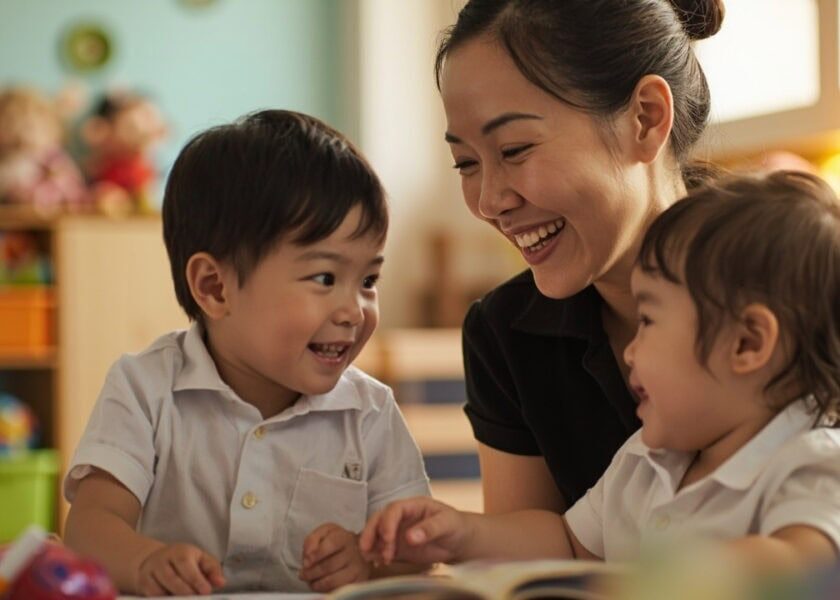
The Moment Singapore Parents Finally Receive the village their families deserve
The Weight No One Sees: What Happens to the Parent When the Village Finally Shows Up
There is a particular kind of tiredness that does not show up on faces, at least not right away. It lives behind the eyes of parents who have been giving — giving attention, giving patience, giving the version of themselves that is calm and present and regulated — long after the reserves should have run dry.
It is the fatigue of pouring from a cup that is never filled, of showing up as the steady one when you are anything but steady inside.
In Singapore, this tiredness has a name, but no one says it out loud enough. So it becomes the background hum of modern parenting: the unspoken weight of raising children in a city that moves fast, costs much, and sometimes forgets that parents are human beings too.
We talk endlessly about what children need. We have built entire libraries of guidance around their development, their milestones, their sense of security. And all of it matters.
But somewhere in the landscape of parenting advice, a quieter question has gone largely unasked: what happens to the parent when the village finally shows up?
That question is what we want to sit with you in today. Not because your child’s needs are secondary, but because the transformation in the parent is the most overlooked story in modern childcare — and it is the story that changes everything.
The Weight Singapore Parents Carry
Singapore parents carry something particular. They carry the weight of high expectations — from family, from society, from the version of themselves they thought they would be.
They navigate the pressures of dual-income households, of education pathways decided before a child can string sentences together, of housing costs and career demands and the strange loneliness of raising children in a city where neighbors do not always know each other’s names. They are told to be present, to be patient, to follow their instincts. And they try — with a kind of fierce determination that often goes unnoticed because it is so ordinary, so daily, so unremarkable to watch someone simply showing up for their child.
But the parent behind that showing up is often running on fumes.
There is a moment — and if you are a parent, you probably know the one we mean — when you realize you have been tolerating your child rather than enjoying them. Not because you do not love them. Not because you chose the wrong childcare or made the wrong decisions. But because you are depleted in a way that makes joy feel like an obligation.
You are not cruel. You are not distant. You are simply exhausted in a way that rest has not touched, because the rest you get is never quite enough to restore what the days have taken.
This is not a failure of love. This is the mathematics of solo endurance.
What we rarely say aloud is that this is not a personal failing. It is a structural problem wearing the face of a personal one. Parents were never meant to raise children alone. The human village that once surrounded families — the grandparents, the aunties, the neighbors, the community — has been replaced, in our modern cities, by a silence that asks parents to be everything.
And many parents, especially here in Singapore, are quietly breaking under the weight of that ask, even as they smile and manage and do their very best.
What Changes When the Village Finally Arrives
So let us ask you to imagine what changes when that village finally arrives — not in the abstract, but in the specific, lived reality of a parent who has been running on empty and suddenly finds themselves with room to breathe.
The Relief of Being Truly Supported
There is a difference between getting help that still requires you to manage the logistics, and receiving support that genuinely holds the weight alongside you.
When the right childcare arrives in a family’s life, there is a moment — sometimes almost imperceptible — when the parent’s shoulders drop. When the background hum of anxiety about the child quiets, not because the parent stops caring, but because they finally trust that someone capable and warm is there.
Quality childcare does not replace the parent. It restores the parent.
Emotional Availability Returns
There is a quality that parents often say they want to offer their children, above almost everything else. It is not academic preparation. It is not a specific set of skills. It is the simple, profound capacity to be emotionally available — to be the kind of presence that a child feels is truly with them, not distracted, not frayed at the edges, not already halfway into the next task or the next worry.
Emotional availability is the most valuable thing a parent can give a child. It is the soil in which attachment grows, in which trust takes root, in which a child learns that they are seen and that their feelings matter.
And yet emotional availability is not a quality you can summon from willpower alone. It requires a parent who is, themselves, regulated. Rested. Capable of bearing the weight of a child’s big feelings without being overwhelmed by their own.
Here is what happens when parents receive the right support: they become more emotionally available. Not because they have learned a new parenting technique, but because the depleted reservoir has been replenished. There is more of them to give.
The patience that used to run out by noon might now last until dinner. The frustration that used to spike at small provocations finds space to soften. The parent who was barely tolerating bedtime might find themselves lingering a little longer, enjoying the small body against theirs, the warmth of the moment.
The Partnership Finds Its Footing Again
The transformation does not stop with the parent-child relationship. There is a phenomenon that families describe again and again, in different words but with the same underlying truth: when childcare stress resolves, something else in the family comes back to life. Often, that something is the partnership.
The arrival of children, as beautiful as it is, puts enormous pressure on even the strongest marriages. There is less time, less energy, less bandwidth for the conversations and connections that once sustained the bond between two people.
When quality childcare enters the picture — when the logistics of drop-off and sick days and caregiver coordination are held with professionalism and warmth — something loosens. The conversation changes. Partners have room to remember why they chose each other.
They might have their first real dinner together in weeks. They might find themselves laughing again about something that has nothing to do with childcare logistics. The childcare decision is not only about the child. It is about the entire family ecosystem.
Parents Find Themselves Again
Somewhere in the early months and years of parenting, many mothers and fathers find that the self they were before has become obscured. Not lost entirely — that self is still there — but buried under the identity of being a parent, a caregiver, a manager of schedules and anxieties and small people who need everything.
The hobbies fall away. The friendships require more energy than exists. The ambitions feel indulgent, or impossible, or just too far away to reach for.
Here is what quality childcare can do, when it is the right kind of care: it can give parents back a piece of themselves.
A mother might rediscover the practice that used to ground her. A father might find time for the project that keeps him feeling like himself. A parent might simply have a morning where no one needs them, and in that spaciousness, remember who they are apart from being needed.
This is not selfishness. This is sustainability.
Children learn how to be whole people by watching whole people. And the parent who is only ever in parent mode is modeling a version of adulthood that is, perhaps unintentionally, incomplete.
From Isolation to Intentional Family Life
The old story of Singapore parenting was isolation. Parents were supposed to manage. Asking for help could feel like an admission of inadequacy. The family unit was small, the expectations were high, and the philosophy was often: we figure it out, we do not burden others, we get it done.
That story is changing.
Today, a growing number of Singapore parents are discovering that asking for support is not a sign of weakness. It is a sign of wisdom — the recognition that raising children in a modern city requires a village, and that building that village deliberately, carefully, with quality care, is not a compromise. It is a strategy.
This shift is not happening in opposition to Singapore’s values of excellence and family. It is an evolution of them. It says: we care so much about our children and our families that we will build the support systems they need to truly thrive.
What Quality Childminding Actually Looks Like
Quality childminding, at its core, is about creating the conditions for both the child and the parent to thrive. Here is what that looks like in practice:
- Consistent, warm relationships: Children develop security through predictability and genuine connection. Quality care means caregivers who are present, attentive, and consistent — not a rotating cast of strangers.
- Developmentally appropriate engagement: Infants and young children learn through interaction, exploration, and responsive care. The best caregivers understand developmental stages and create environments that support natural curiosity and growth.
- Transparent communication: Parents need to know their child is safe, engaged, and cared for. Regular updates, clear routines, and accessible communication channels are essential.
- Professional standards: Training, background checks, and accountability structures that protect children and give parents confidence.
- Appropriate ratios: In infant care, smaller numbers matter. When a caregiver is responsible for fewer children, every child receives more attention and responsiveness.
Quality childminding also means recognizing that the family is a system. When that system is supported — when parents have confidence in their care arrangement — the whole family breathes easier.
EduNanny Singapore: Building the Village
EduNanny was built on a simple but radical premise: that quality childcare is not a luxury for Singapore families. It is infrastructure. It is the foundation on which everything else rests — the parent’s wellbeing, the child’s development, the family’s rhythm, the partnership’s strength.
EduNanny by BUTLER is part of the ECDA Childminding Pilot, which means it is rooted in a vision of supported parenting that the government itself is investing in and validating. This is not a new idea with no track record. It is a thoughtful, structured approach to bringing quality childminding into the lives of Singapore families in a way that is accessible, professional, and deeply human.
What EduNanny Offers
What EduNanny offers is not just childcare in the conventional sense. It is a partnership with families — the recognition that when an infant is in EduNanny’s care, that infant is being held by people who understand the weight of what it means to be entrusted with someone’s child.
- Caregiver-to-infant ratios of up to one to three in infant care, so every child receives the attention they deserve
- Monday to Friday care blocks providing the consistency that parents and children both need
- Communication and transparency measures, including CCTV where deployed, so parents can step away and truly trust
- Pilot fee structures designed with Singapore family finances in mind, including eligibility for CDA and Baby Bonus where applicable
- Pathways for every family — whether the preference is home-based or community-based care
This is what EduNanny is building: not just a service, but a philosophy made real. A philosophy that says parents deserve to be supported. That children thrive when their parents are thriving. That the childcare decision is not about outsourcing love — it is about creating the conditions for love to flourish.
Your Questions, Answered Honestly
If you are considering childcare options in Singapore, you likely have questions — and doubts. That is reasonable. You are entrusting someone with the most important thing in your life. Here are honest answers to concerns parents often carry:
“Will my child feel abandoned?”
When care is introduced with warmth, consistency, and gradual transition, children adapt well — often better than parents expect. The anxiety parents feel about separation is real, but children are often more resilient than we give them credit for, especially when the care environment is warm and the transitions are handled thoughtfully.
“What if I do not trust the caregiver?”
Trust is not a feeling you manufacture. It is built through evidence. Look for care arrangements that offer transparency — regular updates, open communication, visible professional standards. When you can see that your child is thriving, trust becomes possible.
“Is it selfish to want time away from my child?”
No. The research on parental wellbeing and child outcomes consistently shows that children benefit when their parents are resourced. A parent who is depleted, resentful, or running on empty is not offering their child their best self. Choosing support that restores you is choosing to show up better for your child.
“Can we really afford quality childcare?”
Quality care requires investment. But consider the cost of not having it: the marriages strained by childcare logistics, the careers derailed by the unsustainable juggle, the parents who are barely tolerating rather than truly enjoying their children. The question is not whether you can afford quality care. It is whether you can afford the alternative.
Practical Guidance for Choosing Infant Care in Singapore
If you are beginning to explore your options, here is guidance for making this decision with clarity and confidence:
- Start with your priorities: Before you visit any centre or meet any caregiver, get clear on what matters most. Is it location? Flexibility? Ratios? The warmth of the caregiver approach? Your child’s temperament?
- Visit more than once: First impressions matter, but so do second ones. Visit at different times of day if possible. See how caregivers interact with children when no prospective parent is watching.
- Ask about transitions: How a care arrangement handles the transition period says a lot about their philosophy. Quality providers work with families to create gradual, supported transitions that protect the child’s sense of security.
- Trust your gut — but verify: Your instincts are valuable, but they should be informed by evidence. Ask about training, ratios, communication practices, and how they handle everything from feeding to fever. The right provider will welcome these questions.
The Return That Matters Most
The return on investment in quality childcare is most often discussed in terms of the child’s development — their school readiness, their social skills, their future outcomes. And those things matter. They are real.
But the truest, most lasting return on quality childcare lives in the relationship between parent and child. Not in the milestones, but in the moments.
In the parent who is present enough to notice the small miracle of their child’s laughter. In the afternoon when there is no urgency, only connection. In the evening when bedtime is not a battle but a ritual of closeness, remembered with warmth instead of endured with exhaustion.
These moments do not happen by accident. They are made possible by the conditions that surround them. And one of the most powerful conditions a family can create is reliable, warm, professional support that frees the parent to be exactly who their child needs them to be.
If you are a parent in Singapore and you have been carrying weight that no one sees, we want you to know that you are seen.
You are not failing because you need support. You are wise for recognizing that support is what you need.
Choosing quality childcare — choosing to invest in that village, to build those foundations, to give yourself the resources to parent from a place of fullness rather than depletion — is not a concession. It is an act of love.
For your child. For your family. For yourself.
The parent you want to be is not far away. They are waiting, rested and resourced, for the moment when the village finally shows up.
EduNanny Singapore is proud to be part of that village. If you are ready to explore what supported parenting looks like for your family, we invite you to begin a conversation — not as a decision to make today, but as a next step to consider when the time feels right.
EduNanny Singapore supports families through the ECDA Childminding Pilot with warm, professional, development-oriented care. Learn more about our approach or explore what we offer.