Beyond the Door: Why Quality Childcare Is an Expansion, Not an Absence
What Quality Childcare Actually Gives Your Child
If you are short on time, here is what developmental science tells us:
- Your child’s brain is still building. In the early years, neural connections form faster than at any other time in life. Every warm interaction with a responsive caregiver literally shapes the architecture of your child’s mind.
- Consistent, attuned care builds security. When a caregiver notices your child’s mood shifts, knows their preferences, and responds with consistency, your child learns: “The world is reliable. People can be trusted.”
- The first relationship outside the family expands your child’s capacity to connect. It does not replace you. It adds to what your child knows about love and trust.
- Quality matters more than presence. Research consistently shows that children in consistent, warm, responsive care develop secure attachment patterns. The variable is not whether parents are present every hour—it is the quality of attunement during the hours that matter.
- Peer experiences in early childhood build empathy and social resilience. Learning to navigate relationships with other children is foundational for school readiness and lifelong social confidence.
Understanding this changes everything. The guilt does not disappear entirely—love always carries some weight—but it can transform into something else. It becomes the quiet confidence of knowing that what you have chosen is not a compromise. It is a gift.
The First Relationship: Building the Foundation of Trust
Every child is born into a world that is, at first, experienced entirely through sensation and relationship. In the first months, your child’s brain is not yet capable of the kind of thinking that separates self from other, that understands object permanence, that holds time in any meaningful way.
What your child knows, before they know anything at all, is how it feels to be held, to be fed, to have their needs met by someone who loves them. This is not sentiment. This is neuroscience.
The infant brain is exquisitely designed to form attachment bonds, and those bonds are not merely emotional comforts. They are the scaffolding upon which the entire architecture of the self is built.
Every interaction in which a caregiver responds to a child’s cry, meets their gaze, mirrors their expression, or soothes their distress is a micro-lesson in what relationships feel like. These lessons become the internal working model your child carries forward:
- Am I worth responding to?
- Is the world a safe place?
- Can I reach out and find someone there?
This is the foundation that you, as a parent, have already laid beautifully. You have given your child their first experience of being known. But here is what is often misunderstood: this foundation is not finished by the time your child turns six months, or twelve months, or the age at which many Singapore families begin formal childcare arrangements. The architecture continues. The relational world expands.
Beyond the Family: How Quality Care Expands Your Child’s World
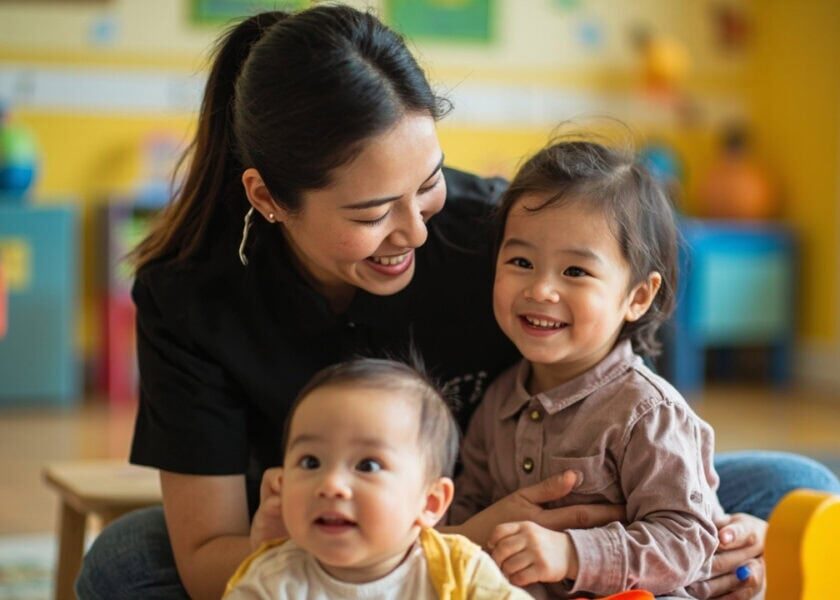
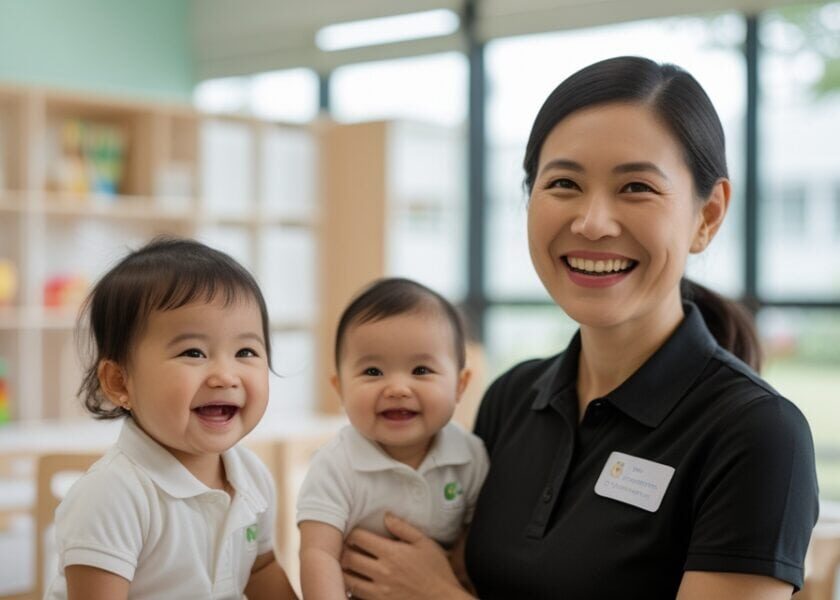
When a child forms their first meaningful bond with an adult who is not their parent—a caregiver, a teacher, someone who is present and responsive and attuned—this is not a diminishment of the parent-child bond. This is an expansion of your child’s capacity for connection.
A child who knows only one relational environment, one way of being held and known and responded to, has one map for relationship. A child who experiences consistent, warm responsiveness from more than one caring adult has a richer map. They learn that love is not limited to one source. They learn that the world contains people who can be trusted—not just family, but others who choose to show up, who remember their preferences, who notice when they are tired or hungry or sad.
The word “quality” is used often in discussions about childcare, and sometimes in ways that blur its meaning. So let us be specific.
Quality in infant care is not primarily about curriculum, though learning happens everywhere in a child’s early years. Quality is about responsiveness. It is about whether the caregiver notices when your child’s mood shifts from curious to overwhelmed. Whether they know that this particular child needs to be held before they can join the group activity. Whether they have the training to recognize the difference between a child who is processing a normal frustration and a child whose nervous system is becoming dysregulated and needs gentle intervention before the distress escalates.
There is a distinction here that matters enormously. Supervision says: someone is watching to make sure nothing goes wrong. Being known says: someone is paying attention to who your child is becoming. They notice the small victories—the first time your baby settles more quickly in the caregiver’s arms because trust is forming. They notice the early attempts at communication with other children, the way your child’s face lights up when they recognize a familiar face arriving at the door.
Infants and toddlers experience the world intensely. Their brains are still learning to regulate responses that adults take for granted—the ability to calm down after being upset, to tolerate frustration without escalating, to shift attention when an activity changes. These are not trivial skills. They are the foundations of emotional regulation that will serve your child throughout their life.
In a quality care environment, caregivers understand that a tantrum is not misbehavior—it is a child’s nervous system asking for help. A child who bites is not “bad”—they are communicating something their words cannot yet express. When caregivers respond to these moments with calm, consistent intervention rather than frustration or dismissal, they are teaching your child’s nervous system something profound: “Distress can be managed. I am not alone in this.”
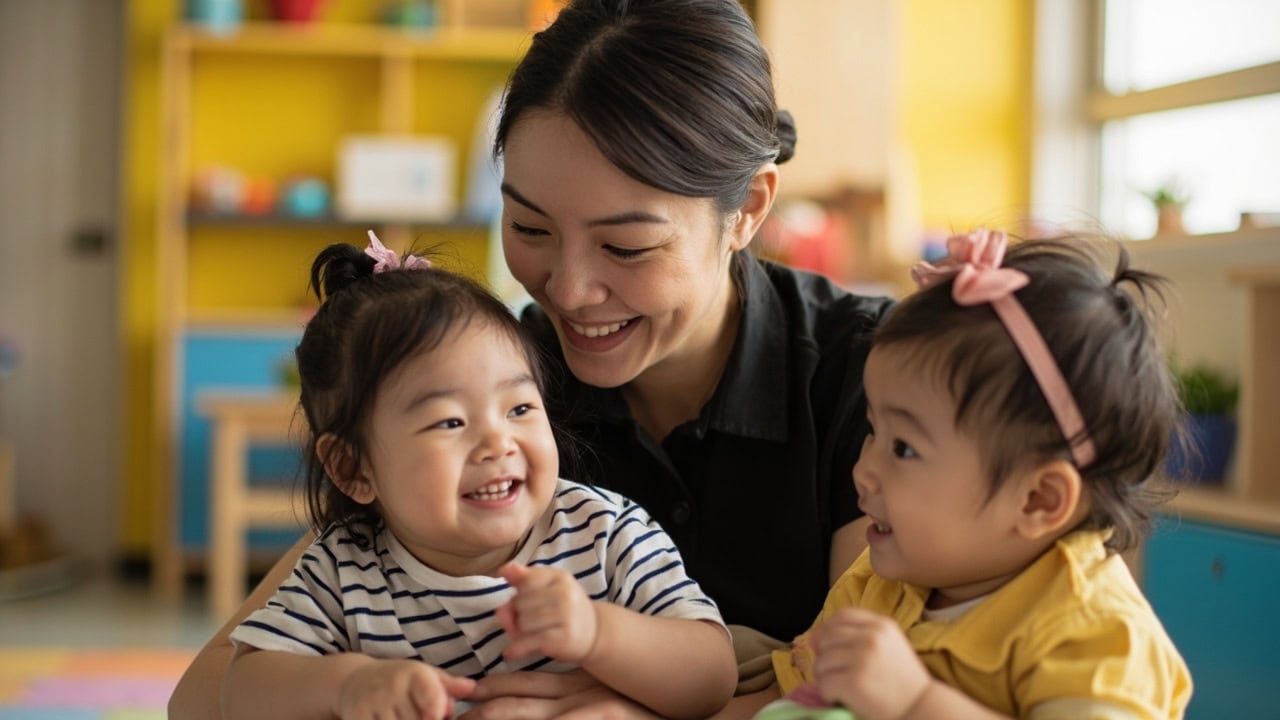
In a quality childcare setting, your child is also beginning to relate to other children. When your child plays alongside another child, negotiates over a toy, experiences the disappointment of not being chosen for a game, or discovers the joy of a shared laugh, they are learning something about who they are in relation to others. They are learning that they have preferences, that others have preferences too, that feelings can be managed, that the world contains other people who matter.
These are not trivial lessons. They are the early foundations of empathy, of impulse control, of the ability to navigate social complexity. Children who have had rich peer experiences in early childhood enter school with a head start in the most important subject: how to be human together.
They are also learning that they can be okay without you. Not because they do not love you, not because your presence does not matter, but because they are developing the internal resources to tolerate distance, to manage the ordinary stress of separation, to trust that you will return. This is resilience. And it is built not by protecting your child from all distance, but by giving them the experiences of managing distance successfully, with support, in the safe context of quality care.
Separation and Security: Addressing Your Concerns
Let me speak now to something that many parents feel but few are encouraged to say aloud: the fear that separation might be harming their child.
This fear is not irrational. It is not the fear of an uninformed parent. It is the fear of a parent who understands, on some level they may not even be able to articulate, that their child’s early experiences are formative. And that is exactly right. They are formative. Which is why we should not dismiss this fear but rather address it with honesty.
Here is what developmental science tells us: it is not separation itself that shapes a child’s emotional development. It is the quality of the caregiving during those separations. A child who experiences consistent, warm, responsive care in their parents’ absence develops secure attachment patterns. A child who experiences inconsistent, inattentive, or emotionally distant care—even in a home where parents are present—may develop insecure patterns.
The variable is not presence or absence of parents. The variable is the quality of attunement.
This is both liberating and demanding. Liberating, because it means that your child can thrive in quality care, and that you are not failing them simply by returning to work. Demanding, because it raises the stakes for choosing that care wisely.
How do you know if your child is thriving in care, not just being cared for? Here are some signs that your child is building the emotional foundations that will serve them for life:
- Your child shows increasing comfort with their caregiver. Over time, they settle more quickly, reach for the caregiver with trust, and show genuine pleasure in seeing them.
- Separation anxiety decreases over time, rather than intensifying. Your child learns that goodbye is temporary and return is certain.
- Your child begins to show interest in other children. This social curiosity—watching, reaching, eventually playing—is a milestone, not a red flag.
- Your child is developing a range of emotional expressions—not just distress, but joy, curiosity, playfulness, and the beginning of empathy for others.
- The caregiver can soothe your child. This is actually a sign of health. It means your child is learning that comfort can come from more than one source.
- Your child is becoming more resilient—able to recover from small disappointments, to tolerate frustration with growing capacity, to move through transitions with increasing ease.
If you see these signs, your child is not experiencing absence. They are experiencing expansion.
The Singapore Context: Why This Decision Matters Here
Singapore parents carry particular pressures. The demands of careers and the expectations of a society that values both family and achievement. The geographic reality of extended families often being far away, the cost of living that makes single-income households difficult for many families, the desire to give your children every advantage in a world that feels increasingly competitive.
These pressures are real. They are not imaginary burdens. And the childcare decision does not happen in a vacuum.
What we want you to know is this: the choice to place your child in quality care is not a concession to these pressures. It is a positive choice for your child’s development. It is a choice that can be made with confidence, not despite the love you have for your child, but because of it.
You are not choosing between your career and your child. You are choosing a framework in which both can flourish.
How to Choose Quality Infant Care in Singapore
When you choose quality infant care—when you choose a programme where caregivers are trained in responsive attunement, where consistency is prioritized, where the environment supports emotional regulation—you are not choosing to be less present in your child’s life. You are choosing to give your child more of what builds them. You are choosing a partner in your child’s development, not a substitute for your parenting.
If you are beginning to research your options, here are the questions that matter most—not as a checklist, but as a guide for the kind of conversations you should be having with any provider:
- Observe the caregivers. Do they kneel to a child’s level? Do they narrate what they are doing? Do they respond promptly to distress, or do they appear rushed or distracted?
- Ask about ratios. How many children per caregiver? In infant care, lower ratios mean more attunement. This matters most for children under 18 months.
- Ask about consistency. Will my child see the same caregiver every day? Will the same faces be present at drop-off and pick-up?
- Ask about training. Do caregivers receive ongoing development in child development, attachment, and emotional regulation?
- Notice the environment. Is it warm and organized, or institutional and sterile? Is there space for children to explore safely? Are routines visible and consistent?
- Trust your instincts. After a visit, ask yourself: Would I feel comfortable being cared for in this environment? Do I sense warmth here?
The right choice will feel like more than logistics. It will feel like a partnership in your child’s development.
What EduNanny Singapore Offers
At EduNanny Singapore, we understand that your child’s caregiver is not simply a service provider. They are becoming part of your child’s relational world, and that is a responsibility we take seriously.
Our approach is built on the ECDA Childminding Pilot framework, which means your child benefits from trained caregivers who understand infant development, who know how to read the subtle signals of emotional state, and who are equipped to respond in ways that build rather than simply fill time.
Our home-based care model means that your child is in an environment structured around their needs—a smaller, more personalized setting where the ratios allow for genuine attunement. In our infant care programme, we maintain ratios of up to one caregiver to three infants, because we know that in those early months and years, the quality of attention your child receives matters in ways that cannot be recovered later.
We offer fee structures designed to be accessible, with care blocks running Monday through Friday to provide the consistency that your child’s developing sense of time and trust requires. CDA and Baby Bonus funding are usable with us, so that the financial logistics of this choice are as manageable as possible.
We believe in transparency and communication. For parents in our home-based or centre-based pathways, we offer regular updates, open communication channels, and where deployed, measures such as CCTV access that allow you to feel connected to your child’s day. These are not replacements for trust, but they are supports for it.
This is not a luxury. This is the work.
The Quiet Confidence of Knowing
I want to close by speaking to what I believe is the deepest desire behind every childcare decision you will ever make.
It is not safety alone, though safety is non-negotiable. It is not convenience, though logistics matter. It is this: you want your child to be seen. You want someone else to see them the way you see them. To notice what makes them unique, what they are good at, what they are working through, what makes them laugh, what makes them sad.
You want your child to be known, not just watched. To be valued, not just supervised. To be tended with intention, not just diligence.
This is what quality childcare can offer—not because it is replacing what you do, but because the work of raising a child belongs to a village, and the village has been too quiet for too long.
The first relationship outside your family is not a compromise. It is a milestone. It is your child’s first step into a larger world, and it is happening in the arms of people who have chosen to hold that world with care.
So the next time you close the door in the morning, and the quiet wondering starts, remember this: what is happening inside your child is not absence. It is expansion. It is the slow, beautiful building of a person who will carry forward everything they are learning about trust, and connection, and the world’s capacity to hold them.
You are not failing them by leaving. You are trusting the process that will help them become who they are meant to be.
And that is the bravest kind of love there is.
If you are ready to learn more about how EduNanny Singapore supports your child’s first relationships outside the family, we invite you to reach out. Your child’s expanding world is waiting—and we would love to be part of it.