Beyond Minding: How Quality Childcare Helps Your Child Develop
What Children Actually Gain in Quality Childcare
Research and experience consistently show that children in warm, professionally staffed early childhood environments develop in ways distinct from what a single caregiver can provide during a busy working day. These are not vague benefits — they are specific, measurable, and profound.
Social Confidence
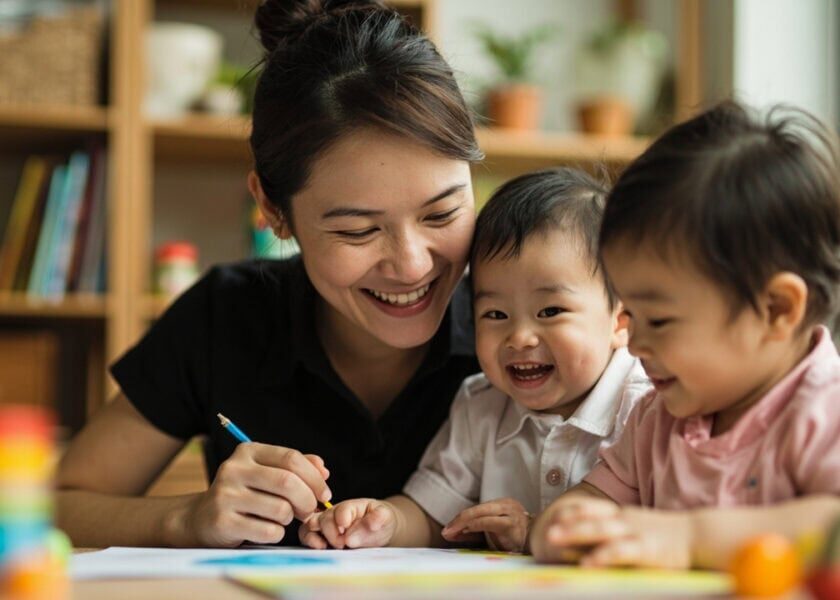
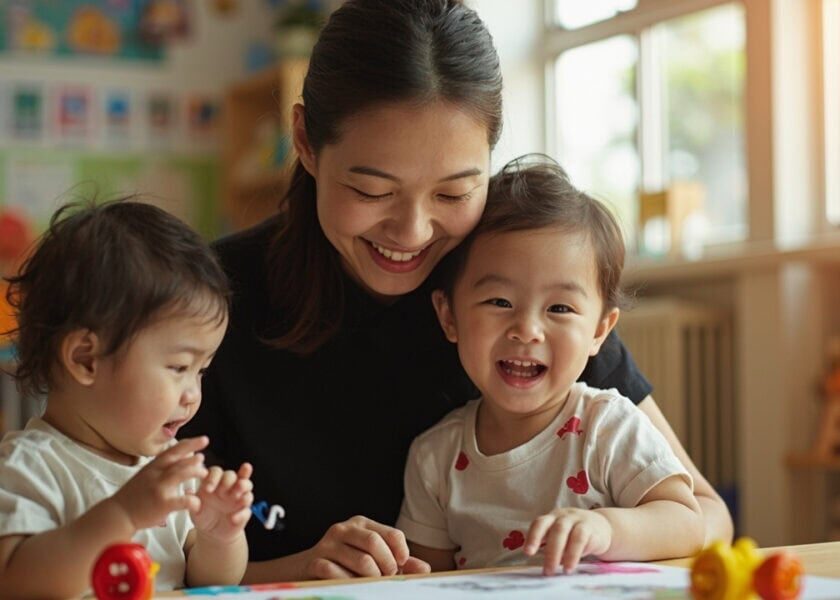
A child can be sociable at home, surrounded by familiar faces. But social confidence — the ability to negotiate, share, wait, and discover that actions affect someone who is not Mum or Dad — develops in a peer group. In a quality infant care setting, children navigate small social problems daily. They learn to reach for another child’s hand, to wait for a turn, to express a need to someone who is not their primary caregiver.
This is a profound cognitive and emotional achievement, and it happens routinely in a well-structured peer environment.
Rich Language Exposure
In a group setting, skilled educators narrate the world aloud — not to one child in particular, but to the room. “Look, Samuel is building with the blue blocks. He is stacking them high. I wonder what will happen when he puts the red one on top.”
This ambient, model-rich language input — what researchers call sustained shared thinking — expands vocabulary and syntactic complexity in ways that even the most devoted home environment can struggle to match during the working day. In a professional early childhood setting, language is the medium. It is happening all the time, with intention.
Motor Exploration Through Designed Environments
Quality infant care settings are not decorated for aesthetics. They are designed for development — soft play areas, outdoor spaces, manipulatives that require grip and precision. Children develop physical confidence not as recreation but as pedagogy, in environments that understand how bodies learn.
Emotional Regulation Through Predictable Rhythm
When lunch comes at the same time each day, when rest follows play follows outdoors in a reliable sequence, a child’s nervous system learns to anticipate, to settle, to trust the rhythm of the day.
Emotional regulation — the ability to calm oneself, to wait, to recover from disappointment — is one of the foundational capacities that predicts later academic and relational success. It is built, day by day, in environments that are consistent, warm, and professionally attuned.
Peer Modelling
Children slightly ahead demonstrate language, gesture, and social problem-solving. This natural modelling — visible, attainable, and relevant — accelerates development in ways that adult instruction alone cannot replicate.
None of this replaces what you give your child. But it is a distinct and valuable addition — one that many parents underestimate precisely because they cannot see it happening.
Reframing What Childcare Actually Is
The conversation around childcare tends to orbit around you — your peace of mind, your trust in the centre, your confidence in your own decision. Those things matter. But they do not answer what your child is experiencing, and that is where the real story lies.
Here is the quiet truth: quality childcare is not a substitute for your presence. It is a second environment, with its own developmental logic, its own gifts, and its own irreplaceable role in what your child is becoming.
In Singapore, where the demands on parents are extraordinary — where dual-income households are the norm, where early education is fiercely competitive, where the pressure to optimise begins before a child can walk — the stakes of this early window feel particularly high. Singapore parents are some of the most informed, most deliberate parents you will encounter. They read, they ask, they compare. And they feel, deeply, the tension between wanting to be present and knowing that the world they are preparing their children for requires them to be somewhere else.
That tension is real. But it deserves to be reframed, because the way we frame it shapes the emotional landscape of those early years for the entire family.
Two Environments, Not One
Think about what a young child needs to grow — not in the abstract, but in the lived texture of a morning or an afternoon. A child needs a space where they feel safe enough to wander. They need adults who are attentive enough to notice when wonder is happening and skilled enough to extend it. They need other children who are just slightly ahead of them, modelling language, gesture, and the way one solves a small social problem. They need rhythm — a predictable sequence of songs and meals and outdoors and rest — because for a child, predictability is not boredom. It is the architecture of security.
Now ask yourself: does your home provide all of this, every day, in a consistent and enriched way? Of course it does, in the ways that only a parent’s love can. But no single environment, however devoted, can offer everything.
The fact that your child moves between environments is not a compromise. It is a gift. Two environments mean two sets of stimuli, two sets of relationships, two lenses through which your child learns to see the world.
This is what is actually happening. Not vague “school readiness.” Not the promise that your child will be “prepared.” Something more specific and more meaningful: your child is building the neurological and emotional infrastructure for curiosity, for connection, and for resilience.
The First Thousand Days
The first thousand days — from birth to roughly age three — are the period of most rapid brain development a human being will ever experience. More than one million neural connections are formed every second. The environments a child inhabits during this window are not incidental. They are constitutive. They are, in a very real sense, building the child you will meet later.
This is why choosing quality matters. Not as a replacement for family, but as an addition that has genuine, lasting value.
How to Evaluate What Actually Differentiates One Setting From Another
The difference between settings is not found in the toys, the curriculum on paper, or the photos shared at the end of the day — though those things have their place. The difference is in the human beings who are with your child.
Ask yourself these questions when evaluating any infant care or childminding option:
- Ratio — What is the number of children to each trained, responsive caregiver? One-to-one is ideal but rare. One-to-three is extraordinary. One-to-six or more begins to compromise the quality of individual attention.
- Observation quality — Do the caregivers notice when a child is on the edge of a breakthrough in language, movement, or social play? Do they extend those moments intentionally?
- Culture — Is the environment one where children are seen as capable, curious, full of meaning? Or simply as small people who need to be managed?
- Caregiver wellbeing — Are the caregivers treated as professionals? Are they supported in training, supervised with care, and given conditions that allow them to be present and warm rather than stressed and procedural?
A calm, fulfilled caregiver is the most important feature any childcare environment can offer. The research on this is consistent: responsive, emotionally healthy adults are what children need most. Everything else — the curriculum, the facilities, the communication apps — is secondary.
Practical Steps Before You Choose
If you are evaluating infant care or childminding options in Singapore, the following guidance will help you look beneath the surface:
- Visit more than once. Unannounced visits reveal what the scheduled tour does not.
- Watch the caregivers, not just the children. Are they crouched at eye level? Are they narrating? Are they warm under pressure or visibly stressed?
- Ask about ratio and turnover. High turnover is a warning sign. Consistent, trained caregivers are invaluable.
- Ask what a typical day looks like. Specificity matters. Vague answers about “learning through play” without detail are a red flag.
- Trust your observation, not just the information pack. If something feels off, it probably is.
- Ask about communication. How will you know what happened in the day? How are concerns escalated?
EduNanny: A Second Environment Built With Intention
EduNanny, a service by BUTLER, was designed with a specific belief at its centre: choosing quality childcare is not the lesser option. It is a second act of love. It is the recognition that your child deserves a rich, warm, professionally supported environment — not just yours — and that being deliberate about choosing that environment is one of the most meaningful things a parent can do.
EduNanny is part of Singapore’s ECDA Childminding Pilot, which means it operates within a framework that values the dignity of the childminder’s role and the quality of the home-based and community care pathway as a legitimate, respected alternative in the early childhood landscape.
What EduNanny Offers
For families who prefer the intimacy and personalised rhythm of a home-based environment, EduNanny offers:
- Up to one-to-three infant ratio — One trained, attentive adult for every three infants. That is not infrastructure. That is relationship. That is the difference between being minded and being known.
- Home-based warmth — A smaller group size, a home-like routine, a closeness with a consistent caregiver that mirrors the warmth of family life.
- Accessible fee structures — CDA and Baby Bonus funding are applicable.
- Flexible coverage — Available across Singapore, Monday through Friday, in care blocks built around the realities of working family life.
- Transparent communication — Regular updates, documentation, and where deployed, CCTVs — tools that genuinely support rather than substitute for trust.
EduNanny has also invested in tools that make parenting easier — not as a gimmick, but as a genuine extension of support. The Thomas AI Chatbot, for instance, exists because navigating the logistics of childcare should not add to your mental load. It should reduce it.
Your Questions, Honestly Answered
Will my child feel abandoned?
A child who is dropped at a warm, consistent, professionally staffed environment does not experience abandonment. They experience transition — which is challenging, yes, and worth being managed with care — into a setting where they are known, attended to, and supported in exploring the world. The emotional security your child feels at home does not disappear when they enter another environment. It travels with them, and it deepens as they learn that the world contains other trustworthy adults and peers.
Is a home-based setting as good as a centre?
This is the wrong question. The right question is: what environment is right for my child and my family? Home-based care offers distinct advantages: smaller ratios, family-like rhythms, one consistent caregiver relationship. Centre-based care offers different advantages: peer diversity, dedicated early childhood spaces, larger group socialisation. Both can be excellent. Both can fall short. The differentiating factor is the quality of the adults and the intentionality of the environment.
What if I chose wrong?
The fact that you are reading this, carefully, with anxiety and hope, tells me you are paying attention. Parents who pay attention adjust. If something is not working — if your child is consistently distressed, if the environment does not feel warm, if the communication is poor — you notice, and you act. The choosing is not a one-time decision carved in stone. It is an ongoing act of care.
Coming Back to That Silence
The parent who drops their child at a quality infant care setting and drives away carrying a small, quiet doubt — that parent is not uncertain. That parent is paying attention. They are asking the most important question a parent can ask: is my child okay? And underneath that: are they more than okay?
The answer, in a setting that is warm, professionally staffed, developmentally intentional, and genuinely loving, is yes. Your child is not simply being minded in those hours. They are discovering. They are building. They are learning to be a person in a world that contains other people.
They are developing the social confidence to reach for another child’s hand. The language to name what they see. The emotional regulation to wait, to share, to recover. They are feeling the security of a predictable routine and the thrill of a curiosity that is being encouraged, not extinguished.
You chose this. Not out of necessity alone, though necessity is real and honest. You chose it because you wanted your child to have more — more language, more stimulation, more social world, more safety — than any single environment, however beloved, could provide alone.
That is not a compromise. That is generosity. That is a parent who understood that love is not only about presence. It is about what you make possible.
Ready to Learn More?
If you are exploring infant care or childminding options in Singapore, we welcome the opportunity to answer your questions honestly. We would be glad to walk you through what a thoughtful, development-focused approach looks like in practice, discuss whether it is the right fit for your family, and help you feel confident in whatever decision you make.
Your child is in the right place when they are growing, actively and with joy, in the hours that matter most. And you are in the right place — here, reading, asking, choosing — when you are ready to learn more.