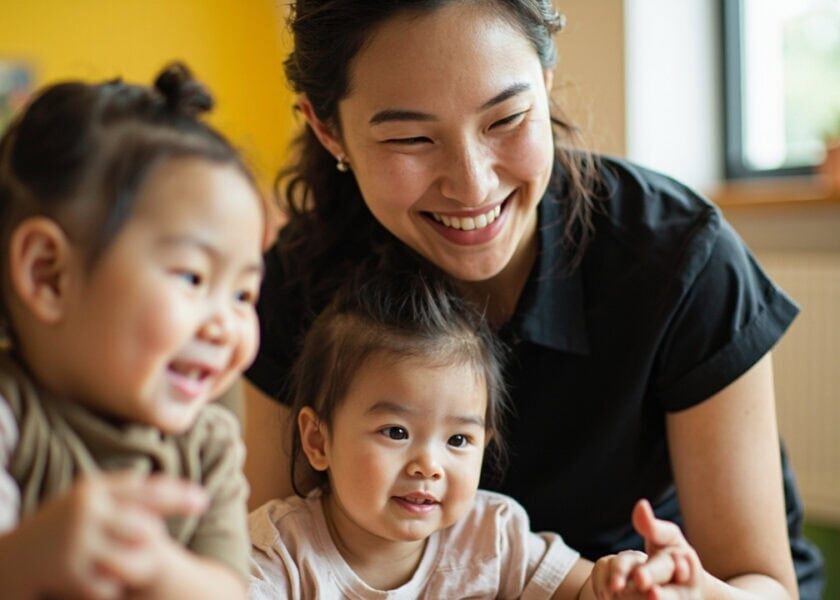
The Science of Early Brain Development Every Singapore Parent Should Know
Your Child’s Brain in the First Five Years
We live in an age where parents have access to more information about child development than any generation before us. We know about attachment theory. We have heard about the importance of the first thousand days. We understand, abstractly, that early experiences shape brain development.
But knowing something intellectually and feeling its weight in your chest on a Monday morning when you hand your fourteen-month-old to someone else—those are different experiences entirely. The abstract knowledge does not always quiet the wondering.
So let me offer you something more concrete than reassurance. Let me offer you understanding.
How Neural Architecture Is Built
During infancy and toddlerhood, the brain produces more neural connections than it will ever use—a process called synaptogenesis—and then refines and strengthens the pathways that are used most frequently while eliminating those that are not. This is not a passive process. It is deeply responsive to experience.
The quality of touch a baby receives. The speed and warmth of an adult’s response to their distress. The richness of language they hear around them. The opportunities they have to solve small problems, to share, to negotiate, to recover from frustration. Every one of these experiences leaves a trace—a slightly deeper groove in the neural pathway being carved—and over time, these traces become the foundations of how a child thinks, learns, regulates, and connects.
This is why the distinction between quality care and adequate care is not merely a philosophical preference. It is a matter of architecture. The brain is literally building itself during these years, and the materials it uses are the experiences you and your caregivers provide.
The Moment That Builds Regulation
Consider what happens in a quality care setting when an infant cries.
In inadequate settings, a cry may be met with delay, with routine, with the minimum necessary response. The child’s need is addressed, but the response does not communicate: I see you. I understand. You matter.
In a quality setting, something different happens. A caregiver notices the cry not merely as a sound to be managed but as a communication to be understood. They respond with warmth, with attunement, with the particular quality of presence that tells a baby: your distress has been received and your distress is valid.
This moment, repeated hundreds of times across the early years, is not sentimental. It is structural. It is building the neural architecture for emotional regulation—the capacity to recognize one’s own feelings, to manage distress, to eventually calm oneself.
This capacity, so fundamental to everything that follows—to school readiness, to friendship, to resilience—begins with a caregiver who responds promptly and warmly to a crying infant. The brain pathways for self-regulation are literally being laid down in these moments.
What Quality Childcare Looks Like in Singapore
You are a parent in Singapore. You may be back at work after maternity leave—that return that arrives sooner than you feel ready for, compressed by the realities of our leave structures, the obligations of your career, the mortgage on your HDB flat, the future you are building for your family.
You drop your child at their care arrangement, and in the car or on the MRT heading to work, the wondering arrives. What is happening in there?
Here is what is happening.
Your child’s developing brain is encountering an environment—a quality environment—that is responsive to their cues, rich in language, full of carefully designed opportunities for learning disguised as play.
The caregiver is not simply keeping your child safe and fed. She is narrating the world. She is naming objects, describing actions, responding to your child’s gestures and sounds with words that expand their understanding.
Language, Social Skills, and Executive Function
Research consistently shows that children in high-quality care environments hear a richer variety of vocabulary, more complex sentence structures, and more back-and-forth conversational exchanges than they might encounter in some home environments—not because home care is inherently inferior, but because a trained caregiver in a designed setting is actively using language as a learning tool.
When a caregiver says, “You want the red cup? Here it is—red, like a strawberry, red, like the fire engine in your book,” she is doing more than handing over a cup. She is building language pathways, expanding concepts, connecting words to meanings.
In a quality care setting, your child is also learning to navigate a world where other children exist. They are learning that sharing feels different from having, that waiting is tolerable, that a small conflict over a toy does not mean the end of a friendship. They are learning to read the facial expressions and body language of peers, to interpret social cues, to practice empathy in small, real ways.
A caregiver is present not to intervene at every dispute but to scaffold these interactions—to model, to guide, to allow children the productive struggle of working things out with support nearby.
These experiences build the foundations of executive function: the capacity to focus attention, to resist impulses, to hold information in mind and work toward a goal.
Executive function in kindergarten predicts academic achievement years later better than early reading or math scores. And it is built in sandbox moments, in the negotiation over whose turn it is on the tricycle, in the gentle but firm guidance of a caregiver who knows when to step in and when to step back.
Why Quality Matters More Than You Might Think
The difference between a quality setting and a custodial one is not cosmetic—it is structural.
In a custodial arrangement, the goal is safety and basic comfort. Children are kept fed, changed, entertained, and unharmed. These are not small things; they are necessary. But they are not sufficient.
In a quality setting, every element of the environment—the ratio of caregivers to children, the training of those caregivers, the design of daily routines, the integration of developmental science into practice—is oriented toward intentional engagement with your child’s growth.
The caregiver is not merely watching; she is observing. She is noticing which skills your child is developing, which challenges they are approaching, which moments of frustration might be productive learning opportunities.
Why Caregiver Ratios Are Not Just Numbers
When a caregiver is responsible for too many children, the quality of responsiveness degrades. The cry that would be met with immediate warmth in a one-to-three ratio may receive a delayed or impersonal response in a one-to-eight arrangement.
The science is clear: lower ratios enable deeper attunement, more individual engagement, more language, more observation—more of exactly the experiences that build neural pathways.
Answering Common Parent Concerns
You may be wondering whether the benefits of quality care outweigh the practical realities and costs. These are fair questions, and they deserve honest answers.
Will multiple caregivers confuse my child? Secondary attachment—the capacity of young children to form healthy secondary attachments with responsive caregivers—tells us that this is not a threat to the parent-child bond. When primary attachment is secure, children can absorb the benefits of additional warm, responsive relationships without confusion or distress. Quality secondary attachments can enhance a child’s social capacity, their adaptability, their comfort with the wider world.
Is this worth the investment? Choosing quality care is not an admission of failure or a compromise. It is a thoughtful choice to give your child experiences that build them, in an environment designed for exactly that purpose, supported by professionals trained for exactly this work.
You are not leaving your child’s development to chance. You are investing it in a system that understands what is at stake.
What EduNanny Offers: Designed for Development
EduNanny Singapore was built on this understanding. It was built on the recognition that Singapore parents deserve more than supervision. They deserve partners in their child’s development—partners who understand the science, who implement it daily, who treat every interaction as an opportunity for growth.
EduNanny is part of the ECDA Childminding Pilot, operating within a framework designed to offer Singapore families access to quality home-based and community-based care that meets the standards our children’s development requires.
What This Looks Like in Practice
- Caregivers trained in child development—not only in safety protocols but in the stages of cognitive and social growth, how to observe and respond to individual children’s needs, how to narrate a child’s day in ways that build language and connection
- Ratios that allow genuine responsiveness—so that when your infant reaches up with arms that mean “hold me,” there is a caregiver who can pick them up, talk to them about what they see, comfort them and connect with them as a full human being
- Transparent communication—regular updates and, in some settings, tools that let you see what your child’s day looks like
- Fee structures designed for accessibility—payment options that allow you to use your child’s CDA or Baby Bonus contributions
- Care schedules aligned with working life—Monday to Friday care blocks that work with your career, not against it
Support for Parents, Too
Raising a child is not only about the hours your child spends in care. It is also about the questions that arise at 10pm, the concerns you carry, the need for guidance that meets you where you are.
EduNanny offers Thomas, an AI-powered chatbot designed to support parents with questions about parenting and childminding—not as a replacement for human guidance, but as a resource available when you need it. A late-night question about toddler sleep. An afternoon curiosity about feeding milestones. A quick check on developmental norms. Being a thoughtful, informed parent should not require you to have a degree in child development. It should require the right support.
The Caregivers Who Make It Possible
The women and men who work as childminders in quality settings are not occupying a lesser profession. They are performing work of extraordinary importance and complexity.
To observe a child’s development daily, to attune to their emotional states, to scaffold their learning, to respond to dozens of individual needs across a single morning—this requires skill, patience, knowledge, and a particular kind of emotional presence.
When you choose quality care, you are not outsourcing parenting. You are inviting a trained professional into your village—a person who will, for the hours your child is in their care, be an extension of your own attentiveness and love.
That is why training, observation, and support for caregivers are built into EduNanny’s foundation. When caregivers are valued and equipped, children benefit.
How to Evaluate Infant Care and Childminding in Singapore
If you are researching infant care and childminding options in Singapore, here are the questions that matter most:
- What is the caregiver-to-child ratio? Lower ratios enable deeper attunement and more responsive interaction. Ask specifically how many children each caregiver is responsible for at any given time.
- What training have caregivers received? Look for training in child development, not just safety certifications. Ask how caregivers are supported in continuing to learn.
- How does the environment support language development? Observe whether caregivers narrate, expand on children’s sounds and gestures, and engage in back-and-forth conversation throughout the day.
- How are social interactions handled? Quality care means caregivers scaffold peer interactions rather than simply preventing conflict. Ask about their approach to sharing, turn-taking, and minor disputes.
- How will you receive updates? Regular communication about your child’s day, development, and experiences is a hallmark of quality care.
- Is observation part of the practice? Caregivers who observe development and track progress are building intentional experiences, not just providing custodial care.
The Confidence to Choose Well
Singapore has long valued education, invested in it, pushed our children toward achievement and excellence. But there is a growing recognition—supported by science, driven by research, echoed by parents who demand more—that the earliest years are not a prelude to education. They are education.
The brain that learns to read in primary school was built in the first five years. The child who navigates friendships and handles disappointment in secondary school was learning those skills in the sandbox at two, in the arms of a caregiver who responded warmly at nine months.
Investment in quality early care is not a luxury. It is the foundation on which everything else stands.
So the next time you drop your child at care, and the wondering arrives, I invite you to sit with it differently. Not as anxiety, but as curiosity.
What is happening in there?
Something significant. Something structural. Something that, when it is done with intention and knowledge and care, is building the person your child will become.
In a quality setting, the hours are building your child’s brain. The caregiver holding your infant is building neural pathways for trust, for regulation, for the sense that the world is a responsive place where needs are met. The caregiver narrating your toddler’s play is expanding vocabulary, modeling concepts, building the language networks that will underpin reading comprehension years from now. The caregiver allowing your preschooler to work out a conflict with a peer is building executive function, social skills, resilience.
Every hour in quality care is an hour of architecture.
That is what quality childcare does. That is what EduNanny offers. And that is what you are choosing when you choose with your eyes open, your mind informed, and your heart full of hope grounded in evidence.
Your child is in good hands. And now you know why that matters so profoundly.
Explore how EduNanny Singapore supports your child’s development from the ground up.
Learn more about who we are or get in touch to begin a conversation about your family’s needs.