Beyond Love When Singapore Children Need More Than Grandparent Care
When Love Alone Is Not Enough: Understanding the Evolution of Grandparent Care in Singapore
There is a moment every Singapore parent recognizes — though few speak about it openly. It often arrives quietly, in the middle of an ordinary afternoon. Your child is restless in a way that your parents’ living room cannot quite absorb. The toys that once captivated have lost their spell. The afternoon stretch feels longer than it should, and somewhere beneath the gratitude you feel for everything your parents do, there is a small, persistent wondering: Is this still working?
If you have felt that, I want you to know something. You are not disloyal. You are not ungrateful. You are paying attention — and paying attention is one of the most important things a parent can do.
Today, we are going to speak honestly about something that sits at the heart of Singapore family life. We are going to talk about grandparent care. Not to criticize it, never that. But to honor it fully by acknowledging what it truly is: a gift that evolves, a foundation that grows, and sometimes, a chapter that opens the door to what comes next.
Here is what we will explore together:
- Why grandparent care in Singapore is genuinely extraordinary — and why it is still okay to recognize its limits
- The developmental milestones that signal your child may need more than general supervision can provide
- The emotional complexity of guilt, loyalty, and love that makes this transition so difficult for Singapore families
- A compassionate framework for having the family conversation you have been avoiding
- How a hybrid model of family care and professional support can strengthen rather than fragment your village
- What quality infant care in Singapore actually looks like — and what questions to ask
- Reassurance for the questions keeping you up at night
Whether you are just beginning to wonder if something needs to change, or you are already researching options with a quiet sense of relief you cannot quite explain — this article is for you.
When Love Meets Development: Why Children’s Needs Change
In Singapore, grandparent care is not simply a childcare arrangement. It is woven into who we are as a society — into the rhythm of multigenerational living, into the quiet expectation that families will carry each other across generations.
When grandparents step in to care for their grandchildren, they do so from a place of deep love. They sacrifice their rest, their routines, their own years of earned freedom. They do it because they cannot imagine doing otherwise.
I have sat with hundreds of Singapore parents, and when they speak about their children’s grandparents, their eyes soften. There is something almost sacred in what grandparents give. Time, yes. Presence, absolutely. But also continuity — a thread that connects your child to your own childhood, to stories you half-remember, to a love that existed long before your child arrived and will persist long after.
When your child runs into their grandparent’s arms, something ancient and irreplaceable is happening. We must never lose sight of that.
And yet — and this is where we must be brave enough to look honestly — love alone does not meet every developmental need. And that is not a failure. That is simply the nature of what children require as they grow.
Here is something we do not say often enough in Singapore: grandparent care is a developmental stage, not a permanent destination.
Every child who enters this world does so as a bundle of needs that expand with remarkable speed. At twelve months, a child needs presence, safety, responsiveness, and love. Grandparents, with their patience and their deep well of affection, are often extraordinary providers of these things.
But by two, by three, by four, the child standing before you is not the same child. He wants to run, to climb, to negotiate, to learn, to be with other children. He is beginning to ask questions that deserve structured answers. He is absorbing language, social cues, the foundations of how to learn. His brain is building itself at a pace that will never be matched again in his lifetime.
And so the question we must ask — not with guilt, but with clarity — is this: does the care arrangement that served our child at twelve months still serve him at thirty-six months? And at forty-eight?
The needs do not just grow bigger. They change in kind. A one-year-old thrives on warmth and physical safety. A three-year-old is racing toward the world — toward peers, toward language, toward understanding how things work and why.
This is not a criticism of any grandparent. This is simply what child development looks like. Recognizing this difference is not disloyalty. It is the most fundamental form of responsive parenting.
What Growing Children Actually Need: Signals and Solutions
There are signals. Quiet signals, often easy to dismiss, but real nonetheless. If you have been noticing them and wondering if you are imagining things — you are not.
Signal 1: Increased Restlessness at the End of the Day
You might notice your child returning from a grandparent’s home more restless than when he left. The afternoon, once a calm and happy stretch, has become a struggle. He has more energy than anyone anticipated. He is bored in ways that no amount of love can fully address.
Signal 2: A Growing Interest in Other Children
You might notice that he speaks often of other children — children at the playground, children in his music class, children whose names he has memorized from encounters that lasted only minutes but left a lasting impression. Children, it turns out, are deeply important to other children. The need for peer interaction does not arrive on a schedule. It emerges when it emerges, and it deserves to be noticed.
Signal 3: Curiosity That Exceeds What Home Can Provide
You might notice a growing gap between what your child is curious about and what a typical home environment can easily provide. Not because grandparents are lacking — never that — but because structured enrichment, designed specifically for developmental stages, requires something that goes beyond what any single caregiver, however devoted, can reasonably provide alone.
These are not failures. These are thresholds. And recognizing a threshold is not a betrayal of what came before. It is the very definition of responsive parenting.
The Difference That Matters: Supervision vs. Enrichment
General supervision — the kind that keeps a child safe, fed, and loved — is a profound gift. At every stage, children need safety. They need to know they are held. But by a certain point, children also need more.
They need purposeful engagement with language, with numbers, with social dynamics, with the physical world. They need adults who are trained to observe their development, to notice where they are thriving and where they might need support, to create experiences that stretch them just enough.
This is not a criticism of grandparents. It is an acknowledgment that structured enrichment is a specialized practice. It requires training, preparation, and a particular kind of sustained energy. It is what early childhood educators spend years learning to do — not to replace the love of family, but to build upon it.
When children receive both — the love of family and the intentionality of structured care — they are not divided. They are enriched. These are not competing forces. They are complementary ones.
A child who has learned what it means to be held, to be safe, to be loved unconditionally — that child has a foundation. And a child who also has access to structured, developmentally-rich experiences — that child has wings.
The Emotional Architecture: Navigating Guilt, Loyalty, and the Conversation
Now, here is where we must pause — because for many of you, the emotions running beneath this recognition are anything but simple.
The Weight of Guilt
I have met very few Singapore parents who do not carry it in some form. The guilt of wanting more than what your parents are giving. The guilt of noticing gaps. The guilt of imagining your child in a setting that is not your mother’s living room and feeling, in some small way, relieved.
Let me speak directly to that guilt, because it deserves to be met with honesty rather than dismissed.
Guilt in this context is not a sign that you are doing something wrong. It is a sign that you are caught between two kinds of love — the love you have for your parents and the love you have for your child. These loves do not always point in the same direction, and the tension you feel is not a character flaw. It is the normal, difficult, beautiful complexity of being a family that is growing and changing.
Your parents gave everything they could. They raised you. They are now, in their golden years, giving their time and their hearts to your children. That is extraordinary. That is worthy of infinite gratitude. And it is also true that what your child needs at four is not what he needed at one, and that truth does not diminish the love that came before.
The Pull of Loyalty
Singapore families run on loyalty. We honor our parents. We do not want to wound them. We worry that asking for more — or different — support feels like a rejection of everything they have done.
I understand that fear deeply. And I want to be gentle but clear: the conversation you are hesitating to have is not a rejection. It is an evolution.
Every family that has navigated this transition has faced the same anxiety, and many have discovered something surprising: when approached with honesty and love, this conversation can strengthen family bonds rather than weaken them.
Your parents, I suspect, want what you want. They want your child to thrive. They have given what they have. And if they knew that there was a way to give even more — or to participate in your child’s life in a different way that honored their own limits — I believe most grandparents would welcome that conversation with open hearts.
Having the Conversation: A Framework That Works
So how do you take the love you feel and the truth you are seeing and turn it into words that a family can hear together? Here is a framework I have seen work — not as a formula, but as a starting place.
Begin with gratitude. Not as a preamble, but as the genuine foundation of the conversation. Speak about what grandparents have given. Speak about it specifically — the afternoon stories, the patient explanations, the way they made your child feel safe. Let that love be the context, not the padding before the “real” talk.
Speak about your child. Not defensively, not as though you are presenting evidence against your parents, but as a parent who is watching someone you love grow. Describe what you see. The restlessness. The hunger for peer interaction. The emerging curiosity. The gap between what he needs and what any single caregiver, however devoted, can easily provide after a long day.
Frame it not as a problem with the care but as a sign of healthy development — your child is growing, and growing children need more.
Offer the framework. What if this is not a step away from family, but a step toward something larger? What if grandparent care was the first chapter in a story that is now inviting new characters — characters who bring different strengths, different energies, different kinds of support?
Invite your parents into the next chapter rather than closing the book on the last one. Grandparents can remain deeply important — for weekends, for school pickups, for the irreplaceable hours of family connection. What they are stepping back from is not their role in your child’s life, but the exhausting full-time weight of care that may be stretching them further than they would admit.
The Hybrid Model: A Village That Grows
This is where the hybrid model becomes not just practical, but genuinely beautiful.
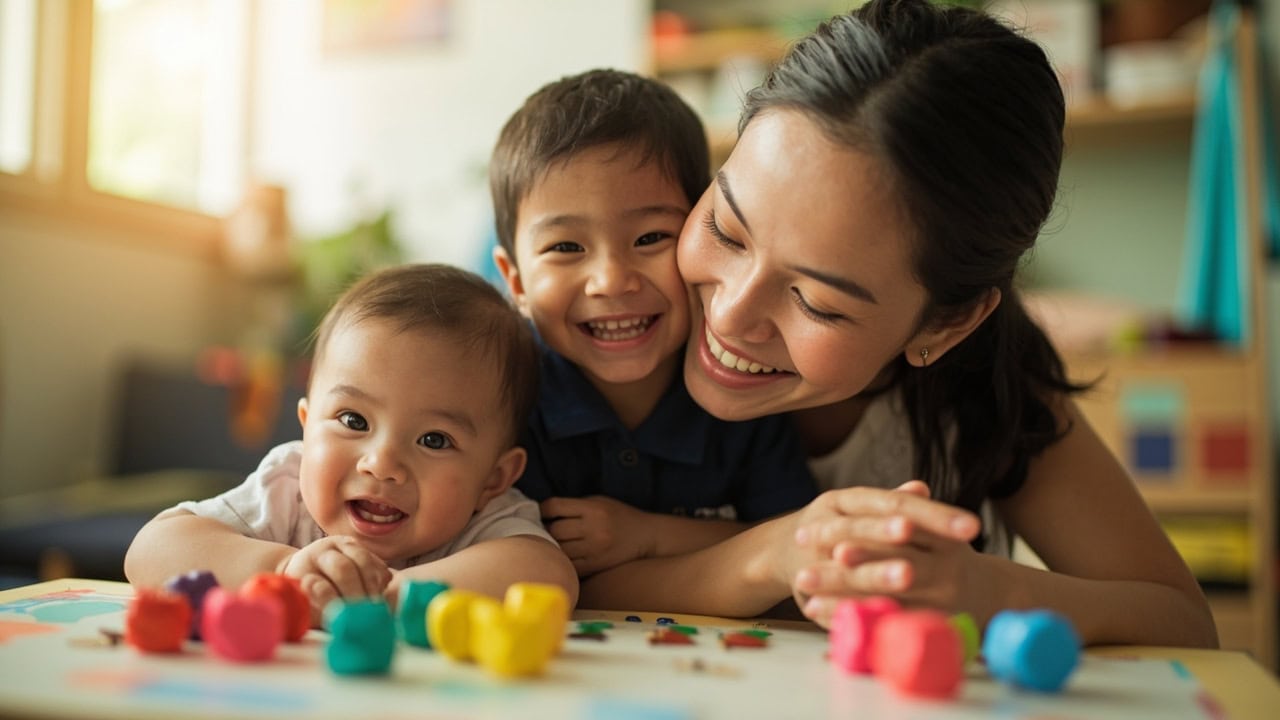
A family where grandparents remain beloved figures of warmth and continuity. Where professional care provides structure and enrichment during the working week. Where everyone is giving what they can give. This is not a fragmented family. This is a family using its full village.
And here is something I want you to hear clearly: this village model does not replace what grandparents have given. It builds on it. Everything your child learned about love, about safety, about being held — that foundation remains.
What you are adding is not a substitute but a complement. A team where everyone plays to their strengths. A family story with more room for more people who love your child.
In practice, this looks like:
- Grandparents continue as anchors of family connection — beloved, present, but no longer carrying the full weight of daily care
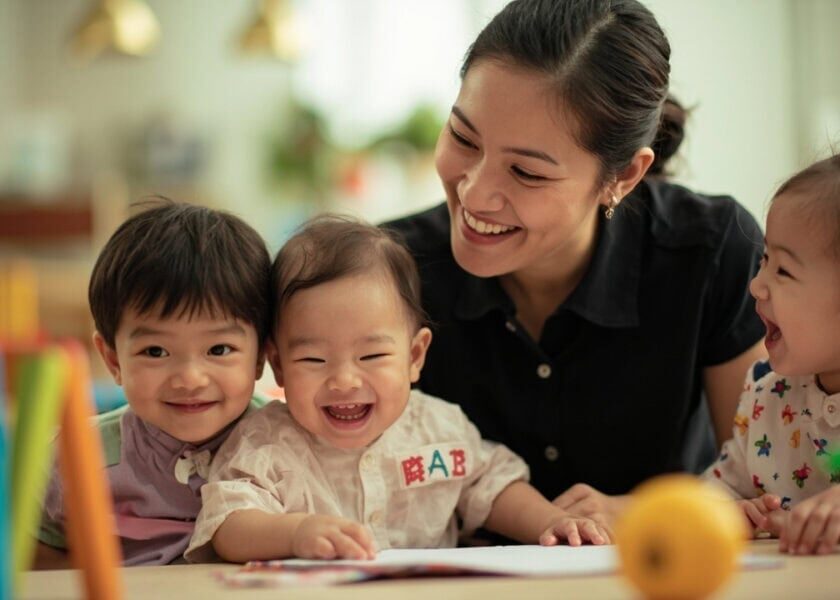
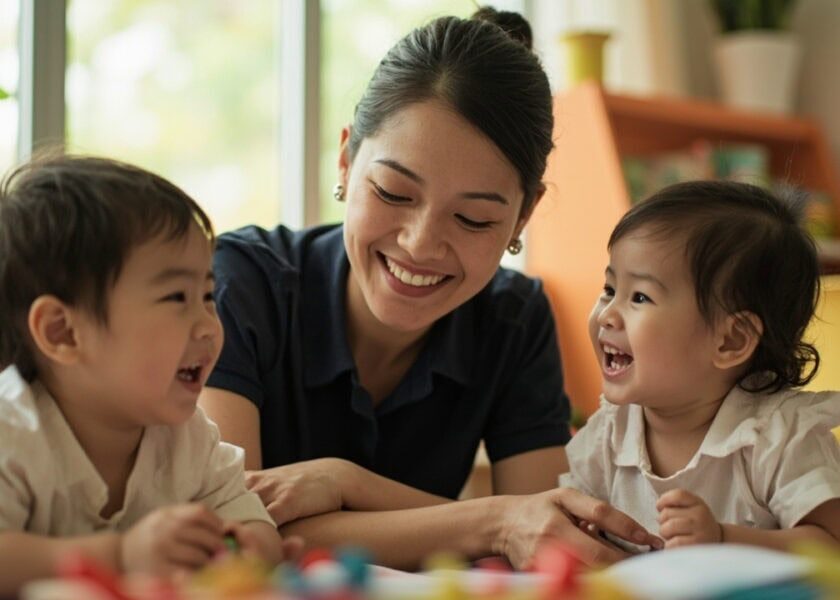
- Professional caregivers provide structured enrichment, peer interaction, and developmentally-appropriate experiences during working hours
- Parents remain the primary decision-makers and connectors, with more energy for quality time rather than exhaustion
- Children benefit from the best of both worlds — family love and professional intentionality
What Quality Childminding Actually Looks Like
If you are considering professional care, it helps to know what you are actually looking for. Here are the markers of quality that matter most:
Attention Ratios That Matter
For infants and young toddlers, the ratio of caregiver to child is not a bureaucratic detail — it is the difference between supervision and genuine attention. Look for arrangements where one caregiver is responsible for no more than three infants at a time. This is not a luxury. It is a baseline for the kind of responsive care that young children need.
Trained and Intentional Caregivers
Quality childminding means caregivers who understand child development — not just as a job requirement, but as a practice. They observe. They notice. They create experiences rather than simply managing time.
Communication as a Foundation
You should know what is happening in your child’s day. Not a daily report card — but genuine visibility. Where transparency measures like CCTV are in place, families have the comfort of knowing. Communication is not an afterthought. It is how trust is built.
Environment That Supports Development
The space should be safe, warm, and organized for exploration. Not a prison of plastic, but not an unregulated living room either. A space designed with a child’s developmental needs in mind.
Consistency and Reliability
Your child’s world needs to be predictable enough to feel safe. Routines matter. Reliable caregivers matter. This is not just about logistics — it is about the emotional security that comes from knowing what comes next.
Whether you choose a service like EduNanny or another provider, these are the standards worth holding. EduNanny, as part of the ECDA Childminding Pilot, maintains ratios of up to one caregiver to three infants, operates Monday through Friday in care blocks designed for working families, and accepts CDA and Baby Bonus funds for eligible families. Where CCTV measures are deployed, families have visibility into daily life. Singapore-wide coverage means quality care does not depend on your postal code.
We are not here to replace your family. We are here because the story of every Singapore family eventually invites new chapters, and we want to be the kind of chapter you are glad to have.
Addressing Your Real Concerns
Before you make any decision, it is fair to ask the questions that keep you up at night. Let me address the ones I hear most often.
“Will my child feel abandoned?”
This fear is understandable, but here is what we have observed across hundreds of families: children are remarkably perceptive. When the transition is handled with honesty and warmth — when they sense that their world is not fracturing but expanding — they adapt. They thrive.
The child who was restless and understimulated becomes a child who is engaged, curious, and growing. That is not abandonment. That is responsiveness.
“Will my parents feel rejected?”
This is the fear that cuts deepest, and it deserves the most care. But consider this: most grandparents are already tired. Many are in their golden years, years they may have hoped would include more rest, more freedom, more time for themselves.
When the conversation is framed as an evolution rather than a rejection, many grandparents feel not wounded but relieved. They are stepping back from a weight they may not have admitted was heavy. They are stepping into a role that is more sustainable — and more enjoyable.
“Is professional care really better?”
Let me be honest: it is not about better. It is about appropriate. At twelve months, grandparent care is often ideal. At three or four, a child who needs peer interaction, structured enrichment, and dedicated developmental support — that child needs something that general family care, however loving, cannot easily provide alone.
The question is not which is better. The question is which is right for where your child is now.
“How do I even begin to research?”
Start with what matters most to you. Ratios. Training. Environment. Communication. Visits. Ask questions. Trust your instincts. And remember: you are not looking for perfect. You are looking for good enough for today — and thoughtful enough to grow with your child.
Ready to Explore What Comes Next?
Every family that has walked this path has discovered something worth knowing: that the transition away from full-time grandparent care does not have to feel like a loss. It can feel like an opening.
An invitation to a larger way of raising a child. A way that includes grandparents for the irreplaceable things they offer, and includes professional care for the intentional, structured, developmentally-rich environment that growing children increasingly need.
This is not an ending. It is a next chapter in a story that began with love — with your parents’ love for you, and your love for your child.
The love that brought your parents into your child’s life is not diminished by the love that brings professional care alongside it. The gratitude you feel for what grandparents have given does not disappear when you acknowledge that your child’s needs are evolving. These are not contradictions. They are the normal, beautiful contradictions of family life — contradictions that require us to be honest, to be brave, and to trust that the people we love can meet our honesty with understanding.
If you are reading this article — if you have made it this far — I want you to know that the wondering you have been doing is not a failure. It is the beginning of wisdom.
The moment you allow yourself to see clearly — to see both the gift of what is and the shape of what could be — is the moment you become the kind of parent your child needs you to be. Not perfect. Not without uncertainty. But honest, attentive, and brave enough to evolve.
Grandparent care was a gift. It remains a gift. And the next chapter — however it takes shape in your family — can be a gift too.
If what you have read here resonates — if you are ready to have the conversation, or to start researching what a thoughtful transition could look like for your family — we would be honored to walk this path alongside you.
We are here to build alongside what your family has built. We will respect the foundation. We will listen to your concerns. We will communicate with you honestly and warmly. And we will care for your child as though they were our own — because we know that they are, in every way that matters, someone’s entire world.
Speak with us today. Let’s begin the next chapter together.
At EduNanny Singapore, we believe every family deserves a village that grows with them. Learn more about our approach or get in touch to start a conversation.