Beyond Fine: Reading Quality in Your Child’s Everyday Care
Why “Fine” Isn’t Enough: The Evaluation Gap
For years, the conversation around childcare quality has focused on the pre-enrollment moment: tours, credentials, ratios, reviews. You walked through the centre, noticed the toys, observed the teachers. You felt something when you were there—perhaps comfort, perhaps hope.
Those things matter. But they are the beginning of evaluation, not the end. The real work of knowing whether your child is thriving happens in the unremarkable hours that make up most of their week.
Here is what most parents discover within the first few weeks: the daily reports arrive—neat, often cheerful, full of phrases like “had a good nap” and “played well with others.” The photographs come through, curated snapshots of activities. The teachers are warm when you pick up. Everything seems fine.
But beneath that surface of fine, you sense something missing. Not because anything is wrong—perhaps everything is exactly as good as it seems. But you realize you have no framework for knowing. You are evaluating on vibes. And quietly, that is not enough.
This is not a failure of parenting. It is a gap in the system—a gap this guide is designed to help you bridge.
What You Are Actually Watching For
A centre can be warm, colorful, full of laughter. Teachers can greet you with genuine smiles. The bulletin board can display beautiful artwork. All of this is meaningful. But it is not the whole picture.
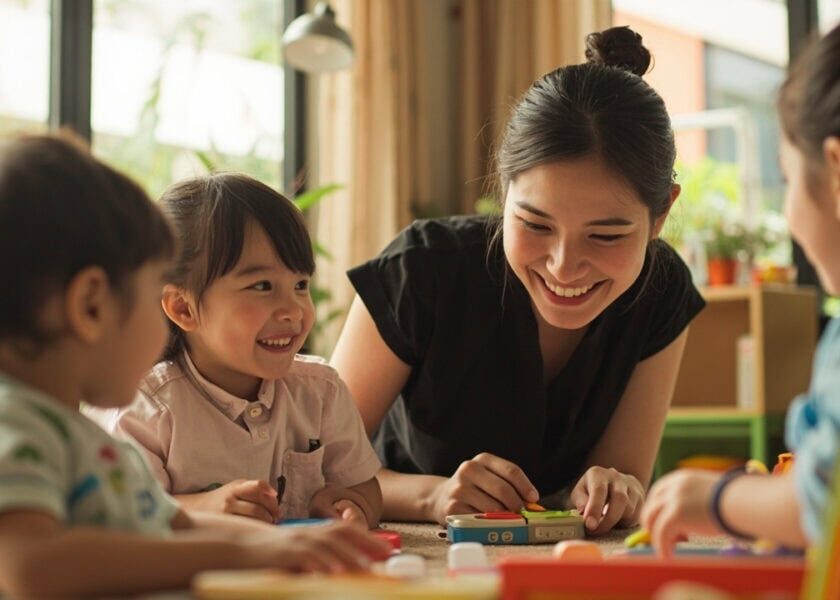
When you observe a classroom, are you watching what the caregivers are doing, or what the children are doing?
The most reliable indicator of quality is not the environment itself but how children move through it. Watch for this: Do children seem at ease, or merely occupied?
A child who is merely occupied will follow instructions, complete activities, appear compliant. A child who is truly at ease will explore, will test boundaries, will show you their real self—not the self that performs for adults, but the self that exists when they feel safe enough to be unguarded.
Reading Quality in Everyday Moments
Quality reveals itself in the spaces between activities, in caregiver responses, and in your child’s behavioral cues. Here is how to read them.
What Happens During Transitions
Consider what happens when one activity is ending and another has not yet begun. These are the moments when scripted routines show their seams and intentional care reveals its depth.
Watch a caregiver during transition time. Are they managing logistics—lining children up, moving from one activity to the next—while children wait, somewhat unattended? Or are they using those moments as opportunities for connection? A brief conversation. A helping hand with a shoe. A moment of eye contact that says, I see you. I know you are here.
In the best caregiving environments, there are no empty moments. Not because every second is programmed, but because the caregiver’s attention is continuous. They are present even when nothing is happening.
The Difference Between Scripted and Intentional Response
Here is a scenario that plays out in some form every day: A toddler drops their cup. The milk spills. The child’s face crumples, the caregiver must manage the spill, other children are watching.
How does the caregiver respond? This is where the difference between scripted and intentional care becomes visible.
A scripted response might sound like: “It’s okay, don’t worry” in a cheerful voice, quick cleanup, redirect to another activity. This is not bad. But it misses the moment entirely.
An intentional response unfolds differently. The caregiver acknowledges the child’s emotional experience first: “You dropped your milk. That was surprising, wasn’t it? You worked so hard to hold it.” Then they manage the practical matter. Then—crucially—they return to the child with genuine connection: “Would you like to try again? I’ll help you hold it.”
The difference is not elaborate. It is simply this: attention to the child’s inner experience, not just their outer behavior.
What Your Child’s Demeanor Tells You
Ask yourself about your child’s end-of-day state. Not what the report says—how your child actually looks and acts when you see them.
- Are they regulated? Tired, yes—that is normal.
- But tired in a settled way, or tired in a way that suggests the day was overstimulating without adequate support?
- Do they seek you out with genuine ease, or is reconnection difficult?
These behavioral cues are not definitive answers. But they are signals. Over time, with attentive observation, they form a picture.
Questions That Reveal Depth of Understanding
Most parents ask questions like: What curriculum do you follow? What activities do you do? How long are the naps?
These are reasonable. But they rarely reveal what you most want to know—whether the adults caring for your child understand child development as a lived practice, not just a theoretical framework.
Here are questions that cut deeper:
“Can you tell me about a moment this week when a child in my child’s group was struggling—maybe frustration or a conflict—and how you responded?”
Listen carefully. Does the caregiver describe a strategy they applied? Or do they describe a process of observation, attunement, and responsiveness? Do they talk about what the child was experiencing, or only about how the situation was managed?
“How do you know when a child is having a hard day versus a hard moment? What signals do you look for?”
Listen for specificity. Listen for awareness that goes beyond “they seem sad.” Listen for signs that this caregiver knows your child’s age group not as a category, but as a lived reality with real developmental texture.
“What do you do when you are not sure what a child needs?”
The best caregivers are not those who always know the right answer. They are those who are honest about uncertainty, who have a process for working through it, and who are humble enough to observe before they intervene.
What Quality Childminding Looks Like in Singapore
There is a particular kind of anxiety that comes with being a parent in Singapore—the awareness that you are making choices during critical years. The pressure to optimize, to choose wisely, to not get it wrong.
I do not want to minimize that feeling. It is real, and it is earned. You are not wrong to take this seriously.
But here is a reframe: The goal is not to eliminate uncertainty. The goal is to develop the capacity to navigate uncertainty with growing confidence.
The ECDA Childminding Pilot Framework
Beyond traditional centre-based settings, Singapore families have pathways under the ECDA Childminding Pilot framework—home-based and community-based care offering smaller ratios and more intimate environments.
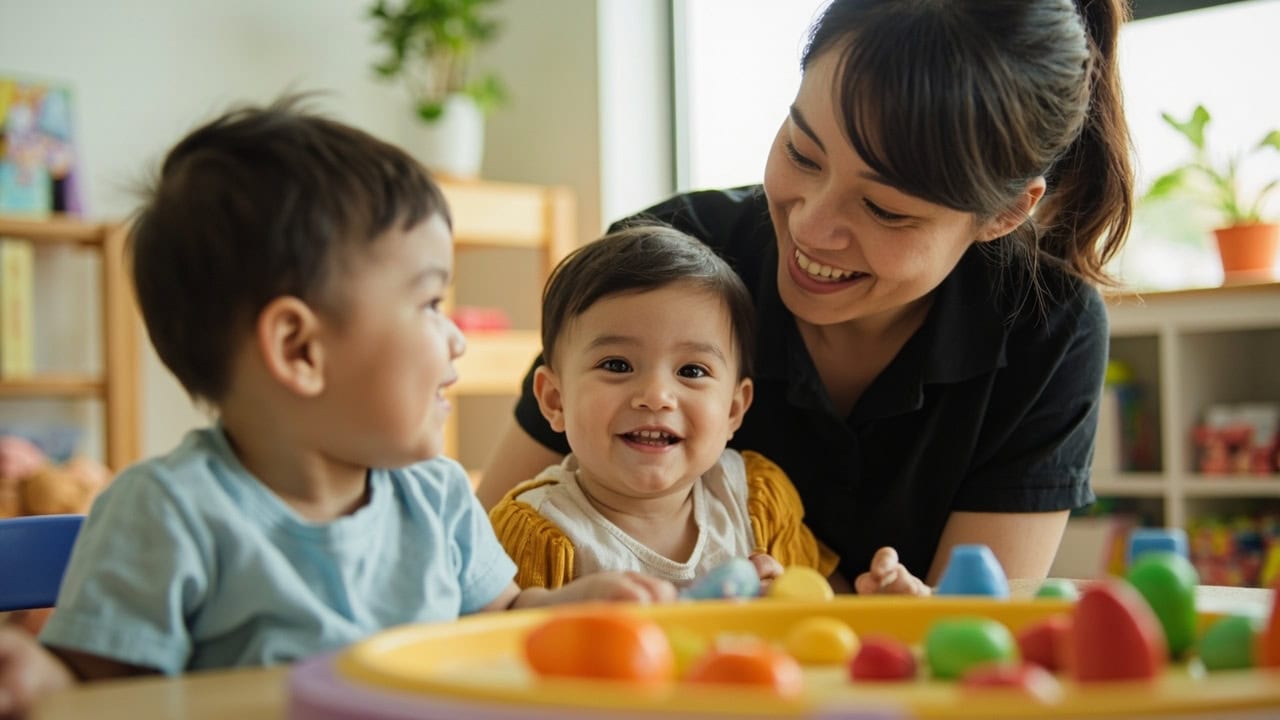
The pilot framework was designed to address exactly the evaluation gap we have been discussing. Smaller ratios mean observation becomes easier—not just for parents, but for caregivers themselves. A caregiver caring for one, two, or three infants has the bandwidth to notice when something is slightly off, to recognize the difference between a tired cry and a frustrated cry, to respond to individual needs rather than managing a group.
The ratio changes everything about what you can observe. In a smaller setting, you can watch your child’s caregiver not as a figure in a classroom but as a person who knows your child—who has the attention to notice the small moments that reveal quality.
But ratios alone do not guarantee quality. You still need the framework for observation we have outlined. Quality requires both the structural conditions that allow for attention, and the observational skills to recognize when that attention is present.
EduNanny’s Approach: Built for This Reality
When EduNanny Singapore was designed, we started with a question: What would childcare look like if it were designed for how children actually develop, rather than the convenience of how systems operate?
Under the ECDA Childminding Pilot framework, EduNanny offers Singapore families alternatives to traditional centre-based care—home-based and community-based pathways that bring quality care into settings with smaller ratios.
But pathways alone are not enough. What matters is how those pathways are implemented.
EduNanny’s approach is built around transparency and partnership. The model includes structured communication protocols—regular updates that go beyond cheerful summaries to include genuine observations about your child’s day. In settings where additional transparency measures such as CCTV access are deployed, this is offered not because we distrust caregivers, but because we believe parents deserve to see what they cannot always be present to observe.
Caregivers are matched with families through an intentional process—aligning caregiver experience and disposition with family needs and values. This matching process recognizes that the relationship between caregiver and child is not incidental; it is the environment in which trust and development actually happen.
Within the pilot framework, quality care is made accessible through thoughtful design—CDA and Baby Bonus can be applied where applicable, and weekday care blocks provide the regularity that working parents need.
Support Beyond the Daily Update
Parents have questions that arise between scheduled consultations. How do I know if my baby’s sleep regression is within normal range? What are some ways to support language development during this phase? How do I talk to my toddler about starting childcare?
These questions often come up at eleven at night, or during a commute, or in small moments when Googling leads to information that is either contradictory or simply not relevant to Singapore’s context.
EduNanny’s Thomas AI Chatbot offers a practical resource for these moments—drawing on evidence-informed guidance and accumulated expertise to offer support that is contextually relevant and designed to complement, not replace, your own decision-making.
Your Evaluation Framework: Growing With Your Child
The skills we have discussed are not static. As your child grows, your evaluation lens should grow with them.
In the infant months, focus on:
- Physical regulation and caregiver responsiveness to cues
- The quality of attunement in feeding and sleeping routines
As your child moves into toddlerhood, watch for:
- Language engagement and social initiation with peers
- How the caregiver supports—rather than directs—play
- How boundary-testing is handled
The same principles apply across ages: observe transitions, notice your child’s demeanor, ask questions that reveal depth of understanding, and trust the picture that emerges over time.
You will not achieve perfect knowledge. No parent does. But you can develop your observational skills, your evaluative instincts, your ability to ask good questions and recognize good answers. You can learn to read the signals with increasing clarity.
When parents develop that capacity, something shifts. The anxiety does not disappear, but it transforms. It becomes less about hoping you made the right choice and more about understanding your child’s experience in real time.
That is not surveillance. That is attention. And attention is one of the greatest gifts a parent can offer.
Moving Forward with Confidence
There is a moment—perhaps you have already had it—when you watch your child do something small and ordinary, and you realize with sudden clarity that they are becoming a person. Not a baby anymore, not a project, but a person with inner life, preferences, curiosities, fears, joys.
That realization is beautiful. It is also, at times, terrifying. Because you understand that you cannot protect them from everything, cannot be present for every moment, cannot orchestrate their development according to a perfect plan.
You have to trust. You have to choose. And then you have to let go.
But here is what I want you to carry forward: Trust and knowledge are not enemies. You do not have to choose between trusting your instincts and developing your understanding. The most confident parents are not those who never doubt—they are those who have built the capacity to observe, evaluate, and adjust.
You are not a passive recipient of whatever system surrounds your child. You are an active, attentive partner in their care.
Singapore’s children deserve our most thoughtful, most informed, most attentive care. And Singapore’s parents deserve support that helps them become the confident, discerning advocates their children need.
Your willingness to learn, to observe, to ask better questions is itself a gift to your child. Carry that forward with confidence.
You are more capable than you know.
If you are exploring childcare options for your infant or toddler in Singapore and want to learn more about EduNanny’s approach—designed around smaller ratios, genuine transparency, and structured partnership with families—connect with us to discuss what pathway may suit your family’s needs.
Learn more about EduNanny’s childminding pathways, our approach to quality care, or connect with our team.