
Fraud Blocker edunanny.com
edunanny-066b3b586bfe5d86cbf485bed68f5179
May 31, 2026

The Quiet Signs of Quality Every Singapore Parent Should Notice

What Quality Childcare Actually Looks Like

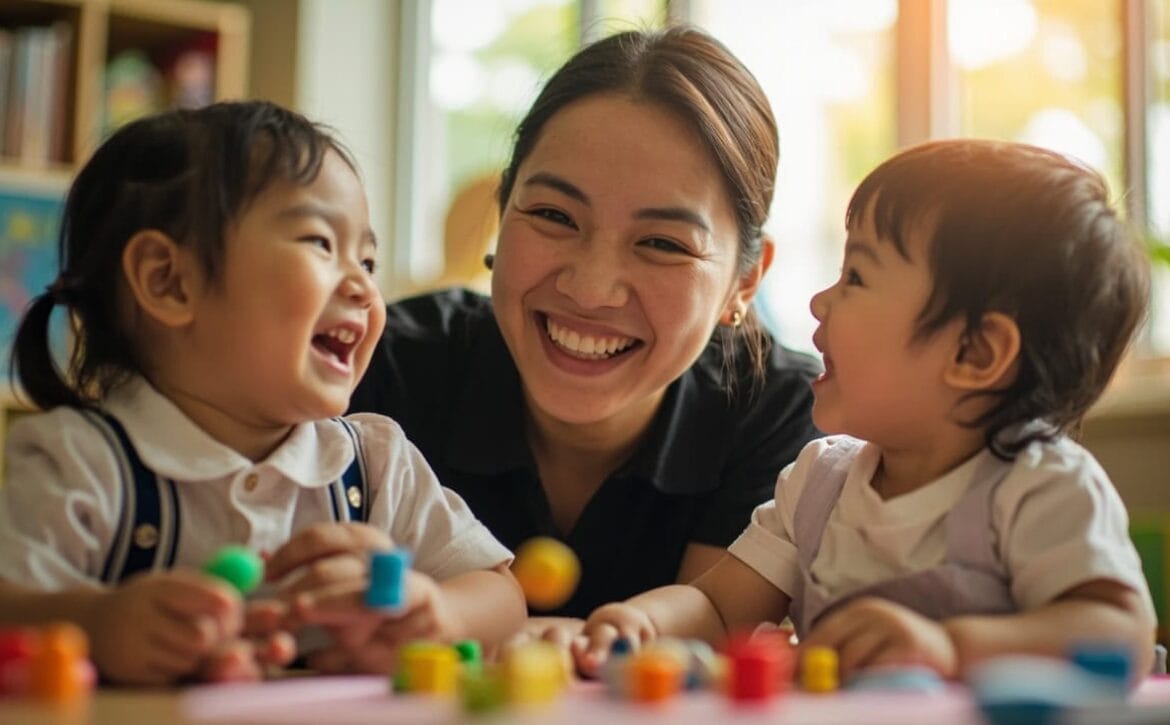
Imagine standing in a childcare centre for the first time. The lights are warm. The walls are colourful. Toddlers play with blocks near the window while a caregiver kneels beside them, speaking softly. Everything looks friendly. It looks safe. But a quiet question surfaces: how do I actually know if this is good?

You walk through the space. You notice the cleanliness, the child-sized furniture, the carefully arranged activity stations. You watch a teacher read to a small group. You see your child smile at a new toy. Still, the question remains: what is actually happening here? Is my child being cared for—or being grown?

That gap between what looks fine and what is genuinely good is where most Singapore parents live when searching for childcare. We want more than supervision. We want our children’s days to matter.

Here are the key indicators of quality you can observe during a visit: a calm, predictable daily rhythm; caregivers who extend play strategically; intentional physical and sensory experiences; rich conversation that builds vocabulary; calm, attuned responses to emotional moments; and individualised communication about your child’s development. If a centre demonstrates these elements, you are looking at genuine developmental support—not just watchful supervision.

This guide will help you close that gap—not with a checklist, but with a framework for seeing. Because when you understand what quality actually looks like in the architecture of a day, you stop relying on surface impressions and start recognising what is really happening for your child.


The Rhythm of the Day: Why Structure Creates Security

Most parents never think to ask: why does the structure of a day matter so much for a young child?

There is a reason we call it rhythm. Rhythm is not a schedule printed on paper. Rhythm is the felt sense of predictability that allows a child to relax into their day, to know what comes next, to trust that after snack time comes story time, and after story time the caregiver will wash hands before lunch.

This predictability is not about control. It is about security.

For infants and toddlers, the world is overwhelmingly large. They have not yet developed the cognitive architecture to navigate uncertainty with ease. What their developing brains require is a surrounding structure that says: this is safe, this is consistent, we know what to expect.

In a childcare environment with intentional rhythm, children do not just behave better. They explore more freely. They engage more deeply. They are available for learning precisely because they are not expending energy on anxiety and vigilance.

Watch a child in a classroom with well-designed rhythm. Notice how, as the morning progresses, the child becomes more engaged, more curious, more willing to try new things. That is not accidental. That is the child settling into the safety of predictability and using that stability as a launchpad for discovery.

Consider what happens in a day that lacks intentional structure. Children are moved from one activity to another without transition. There is no sense of flow. Meals come at irregular intervals. Caregivers change without warning. The day becomes a series of disconnected moments, and the child spends energy not on learning, but on simply surviving the uncertainty.

When you visit a childcare centre, ask yourself: How do the children move through their day? Is there a sense of calm predictability? Or is there constant redirection, transition battles, the sense that nobody quite knows what comes next?

When you find a centre with strong rhythm, you are seeing the first layer of quality—the foundation upon which everything else is built.


Learning Through Play: What It Actually Looks Like

There is a phrase used often in early childhood education: learning through play. It has become so familiar that it risks losing its meaning. Let me be specific about what it actually looks like—and why it is profoundly different from what we used to think of as education.

When a toddler stacks blocks, they are not just playing. They are building neural pathways that will later support mathematical thinking, spatial reasoning, and problem-solving. When a one-year-old pours water from one container to another, they are developing scientific concepts: volume, capacity, cause and effect. When two-year-olds engage in dramatic play—pretending to cook, to visit the doctor, to care for a doll—they are developing executive function, empathy, language, and the ability to understand other people’s perspectives.

This is learning through play. It is not a softening of education. It is education, fully realised, at the developmental stage where children are actually capable of absorbing it.

Here is what distinguishes a quality childcare environment from a mediocre one: in a quality environment, every moment of play is understood as an opportunity for development.

The caregiver does not simply watch children play. The caregiver watches, observes, and then strategically enters the play to extend it—to ask a question that deepens thinking, to introduce a small challenge that builds persistence, to name an emotion that builds emotional vocabulary.

A child who is happy is not necessarily a child who is learning. Happiness is wonderful. Happiness is necessary. But if your child’s day consists entirely of free play with minimal intentional adult engagement, your child may be kept busy without being genuinely grown.

The question is not whether your child is happy in childcare. The question is whether your child is being thoughtfully challenged, supported, and extended throughout the day.


Physical, Sensory, and Language Development

In the first three years of life, the child’s body is the primary vehicle for learning. This is not metaphor. This is neuroscience.

A child’s brain develops in response to physical experience. When a baby crawls across different surfaces—smooth floor, textured mat, grass outside—her brain is building sensory maps that will later support reading, mathematics, and spatial awareness. When a toddler climbs, jumps, and runs, she is developing the proprioceptive sense—the body’s awareness of itself in space—that underlies coordination, balance, and eventually handwriting.

In a quality childcare day, you will see intentional physical development woven throughout. There will be time for large motor play—not just a brief stint on a playground, but extended, varied opportunities to run, climb, jump, and explore physical challenges appropriate to each child’s developmental stage.

There will also be careful attention to fine motor development: the pincer grasp needed to pick up small objects, the hand strength needed to manipulate playdough, the finger dexterity needed to turn pages.

Watch a group of one-year-olds at a well-designed sensory table. You might see water, sand, rice, or beans—simple materials that invite exploration. Notice what the caregiver does. Does she simply watch? Or does she narrate what the children are doing, ask questions, introduce new vocabulary, model new ways of interacting with the materials?

The difference between passive observation and intentional facilitation is the difference between a child who is playing and a child who is learning through play.

By the age of three, a child’s vocabulary development is strongly predictive of later academic success. Children who are exposed to rich, varied language in the early years arrive at school with thousands more words in their vocabulary than children who were not.

The neural pathways for language are established in the early years. Once that window closes, they become far more difficult to develop. Listen to a caregiver in a quality childcare environment. You might hear her say:

“I see you are building a tower. It is very tall. What do you think will happen when you add one more block on top?”

She is not filling silence. She is building language. She is introducing words like “tall,” “add,” “top.” She is modelling sentence structure. She is showing the child that her thoughts are valued by responding to them.

Compare that to a caregiver who speaks only to direct behaviour: “Sit down.” “Don’t touch that.” “Share with your friend.” These are not negative interactions. They are necessary. But alone, they do not build language. A child who hears only directives all day is not receiving the rich language exposure that will serve her throughout schooling and beyond.

When you observe a childcare environment, listen. What do you hear? Is there conversation? Is the caregiver talking with children, not just at them? Are new words being introduced? Are questions being asked?


Social-Emotional Development: How Children Learn to Be People

In the early years, children are not just learning facts and skills. They are learning how to be people. They are learning how to recognise and manage their own emotions. They are learning how to regulate when upset, how to wait when they want something immediately, how to express frustration without hurting others.

These are not soft skills. These are the foundational competencies that will determine how well a child navigates relationships, handles stress, and functions in a community throughout their entire life.

In a quality childcare environment, social-emotional development is not left to chance. It is intentionally scaffolded.

When a toddler has a tantrum—and they will, because that is developmentally appropriate—the caregiver responds not with punishment or dismissal, but with calm, steady presence. She names the emotion. She acknowledges the frustration. She helps the child put words to what is happening inside:

“You are feeling angry because it is time to clean up and you want to keep playing. That is hard. I am here with you.”

This kind of response does several things at once. It helps the child feel understood. It teaches vocabulary for emotions. It models emotional regulation. And it shows the child that difficult feelings are manageable, that they do not have to be afraid of their own emotions.

Over time, with consistent scaffolding, children develop what we call co-regulation—the ability to borrow calm from a caring adult until they can generate calm themselves. This is one of the most valuable gifts a childcare environment can give a child.

You can observe this in any childcare centre. Watch how caregivers respond to children’s emotional moments. Is there patience? Is there attunement? Does the caregiver seem to genuinely see the child behind the behaviour? Or is there impatience, quick fixes, dismissal?

The way a caregiver engages with a child’s emotional world tells you almost everything you need to know about the quality of that environment.


Observation, Communication, and What Parents Can Evaluate

In a truly excellent childcare environment, caregivers are watching your child. Not just supervising. Not just keeping them safe. Watching with intention, noticing developmental milestones, tracking progress, identifying areas where your child might need additional support or challenge.

This means that when you receive updates about your child’s day, those updates are informed by genuine observation. You are not receiving a generic report that could apply to any child in the class. You are receiving insight into your child’s specific experience—what she was drawn to, what challenged her, how she interacted with peers, what she learned.

Communication between caregiver and parent is not an administrative task. It is a partnership in your child’s development. When you drop your child in the morning, that caregiver knows your child—not just her name, but her temperament, her interests, her current developmental focus. And at the end of the day, you receive information that helps you continue that developmental work at home.

Evaluating childcare is not about finding perfection. There is no perfect centre, because centres are made of people, and people are imperfect. What you are looking for is not flawlessness. What you are looking for is intentionality—a place where someone has thought carefully about how children develop, where the daily experience is designed with that development in mind, where caregivers are not just present but purposefully engaged.

When you walk into a childcare environment, ask yourself:

  • Do I see intentionality here?
  • Is there a rhythm that feels calm and predictable?
  • Is play being used as a vehicle for learning?
  • Are children being physically challenged and sensory engaged?
  • Is language being built throughout the day?
  • Are emotions being named and supported?
  • Are caregivers observing and responding to individual children?
  • Is there genuine attention to development, not just supervision?

Quality is not exclusively found in premium-priced programmes. Intentionality, strong caregiver training, and developmentally informed practice can exist at various price points. What matters is the thoughtful design of the daily experience and the knowledge of the caregivers—not the cost of the facility.

If caregivers can articulate what learning is happening and why, that is a strong indicator of intentional practice. Ask how they document learning. Request specific examples of how play connects to developmental goals.

Happiness is necessary but not sufficient. A child can be happy in an environment that is essentially entertainment without genuine developmental value. Look beyond the smiles. Ask about the daily structure. Observe caregiver-child interactions. Trust your instincts, but also trust the framework—because when you know what to look for, you will see more than surface impressions.


EduNanny: Quality Childcare for Singapore Families

EduNanny by BUTLER was built on a simple but profound belief: every child deserves quality care that genuinely supports their growth. We know that Singapore parents face real pressures—long working hours, demanding careers, the need for affordable, reliable childcare that does not require sacrificing developmental quality.

We built EduNanny to meet that need, not with a one-size-fits-all solution, but with an approach that recognises the importance of individualised attention and intentional care design.

EduNanny participates in the ECDA Childminding Pilot, which means our home-based and community pathways are designed with the highest standards of quality in mind. Our infant ratios—up to one caregiver for every three infants—ensure that your child receives the focused attention that developmental science tells us is essential in the early years.

Our fee structures are designed to be affordable within the pilot framework, and we are pleased that CDA and Baby Bonus funds can be used, making quality care accessible to more Singapore families.

We operate Monday to Friday care blocks because we know that parents need reliability. And because we believe that consistency is not just convenient—it is foundational to the security and development that we have discussed throughout this guide.

When you choose EduNanny, you are choosing a team that understands child development as deeply as you understand your own child’s needs. Our caregivers are not just trained. They are educated in the science of early childhood.

They understand the rhythms that create security. They know how to use play as a vehicle for learning. They are intentional about language, about sensory experience, about social-emotional scaffolding. They observe, they document, they communicate.

We also believe in transparency. Where CCTV measures are deployed, they serve not as surveillance, but as assurance—giving parents the confidence that comes from knowing exactly what is happening in your child’s day.

For those moments when you have questions—when you wonder about your child’s development, when you want guidance on how to continue at home what we are doing in our care—we have developed tools to support you. Because parenting and childminding should not be lonely endeavours. They should be partnerships.

We understand the unique pressures you face. The commute, the long working hours, the cost of living, the desire to be present even when work demands are real. You are not looking for excuses. You are looking for solutions that do not require you to compromise on what matters most.

That is why EduNanny exists—not as a compromise, but as a genuine option for families who want both reliability and quality, accessibility and excellence.

We invite you to visit us. To see our environments. To speak with our caregivers. To ask the hard questions and expect thoughtful answers. To experience what intentional, developmentally informed care actually looks like in practice.


Moving Forward: Seeing Quality for Yourself

Every day, in childcare environments across Singapore, children are either being supervised or being grown. Both look similar from the outside. Both involve children who are safe, fed, and content.

But only one of them is building the architecture of a lifelong learner, an emotionally intelligent human being, a child who will carry the foundations laid in these early years into everything they become.

The difference is not visible in a happy photograph or a clean facility or a friendly face at pickup. The difference is invisible until you know how to see it.

It lives in:

  • The rhythm of the day
  • The intentionality behind the play
  • The language a caregiver uses when she thinks no one is listening
  • The way a child’s frustration is met with steady presence rather than quick dismissal
  • The careful observation that says: we see your child, not just as a student in our class, but as an individual whose potential we are honoured to support

You deserve to know what is happening in your child’s day. You deserve partners in your child’s growth. And you deserve the confidence that comes from understanding—not blind trust, but informed confidence.

The next time you walk into a childcare centre, you will see differently. You will notice the rhythm. You will listen for language. You will watch how caregivers engage with children’s emotions. You will look for the intentional design that separates supervision from growth.

And when you find it, you will know. Not because someone told you it was good. But because you can see it for yourself.

Take the next step. Speak with our team. Schedule a visit. Ask about our approach, our caregivers, our philosophy, and our practices. See for yourself what intentional care looks like when it is built on genuine expertise and deep respect for both children and parents.

Your child deserves to be seen, supported, and grown. And you deserve to know that this is happening—not hope for it, but know it.

EduNanny is here to make that possible.
edunanny-066b2d76b280c14ee69df08a0e3433a8
May 31, 2026

How Singapore Parents Can Recognize Truly Excellent Childcare

“`html

Beyond “Is It Safe?”: The Question That Changes Everything

When we talk about choosing childcare in Singapore, the conversation tends to orbit a handful of familiar ideas. Is the environment safe? Is the caregiver warm? Does my child seem happy when I pick them up?

These are not the wrong questions. But they are, if we are honest, incomplete questions — and they are questions that any adequately run service can answer in ways that are technically true and substantively misleading.

A child can be safe and supervised without being engaged. A caregiver can be professionally warm without being developmentally attuned. A child can appear happy at pickup because children are remarkably resilient at performing the version of themselves their parents expect to see.

The deeper question — the one that actually matters as your child moves through these foundational years — is not whether your child is being cared for. It is whether your child is being seen.

That distinction sounds philosophical. It is actually profoundly practical. Let me show you why.


Two Scenes: What Quality Actually Looks Like

Imagine two different childcare settings at the end of the day.

In the first, a parent arrives. The room is bright and orderly. The caregiver greets the parent warmly, reports that the child ate well, slept well, and played nicely. The child runs over, reaches up to be carried, looks comfortable. The parent leaves feeling reassured.

In the second, a parent arrives at a different setting. The room is equally clean. The caregiver greets the parent, and before the parent can ask anything, the caregiver says: “This afternoon, Maya spent forty minutes working on a tower of blocks. She knocked it down three times and watched how it fell differently each time — heavier blocks at the bottom made a wider spread, lighter ones on top made it topple differently. She was completely absorbed. I didn’t redirect her once. I wanted to tell you because that’s the first time she’s sustained that kind of focused investigation.”

The parent stands there for a moment, not because the report is extraordinary, but because they realize they have just been handed a window into their child’s thinking.

Both children are safe. Both caregivers are warm. Both caregivers are competent. But the parent in the second scene has received something entirely different — not just a report of what happened, but evidence of how their child thinks, what their child notices, where their curiosity lives.

That evidence is not accidental. It is the product of a caregiver who knows how to observe, who has been trained to notice, and who understands that developmental quality reveals itself in moments that most parents have not learned to read yet.

This is what I mean by the hidden language of childcare quality. Every excellent childcare environment is communicating something — about your child’s development, about the responsiveness of the care, about the depth of engagement your child is experiencing — in signals that are available to anyone willing to learn them. The problem is that most of us were never taught the language.


What to Look For: Reading Quality When You See It

The Environment as Teacher

Start with the environment itself. Not whether it is clean and childproofed — you should assume that any credible service meets those baseline standards. Look instead at what the environment is quietly teaching your child about what their curiosity is worth.

Walk through a room and ask yourself:

  • Are the materials at a height the children can reach independently?
  • Is there a deliberate variety of textures, weights, and open-ended possibilities — things that invite manipulation rather than consumption?
  • Is there evidence that the children themselves have shaped the space? Is their work displayed? Is their presence treated as meaningful rather than managed?

A room that tells you it was designed for children is very different from a room that tells you it was designed to be safe for children. The first invites exploration. The second manages risk. Your child’s development depends on the invitation.

What Engaged Children Actually Look Like

Now watch the children — not just your own, but all of them — for how they move through the room. Engaged children are not always busy. Some of the most important development happens in what looks, from the outside, like stillness.

A child sitting quietly, turning an object over in their hands, watching another child’s face, listening to a sound outside — these are not gaps in engagement. These are the moments when the brain is doing its deepest work, building the architecture of attention, curiosity, and cognition that will shape everything that follows.

A childcare setting that allows for this kind of quiet, self-directed engagement — that does not feel the need to keep every child in constant visible motion — is revealing something profound about its understanding of child development.

Warmth That Cannot Be Faked

One of the most important things I can help you recognize is the difference between genuine warmth and professional politeness.

Professional politeness is competent and consistent. It says the right things. It maintains appropriate boundaries. It answers your questions thoroughly. It is, by any reasonable measure, fine.

Genuine warmth is different. It shows up in moments the caregiver does not know parents are watching:

  • In the way a caregiver kneels to a child’s level when the child is struggling with something — not to fix it, but to be alongside them
  • In the way a caregiver narrates a child’s experience back to them in language that is slightly more complex than the child would use themselves — one of the most powerful teaching techniques humans have ever discovered, and it costs nothing
  • In the way a caregiver notices a child’s mood before it becomes a problem and quietly adjusts the environment or their presence to meet it

Watch for that responsiveness. It is the single most reliable indicator of caregiver quality I have encountered, across every context and every framework.

Your Child’s Language as a Window Into Thinking

Children’s language, especially in the first three years, does not develop in a vacuum. It develops in response to rich, reciprocal interaction — to adults who talk with them, not just at them, who respond to their gestures and sounds with words, who expand on what the child is communicating and offer new layers of meaning.

When you pick up your child, listen to them. Not just to whether they are speaking in sentences. Listen to how they put ideas together. Listen to whether they seem curious about words, whether they notice sounds, whether they are beginning to narrate their own experience.

When you ask the caregiver about your child’s communication, notice whether they can tell you something specific. Not “she’s progressing well” — that phrase means nothing. But something like: “He’s started using two-word combinations to describe cause and effect. He’ll say ‘milk spill’ or ‘block fall’ and he’s started doing it with a kind of satisfaction, like he’s proud of the idea he just made.”

That is a caregiver who is paying attention to your child’s thinking, not just their behaviour.

Peer Interaction: What “Playing Together” Actually Means

Very young children — infants and toddlers — do not play together the way older children do. They parallel play. They sit near each other. They watch each other. They reach for the same toy and look at each other when it happens.

These moments are not incidental. They are the earliest forms of social cognition, and the way a childcare environment handles them reveals a great deal about its developmental sophistication.

Look for environments where children are given the space and time to navigate these early social moments without immediate adult intervention — not without supervision, but without the instinct to smooth every friction before the child has had a chance to learn.

A skilled caregiver in a quality setting will hover near a social moment, ready to support, but will allow the children the chance to work through the negotiation themselves first. That restraint, that trust in the children’s emerging capabilities, is a sign of profound understanding.

Equally, look for how the caregiver responds when a child is frustrated or distressed. Not whether the caregiver is soothing — of course they are. But how. A caregiver who names the emotion, who reflects it back in a way that teaches the child what they are feeling, who stays present without rushing to eliminate the feeling — that caregiver is doing something far more valuable than making the child happy. They are teaching the child that their inner world is intelligible, and that another person can be trusted to understand it.


The Ratio That Changes Everything

All of what I have described — the environment, the caregiver responsiveness, the language richness, the peer interaction quality — requires something that no amount of goodwill can substitute for. It requires time. It requires attention. And it requires the right numbers.

The ratio of caregivers to infants in a childcare environment is not a bureaucratic detail. It is the foundation on which every other quality indicator rests.

When a single caregiver is responsible for too many children, the kind of observation I have been describing — the noticing, the responsive language, the attunement — simply cannot happen with consistency. It is not a failure of the caregiver. It is arithmetic.

Care Setting Typical Caregiver-to-Infant Ratio What This Allows
Centre-based infant care Up to 1:6 or 1:8 Supervision; limited individual observation
Home-based childminding (ECDA Pilot) Up to 1:3 Deep observation; responsive attunement

That is not a small difference. It is the difference between an environment where a caregiver can narrate your child’s afternoon back to you with specificity and one where the most honest report available is “she had a good day.”

When you understand what to look for, the ratio tells you whether what you are looking for is even possible.

Communication as a Quality Signal

What does it look like when a service is designed around genuine developmental quality? It means parents deserve to be partners in observation, not just recipients of reassurance.

A service that understands developmental quality will communicate with you in ways that give you insight into your child’s thinking and experience, not just a log of meals and naps. It lives in the culture of the service:

  • In whether the caregivers are trained to observe and document
  • In whether the service welcomes your questions and treats them as the right of an engaged parent rather than an intrusion
  • In whether, when you walk through the door, you feel like you are entering a partnership rather than a transaction

When those things align — when the ratios allow for genuine attunement, when the caregivers are trained and supported to observe deeply, when the communication is honest and specific, when the environment invites exploration — you do not have to choose between your child’s safety and their development. You get both.


EduNanny by BUTLER: Designed for This Standard

EduNanny by BUTLER was built on a conviction that quality childcare is readable — and that parents can be empowered to verify it. This is not incidental to what EduNanny does. It is the philosophy from which everything else follows.

EduNanny participates in the ECDA Childminding Pilot, and this is important not just as a credential but as a structural commitment. The pilot operates within frameworks designed to maintain the conditions that make genuine quality possible — the ratios, the training standards, the accountability structures. It is a deliberate participation in an ecosystem that Singapore is building because it recognizes that the first thousand days of a child’s life are not a period to be managed. They are a period to be invested in with everything we know about human development.

The Home-Based Advantage

Home-based childminding through the pilot offers something that deserves more recognition than it sometimes receives — the continuity of a consistent caregiver in a consistent environment.

For infants and very young children, this is not a minor advantage. The ability to form a deep, sustained attachment to one trusted adult, in a space that becomes familiar and secure, is one of the most powerful developmental gifts we can offer a young child. It is the opposite of the fragmented, rotating experience that many centre settings, despite their other strengths, sometimes inadvertently create.

Practical Dimensions for Singapore Families

The practical dimensions are worth noting too:

  • Monday to Friday care blocks that align with the rhythms of working families
  • Fees structured to be accessible within pilot parameters
  • Ability to access CDA and Baby Bonus arrangements through the pilot
  • Coverage across Singapore

EduNanny’s service is designed to meet families with this combination of developmental intentionality and practical sensibility — not as a compromise between quality and affordability, but as a demonstration that the two do not have to be in tension when the structure is right.


Addressing Your Real Concerns

“Am I overthinking this?”

No. The awareness you carry — that you cannot be in the room with your child during the hours that may matter most for how their brain develops, how they come to understand themselves, how they learn to trust the world — that awareness is not a weakness. It is not guilt. It is the most fundamental expression of what it means to love a child.

What you need is not reassurance. Reassurance is cheap. What you need is a framework — a way of reading what you are seeing so that your natural parental intuition has something to work with.

“How do I evaluate childcare if I don’t have a background in child development?”

You do not need a degree to recognize quality. You need to know what questions to ask and what answers look substantive versus polished. The framework in this article is designed to give you exactly that.

The caregiver who can tell you specifically what your child was curious about today — that is readable. The environment that invites exploration rather than just managing risk — that is visible. The setting that allows for quiet, focused engagement — that you can observe.

“Is home-based care right for my child?”

For infants and toddlers especially, the continuity of one trusted caregiver in one familiar environment offers developmental advantages that are well documented. The question is whether the caregiver has the training, support, and ratios to provide the quality your child deserves.

When those conditions are met — as they are in the ECDA Childminding Pilot — home-based care is not a compromise. It is often the most developmentally aligned choice for the earliest years.


You Now Have the Language

In these early years, your child is building a person. Every interaction, every moment of being truly seen by another human being, every time a caregiver notices what they are curious about and responds with words that stretch their thinking just slightly further — these are not filler hours between now and “real” school. They are the period in which the foundational architecture of a human being is being constructed.

The neural pathways. The emotional templates. The relational habits. The sense of self as a capable and worthy person. All of it is being shaped in these years, and it is being shaped largely by the quality of the care your child receives when you are not in the room.

The beautiful thing — the thing I hope you take away from everything I have shared today — is that you now have more of the language you need to recognize excellence when it is in front of you.

Not to second-guess yourself. Not to become anxious or hypervigilant. But to trust your instincts with precision. To know what you are seeing. To walk into any childcare environment and read the room the way someone who genuinely understands child development would read it.

Because you are that someone. You are your child’s first and most important interpreter of the world. And when the right childcare partner is in place, you do not have to wonder whether your child is being seen.

You will be able to see that they are.

If what you have read here resonates — if you are ready to look for care that meets this standard, care where your child is not just supervised but truly seen — EduNanny by BUTLER invites you to start a conversation.

Not because we are perfect. Perfection is not achievable. But because the standard to hold ourselves to, when we are shaping a child’s first understanding of the world, is not adequate. It is excellent.

And that is exactly the standard we hold ourselves to every single day — not as a promise, but as a practice.

To learn more about EduNanny by BUTLER and how our home-based childminding service, operating under the ECDA Childminding Pilot, can offer your child the quality of care you have just learned to recognize, we welcome you to connect with us.


“`

edunanny-066b1ecc32324e130e0ac13c777296ac
May 31, 2026

Understanding the Professional Caregiver Difference for Singapore Families

The Professional Caregiver Difference: What Distinguishes a Quality Nanny From Childcare in Singapore

There is a moment, familiar to every parent who returns to work, that arrives before words. It is the moment you hand your child to someone else and walk out the door.

In that moment, something inside you asks a question you may not even fully form: Who is this person, and can I truly trust them with the most important thing in my life?

That question is not irrational. It is not weakness. It is the most reasonable question a parent can ask.

And it is the question that separates the experience of choosing childcare from every other logistical decision you will make as a parent. Because when you choose childcare, you are not choosing a service. You are choosing a person. That person will shape your child’s days, their routines, their first words about the world, their sense of security.

That is not a detail. That is everything.

This article explores what truly distinguishes professional childminding from other childcare options in Singapore—and why that distinction matters for your child’s early development.


What You Actually Need: Beyond Supervision

Most parents enter the childcare conversation from a place of scarcity. They are returning to work. They need coverage. They are balancing costs, commutes, and the quiet guilt that modern parenting somehow makes unavoidable.

They search for options the way they might search for any service provider, comparing hours, fees, and proximity. And that is understandable.

But somewhere beneath that practical search is a deeper hunger for something harder to quantify: the desire to know that your child is not just supervised, but genuinely cared for. Not just safe, but seen.

You are hoping that the person caring for your child knows their name, their temperament, their favourite way of being comforted. You are hoping they notice when your child is about to have a breakthrough in language or motor skills—and that they know how to support it.

You are hoping they communicate with you not in generic updates but in meaningful observations that help you understand who your child is becoming. You are hoping for consistency, for relationship, for someone who will be a steady presence in your child’s life the way you yourself try to be.

This is not an unreasonable hope. It is, in fact, the only reasonable hope, because early childhood development happens in the context of relationship. A child’s brain builds itself through thousands of daily interactions, and the quality of those interactions matters enormously.


Childcare Options: What You’re Actually Choosing

Babysitting: Transactional by Nature

When you hire a babysitter, you are engaging someone for a specific window of time. There is nothing inherently wrong with this—babysitters serve a real purpose.

But let us be honest about what babysitting is: a transaction. It is the exchange of time for money, with variable preparation, inconsistent experience, and no guarantee that the person arriving at your door understands your child’s cues, your family’s rhythms, or the developmental landscape your child is navigating.

Each babysitter, if you rotate through several, is essentially starting from scratch. They learn your child by trial. Your child learns them by trial too.

And in those trials, there is a cost that is easy to overlook: the emotional labor of re-adjustment, the subtle stress of the unfamiliar, the minutes or hours spent in uncertainty before trust is rebuilt.

Centre-Based Care: Understanding the Math

There are excellent childcare centres in Singapore, run by dedicated professionals who genuinely love what they do. But centres operate within a model that has real structural constraints.

When an infant room maintains a ratio of one caregiver to three infants, that caregiver is managing three separate lives simultaneously. Three sets of needs, three crying episodes, three feeding schedules, three nappy changes.

She is doing her best. But her best is distributed. Your child’s individual rhythm—their particular moment of curiosity or frustration or wonder—is one voice in a room of many.

This is not a failure of centres. It is mathematics.

The question is not whether centre-based care is good or bad. The question is what you are actually buying, and what you are hoping for.


What Quality Childminding Actually Looks Like

Most parents have no window into what a truly professional caregiver does throughout a day. They drop their child in the morning and imagine the hours ahead as a kind of pleasant babysitting, perhaps some supervised tummy time, perhaps a cartoon.

But a trained, intentional caregiver is engaged in a far more nuanced practice.

She observes your child’s moods across the morning, noticing patterns that reveal something about sleep, nutrition, or developmental leaps. She engages your child in language-rich interaction during feeding, narrating the moment, naming objects, responding to coos as if they were profound statements—because to your child, they are.

She follows your child’s lead during play, stepping in when the play becomes a learning opportunity and stepping back when your child is in the deep work of concentration. She documents these moments not as administrative burden but as a gift to you: the parent who missed the morning and wants to know who your child was while you were away.

She is also, quietly, building your child’s cultural foundation. Singapore is a city of many languages, many traditions, many ways of being in the world. A caregiver who shares your cultural context, who speaks your home language, who understands the foods your family eats and the customs your family values, brings something to your child’s day that no curriculum can replicate.

For a child developing their sense of identity and belonging, this is a quiet cornerstone, not a luxury detail.


The EduNanny Difference: A Deliberate Philosophy of Care

When EduNanny Singapore speaks about the quality of our caregivers, we are not speaking in abstractions. We are speaking about a deliberate philosophy of care that begins with selection and does not end until the placement is complete and thriving.

A caregiver in the EduNanny model is not someone who answered a classified ad and showed up for an interview. She is someone who has been assessed not just for skills, but for temperament, for patience, for the particular quality of attention that excellent caregiving requires.

She understands infant development not as a checklist but as a living process. She knows that a baby’s cry is communication. She knows that play is learning. She knows that the mundane moments of feeding, changing, and soothing are also the moments when trust is being built, neuron by neuron, interaction by interaction.

Selective Matching

EduNanny does not place caregivers algorithmically, based on proximity and availability alone. The matching process takes into account your child’s temperament, your family’s values, your cultural background, your communication preferences, and the specific needs of your household.

A caregiver who is perfect for one family may be wrong for another. This is not inefficiency. This is respect for the fact that relationship is not interchangeable.

Operating Within the ECDA Childminding Pilot

The EduNanny model operates under the ECDA Childminding Pilot, which is built on principles that recognise real developmental realities. The pilot prioritises the home-based model, understanding that for infants and young children, the familiarity of a home environment with consistent caregivers serves developmental outcomes meaningfully.

The care blocks are structured Monday to Friday, aligning with the rhythm of working family life. The infant ratios permitted under the pilot allow for the individual attention that a professional caregiver can provide.

Why This Differs From Finding Someone Independently

Parents sometimes ask us: how is this different from what I could arrange on my own?

The honest answer is that on your own, you are managing risk. You are reviewing resumes, conducting interviews, relying on references that may be superficial, and hoping that the person you choose will be what they present themselves to be.

With EduNanny, the selection process has already happened before your child ever meets the caregiver. There is a pre-qualification layer. There is an assessment of skills, experience, and disposition. There is verification of credentials and structured onboarding that prepares the caregiver for your specific family context.

You are not starting from zero. You are choosing from a curated group.

The Real Cost of Inconsistency

The cost of inconsistency in a child’s early years is real, even if it is difficult to measure precisely.

Every time a child must form a new attachment, must learn a new caregiver’s rhythms, must adapt to a new environment, there is an emotional toll. It may not show up in medical records or developmental milestones. But it shows up in the texture of a child’s sense of security, their willingness to explore, their baseline anxiety in new situations.

The value of a known caregiver—a consistent presence who has earned your child’s trust—is not a soft benefit. It is a foundational one.


Questions Every Parent Should Ask Any Childcare Provider

This is not just an introduction to EduNanny. It is an invitation to raise your standards.

Every parent considering childcare, whether through a service like ours or through any other arrangement, should be asking specific questions. Not vague questions about whether their child will be happy, but concrete questions about process and practice.

  • Caregiver selection: How was this caregiver assessed? What screening was conducted?
  • Consistency: Will my child have a primary caregiver, or will they rotate through multiple staff?
  • Ratios: How many children will one caregiver be responsible for at any given time?
  • Communication: How will I know what my child did today? Will there be written updates, photos, or real-time reporting?
  • Training: What ongoing professional development does the caregiver receive?
  • Cultural alignment: Have you considered our family’s background and values in this placement?
  • Developmental observation: How do you track my child’s developmental progress, and will I have access to that information?

These are not aggressive questions. They are responsible ones. Any provider worth your trust will welcome them.


Understanding Cost and Available Support

Premium care costs more than budget options. This is true across industries and geographies. But within the Singapore context, the ECDA Childminding Pilot offers fee structures designed to make quality care accessible.

There are mechanisms like the Baby Bonus scheme and the use of Child Development Accounts that can meaningfully offset costs.

The conversation about affordability is not a conversation about cutting corners. It is a conversation about where your resources are best allocated.

For many families, the calculus is clear: paying a little more for consistent, professional, relationship-based care is an investment in their child’s early years that will not come again.


The Question, Answered

Let us return to the question that opened this article.

Who is this person, and can I truly trust them with my child?

The answer is not found in a website or a brochure. The answer is found in the model. It is found in the deliberate decision to select, train, match, and support caregivers who bring not just competence but genuine commitment to the children in their care.

It is found in the recognition that your child’s first thousand days are not a waiting period but a foundational period, and that the quality of care during those days leaves marks that never fully fade.

When you choose EduNanny, you are not choosing a childcare logistics provider. You are choosing a partner in your child’s development. You are choosing someone who will be present for the small moments that actually build a person: the first time your baby masters a new sound, the first time they figure out how to open a container, the first time they reach for you and then, confidently, let go.

These moments are not interruptions in the caregiver’s day. They are the day.

We know that choosing care for your child is one of the most personal decisions you will ever make. It is wrapped up in your identity as a parent, your relationship with your child, your own history, your values, your fears.

We do not take that lightly. We have built EduNanny around the conviction that every child deserves a caregiver who is chosen for them, not just assigned to them. That every parent deserves transparency, communication, and peace of mind. That the work of childminding is not domestic labor but developmental work, worthy of professionalism, dignity, and respect.

This is not a small ambition. But then again, neither is a child.

If you are standing where so many Singapore parents have stood—weighing your options, feeling the weight of that first morning handover—know that the question you are asking is the right question.

And know that the answer exists. It is built on intentionality. It is built on consistency. It is built on the simple, radical idea that the person who cares for your child should be chosen not just for availability, but for excellence.

We would be honored to be part of that choice with you.


Ready to explore what a professional caregiver relationship could look like for your family? Speak with our team to discuss your needs, ask your questions, and understand how EduNanny Singapore approaches the work of matching your child with the right caregiver.

Learn more about who we are or visit eduNanny.com to begin.

edunanny-066b1108cc59a45e74ae5b5b8651addf
May 31, 2026

Singapore Parents Are Learning to Read Their Child’s Growth at Pickup

The Quiet Question Every Singapore Parent Carries at Pickup

There is a particular quiet that settles over a childcare setting in those last minutes before pickup. The morning’s activities have wound down. The toys are being gathered. And then—through the door, through the gate, through whatever threshold separates your morning from your afternoon—there you are. Your child sees you.

What happens next, in the span of those ten or fifteen seconds, is something you will carry with you for the rest of the day.

Most parents, in that moment, are asking a question. Not the surface question—not “was my child okay today”—but something deeper, something harder to name. You are asking, in your own way: are they growing? Not just fed and rested and uninjured, but growing. Developing. Becoming more of who they are.

Here is what makes this question so particular for parents in Singapore. You are asked to make enormous decisions—about childcare, about development, about who will hold and shape your child during the hours you cannot be there—within a system that is still finding its language. The growth charts at the polyclinic. The milestone brochures. A handful of well-meaning articles. And then you are expected to evaluate, with confidence, whether a childcare arrangement is producing real developmental progress or merely a well-supervised holding pattern.

That is an unreasonable ask. And yet here you are, every morning at drop-off and every evening at pickup, doing exactly that—reading your child’s face, watching how they move across the room, trying to translate a few hours of invisible experience into something you can understand and trust.

You are already an observer of your child’s development, whether or not anyone has given you the vocabulary for it. What we want to offer you today is a clearer lens—not because we doubt your instincts, but because when parents can see developmental progress clearly, they make better choices, they worry less, and they partner more effectively with the people caring for their children.


The Critical Difference Between Entertainment and Engagement

Let us start with a distinction that matters more than most people realize: the difference between a child who is entertained and a child who is engaged.

Entertainment is passive. It asks very little of a child. A screen. A colourful mobile. A toy that plays music when pressed. These things can soothe, can occupy, can fill time. There is nothing inherently wrong with any of that. But entertainment is not development. A child can be entertained for six hours and emerge at pickup no different than when they arrived. Dazed, perhaps. Pleasantly overstimulated, maybe. But not changed.

Engagement is something else entirely. Engagement is a child who is reaching for something just beyond their current ability—not frustrated by the distance, but intrigued by it. Engagement is a child who watches another child stacking blocks and then immediately tries it themselves, not because anyone told them to, but because something inside them has said: I want to know if I can do that.

When you watch your child at pickup and see them reach for a toy they have never quite managed to grip before, and grip it successfully—that is not luck. That is a series of small, purposeful experiences, repeated across days and weeks, that have built the neural pathway and the motor confidence for that single moment of success. You are watching the visible tip of an invisible process.

Quality childcare is not about flashy curricula or impressive-sounding programmes. It is about creating the conditions that allow engagement to happen. Those conditions have specific, observable features:

  • Responsive caregiving—a caregiver who notices what your child is reaching for before your child finishes reaching, who reads frustration before it becomes a meltdown, who celebrates effort before celebrating success.
  • Appropriate ratios—in home-based and community pathways, quality settings maintain up to one-to-three infant ratios. This means when your child reaches for something, there is a caregiver close enough to notice, to respond, to scaffold.
  • Intentional environment—every surface a child touches, every material within reach, every transition between activities designed to create moments of challenge just slightly beyond where your child currently is. Not frustrating. Intriguing.
  • Relationship continuity—your child forms a bond with someone who knows their rhythms, their preferences, their particular way of expressing curiosity or distress.

The Six Developmental Domains That Signal Real Growth

One of the greatest sources of parental anxiety in Singapore is not the fear that something is wrong—it is the fear that nothing is happening at all. That the days are passing and the child is merely aging, not advancing. Here are the domains to watch for, with real behaviors you can look for at pickup.

Independence: Emerging Selfhood

A child who arrives at a setting and cannot feed themselves at all, who needs to be held constantly, who cannot tolerate even brief periods of autonomous play—that is a child at a starting point.

A child at a quality setting, six months later, who is picking up a spoon with intention, who is reaching for their own cup, who is exploring a shelf of toys and selecting one without being guided—these are not trivial things. When your child walks toward the handwashing basin without being told and holds their hands out, ready, they are showing you that they have internalized a routine, that they understand sequence and anticipation, that they trust the world enough to expect what comes next.

Emotional Regulation: What Your Child Does Not Do

This one is harder for parents to see because it lives in what your child does not do. It is the absence of a meltdown that would have happened six months ago. It is the child who can wait—not happily, perhaps, but without completely falling apart—when the sand timer runs and the turn is not yet theirs.

Emotional regulation is one of the most sophisticated achievements of early childhood, built entirely through relationship—through thousands of small, consistent experiences of being soothed, of seeing others soothed, of learning that big feelings come and go and that the world does not end when things are frustrating or frightening.

Social Curiosity: The Beginning of Social Intelligence

The moment to notice is when a child looks at another child not to take a toy but to watch. To study. To wonder: what are they doing, and why?

That is social curiosity—the beginning of true social intelligence, the capacity to be interested in another human being’s experience, not just your own. In a quality childcare setting, you will see children at various stages of this trajectory: some still in the parallel phase, others tentatively offering a toy, others navigating their first small conflict over a preferred item and beginning, in a fumbling but genuine way, to negotiate.

Communication: More Than Words

Language development in the first thousand days is nothing short of astonishing, and it happens fastest in environments that treat communication as a whole-body experience, not just a verbal one.

Watch for this: a child who, at pickup, points to a drawing on the wall and looks at you, then looks back at the drawing, then at you again—expecting you to understand what they are trying to share. That is communication in its fullest form. It is not about vocabulary size alone. It is about the intention behind communication—the desire to connect, to be understood, to bring someone else into an experience that mattered.

Motor Confidence: Visible Growth in Every Movement

This one is often the most immediately visible at pickup. Watch how your child moves through a space. An infant or toddler in a quality developmental environment moves with increasing authority—they pull themselves up and look around with a kind of quiet pride, they navigate a low obstacle with purpose rather than panic, they pick up small objects between finger and thumb rather than raking with the whole hand.

These are not just physical achievements. They are statements of growing competence. Every time a child successfully masters a physical challenge, something in their brain rewires itself to say: I can do hard things. That is the foundation of resilience.

Cognitive Engagement: The Deepest Work

Cognitive engagement looks like curiosity that persists past the first few seconds. It looks like a child who does not just bang a shape-sorter once and abandon it, but who turns it over, who tries the square hole again after the circle went in, who looks frustrated not because they want to quit but because they want to understand.

It looks like a child who, when read a story for the hundredth time, leans closer instead of tuning out—because the environment has taught them that familiar things contain depths you can return to again and again. Cognitive engagement is the difference between a child who has had a day full of activities and a child who has had a day full of thinking.


What Quality Childcare Looks Like in Practice

These are not aspirational qualities. They are the natural, observable outcomes of environments that understand what infants and toddlers actually need to grow. And they are visible to parents—especially parents who have been given the tools to recognize them.

EduNanny operates within the ECDA Childminding Pilot, which means our approach is not improvised—it is grounded in a framework that Singapore’s own educational authority has examined and supported. But beyond structure, we are committed to closing the gap between what is happening in our settings and what you can see and understand at pickup.

That is why communication is woven into everything we do. Transparent updates. Documented observations. Structured sharing of what your child explored and discovered and struggled with and mastered. We do not want you to take our word for quality. We want you to have the framework to see it for yourself.

Our caregivers are not interchangeable workers. They are educators in the deepest sense—people who understand that the way they hold a frustrated child, the way they narrate a moment of discovery, the way they step back and let a child struggle productively before offering help—these are not small decisions. These are the decisions that shape a child’s understanding of themselves and the world.

When your child, over weeks and months, becomes more settled, more curious, more confident—not just in the environment, but specifically with that caregiver—you are seeing evidence of a bond that is an extension of the relational world you are building with your child. Secure attachment to caregivers expands a child’s world rather than contracting it. When your child knows they are loved and held at childcare, they are freer to explore, to grow, to take the risks that development requires.


What to Watch For at Your Next Pickup

Here is what you can start looking for, whether your child is in a centre-based programme or a home-based childminding setting:

  • Movement through space: How does your child navigate from where they are to where you are? Tentatively? With purpose? Do they pause to show you something on their way?
  • Response to caregiver: Do they acknowledge leaving? Is there warmth in the goodbye? Does the caregiver offer you a specific observation about your child’s day?
  • New behaviors: Is there something your child is doing today that they could not do last week? A word, a grip, a social gesture?
  • Energy and ease: Is your child genuinely happy to see you, or is there something guarded or dysregulated about their demeanor? Both tell you something.
  • Signs of engagement: Are they pointing at something they want to show you? Trying to narrate their day? Reaching for a toy they played with and want to share?

These are not tests. They are invitations to see what is already there.


The Answer to That Quiet Question

As we close, we want to return to that moment at pickup. The quiet question.

You are standing at the door. Your child has seen you. And in those next few seconds, you are reading everything—their energy, their ease, the way they move toward you or hesitate or run with purpose across the room. You are asking: are they okay? Are they more than okay? Are they growing?

Here is what we hope you will carry with you from today. That question is not a sign of uncertainty. It is a sign of love. And it is a question that deserves an answer—not a vague reassurance, but a real, specific, observable answer.

Because your child is not a black box. Between drop-off and pickup, they are not just being kept. They are being shaped. They are reaching and grasping and speaking and negotiating and falling and getting up and trying again. They are becoming.

You, watching at pickup with the particular attention that only a parent carries, can see it. You always could. What we are offering you today is the language and the confidence to name what you are already seeing—to trust that your observations are valid, that your instincts are well-founded, and that when your child is in the right environment, their growth is not invisible.

It is right there. In their hands. In their words. In the way they look at the world and lean toward it, curious and unafraid.

This is what quality childcare produces: a child who, at pickup, runs toward you not just because you are there, but because they have something to show you—something they learned today, something they did today, something they became today—and they cannot wait for you to see it.


If you are currently searching for infant care or childminding in Singapore, EduNanny invites you to learn more about how our approach creates the conditions for genuine developmental growth—and how we keep you connected to what your child is becoming every day.

The quiet question you carry at pickup deserves more than vague answers. It deserves a childcare partner who will help you see the growth that is already happening, and who will walk alongside you as you learn to read your child’s development with growing confidence. We would be glad to hear from you.

edunanny-066b02d43a982ea4cfecfec08d238338
May 31, 2026

Beyond Supervision: What Real Child Development Looks Like in Singapore Childcare

The Quiet Question Every Singapore Parent Carries (But Rarely Asks Out Loud)

There is a question that many Singapore parents carry quietly, often in the back of their minds during the morning drop-off, in the brief window between leaving their child and returning to their workday. It is not a question born of anxiety or guilt. It is a question born of love, of genuine care, and of wanting the best for a small person who is growing faster than they ever imagined possible.

That question is this: Am I confident that my child is truly growing here, or am I simply trusting that they are safe and content?

It is a question that deserves an honest answer, and it is a question that most childcare conversations in Singapore never actually address.

We spend a great deal of time talking about safety. About trust. About the comfort of knowing our children are in clean, regulated, well-staffed environments. These things matter, of course they do. A child who feels unsafe cannot learn. A child who is not healthy cannot grow. But safety and comfort are the baseline, not the destination.

Somewhere along the way, we have allowed the conversation about childcare to stop at that baseline, as though keeping a child fed, rested, and supervised were the full measure of what early childhood care should achieve.

It is not. And Singapore parents know this, even when they cannot always articulate it.


The First Thousand Days: Why This Window Matters More Than You Think

The first thousand days of a child’s life are not simply a period to be survived. They are not merely a logistical challenge to be managed while parents return to work and households continue to run.

The first thousand days are a window of extraordinary neurological development, a time when the brain is building connections at a speed it will never again achieve, a time when the foundations for language, emotional regulation, curiosity, and the capacity to learn and to love are being laid down in ways that will shape a human being for decades to come.

Research in developmental psychology has told us this. Early childhood educators have known it in practice. And yet, when parents in Singapore set out to find childcare, they are rarely equipped with the language or the framework to ask whether the care they are choosing is actively nurturing this development, or simply providing a kind and responsible version of supervision.

This is the gap we want to address today. Not because we wish to add to the pressures that Singapore parents already carry, but because clarity creates confidence.

When you understand what to look for, when you have the evaluative tools to ask the right questions and observe the right things, you stop relying on hope and start relying on knowledge. And that knowledge changes everything.


What Separates Supervision from Intentional Development

The difference is not always visible in a photograph or a tour. The environments might look similar. The children might seem happy in both. The caregivers in both settings might be warm and well-intentioned.

But the quality of the experience, the developmental value being offered, can be as different as night and day. What distinguishes them is intention.

Intentional childcare understands that every moment of a young child’s day is a potential learning moment, and that the role of the caregiver is not merely to keep the child safe and comfortable, but to actively support and extend the child’s development.

How Do Young Children Really Learn?

Not through worksheets or formal instruction. Not through being told things or being expected to sit and listen.

Young children learn through doing, through exploring, through the messy and wonderful process of manipulating objects, testing hypotheses, and making sense of the world through their senses. They learn through interaction, through the back-and-forth of genuine conversation, even before they can speak in full sentences.

They learn through being observed, being responded to, being met at the edge of what they can almost do and gently encouraged to go further. They learn through repetition, through ritual, through the rhythms of a day that feels safe enough to allow them to venture out.

This is what quality infant care looks like in practice. It is not a curriculum on a shelf. It is a living, responsive relationship between caregiver and child, mediated by an environment that has been thoughtfully arranged to invite investigation and growth.


Caregiver Attunement: The Sign That Reveals Everything

One of the most reliable signs of a learning-enriching environment is something that researchers call caregiver attunement. This is the quality of attention that a caregiver brings to each interaction, the ability to notice what a child is focused on, to enter into that focus alongside them, to respond in a way that extends the child’s thinking rather than interrupting it.

Attunement sounds like a soft concept, but it has concrete manifestations. Here is what it looks like in practice:

  • When a child points at something with interest: Does the caregiver name the object, describe it, invite the child to explore it further? Or does the moment pass without acknowledgment?
  • When a child is frustrated or distressed: Does the caregiver simply redirect the child, or does she help the child name and manage the feeling while still setting appropriate limits?
  • In the rhythm of the day: Is there time for children to become deeply absorbed in their play, or is the schedule so rigid that children are constantly being moved from one activity to the next before they have had the chance to learn through sustained concentration?

These are the observable signs that reveal whether a childcare setting is genuinely committed to your child’s development. They are not on most brochures. They are not captured in the glossy photos that childcare centres post online.

But they are visible to any parent who knows what to look for.

You Do Not Need to Be an Expert

Here is what many parents do not realize: you do not need to be an early childhood expert to see these things. You need to be a curious observer. You need to be willing to slow down during your visits, to watch not just your child but the environment as a whole, to notice how the caregivers interact with the children around your child, not only when they know they are being observed.

Ask questions. Ask specifically:

  • How do you support children when they are frustrated?
  • What does a typical morning look like and why is it structured that way?
  • How do you handle nap time, and does that approach reflect an understanding of infant sleep biology?
  • How do you introduce new experiences to children who are still adjusting?

These questions will tell you far more about the developmental philosophy of a setting than any list of activities or equipment ever could.


Three Misconceptions That Lead Parents Astray

There are also misconceptions that we need to address, because they lead parents to evaluate the wrong things.

Misconception 1: Early Learning Is About Academics

Parents sometimes worry that their child is not being taught letters or numbers or how to read, and they interpret the absence of these activities as evidence that no learning is happening.

But for infants and toddlers, academic learning is developmentally inappropriate. The brain is not ready for symbolic representation, for abstracted letter-sound correspondence, for the cognitive demands of formal literacy.

What the brain is ready for is sensory exploration, language acquisition through real conversation, the development of fine and gross motor skills through active movement, and the emotional regulation that will later enable focused attention and learning.

When you see a child stacking blocks, pouring water from one container to another, feeding themselves with their fingers, babbling in response to a caregiver’s voice, you are watching learning happen. It may not look like school. But it is the foundation upon which all future learning will be built.

Misconception 2: Development Happens in Discrete Moments

Parents sometimes ask, “What did my child learn today?” as though the answer should be a specific skill acquired during a specific activity.

But development is not linear. It is not a series of checkboxes. A child may not demonstrate a newly acquired skill for weeks, and then suddenly surprise you with an ability that seems to have emerged from nowhere. The truth is that the learning has been happening all along, in the background, as the brain consolidates new connections.

What matters is not whether you can see a specific lesson being delivered, but whether the environment is consistently offering the kinds of experiences that support the child’s overall developmental trajectory.

Misconception 3: Expensive Equals Developmental

Singapore has no shortage of premium childcare options, and many of them offer genuinely high-quality experiences. But price alone is not a reliable indicator of developmental value.

Some of the most powerful learning environments are also some of the simplest, built around deep caregiver attunement and thoughtful use of space rather than elaborate equipment and branded curricula.

What matters is not the square footage of the playroom or the pedigree of the curriculum, but the quality of the interactions and the intentionality of the approach.


A Practical Framework for Evaluating Childcare Quality

So if you are a parent in Singapore, searching for the right childcare, how do you evaluate whether the environment you are considering is genuinely enriching your child’s development? Here is a practical framework you can use during your visits and beyond.

1. Observe the Environment as a Learning Space

Look at the space through developmental eyes, not just a care-space lens.

  • Is it arranged in ways that invite exploration?
  • Are materials accessible to children at their eye level, rather than locked away in cabinets?
  • Is there a sense of order and calm that allows children to focus?
  • Are there natural materials, open-ended toys that can be used in multiple ways, books that are visible and within reach?

These environmental cues tell you whether the setting has thought carefully about how space can support development.

2. Observe the Caregiver Interactions

Not just with your child, but with all the children in the room.

  • Do the caregivers get down to the children’s level?
  • Do they speak with children, not just at them?
  • Do they wait for responses, allow for silence, give children time to process and respond?
  • Are the interactions warm but substantive, the kind that help children feel heard while also being gently challenged?

These are the micro-moments where development either happens or does not.

3. Ask About the Philosophy Behind the Schedule

Why is the day structured the way it is?

A quality infant care setting understands that young children need both active exploration and restful recovery, that they need time outdoors and time in quieter indoor spaces, that they need routine and also the flexibility to follow the interests that emerge spontaneously. The schedule should feel like it has been designed with the child’s developmental needs in mind, not merely with the logistics of a group setting in mind.

4. Ask About Communication with Parents

This is not about receiving daily report cards or photographs, though these can be lovely. It is about whether the caregivers have a genuine commitment to sharing observations, to helping you understand what your child is working on developmentally, to partnering with you in a way that allows your child’s growth to be supported both at home and in the childcare setting.

5. Consider the Ratio

In infant care, ratios matter enormously. A caregiver who is responsible for too many children cannot possibly provide the attunement that young brains need.

The ECDA Childminding Pilot, under which EduNanny operates, maintains ratios of up to one caregiver to three infants in certain settings, which allows for a quality of attention that larger group settings often cannot match. This is not a minor detail. It is one of the structural foundations upon which genuine developmental support is built.

6. Look for Evidence of Partnership

The best childcare settings see themselves as extensions of your family, not replacements for it. They communicate not just what your child ate and when they slept, but what they were curious about, what they were working on, what fascinated them.

When you evaluate childcare through this lens, something interesting happens. The decision stops being about finding a safe place to keep your child while you work. It becomes about choosing a developmental partner, a setting that will walk alongside your family during one of the most consequential periods of your child’s life.


Your Child Deserves to Be Truly Growing

Singapore, we have an opportunity here. We have the chance to change the conversation about childcare from one of anxiety and compromise to one of intention and confidence.

We have the chance to give parents the tools they need to evaluate developmental quality, not just for our sake, but for the sake of every child in Singapore who deserves to spend these formative years in an environment that is actively nurturing their potential.

The search for childcare does not have to feel like a leap of faith. It can feel like a choice informed by knowledge, driven by clarity, and grounded in the understanding that you are not just choosing a place to keep your child safe.

You are choosing the people and the environment that will help shape who your child becomes.

That is a choice worth making carefully. And that is a choice worth supporting well.


At EduNanny, infant care and childminding in Singapore are not compromises that working parents make. They are genuine investments in a child’s future.

Operating under the ECDA Childminding Pilot, we have built a model that prioritises developmental quality, caregiver excellence, and family partnership. Our approach offers flexibility for Singapore families, with both home-based and centre-based pathways, and care operates during Monday to Friday blocks because families need reliability in both the hours of care and the consistency of the caregivers who support them.

Where CCTV measures are deployed, they reflect our commitment to openness and accountability. And because modern parenting raises questions at odd hours, we have developed Thomas, our AI chatbot, designed to support parents with practical guidance on developmental milestones and daily care questions.

Beyond the features and the structure, what defines EduNanny is a genuine respect for the developmental journey of every child in our care. We believe that the person who holds your child in the early years is not merely a caregiver. She is a developmental partner, a co-creator of the experiences that will shape your child’s neurological architecture, emotional resilience, and capacity for wonder.

We believe that the best childcare feels like an extension of your family’s intentions. That when you drop your child off in the morning, you should feel not just relief that they are safe, but genuine excitement about the day they are about to experience. That when you pick them up, you should have language to understand what they have been working on, what they have discovered, what they have struggled with and how they were supported.

That the question you carry in the back of your mind, the quiet question about whether they are truly growing here, should be answered not with vague reassurances, but with specific, observable evidence that your child is in a place that sees them, knows them, and is actively helping them become who they are meant to be.

EduNanny Singapore stands ready to walk this journey with you. Not as a service provider checking boxes, but as a committed partner in your child’s development. Because every child deserves to be truly growing. And every parent deserves to know that they are.

Ready to explore what intentional development looks like in practice? Connect with EduNanny to learn more about our infant care and childminding options in Singapore.


edunanny-066af4e1884b79794c26156de6358d94
May 31, 2026

What Your Child Shows You at Pickup Reveals How They’re Really Growing

The Moment That Tells You Everything: Reading Your Child at Pickup

There is a particular moment at the end of every childcare day that most parents in Singapore know well. You walk through the gate, and there is your child — flushed from outdoor play, or settled into quiet concentration, or running toward you with something clutched in their fist that they want to show you before anything else.

You scan their face first. You are looking for distress, for tears, for any signal that something went wrong. It is an instinct that never quite turns off, no matter how confident you feel about the choice you have made.

But if you stay in that moment a little longer — if you look beyond the absence of distress — you will notice something else. Something quieter. Something that tells a different and far more important story than whether your child cried today.

You might notice the way your toddler uses a word you have not taught them. The way your infant reaches for a caregiver with easy trust, then turns back to you with a smile that says both are true. The way your two-year-old walks to the gate with a new kind of independence, pausing to wave goodbye to a friend.

These are not small things. These are the hours you could not see, made visible in your child.

What matters now — what is genuinely useful — is understanding what quality childcare produces, and learning to read it in your own child at the exact moment when you need that evidence most.


The Five Signs Your Child Is Flourishing

Whether you are evaluating your current arrangement or researching options, here are the observable signs that your child is genuinely growing — not just safely occupied:

  • Language that surprises you — new words, new ways of using words, the beginning of narration and questioning
  • Social ease — the ability to play near, then with, then alongside other children
  • Curiosity that persists — reaching, trying, exploring without excessive fear
  • Emotional regulation — the ability to be soothed, to wait, to show calm rather than just quietness
  • Genuine connection — easy trust with the caregiver, not dependency or distress

These are not personality traits your child either has or does not have. They are outcomes — produced by environments that allow them to develop.

Language Development

When a child is in an environment that is genuinely excellent — not just safe, not just clean, but genuinely excellent — you will see it in their language. Whether they are beginning to narrate their experience: “Mama, today we went to the garden and the butterfly was blue.” Whether they are asking questions that reveal real thinking: “Why is the water going down?” Whether they are using language to negotiate rather than only to demand: “Can I have a turn when you are finished?”

Language development in the early years is not a checkbox. It is a window into cognitive and social growth, and it accelerates most dramatically in environments that are language-rich, responsive, and tuned to the individual child.

Social Ease

You will see it in their social ease. Whether they can play near another child, then with another child, then in a group — each stage building on the last, each stage requiring a different kind of safety and facilitation.

Children who are simply supervised may tolerate proximity. Children who are genuinely nurtured learn to be social beings — and this is the most important and most difficult skill humans ever develop.

Curiosity

A child who feels safe explores. A child who explores grows.

The physical confidence to climb. The cognitive willingness to try something unfamiliar. The emotional resilience to come back after something does not work. These are not personality traits some children have and others do not. They are outcomes produced by environments that reward curiosity and protect the explorer.

Emotional Regulation

Perhaps the most important and most overlooked sign of all: a child who can be soothed. A child who can wait. A child who can name what they are feeling, or who can show you through their body that they are calm rather than merely quiet.

Emotional regulation is the foundation of every relationship your child will ever have. It is developed not through instruction but through consistent, responsive, attuned caregiving — the kind that notices when a child is frustrated and gently helps them find their way back to calm.

Connection With the Caregiver

The kind of bond that allows your child to feel safe enough to go to the caregiver when they are hurt, then turn around and engage with the world again. Not dependency — not clinging, not distress at separation. Connection.

Your child is not confused about who their parent is. They are simply able to trust another adult — which is exactly what healthy development looks like.


What You Are Seeing Is Not Luck

These signs do not appear because children are resilient by nature. Resilience is not a trait children have or do not have. It is an outcome of environments that allow it to develop.

What you are seeing at pickup is not luck. It is the visible result of invisible work — the work of trained, attentive caregivers who have been present all day, noticing your child, responding to your child, facilitating growth in ways that are gentle and intentional.

This is the structural reality of childcare in any society: you drop your child off in the morning, you go to work, and you are simply apart. You cannot see the hours in between. What matters is not pretending that gap does not exist, but building the bridge that makes it legible.

Quality childcare writes a very specific text. It is not written in test scores or performance reviews. It is written in the small, ordinary, extraordinary details of your child’s development: how they speak, how they move, how they relate to others, how curious they are, how regulated their emotions have become.

These are not abstract milestones. These are observable, daily facts about your child’s inner life — and they are the signs you can learn to see.


How Communication Bridges the Invisible Hours

Here is where caregiver communication becomes not just a nice-to-have but the essential bridge between the hours you cannot see and the child who comes home transformed.

Most parents receive some version of a daily report. A note, a photograph, a few lines in an app. But a report is not communication. A report is data without interpretation.

What parents need — what parents deserve — is meaning. They need someone who has been with their child all day to translate what happened into something legible: what your child was interested in, what challenged them, what they mastered, what they are beginning to work toward.

This is not administrative reporting. This is developmental storytelling. The difference between knowing your child’s schedule and knowing your child’s experience.

When a caregiver tells you not just that your child had porridge for lunch, but that they refused the porridge at first, then watched another child eat it, then tried it, then asked for more — that is a story. That is information about your child’s relationship with food, with peer modeling, with new experiences. That is the kind of insight that allows you to continue the work at home, to understand your child more deeply, to see them as a person who is actively growing rather than a schedule to be maintained.


What to Look For When Evaluating Childcare in Singapore

For parents researching their options, here are the concrete questions to ask and signs to look for:

  • Caregiver narrates the day with observation — They are paying attention to your child’s individual experience, not just reporting activities
  • Your child shows easy familiarity with the caregiver — The relationship is warm and trusting, not transactional or anxious
  • Small group ratios, especially for infants — More individual attention, genuine observation, less dilution of care
  • Your child uses new language after days at care — The environment is language-rich and developmentally responsive
  • Evidence of social development over time — Your child is learning to be social, not just tolerating proximity to others

What quality childcare is not: perfection. Children have hard days. Children regress. Children are human beings, and their development is not linear.

A day in which your child is clingy or off-color or overwhelmed is not evidence that your childcare is failing. It is evidence that your child is having a human experience, and that the environment is safe enough to show that.

You are not looking for a perfect report card at every pickup. You are looking for a trajectory — the direction your child is moving over weeks and months.


The EduNanny Approach: Built for Families Who Want More Than Supervision

EduNanny was built on the recognition that Singapore parents needed more than adequate supervision — they needed visibility, relationship, and developmental support.

As part of the ECDA Childminding Pilot, EduNanny represents a different model of childminding: one that treats caregiver work as a profession, invests in training and ongoing support, and maintains communication systems designed to make the invisible hours legible to parents.

The home-based option allows your child to be cared for in a familiar environment, with ratios that are remarkable by any standard — up to one to three for infants. That means your child is not one of eight or ten. They are one of two or three. The attention is not diluted. The observation is not generalized. The caregiver can genuinely know your child.

The centre-based pathway offers a different kind of richness: peer interaction, community, a curriculum that is intentionally designed around developmental stages rather than arbitrary age groupings.

Both pathways share the same commitment: that the hours you cannot see should not remain invisible.

On the practical side, EduNanny’s fee structures are designed to remove cost as a barrier. CDA and Baby Bonus usability means that the financial tools Singapore has put in place to support families can actually be used for this. Monday to Friday care blocks fit the reality of working family life.


The Most Honest Sign of Quality

Your child is not a mystery you must solve by interrogating your caregiver or scrutinizing credentials. Your child is a text that is always telling you the truth about whether they are in the right place.

You have been reading this text already, every afternoon at pickup, even if you did not know what you were looking for.

The next time you collect your child, stay in the moment. Look beyond the absence of distress. Look for language — new words, new uses of words, the way they tell you something. Look for social ease — the way they relate to the caregiver, to other children, to you. Look for curiosity — the reaching, the trying, the noticing. Look for regulation — the calm body, the recoverable frustration, the ability to be soothed. Look for connection — the easy trust, the genuine warmth, the willingness to let go and come back.

These are not luxuries. These are not bonuses. These are the signs of a child who is flourishing — and when you see them consistently, over time, you will know something important.

You will know that your child is in a place that is producing growth, producing capability, producing the person they are becoming.


Explore EduNanny’s ECDA Childminding Pilot pathways — home-based and centre-based options designed for Singapore families who want more than adequate supervision. Because the hours apart matter, and they should be visible.

To learn more about EduNanny and what sets this approach apart, visit about EduNanny or get in touch to start a conversation.

edunanny-066ae6dd801d3fa71cd12f84944873e2
May 31, 2026

Is My Child Genuinely Okay A Singapore Parent’s Childcare Guide

The Question That Keeps You Up at Night

It is late evening. The house is quiet except for the soft sound of your child breathing beside you, or perhaps still awake, needing one more comfort before sleep comes. In these quiet hours — in the brief moment after the drop-off when you are still sitting in the childcare car park, hands warm from holding theirs — there is a question that many Singapore parents carry but rarely say aloud.

It is not really a question about ratios or certifications or curriculum. Those things matter, and you have thought about them carefully. But underneath all of that logistics, there is a deeper, quieter fear:

Is my child okay in there? Not supervised. Not occupied. But genuinely okay. At ease. Safe in the way that matters most — emotionally, internally, in that place inside them where trust either grows or quietly withers.

This is the question we want to explore with you. Because in Singapore, we are exceptionally skilled at evaluating childcare on almost every dimension except the one that counts most deeply.

What This Article Covers

  • Why the emotional dimension of childcare is the most important — and most overlooked
  • What it actually looks like when a child feels genuinely at home in care
  • How young children’s nervous systems respond to emotional safety
  • Observable signs parents can look for without being intrusive or anxious
  • The practical questions that reveal whether your child is truly known and held
  • How EduNanny Singapore approaches childcare as a second emotional home

The Difference Between Accommodation and Belonging

You check ratios. You read reviews. You compare curricula and ask about food schedules, napping routines, and whether the centre has CCTV. All of that has its place, and responsible parents do this work.

But there is a far deeper concern that rarely gets named out loud — and when it does, it often gets folded into a conversation about safety or trust, as if the real fear is that something might go wrong. The real fear is subtler than that.

It is the fear that your child is in a place where no one really knows them. Where they are warm and fed and changed and stimulated, but not held in the way that builds the kind of confidence a human being carries for the rest of their life.

Here is what guides everything we do at EduNanny Singapore: the difference between a childcare arrangement and a childcare home is not about facilities or fees or even the qualifications on the wall — though those matter too.

The difference is whether your child has walked into a space where they are not merely accommodated, but genuinely at ease. Where the routines are not just observed but felt as rhythm and comfort. Where the caregiver is not just a capable professional but a familiar, trusted person who has learned the particular way your child needs to be soothed, the particular sound that calms them, the particular way their face changes just before they fall asleep.

This is not a small thing. It is, in many ways, the most important thing.


What Emotional Safety Looks Like From the Inside

Think for a moment about what it actually means for a young child — an infant, a toddler — to spend their days in someone else’s care. For hours each day, the world they are navigating is not the world of their family. The faces, the sounds, the textures, the rhythms — these are different.

A child’s nervous system is exquisitely sensitive to that difference. It registers it constantly, in ways that are invisible to the eye but deeply real in their effect.

When a Child Feels Safe

When a child feels emotionally safe in their childcare environment, something remarkable happens. Their body relaxes. They begin to explore. They reach out to other children. They experiment with words, with objects, with their own emerging sense of agency. They cry less. They laugh more — and more freely.

They begin, quietly and without fanfare, to build the foundations of who they will become.

When a Child Does Not Feel Safe

When a child does not feel safe — not physically unsafe, but emotionally uncertain — the opposite occurs. Their energy goes inward, toward managing anxiety rather than toward the magnificent, demanding work of growing.

They adapt. They perform. They become, in a very real sense, passengers in their own days.

This registers quietly, in ways that parents often sense before they can name:

  • The child who is inexplicably more clingy after pick-up
  • The child who resists being dropped off with a desperation that seems out of proportion
  • The child who seems fine, perfectly fine, but somehow not quite themselves

These are not definitive signs of poor care — children have difficult days, and all children go through phases. But they are worth noticing. They are worth asking about. And they are worth taking seriously.


The First Thousand Days: Why the Early Years Shape Everything

We want to be honest about something else, because Singapore parents deserve that honesty. The early years — and we mean the first thousand days, from roughly the first two to three years of life — are not just a period of growth. They are a period of construction.

The architecture of a human being’s emotional and social capacity is built during this time, through exactly the kinds of experiences we have been describing: the felt sense of safety, the experience of being responded to consistently, the gradual discovery that the world is a place where their needs are understood and met.

This is not a metaphor. It is how development works. The neural pathways that govern stress response, attachment style, social confidence, and emotional resilience are all being laid down and refined during these years. What happens during this period does not disappear. It becomes the substrate on which everything else is built.

This is why the childcare decision is, in a very real sense, one of the highest-stakes decisions a parent makes. Not because the wrong choice will cause visible, immediate harm — it rarely does. But because the right choice — the one where your child is genuinely at home, genuinely seen, genuinely held — creates something in your child that lasts.

It creates a base of security from which they can explore, take risks, learn, connect, and grow. It gives them what they need to walk into the world not armored but confident. Not performing safety but genuinely feeling it, deep down, in a place that no curriculum can reach and no activity plan can manufacture.


Signs You Can Actually Observe

So what does this look like — not in theory, but in the actual, observable, daily experience of a child?

It looks like a child who runs toward their caregiver in the morning, not with hesitation but with recognition. It looks like a child who, when they fall and skin their knee, is soothed not just by being picked up but by being picked up in the way they specifically need — a particular hold, a particular voice, a particular phrase.

It looks like a child who is learning to say “I don’t like that” and having it be heard and respected. It looks like a child who is beginning, in small and tentative ways, to tell you what they want for lunch, what song they want sung, who they want to sit next to at circle time.

It looks like a child who is not just being cared for but who is beginning to feel a sense of ownership over their own care — who is learning that their preferences have weight, that their voice matters, that they belong.

The Child’s Voice as a Sign of Quality

This is one of the most underappreciated signs of quality care. A childcare environment that has genuinely become a home for a child is one where the child is not merely a recipient of excellent care but an active participant in it. Where their likes and dislikes, their rhythms and peculiarities, their emerging personalities are known and honoured.

This is not a soft or sentimental idea. It is a developmental one. Children who feel their voice is heard — even in the small, daily negotiations of a childcare day — develop stronger self-regulation, more secure attachments, and a more resilient sense of self.

Questions That Reveal Quality

You can also ask, and the answers matter as much as the questions.

Not “what did my child do today” but “how was my child today.” Not “what did my child eat” but “was my child comfortable, was my child at ease.”

These are not questions that every caregiver can answer easily, because they require a different quality of attention — an attention that is not just monitoring but truly observing, not just recording but understanding. When a caregiver can answer these questions with specificity and genuine knowledge of your child’s inner state, you are seeing evidence of something important: a person who has been paying attention to the child as a whole person, not just as a set of needs to be met.

You might also notice:

  • Whether your child’s caregiver can tell you, without prompting, that your child has been asking for the blue cup today, or that they seemed a bit off colour this morning
  • Whether your child talks about their day — not in detail, because young children rarely narrate their experiences the way adults do, but in feeling. “Mama, I go school. I like school.”
  • Whether your child draws a picture of the childcare space with a figure that has a smile
  • Whether your child, on a Saturday morning, asks to go to school

These are not proof. But they are signals, and attentive parents are extraordinarily good at reading them.


EduNanny Singapore: Built Around the Child’s Inner World

We know that in Singapore, this vision — childcare that is genuinely a home — meets a very particular set of realities. Singapore parents are navigating extraordinary pressures: the cost of living, the demands of dual-income households, the expectations of career and advancement, the particular social landscape of a city that moves quickly and expects a great deal of its people.

For many families, childcare is not a choice but a necessity, and it comes with its own set of complex feelings — some of which can carry guilt, or doubt, or a sense of something lost. We understand those feelings, and they do not make you any less of a parent. In fact, they are evidence of the depth of your care.

Our Framework and Approach

EduNanny Singapore is part of the ECDA Childminding Pilot, which means it sits within a carefully structured framework designed to raise the quality and accessibility of childminding across Singapore. We offer both home-based and centre-based pathways, because families are not all the same and neither are their needs.

In our home-based model, your child can be cared for in the familiar, warm environment of their own home, by a trained and vetted caregiver who becomes a consistent, trusted presence in your child’s daily life. In our centre-based option, small groups and carefully considered environments create the conditions for the kind of closeness and attentiveness that define quality care.

What This Means in Practice

Our ratios matter — up to one to three infants — because we believe that the capacity for genuine emotional attunement is not a numbers game. No caregiver can truly know and respond to a child if they are responsible for too many.

Our pilot fee structures are designed to be accessible, and eligible families can use the Child Development Account and Baby Bonus schemes, because quality care should not be a privilege reserved for those who can afford premium pricing. Our care operates Monday through Friday, in structured blocks that give parents the consistency they need for their own work and family planning.

Where deployed, our communication and transparency measures — including CCTV — are in place not as a surveillance tool but as a reassurance, because we believe parents deserve to know what is happening in their child’s day.

The things we have described — the warmth, the attunement, the child’s voice, the second emotional home — these are not features on a list. They are the way we think about what we do, and they inform every decision we make:

  • How we train our caregivers
  • How we design our environments
  • How we communicate with you about your child’s day
  • How we think about ratios, schedules, and the small rituals of daily care

We are building something here that is rooted in a simple but demanding conviction: that every child in our care deserves to feel at home. Not safe in the basic sense — though they are that, and thoroughly. But at home in the way that matters most: emotionally, deeply, in the place where they are known and where they belong.


Choosing With Confidence: A Practical Guide for Singapore Parents

Singapore parents deserve clarity about what they are actually choosing. So let us be direct about some of the concerns we know you carry.

Will my child feel abandoned or confused?

Children are remarkably adaptive, but they are not fooled. They know the difference between being cared for and being held. The goal is not to replace the family — that is neither possible nor desirable. Children need the experience of multiple attachments, multiple environments, multiple sets of warmth and expectation. What they need alongside that is at least one place outside the home where they feel equally safe, equally known, equally at ease.

How do I know if my child is really okay and not just “fine”?

Look for the small things, and trust the pattern they form. Pay attention to the quality of your child’s engagement after pick-up — are they clingy or genuinely glad to see you? Do they mention their caregiver with warmth? Do they resist the drop-off with increasing desperation, or with a kind of reluctant acceptance that suggests they trust the process? These are the signals that tell you what is really happening beneath the surface.

Is it selfish to prioritise my career over full-time parental care?

The love you feel for your child is not a small thing. It is not a manageable thing. It is enormous, and it demands the best of everything you have — including your time, your energy, your resources, and your own wellbeing. Parents who show up for their children with intention and care — even if that includes quality time with trusted caregivers — are not failing. They are doing what families in Singapore, and everywhere else, have always done: adapting to reality while holding onto what matters most.

Questions to Ask During Your Visit

  • How does the caregiver respond when a child is distressed? (Look for specific, individualised responses, not just general soothing)
  • Can the caregiver tell you something specific about your child’s personality, preferences, or recent development without being prompted?
  • What does a typical day look like from the child’s perspective — is there space for child-led activities, or is everything scheduled and rigid?
  • How do caregivers handle conflict between children? (Look for respect for each child’s perspective)
  • What is the ratio of caregivers to children, especially for infants?

Signs to Observe Over Time

  • Does your child seem genuinely happy at pick-up, not just compliant?
  • Does your child mention their caregiver or friends at home with warmth?
  • Does your child show any signs of regression — increased clinginess, sleep disturbances, changes in appetite — that persist beyond the initial settling period?
  • Do you feel that your child’s individual personality is being seen and valued, not just their needs being met?

Trust your instincts as a parent. You know your child better than anyone. If something feels off — even if you cannot articulate exactly what it is — take that seriously. Visit at different times of day. Ask the questions that matter to you. And remember: the right childcare arrangement should feel like a partnership, not a transaction.


What You Are Actually Choosing

You are not choosing a service. You are choosing a place where your child’s heart and mind and sense of self will be shaped, day by day, by the people and the environment around them.

That is not an exaggeration. That is what is actually happening, every day, in the hours you are apart.

So we believe — and we invite you to believe this with us — that the childcare decision deserves to be made with that weight in mind. Not with anxiety, but with intention. Not with fear, but with the full recognition of what is at stake.

You are doing something extraordinarily difficult. You are holding the weight of a new human being’s entire future — or at least, that is how it feels in the quiet moments, and it is not an exaggeration.

The love you feel for your child is enormous, and it deserves the best of everything — including the best place outside your home where your child can grow, feel safe, and flourish.

That is what EduNanny Singapore is here for. Not just to care for your child in your absence, but to stand alongside you in this profound, demanding, extraordinary act of raising a human being.

If you are ready to learn more about how EduNanny Singapore can become your child’s second emotional home, we invite you to reach out. Ask your questions. Share your concerns. Tell us about your child.

We are listening.


At EduNanny Singapore, we believe every child deserves to feel at home. Learn more about who we are and our approach to thoughtful, development-oriented childcare.

edunanny-066ad9217b7db9d7835dd1c11d6a9164
May 31, 2026

What Your Child’s Day at Childcare Really Looks Like

The Morning Handover: What Really Happens When You Leave Your Child at Childcare

There is a moment every morning that most parents in Singapore know intimately. The handover. The brief exchange at the door. The small rituals of settling — a kiss, a reassurance, a glance back over one shoulder as you walk away knowing your child is in someone else’s hands.

And then you leave. And the question arrives, unbidden and familiar: what is happening in there, right now, while I am not there?

It is not a question of distrust. Most parents do not doubt their childcare provider’s intentions or goodwill. The question is something quieter, something more specific. It is the hunger to understand what a day actually contains. Whether your child is engaged, curious, safe, growing. Whether the hours apart are hours well spent.

You are not looking for a report card. You are looking for something harder to name: proof that your child’s day has had substance. That it has been a real day.

This article is about that question — and about what quality childcare has learned in answering it, not with promises, but with an open door.

Quick Summary: What a Quality Childcare Day Actually Contains

  • Morning arrival — a trained caregiver reads your child’s emotional state and adjusts their welcome accordingly
  • Intentional free play — materials are chosen for developmental purpose, not just to fill time
  • Small caregiver ratios — up to 1:3 for infants, enabling genuine attunement rather than mere supervision
  • Group time — age-appropriate songs, stories, and repetition that build language and social connection
  • Rest and meals — treated as social and developmental opportunities, not schedule checkpoints
  • Afternoon activities — outdoor time, process-focused art, and guided conflict resolution
  • Pick-up evidence — the tiredness that comes from engagement, not overstimulation, is the real sign of a quality day

A Morning in Quality Childcare: Walking Through the Door

Walk through that door with us, if you will, and imagine what you might see.

It is eight in the morning. The environment has been prepared with intentionality — the kind that separates routine from rhythm. Lighting is adjusted. The space is organized not for aesthetics but for inquiry: low shelves with open-ended materials, soft corners that invite both activity and rest, a sensory table positioned where natural light catches the water or sand or rice that will occupy small hands and concentrated minds over the next hour.

Your child, let us say she is twenty months old, is being welcomed in. Not with a formula. With attention. The caregiver kneels to her level. Speaks her name. Notes how she is arriving this morning — the energy in her step, the grip on her mother’s hand, the way she looks toward the familiar shelf where yesterday she spent twenty minutes transferring blocks from one container to another.

That observation is not incidental. It is the beginning of the day.

This is what most parents do not see: the assessment that happens in the first five minutes of arrival, when a trained caregiver reads the child like a text. The child who needs a slow entry is given a slow entry. The child who is bursting with energy is met with movement. The child who is clinging is held, briefly and firmly, before the business of the day begins.

This responsiveness is not instinct. It is trained. It is the difference between supervision and care.

Caregivers trained in quality infant and toddler frameworks understand something many parents intuitively feel but rarely see articulated: infant and toddler care is not a lesser form of education. It is education at its most foundational, its most consequential, its most delicate.

The first thousand days of a child’s life — from birth to roughly age three — are not a warm-up for school. They are the architecture of everything that follows. Neural pathways are forming at a pace that will never be replicated. Attachment patterns are being established. The capacity for regulation, for curiosity, for trust, for empathy — these are being built in real time, in the interactions that happen dozens of times a day.

Intentional Free Play and Group Time

At nine, there is free play. Not aimless. Intentional. The environment has been set up to invite exploration: a ramp and balls, a basket of fabric squares for sensory sorting, a low mirror where a toddler can watch their own face, a play kitchen with wooden fruits.

The caregiver moves through the space not as a director but as a responsive presence — narrating what she sees, naming emotions she notices, sitting alongside a child who is working on something hard, remaining quiet when quiet is what the moment needs.

This is where development happens. In the sustained attention a child brings to pouring water from one jug to another forty times until the motion is mastered. In the negotiation that happens when two children both want the red truck. In the frustration and the recovery. In the moment a child looks up to check if the caregiver saw what they just accomplished.

At half past ten, there is group time — brief, age-appropriate, warm. A song with hand movements. A story held open so small faces can see the illustrations. The repetition of familiar words that builds language in ways that feel like play.

For infants, it is exposure — to sound, to social attention, to being part of a group. For toddlers, it is more: listening, participating, learning that their voice belongs in a room.


Why Small Ratios Matter: The Mathematics of Attunement

You may wonder, at this point, about ratios. About numbers. About how one person can possibly hold this kind of attention for multiple children throughout a full day.

In quality infant and toddler care settings, the ratio of caregivers to children is deliberately kept small — up to one to three for infants. This is not a luxury. It is a structural necessity for the kind of care we are describing.

You cannot attune to a child’s emotional state, notice the developmental leap they are attempting, respond to an infant’s first distress call with specificity, if you are responsible for six, seven, or eight children at once.

Small ratios are the condition under which quality becomes possible. They are also the condition under which parents can genuinely know who is caring for their child — not a rotating cast, not a stranger brought in to cover a shift, but the same familiar faces, day after day, building the consistency that infants and toddlers require to feel safe enough to explore, to learn, to grow.

Programmes like the ECDA Childminding Pilot make this possible — taking childminding seriously, not as babysitting, not as a stopgap, not as a lesser option, but as a profession worthy of training, support, and recognition.

Parents sometimes ask whether home-based childminding can deliver the same developmental richness as a centre. The answer is yes, when the conditions are right: when the environment is prepared, when the caregiver is trained, when the ratio is honored, when the daily structure follows the principles of quality infant and toddler care.

Quality is not determined by the building, but by the intention, training, and attention within it.


The Rest of the Day: Lunch, Rest, and Afternoon Exploration

It is nearly noon. Lunch has been prepared — a meal that children may or may not eat with enthusiasm, because feeding young children is its own complex negotiation, and a good caregiver knows when to encourage and when to step back.

The table is a social space. Food is shared. Conversation — or the toddler version of it — flows around the table. A child who has been struggling with a peer interaction all morning sits next to the caregiver and feels the day reset.

After lunch, rest. Not because schedules demand it, but because developing brains require it. The room darkens slightly. Soft music or white noise. The ritual of sleep — a cot, a familiar sheet, a small hand held briefly until eyes close. For some children, this is easy. For others, it requires patience and presence. The caregiver stays until the room is settled, checks the monitor, and notes who slept well and who did not — information that will shape the afternoon’s pacing.

And then the afternoon begins again, different from the morning in texture and temperature, carrying children through the remaining hours with the same intentionality.

There is outdoor time, weather permitting. Grass and sky and the sensory richness of the natural world. There is art — not product-focused, not about outcomes, but process-immersed. Paint in a bag. Chalk on a tray. Sticks and glue and torn paper. Fine motor skills developing without the child knowing they are developing anything.

There is a moment of conflict — two children reaching for the same toy — and the caregiver does not swoop in to solve it. She stays close, observes, and when intervention is needed, she names what she sees. She gives the language of negotiation to children who do not yet have it.

This is emotional coaching. This is social learning. This is what happens in a quality day when no parent is watching.

What Your Child Shows You at Pick-Up

You are back at the door now. It is five-thirty, or perhaps six. The caregiver hands your child to you, and you see immediately — because parents always see — that something has happened today.

Your child is not tired in the wrong way. Not listless, not overstimulated, not shut down. She is tired in the right way — the tiredness that comes from having engaged fully with the world.

There is something in her eyes that was not there this morning. A satisfaction. A completion. She may not have language for what she did today, but her body knows. Her play at home tonight will be different. She will reenact something she learned. She will use a word she did not know this morning. She will reference a face or a song or a moment that mattered.

Your child is showing you that she lived a real day.

When the day is well-made, parents do not need to be convinced. They can see it. They feel it. The child arrives home different — not better, not transformed beyond recognition, but more present, more engaged, more alive to her own experience.


What Singaporean Parents Carry: Addressing the Real Concerns

Let us be honest about something Singaporean parents carry in their bones, even when they do not say it aloud.

The cost of childcare in this city is real. The pressure on dual-income households is relentless. The expectations placed on parents — to work, to produce, to remain competitive, to raise children who will somehow thrive in one of the world’s most demanding educational environments — are immense.

And woven through all of it is a quiet, persistent guilt: the sense that leaving your child in someone else’s care is somehow a failure of love.

Quality childcare does not offer reassurances about working motherhood or the dignity of career parents. Those conversations have been had. They are important. But they are not this conversation.

This conversation is about what happens when parents are given a window into the substance of quality care. When they see not just that their child is safe, not just that they are supervised, but that they are engaged, growing, challenged, delighted, and held by a trained professional who takes this work as seriously as any teacher, any doctor, any engineer.

When parents understand what they are actually purchasing — not hours of babysitting, but hours of development — the guilt loosens its grip. Not because it was irrational to begin with, but because it is being met with something real.


What EduNanny Singapore Does: A Description of Practice

EduNanny Singapore was built on a simple conviction: that infants and toddlers are not waiting to become people. They are people. Right now. Complete with curiosity, capacity, emotion, and the urgent drive to make meaning of the world around them.

Every interaction in the first three years of life is shaping the adult they will become. Every hour matters.

EduNanny was designed to honor that urgency — not with anxiety, not with pressure, but with respect. With trained caregivers who understand child development. With environments that invite inquiry. With daily rhythms that balance structure and spontaneity. With communication that keeps parents informed without overwhelming them. With ratios that make quality possible.

Where technology tools are deployed, they serve parents, not replace caregivers. You can ask questions at midnight when your child has a rash you cannot identify. You can use them to track developmental milestones, to find resources, to feel less alone in the enormity of raising a small human. These are additions to human care, not replacements for it.

The caregiver remains the centre of everything. Her eyes on your child. Her hands steadying a first climb. Her voice naming the emotion no one else has noticed. Her patience in the long afternoon when everything is hard.


Choosing Infant Care in Singapore: What to Look For

When researching childcare options, here are the questions that matter most:

  • How does the caregiver respond to your child at arrival? Quality care begins with attunement — watching how your child is received on arrival tells you everything about the day ahead.
  • What is the child-to-caregiver ratio? For infants, a maximum of 1:3 allows for genuine responsiveness. For toddlers, 1:4 to 1:5. Anything higher makes quality difficult to deliver.
  • How is the environment prepared? Low shelves, open-ended materials, natural light, and organized chaos signal intentionality. Crowded shelves stocked with plastic toys signal something else.
  • What does a typical day actually look like? Ask for specifics. The answer should include free play, group time, meals, rest, and outdoor time — rhythm matters.
  • How does the programme communicate with parents? You should never feel you need to guess what happened during the day.
  • Is the caregiver trained? Frameworks like the ECDA Childminding Pilot professionalise the work. Training matters.
  • Who will actually be caring for your child? Consistency is foundational for infants and toddlers. Ask about staffing.

The Question Answered Over Time

The question we began with — what is happening in there, right now, while I am not there — is not a question that can be answered in a pamphlet or a website tour or a settling-in session. It is answered over time, in the accumulation of small moments that add up to trust.

It is answered when your child runs to the caregiver in the morning without hesitation. When she uses a word at home she learned in the group circle. When she asks to go to “the playground” and means the outdoor space where she learned that grass is soft and sand is granular and other children are both frustrating and necessary. When she sleeps well at night because her day was full enough to exhaust her in the right way.

Quality childcare is not an apology for your absence. It is an extension of your love.

Your child is living more than a day in quality care. She is building a life. And that responsibility deserves to be taken seriously — by the people who provide the care, and by the parents who choose it.

When you can finally see behind the door — when the daily rhythm, the intentional environment, the trained responsiveness, and your child’s own evidence all align — the question does not disappear. But it quietens.

Because you know now. You have seen it. And you can trust what you see.


Understanding what happens during the day is the first step toward making a confident choice. Every child deserves a real, rich, intentional day — and every parent deserves to trust where their child spends it.

Explore EduNanny Singapore to learn more about quality childminding and childcare, or get in touch to discuss what the right arrangement might look like for your family.

edunanny-066acb4524995aae190eee7c25f6b130
May 31, 2026

How Singapore Parents Build the Knowing That Protects Their Child

Your Child Lives in a World You Cannot See

You chose that world with care, with intention, with the best judgment you could bring to a significant decision. Perhaps you enrolled your infant in a home-based childminding arrangement through the ECDA Childminding Pilot, where small ratios mean your child is known by name, by temperament, by the small rituals that comfort them. Perhaps you chose a community-based pathway where that same intimacy of care is held within a broader network of support.

Whatever the pathway, you are there. Your child is there. And the question that lives beneath the surface of your daily routine is real, and it matters—because the answer shapes not only your peace of mind but the quality of the care your child receives.

Here is what we have learned from walking alongside hundreds of Singapore families through this exact experience: the parents who feel most connected to their child’s care are not the ones who worry the most. They are the ones who know what to look for.

They have built habits of observation. They have language for what they are noticing. They have a framework for when to speak and when to trust, when to ask and when to simply let the relationship breathe. They have moved beyond the anxiety of not knowing into the practice of informed engagement.

The Habit of Daily Observation

This is where partnership begins—not in grand conversations or formal reviews, but in the small details you gather each day without even realizing you are gathering them.

Consider these questions as a starting point:

  • How does your child greet the morning? Not just on the first day, but now, after weeks or months of routine. Does energy rise as the day approaches, or does reluctance linger?
  • What do their hands do when they see their caregiver? Is there a reaching, a recognition, a comfort in the familiar face?
  • How do they respond to transitions? The handoff in the morning, the gathering of belongings at day’s end. Is there ease, or a pattern of reluctance that repeats itself?
  • Is your child’s body relaxed in the caregiver’s presence, or is there a guarding, a holding back that seems unusual for them?

These are not clues to be decoded like a secret language. They are simply the texture of your child’s experience, and you are the one who knows that texture best.

Supervising Versus Knowing

The quality of care reveals itself not in dramatic moments but in the consistency of small ones.

Here is the distinction we find most useful: supervising is what we do when we feel uncertain. We check, we monitor, we look for proof. Knowing is something quieter. It is the confidence that comes from patterns recognized over time, from a relationship with your child’s routine that has become fluent.

When you know, you can distinguish between:

  • A difficult day and a difficult pattern
  • Normal adjustment fluctuations and signals that deserve attention
  • The caregiver relationship having a season versus something being genuinely off

When you have built the habits of daily observation, you develop this knowing. You become the most important observer in your child’s life—and that presence is itself a protection.


Signs of Thriving Versus Normal Adjustment

Here is a framework we offer to every parent in our community: look for signs of thriving, not just signs of tolerating. These are not the same thing.

A child can tolerate care. They can be safe, fed, changed, kept occupied. They can get through the day without distress.

But thriving is different. Thriving looks like:

  • The child who comes home energized rather than depleted
  • The child who speaks about their caregiver with warmth
  • The child who mentions activities from the day with genuine interest
  • The child who shows you that care has added something to their life rather than simply filled a gap

Look at your child’s behaviour through this lens. Not “Is my child surviving care?” but “Is my child growing in care?” The difference is subtle but profound. It changes what you notice. It changes what you ask about. It changes the standard you hold when you evaluate whether this arrangement is working.

Children do not develop in straight lines, and neither does their relationship with care. A week of separation anxiety does not mean care has gone wrong. A day of unusual fatigue might mean a growth spurt, a disrupted night, a developmental leap that is demanding more energy than usual.

The caregiver relationship, like any relationship, moves through seasons. What you are watching for is the overall trajectory—is there genuine engagement, genuine warmth, genuine progress over time? Not perfection. Not the absence of any difficulty. But a direction that feels healthy and alive.

When to Pay Closer Attention

Red flags exist. They are worth knowing, but they are not subtle. When something is genuinely wrong in a care relationship, it usually announces itself.

Watch for:

  • Sudden and persistent change in behaviour—heightened aggression, extreme withdrawal, regression in skills that were previously established
  • A caregiver who is defensive when asked questions, who discourages communication, who seems to resist your involvement
  • A care environment where you do not feel welcome to visit, where transparency is low and communication is sparse

It is the persistent pattern, not the occasional rough day. It is the wall rather than the door.

And when you have built the habits we have been describing—daily observation, consistent communication, collaborative questioning—you will notice. You are paying attention. You are present.


How to Stay Engaged Without Overstepping

How do I ask without overstepping? How do I stay engaged without becoming intrusive? How do I be an informed partner without being perceived as difficult?

These questions reveal something beautiful about you. They reveal that you care about the relationship, not just the outcome. You understand that care is a human partnership, and like all human partnerships, it requires balance, respect, and ongoing communication.

Here is the posture we recommend: curious, consistent, and collaborative.

Curious

Approach each day with genuine interest in what your child experienced, not with suspicion or preemptive worry. When you ask, “How was her morning?” you are asking because you care, because you want to know your child, because that knowledge brings you closer.

You are not asking because you expect something to be wrong. You are asking because that is what involved parents do.

Consistent

Build regular rhythms of communication that are predictable and comfortable for everyone. Perhaps it is a brief check-in at pick-up, a few minutes of unhurried attention when you arrive. Perhaps it is a weekly update you have agreed upon with your caregiver, a written note or a quick conversation where both of you can reflect on how things are going.

Consistency builds trust. When your caregiver knows that you will be present and interested every day, they come to see that presence as partnership rather than surveillance.

Collaborative

Understand that you and your caregiver are on the same team. You are not the employer and they are not the employee. You are two people who care deeply about the same small person, and your job is to support each other in that care.

When you see something at home that might be relevant—a change in sleep, a new fear, a developmental leap—you share it. When your caregiver notices something during the day that deserves your attention, they share it. This back-and-forth is not bureaucracy. It is the substance of partnership.

Questions That Open Genuine Conversation

There are questions you can ask that open genuine conversation rather than eliciting one-word answers:

  • Instead of: “Did she have a good day?” Try: “What was the highlight of her day today?”
  • Instead of: “Was she upset?” Try: “How did she respond when she was upset?”
  • Instead of: “Did she eat well?” Try: “What seemed to interest her most today?”
  • Instead of: “Is everything okay?” Try: “What do you think she is working on right now?”

These questions invite story, invite detail, invite your caregiver to share something they noticed and valued. This is not about scripting conversations. It is about a posture of genuine curiosity that signals respect for the caregiver’s knowledge while asserting your own stake in the relationship.

Addressing Your Concerns

“What if I am perceived as difficult?”

The parents who ask this question are almost never the ones who actually become difficult. They are the ones who care about the relationship. When you approach partnership with respect, curiosity, and consistency, you will find that caregivers welcome your engagement. The parents who create friction are usually those who are unpredictable, demanding, or disrespectful of boundaries. Informed, consistent partnership almost always strengthens the relationship.

“What if I am overreacting?”

This is exactly why daily observation matters. When you have been gathering small data points over weeks and months, you can distinguish between your own anxiety and genuine signals. If something feels off, it is worth asking about. “Have you noticed anything like this at care?” is a reasonable question that opens dialogue rather than making accusations.

“What if the caregiver gets defensive?”

A caregiver who becomes defensive when asked reasonable questions about your child is displaying a red flag worth noting. Professional caregivers expect and welcome partnership. If your questions consistently create tension, that tension itself is information.


The Emotional Reward of Sustained Partnership

When you engage in this ongoing practice—when you show up consistently, when you ask good questions, when you build a relationship with your child’s caregiver that is based on mutual respect and shared investment—you create something remarkable.

You create a continuity of attention that your child can feel. You create a bridge between home and care that makes both environments stronger. You create a caregiver who feels supported and valued and therefore brings their best professional self to the relationship.

You create, in essence, the conditions for your child to not just be cared for but to be truly known.

Children know when they are seen. They know when the adults in their life are paying attention, when there is coherence between what happens at home and what happens elsewhere, when the important people in their world are in conversation about them.

That coherence is not a luxury. It is a developmental resource. It is the soil in which security grows.

What This Looks Like for You

And for you, the parent, there is a reward too. It is the reward of connection—not the anxious, uncertain connection that comes from worrying about what you cannot see, but the grounded, confident connection that comes from knowing what questions to ask and trusting that you will receive honest answers.

It is the reward of:

  • Moving through your workday without that low-grade hum of not knowing
  • Pick-up time feeling like a reunion rather than an interrogation
  • Feeling like a capable, informed parent rather than someone who is simply hoping for the best

How EduNanny Singapore Supports Your Partnership

This is what EduNanny Singapore was built to offer: not just the decision stage, not just the settling-in period, but the entire arc of your family’s relationship with care.

We understand that choosing quality is only the beginning. The real work is in staying present, staying engaged, staying partnered. That is why every element of our service is structured to support ongoing communication and transparency.

The Structure Creates the Conditions

When you work with EduNanny by BUTLER, our childminding arrangements through the ECDA Childminding Pilot are designed with small ratios—up to one to three infants in care. This means:

  • Your caregiver can truly know your child
  • There is time and attention for responsive, individualized care that builds security
  • Your caregiver is not stretched so thin that observation becomes impossible
  • The structure of the care itself creates the conditions for partnership

Our communication practices are built on the belief that you deserve to know what your child’s day looks like. Depending on the arrangement, this includes regular updates, scheduled check-ins, and transparent practices that help you feel genuinely connected to what is happening while your child is in care.

We also know that the practical dimensions of care matter: Monday to Friday care blocks that align with real family schedules, fee structures within the pilot that make quality care accessible rather than a privilege, and the ability to use CDA and Baby Bonus for eligible expenses, because financial clarity should reduce stress, not add to it.

Support When You Need It

We have built tools to support you in this ongoing practice. Our Thomas AI Chatbot is available to answer your questions at any time—not as a replacement for human connection, but as a resource when you need quick guidance, when a concern arises in the evening and you want to reflect before the next morning, when you need a framework for a conversation you are planning to have.

Thomas is there so that you never feel alone with your questions, so that the support you need is always within reach.


You Do Not Have to Do This Alone

We believe in the dignity of the childminder’s role, because we have seen what happens when that role is valued and supported. We believe in the capacity of parents to be informed and involved without being intrusive.

We believe that these two beliefs are not in tension but in harmony—that when caregivers are respected as professionals and parents are supported as partners, children thrive in the space between.

This is not an abstraction for us. It is the work we do every day with families across Singapore, in home-based arrangements and community settings, in neighbourhoods across the island. We have seen what is possible when the conditions are right. We have seen children who are secure, curious, and growing. We have seen parents who are confident, connected, and at peace. We have seen caregivers who are valued, professional, and fulfilled.

There is a moment, quiet and familiar, when the question arrives. How do I really know my child is okay here?

You know because you are paying attention. You know because you have built the habits. You know because you have found the partner—a caregiver, and an organization—that meets your engagement with transparency and respect.

And you do not have to do it alone.

Your child is known. Your questions matter. Your partnership is valued.

That is not just our promise. It is our purpose.


Ready to Explore Childminding in Singapore?

If you are considering home-based childminding for your infant and want to work with an organization that structures partnership into every element of its service, we invite you to learn more about EduNanny by BUTLER. Our childminding arrangements through the ECDA Childminding Pilot are designed to give you transparency, communication, and the small ratios that make genuine knowing possible.

Connect with our team to discuss your family’s needs and discover how we can support you—not just at enrollment, but throughout the entire journey.

edunanny-066abd377eb5daa9a5cec5d9cb1c06dd
May 31, 2026

Why Smart Singapore Parents Treat Childcare as an Ongoing Partnership

The Moment Every Singapore Parent Recognizes

There is a moment every parent in Singapore knows well. It usually happens somewhere between the second and fourth month, after the fog of the early weeks has begun to lift, and you realize your baby is not a newborn anymore. Your child is becoming a person with preferences, with opinions expressed in sound and movement, with a growing sense of who you are and what you mean.

And at some point in that realization, the question arrives: what comes next? Not in the abstract, generational sense — but concretely, practically, urgently. Who will care for this child while I work? Who will I trust with this small, extraordinary life?

You read articles. You ask friends. You visit centres, meet nannies, explore options. You weigh your values against your budget, your schedule, your instincts. And then — you choose. You make the arrangements. You settle your child in. You take the photograph at the gate, the one where your child is wearing a new backpack that is still too big, and you tell yourself you hope you made the right call.

That is where most parenting content ends. But if you are here, you probably already know that the real story does not end there. It is barely beginning.

Here is what this article will help you understand: choosing childcare is not a single act — it is the first chapter of an ongoing relationship. Your child’s developmental needs change significantly from infancy through preschool age. The childcare that was right at eight months may need to evolve by eighteen months. And strong outcomes come from partnerships that adapt, not decisions that simply hold.


Why Most Childcare Conversations Fail You

Every parent in Singapore is not just choosing a childcare arrangement — they are beginning a relationship that will last years. A relationship between you and the person who spends more waking hours with your child than anyone else outside your family.

This relationship will reshape itself again and again as your child moves from infant to toddler to preschooler, as your family grows or restructures, as your work demands shift, as your child’s temperament reveals itself, as the needs you once thought were essential quietly give way to ones you never anticipated.

The decision you made at the gate — the one captured in that photograph — was not a destination. It was the opening move in a partnership that will ask more of you, and offer more to you, than any single decision point could ever contain.

The parents who feel most confident about their childcare are not the ones who made the most perfect initial choice. They are the ones who understood, from the very beginning, that choosing childcare was not a single act but the first chapter of an ongoing, evolving relationship — and who found a partner willing to grow with them.

Fixed Decision vs. Living Partnership

When you think of childcare as a fixed decision, you approach it with anxiety. You second-guess. You monitor for failure. You treat every incident, every change in routine, every sign that your child is struggling as evidence that you chose poorly.

When you understand childcare as a living partnership, your relationship shifts from vigilance to collaboration. You stop asking, “Did I make the right choice?” and start asking, “What does my child need right now, and how do we meet that together?”

That question — the one that starts with how do we rather than did I — is the question that builds extraordinary childcare outcomes.

What Quality Childcare Looks Like

Across every developmental stage, quality childcare shares common characteristics:

  • Attunement over pedagogy. In the early years, the most important thing is not what curriculum is being taught. It is whether your child is being seen — whether someone notices the flicker of fatigue before the cry begins, whether your child’s temperament and joys are known and held.
  • Continuity of relationship. A child who knows, with deep certainty, that the same trusted adult will be there tomorrow — not just today, but tomorrow, next week, next month — has a foundation from which to explore, to learn, to take risks, to grow.
  • Transparent communication. The daily update that tells you what your child ate, how long they napped, what they played with. The ability to know your child is safe, known, and loved — even during your most demanding workday.

How Your Child Grows: The Developmental Arc in the Early Years

Children change with astonishing speed in the first five years. This is not a softened observation — it is a developmental fact that shapes everything about how we must think about childcare.

The Infant Stage: Building Trust (0–12 months)

In the first year, your child is building the foundation of trust. They are learning that the world is a place where their needs are met reliably, consistently, with warmth.

The infant care you choose at this stage must prioritize safety and attunement above almost everything else:

  • A high ratio of caregivers to infants
  • Someone who responds within seconds, not minutes
  • Someone who notices the flicker of fatigue before the cry begins

That is not a luxury at the infant stage — it is the entire curriculum. Your baby is not yet learning colours or numbers. They are learning whether the world is safe, whether adults are reliable, whether their needs will be heard.

The Toddler Stage: Growing Independence (12–24 months)

By the second year, everything shifts. Your toddler is moving, exploring, asserting independence with an intensity that can feel almost combative. They are testing boundaries, developing language, beginning to understand themselves as a separate person with agency and will.

The childcare that served your infant beautifully may begin to feel like it is under strain — because it is. A caregiver who was perfectly calibrated for a six-month-old may find themselves unprepared for a determined twenty-month-old who wants to climb everything and says “no” to everything.

This is not a failure. This is growth. The question is not whether your childcare is still good. The question is whether your childcare is still right for this stage.

The Preschool Stage: Social and Cognitive Expansion (2–5 years)

By the third year and into preschool, your child is developing socially. They are learning to share, to negotiate, to understand the feelings of others. Their cognitive curiosity is accelerating. They want to know why the sky is blue and where the rain comes from.

The childcare that served them as a toddler must now serve a young person who is ready for something more:

  • More structure and stimulation
  • More intellectual engagement
  • More opportunities to practice social skills that will define their early school years

The Quiet Crisis Most Parents Experience

Most parents experience this progression as a series of quiet crises. The infant care that felt so reassuring at eight months suddenly feels insufficient at eighteen months. The toddler programme that was perfect at two seems to stall at three and a half.

And because they were never guided to think of childcare as an evolving relationship, they interpret these moments as signs that they made the wrong choice — when in fact, the only thing that has gone wrong is that their child has grown.


The Singapore Reality: Work, Family, and Finding Trust

Any conversation about childcare in Singapore must acknowledge the world in which these decisions are actually made.

You are balancing work commitments. You are navigating the costs of raising a child in one of the world’s most competitive cities. You are managing extended family expectations, perhaps from parents or in-laws who hold different views about childcare arrangements. You are working within Monday to Friday care blocks, school schedules, office hours that do not always flex gracefully.

Affordable, reliable, high-quality childcare is not a luxury for Singapore families — it is infrastructure. It is what makes it possible for you to work, to provide, to parent from a place of stability rather than scarcity.

Centre-Based vs. Home-Based: An Honest Comparison

For families navigating the choice between centre-based and home-based pathways, both are valid and both can be excellent. The best choice is the one that fits your child’s temperament, your family’s rhythms, and your values — and then grows with you over time.

Centre-Based Care Home-Based Childminding
Structured group environment Intimate, consistent adult relationship
Multiple caregivers possible Primary caregiver who knows your child deeply
Peer interaction from an early age Individualised attention and pacing
Established curriculum frameworks Flexible, responsive to individual needs
Standardised communication systems Personalised daily updates

The childminder is not a lesser version of a centre-based teacher. Under the ECDA Childminding Pilot, EduNanny’s childminders are trained, supported, and integrated into a professional network — part of a community of practice with access to ongoing development and accountability to standards shaped by Singapore’s education authority.

This is not informal care. This is professional childcare, delivered in a home setting, with all the warmth that environment can offer.

Support When You Need It

Technology can strengthen, not replace, the human bond at the centre of good childcare. Our Thomas AI Chatbot is available to support parents in navigating everyday questions — from developmental milestones to routine guidance to the small concerns that feel too small to call about but too persistent to ignore.

It is there at two in the morning when your baby is fighting sleep, when you are wondering whether your toddler’s language development is on track, when you want to know what activities support early literacy at home.

But it is not the relationship. The relationship is the caregiver who greets your child at the door each morning by name. The relationship is the caregiver who texts, “She said her first sentence today — ‘Daddy big.'” Technology serves it. Thomas supports it. But nothing replaces the professional bond that develops between a caregiver who is deeply committed and a family who trusts them with the most important work of their lives.


When Partnerships Rupture: Navigating the Harder Moments

Let us be honest about something the childcare industry often avoids: partnerships rupture. Not because parents are difficult or caregivers are inadequate, but because relationships between human beings — even very good ones — experience strain.

There will be moments when you feel disconnected from your childcare arrangement:

  • Your child comes home with a behaviour you do not recognize, and you wonder what happened during the day
  • A routine changes without sufficient notice, and you feel a flash of frustration
  • Your caregiver raises a concern about your child’s development, and you feel your chest tighten with protective anxiety

These are not failures. These are the natural friction points of any sustained professional relationship that deals in something as precious as a child.

The question is not whether these moments will come. They will. The question is whether you have the language, the perspective, and the trusted partner to navigate them without abandoning the relationship that has, up to that point, served your family well.

What Families Who Weather These Moments Well Have in Common

  • They communicate early and often
  • They share what they observe at home
  • They ask questions instead of making assumptions
  • They bring concerns forward as invitations to collaborate, not as accusations
  • They revisit the arrangement — not to judge it, but to refine it — as their child’s needs evolve

This is what we mean when we talk about the childcare relationship maturing over time. Trust must be established at the outset. But trust deepens. It develops into genuine professional partnership. And that partnership, when tended well, becomes one of the most stabilising forces in your child’s early life.


Choosing Infant Care in Singapore: A Practical Guide

If you are currently in the research phase, here is what we suggest you look for — not as a checklist to anxiety-proof your decision, but as markers that will support the kind of partnership you want to build.

Questions to Ask Yourself

  • Does this arrangement feel like somewhere a relationship could grow, or does it feel transactional?
  • Can I imagine communicating openly with this caregiver about my child’s needs, my family’s rhythms, my concerns?
  • Is there a structure in place for ongoing dialogue — not just at drop-off and pick-up, but as my child’s needs evolve?
  • Will this arrangement be able to adapt if my child’s temperament reveals itself in ways I do not yet anticipate?

Questions to Ask Potential Caregivers or Centres

  • How do you handle transitions as children move between developmental stages?
  • What does your communication look like day-to-day?
  • How do you approach it when a parent raises a concern?
  • What does your approach look like when a child’s needs begin to exceed what the current arrangement was designed for?

The answer to these questions will tell you more than any tour, any brochure, any list of activities. What you are really assessing is not a service but a relationship waiting to be built.


A Partnership Worth Building

You do not have to carry the weight of this decision alone. You do not have to make every childcare decision as if it is the last decision you will ever make. You do not have to feel that a single choice, made in a moment of exhaustion and hope, must carry the full burden of your child’s future.

What you can do is begin. Begin with trust. Begin with the best information you have. Begin with the partnership that feels right for your family today. And then commit — not to a fixed arrangement, but to an ongoing dialogue.

Revisit. Refine. Ask questions. Share observations. Tell your caregiver what you need. Ask what they need. Build the relationship with the same intention and care that you bring to every other meaningful relationship in your life.

Because that is what this is. Not a service contract. Not a line item in your household budget. Not a problem to be solved and checked off. A relationship. One of the most important you will ever have.

What Every Child Deserves

Every child deserves to grow up with adults who know them. Not just their name and their schedule, but their temperament, their fears, their favourite songs, the way they hold a crayon, the way they turn to you when they are tired, the way they laugh when something surprises them.

Every child deserves to grow up with a consistent presence — someone who has seen them at their most frustrated and their most delighted, who has been there through every small triumph and every ordinary Tuesday, who knows the shape of who they are becoming because they have been present for the becoming.

That is what EduNanny offers. Not just childcare. A partnership in development. A sustained, professional, deeply human relationship that begins at the first drop-off and continues — adapted, strengthened, refined — through every stage of your child’s early years.

Ready to explore what partnership looks like for your family?

Take the first step. Tell us about your family, your child, your situation. We will listen, and we will talk with you about what a sustained partnership could look like for you.

Because this is the work that matters. And it is work we are proud to do, with you, in Singapore.