Fraud Blocker edunanny.com
edunanny-06147f684acf6f169f1a573bd575ff96
March 26, 2026

What Your Child Is Really Telling You at Pickup

The Hours Between: Why They Matter More Than You Think

There is a moment, at the end of most ordinary days, when you stand at the gate and hold your child in your arms. You look at their face. You scan for signs. Is this a child who had a good day? Is this a child who is regulated, content, maybe tired but peacefully so? Or is something off — a quality of fussiness you cannot name, a stiffness in their body, a distant look that seems wrong for a four or five or eight o’clock in the evening?

You hold them and you search their face and you wonder.

This is one of the most universal experiences of modern Singapore parenting. The hours in between are hours of imagination. We fill them with worry and curiosity and, sometimes, a kind of helpless speculation. We trust, mostly, that something good happened. But we are not always certain.

This article is about those hours. Not because they are mysterious, but because they do not have to be. Because there is a way of understanding what quality childcare actually looks like in real, ordinary moments — and when you know what to look for, something shifts. The anxiety softens. The guessing stops. And what replaces it is something more valuable: informed trust. The kind of trust that comes not from hoping, but from seeing.

Let me start by naming something that most childcare marketing will not tell you directly. The hours between drop-off and pickup are, in many ways, among the most important hours of your child’s day. Not because what happens in childcare is more important than what happens at home — nothing could replace the intimacy of your own care. But because in those hours, something is happening that most parents have never been invited to fully understand.

When you walk into a quality childcare setting, what you are entering is not a holding facility. What you are entering is a carefully structured world designed around the rhythms that young children need to thrive. And the quality of that world reveals itself, every single day, in the small moments — in how food is offered, in the language that fills the room, in the social world between peers, in the small moments of regulation that shape a child’s nervous system.

Food: More Than Fuel

They need food — but not just food placed in front of them. They need food offered at intervals that match their developing metabolism, in an environment where eating is not rushed, where they are seated comfortably, where the textures and temperatures and social context of mealtimes are all part of what makes eating a positive, grounding experience.

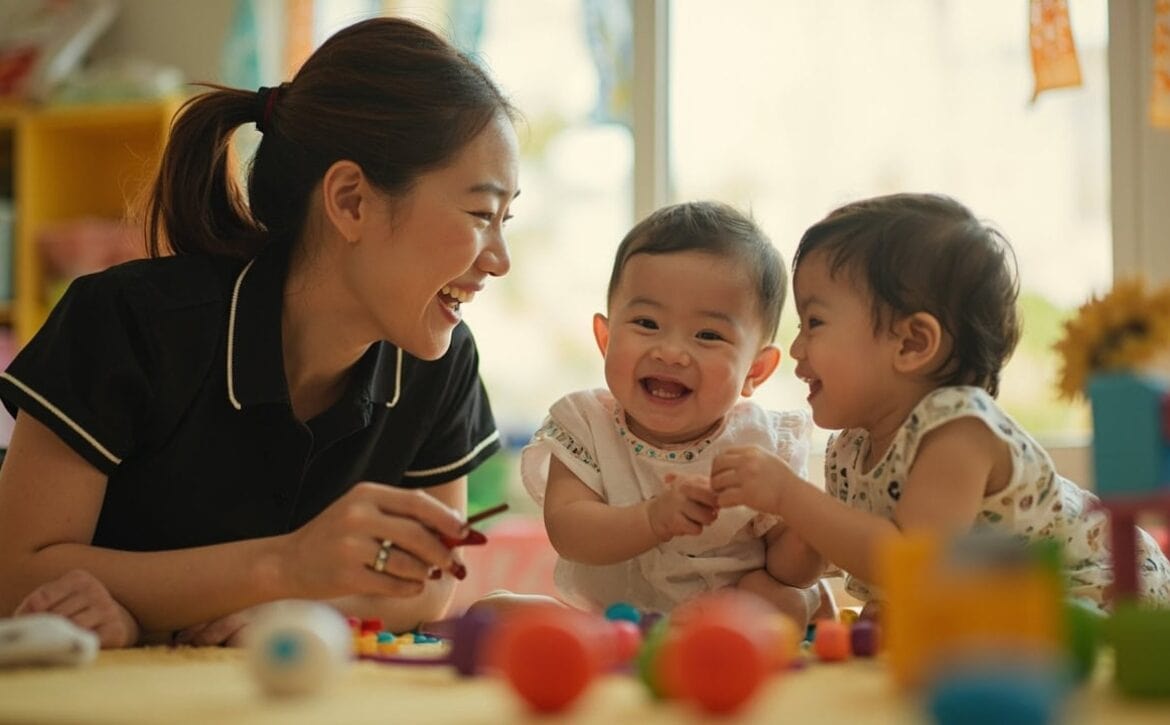
Watch what happens in quality care at lunchtime. A caregiver does not simply set a plate down and move on. They sit with the children. They narrate what is on the menu. They model eating — genuinely enjoying it — so that a hesitant child has something to mirror. When a child pushes a new food away, a quality caregiver does not force. They wait. They try again tomorrow. They make eating a social act, not a task. In Singapore, where mealtimes are already deeply woven into family culture, this approach resonates — because it echoes the care you give at home, extended into the hours you are apart.

Rest: A Non-Negotiable, Not an Afterthought

They need rest — not just sleep scheduled because it is convenient for the programme, but rest woven through the day in ways that respect each child’s individual patterns. A child who is overtired is a child who cannot learn, cannot connect, cannot regulate. A child who is rested is a child who is available for the world.

In practice, this means a dimly lit room, white noise, a consistent routine that signals safety to a developing brain. It means a caregiver who does not rush a child awake because the schedule says nap time is over. It means understanding that some children in Singapore’s equatorial climate need more rest during the heat of midday, and adjusting accordingly. Rest, in quality care, is not downtime between activities. It is a pillar of the day, as important as any learning experience.

Movement: The Work of Childhood

They need movement. Not entertainment, not structured activities imposed upon them, but the kind of movement that a young body craves — crawling, climbing, rolling, exploring. Movement that builds the proprioceptive sense, that develops coordination, that allows a child to feel at home in their own physical self.

Outdoor time in Singapore’s childcare settings is not a bonus. It is a necessity. In quality care, a child is not kept at a table doing worksheets. They are moving. They are climbing, digging in sand, feeling grass under their feet, running in spaces where their bodies can practice what bodies practice. A caregiver in quality care is nearby — attentive, not intrusive — watching a child’s face for cues of overwhelm or delight, ready to scaffold, ready to redirect, but mostly just present and warm and allowing the child to move.

Language: The Invisible Architecture

They need language all day long. Not the language of worksheets or flashcards, but the language of a caregiver who narrates the world, who labels what the child is touching, who responds to a babble as though it were a meaningful contribution to a conversation.

Imagine a caregiver kneeling down as a toddler picks up a yellow wooden block. The caregiver says, quietly: “You’re holding the yellow block. It feels smooth, doesn’t it? Shall we see if the red one feels the same?”

This is not scripted. This is not curriculum. This is the natural, continuous act of a caregiver who understands that language is oxygen for a developing brain, and that every moment is an opportunity to provide it.


What Quality Caregivers Actually Do When You’re Not There

Here is what most parents do not see: the work that happens in a quality childcare environment before, during, and after the hours you are present.

When you drop your child off in the morning, the work has already begun. A quality caregiver has been preparing the environment — not just physically, by arranging the space and laying out materials, but relationally. They have been preparing themselves. They have been thinking about the children in their care as individuals with specific needs, preferences, and developmental trajectories. And when you hand your child over, that caregiver is not just receiving a small person into a room. They are receiving a relationship.

In the ECDA Childminding Pilot, the ratios are intentionally small — up to one to three infants in certain configurations. This is not an accident. This ratio means that a caregiver can actually observe. Can actually notice when a child’s brow furrows before a meltdown, when a child’s hand reaches out not for a toy but for another child, when a child’s body language shifts in ways that indicate hunger or fatigue or the early signs of illness.

These are the moments that matter. These are the moments that a caregiver who is rushed, who is managing too many children, who is distracted by administrative demands — that caregiver will simply miss.

A quality caregiver in the hours you do not see is doing something remarkable. They are holding the emotional temperature of the room. They are reading the social dynamics between children who cannot yet articulate what they feel. They are noticing when one child needs a quiet corner and gently guiding them there without making it a punishment, without making it a thing. They are narrating what is happening for children who are not yet verbal: “I see that you want the red truck. Ethan is using it right now. You can wait, or you can choose the blue one.” They are doing this not once, but dozens of times a day, across every small interaction, every transition, every moment of potential friction.

And here is something that parents rarely get to witness: they are doing it with warmth. Not the performed warmth that you see on a tour, when caregivers smile at you and make eye contact and say all the right things. But the genuine, consistent warmth that comes from professionals who have been trained not just in child development but in self-regulation, who understand that their own nervous system is a model for the children in their care, who know that a calm voice and a patient presence is itself a therapeutic intervention for a toddler who has just dropped their favourite cup and is sobbing as though the world has ended.

When EduNanny talks about the quality of care, this is what they mean. They mean the hours when you are not there. They mean the care that does not need to be marketed because it simply is. They mean the caregiver who notices a child’s hair is damp before the child herself seems to know she is overheating from active play, and who moves that child gently toward water and shade. They mean the caregiver who hears a subtle change in a baby’s cry — not because they have superhuman hearing, but because they have spent weeks learning that this particular baby’s cry at this particular time of day means something specific, and they respond accordingly.

Observation vs. Reporting: The Difference That Changes Everything

There is a difference between observation and reporting, and it matters enormously.

When a caregiver tells you at pickup, “He had a great day,” that is a report. It may be true. But it is not observation. Observation looks like this:

“He was really engaged during music time today — I noticed he was clapping along to the beat, which he hasn’t done consistently before. He ate well at lunch, especially the pasta. And he did seem to get a little frustrated during free play when another child took the car he was using, but I saw him try a different one and settle. He seems like he’s starting to understand that there are other options when things don’t go his way.”

That is observation. That is the kind of detail that tells you what the day actually looked like from your child’s perspective. It names a moment of challenge as well as a moment of growth. It connects a small incident to a larger developmental narrative. It treats your child as a person who is doing things, learning things, progressing through the world in real ways.

When you hear observation like that — when you find a childcare setting where the caregivers are trained to observe and communicate in this way — you will feel the difference. You will feel less like you are receiving a performance and more like you are receiving a window. And windows, it turns out, are what most Singapore parents are hungry for. They do not need to be told their child is fine. They need to see, themselves, that their child is fine. They need to be equipped with the knowledge to understand what they are seeing.

This is why EduNanny has built communication as a core pillar of their approach. Not as an add-on or a selling point, but as a fundamental expression of how they understand quality care. Regular updates, open channels for questions, and in certain deployments, technological measures like CCTV that give parents an additional window into the day — not because technology replaces trust, but because trust and transparency work together. The more you see, the more you understand. And the more you understand, the more your trust becomes informed rather than blind.


The Social World Between Peers: Where Personality Takes Shape

Let me say something now about the social world that forms between children in quality care, because this is something that parents can learn to see, and it matters more than most parents realise.

When your child is in a setting with other children — even just one or two others, in a home-based arrangement — something begins to happen that cannot happen at home with only adults. Your child begins to learn about others. Not as objects, not as convenient playmates, but as people with their own needs, their own preferences, their own emotions.

A toddler in quality peer care learns, in small daily doses, that another child might want the same toy, that another child might feel sad, that another child might be delighted by the same thing that delights them. This is social development at its most foundational. And it is happening in hours you are not there to see.

Here is what you can look for at pickup: signs that this social world is a safe one. Does your child glance at other children with interest or wariness? Does your child emerge from the day showing any signs of having been overwhelmed by peer interaction, or do they emerge with a kind of social ease, a willingness to be near others?

In quality care, peer interaction is carefully managed. It is not a free-for-all. A caregiver is always nearby, not to intervene constantly, but to scaffold. To help a child who is frustrated. To celebrate a moment of sharing. To redirect before a conflict escalates. The social world in quality care is a classroom, but it does not feel like one. It feels like life.

You may notice, at pickup, that your child has a particular way of relating to a peer in the room. They might have a friend, or a comfort figure, or a child they are learning to negotiate with. This is enormously important. This is the earliest formation of social competence. When you learn to recognise it, you can ask about it. You can ask: “Who did Samuel play with today?” And the answer will mean something to you in a way that it did not before.


Learning to Read Your Child at Pickup: A Practical Framework

Now I want to bring this all together around something that I believe is the most practical gift you can give yourself as a Singapore parent navigating childcare decisions: learning to read your child at pickup.

Here is what I want you to carry with you. Your child is communicating to you, every single day, in ways that are quiet but significant. And most parents, in the absence of a framework for understanding what they are seeing, default to one of two responses. They either assume everything is fine — because their child is not crying, because they seem okay, because the caregiver said nothing was wrong. Or they assume the worst — because something feels off, because the child was clingier than usual, because the child asked about a caregiver in a way that felt uncomfortable.

Both responses are forms of guessing. And guessing, I have come to believe, is the great thief of confidence in modern parenting. You deserve better than guessing.

So let me offer you a different approach. At pickup, when you hold your child, take sixty seconds. Just sixty. And look at them as though you are learning to read a new language. Here is what you are looking for.

1. Look at Their Face

Not for a big smile, necessarily. Smile is nice, but it is not the whole story. Look at the quality of their expression. Is it open? Is there a softness around the eyes? Does their face show the kind of relaxation that suggests they have been in an environment where they did not need to be on guard?

A child who has been in chronic stress — not occasional frustration, which is normal, but chronic, unmitigated stress — will often have a facial quality that is subtly different. Their brow may be slightly furrowed even when they are not upset. Their face may have a kind of flatness that is not the same as contentment. You are learning to read calm.

2. Look at Their Body

Is their body loose or stiff? Does your child melt into you when you hold them, or does their body seem braced, held? A child’s body tells the truth. A child who has been held gently and spoken to warmly all day will often have a different quality of physical contact at pickup than a child who has been managed by a series of transitions with insufficient warmth. You are not looking for perfection. You are looking for the general direction of ease.

3. Look at Their Energy

Not just whether they are tired — children in quality care do get tired, because they are engaged and active and learning — but the quality of the tiredness. Is it the kind of tired that comes from a satisfying day, a day full of doing and being? Or is it the kind of tired that comes from a day of managing, of being in an environment that did not quite fit?

4. Look at Their Behaviour in the Hours After Pickup

This is, in some ways, the most informative window of all. A child who has had a good day in quality care will often show a kind of regulated ease in the evening. They may be tired, but they are available. They play. They engage. They are not more irritable than usual, they are not clinging desperately, they are not having the kind of meltdowns that suggest they have been holding themselves together all day.

Of course, all children have hard evenings sometimes — a growth spurt, a missed nap, a virus coming on. But the pattern, over time, is something you can learn to read. If your child consistently comes home dysregulated, distressed, or disconnected, that is data worth taking seriously.

5. Ask Questions That Invite Observation, Not Reassurance

Do not ask, “Did you have a good day?” You will almost always get a yes or no that does not tell you much. Instead, ask:

  • “What was your favourite part of the day?”
  • “Who did you play with at snack time?”
  • “What did Ms. Sarah read this afternoon?”
  • “What did you do outside today?”

These questions do two things. They signal to your child that the day matters to you, that you want to know. And they give you, over time, a mosaic of small details that will help you understand whether the picture they are painting matches what you are observing at home.

Learning to read these five signals — face, body, energy, evening behaviour, and the details your child shares — will give you something invaluable. It will give you a language for understanding your child’s experience of childcare. And that, more than any tour or testimonial or marketing material, is what will help you trust what you are seeing.


What Quality Childminding Looks Like in Singapore

Let me be specific about what this looks like in the context of the ECDA Childminding Pilot and EduNanny’s approach, because specifics matter when you are making a decision that affects your child’s daily life.

Small Ratios, Big Impact

EduNanny’s home-based childminding model operates with intentionally small caregiver-to-child ratios. In practice, this means that a caregiver can genuinely know each child — their rhythms, their preferences, their current developmental leaps, their social styles. This is not a luxury. It is a prerequisite for the kind of observation and responsiveness described above. When a caregiver knows your child as an individual, they can tune in to the subtle shifts that indicate a good day or a hard one.

Rhythm and Routine

A quality childcare day in Singapore should feel predictable to a child without feeling rigid. There is a rhythm — greeting, movement, snack, rest, play, outdoor time, lunch, more rest if needed — but within that rhythm, there is flexibility. A child’s needs on a given day might call for more outdoor time or an earlier nap. In quality care, the rhythm serves the child, not the other way around.

Prepared Environment

Quality care means a space that has been thought about. Materials that are appropriate for the ages present. Safety that is assured without being oppressive. Areas for active play and areas for quiet retreat. In a home-based setting, this means a caregiver has considered the space through the eyes of a toddler — what they can reach, what they might put in their mouth, where they might feel unsafe.

Transparent Communication Structures

Within the EduNanny model, there are intentional structures for parent communication. Regular updates that go beyond “they had a great day.” Updates that describe what happened, what was noticed, what was learned. Parents can ask questions. They can raise concerns. They can share what they are seeing at home so that the caregiver can connect the dots. This two-way flow of information is not administrative overhead — it is a hallmark of quality.

Pathways That Fit Real Lives

The pilot offers different arrangements — home-based care and community or centre-based options — so that families across Singapore can access the kind of arrangement that fits their lives. Whether you need full-day care, half-day care, or something in between, there is a configuration that can work. Many families are also able to use CDA funds and Baby Bonus contributions, which removes one layer of financial stress from an already complex decision.


Addressing the Concerns Singapore Parents Carry

Let me speak directly to something I know many parents reading this are feeling. There is a particular kind of vulnerability in leaving your child with someone else. It does not matter how much you trust the setting. It does not matter how well you have vetted the caregiver. There is a residue of uncertainty that clings to those drop-off moments, that makes you pause in the car before you drive away, that sometimes surfaces as a tightness in your chest at pickup before you even see your child’s face.

I want you to know that this is not weakness. This is not a sign that you are doing something wrong by using childcare. This is the normal, appropriate response of a parent who loves their child deeply and wants to make sure that love is being matched by the world when you are not there.

But I also want to tell you something. The uncertainty you feel is not actually about the childcare. It is about the gap — the gap between what you know and what you wish you knew. And that gap is not inevitable. It can be bridged. Not by eliminating all uncertainty, because uncertainty is part of parenting — but by filling it with understanding.

When you learn what quality looks like in ordinary moments, when you learn to read your child at pickup, when you find a programme that is genuinely committed to transparency and communication, something shifts. The anxiety softens into something more like vigilance — and vigilance, unlike anxiety, is useful. Vigilance is the parent who notices, who asks, who stays curious. Vigilance is the parent who is present even in the hours when they are not physically present.

And here is another concern worth naming: the fear that using childcare means you are failing your child, or outsourcing something that only you can provide. This fear is understandable, and it is common, but it is also based on a misconception. What you are doing, when you find quality care, is not replacing what you do at home. You are adding to your child’s world. You are giving them a second set of warm eyes, a carefully prepared environment, a community of peers, and a caregiver who has been trained to notice what you notice — your child’s wonder, your child’s frustration, your child’s enormous capacity to grow.

Making the Decision: What to Look For and What to Ask

If you are a parent in Singapore beginning to research infant care or childminding, here is a practical list of things to look for and questions to ask during your search:

  • Observe the environment during a visit. Does it feel calm? Is it clean but not sterile? Are the materials appropriate and accessible? Does the space feel like a place where a child could thrive?
  • Ask about ratios. How many children per caregiver? Small ratios are not a luxury — they are a precondition for the kind of individualised attention that makes quality care possible.
  • Ask how the daily rhythm is structured. Is there a consistent routine that includes food, rest, movement, and language-rich interaction? Or does the day feel unstructured or overly regimented?
  • Ask to see an example of a daily update. What does communication look like between caregivers and parents? Does it feel observational and specific, or general and reassuring?
  • Ask about caregiver training. Are they trained in child development, not just in safety protocols? Do they receive ongoing professional development? Are they trained in self-regulation?
  • Notice how caregivers interact with children during your visit. Is the warmth genuine and consistent, or performed? Do the children seem at ease? Do the caregivers kneel to children’s level? Do they narrate what is happening?
  • Ask about the social environment. How are peer interactions managed? What happens when children conflict over toys or space?
  • Ask about CDA and Baby Bonus usage. Can you apply your child’s funds to this programme? What is the fee structure?
  • Trust your gut. After a visit, sit with how you feel. If something feels off, take it seriously. If something feels warm and right, take that seriously too.

Moving Forward with Confidence

Here is the part I want you to remember, long after today.

Your child will not remember most of these days. They will not grow up with explicit memories of the songs, the routines, the taste of the snack they loved, the feeling of being held when they were tired. But their body will remember. Their nervous system will remember.

The way they approach other people, the way they regulate their emotions, the way they trust that the world is basically a safe place where warm adults exist and peers can be navigated — all of it is being written in the hours you cannot see. Every moment in quality care — every calm voice in a moment of frustration, every patient hand on a trembling back, every small act of “I see you, I hear you, you are okay” — is building something. It is building the architecture of a human being. And that architecture matters enormously.

This is why the ordinary hours are the most important hours. Not because they are dramatic, but because they are consistent. Because they are warm. Because they are happening day after day after day, and children are built in the repetition of small, good moments.

So when you stand at the gate, and you hold your child, and you do not fully know what happened today — know this. Something happened. Something formative happened. And the reason you are wondering, the reason you are paying attention, the reason you care so much about getting this right — that is exactly the kind of parent your child needs.

Curious. Present. Willing to learn the language of reading your own child. Willing to trust that when you see the signs of a good day — the open face, the relaxed body, the regulated evening, the small stories that spill out in the car — you can believe what you are seeing.

The hours between drop-off and pickup are not a mystery. They are a language. And now, you are learning to read it.

If you are ready to explore childcare arrangements in Singapore that are built on small ratios, genuine communication, and quality care your child deserves, EduNanny by BUTLER, operating through the ECDA Childminding Pilot, may be the right fit for your family. Visit their website to learn more about the pathways available, the fee structures, and how to apply CDA funds. Or reach out directly to speak with a member of their team.

You are not failing your child by using childcare. You are giving them the world. And the world, when it is warm and attentive and full of good ordinary hours — that is exactly what a child needs.



edunanny-06147aeffac4cabcf54ed4de469a8e03
March 26, 2026

What Quality Childcare Really Costs Singapore Families

The Real Cost of Childcare in Singapore: A Parent’s Guide to Affordability Without Compromising Quality

Choosing childcare is not simply a logistical decision. It is one of the most consequential choices a family makes in those early, irreplaceable years. And for Singapore parents, that decision comes wrapped in something that weighs as heavily as the care itself: the question of what you can afford.

That question—can I afford this?—carries a particular heaviness here. We live in a city where the cost of raising a child is visible on every spreadsheet and receipt. Government support exists. Subsidies and schemes are designed to ease the burden. But even with all of that in place, the arithmetic can feel bewildering. The numbers are complex. The variables are many. And the stakes, as any parent knows, feel impossibly high.

This guide exists to lift some of that fog. Not to add to your anxiety, but to help you understand what you are really choosing between—so that whatever decision you make, you make it with clarity and confidence.

What This Guide Covers

  • Subsidies are available and substantial—but many parents do not fully understand what they qualify for or how to apply
  • Price alone tells you very little—a lower monthly fee may reflect larger group sizes, less training, or environments not designed for infants
  • Quality care is an investment, not a luxury—the difference in price often reflects investment in training, caregiver ratios, and the attention your child receives
  • Value differs from cost—an expensive programme may offer exceptional value; a cheap one may cost more in stress, compromises, and developmental gaps
  • The right choice aligns with your family’s needs—centre-based and home-based models serve different families; understanding what matters most narrows the field

Singapore’s Childcare Subsidy Landscape: What You Actually Have Access To

Singapore’s government has built one of the most comprehensive childcare subsidy structures in the region. Yet many parents approach it uncertain of what they qualify for or how the pieces fit together. Understanding these resources is the first practical step toward making a financially sustainable decision.

Key Subsidies and Schemes Available

The Child Development Account (CDA) is a dedicated savings account that grows with government contributions. It can be used for childcare fees, medical expenses, and approved educational items at participating institutions. For families who qualify, this represents meaningful, directly applicable support.

Basic and Additional Childcare Subsidies provide monthly support directly to eligible families. The Additional Childcare Subsidy is means-tested and designed for lower to middle-income households, substantially reducing out-of-pocket costs for those who qualify. The Basic Subsidy provides a baseline level of support to a broader range of families.

The Baby Bonus Cash Gift offers a one-time birth grant plus ongoing payouts tied to eligible childcare spending. When combined with CDA usage, this creates a coordinated support structure that can meaningfully offset early years costs.

The Critical Point About Subsidies

These are real, tangible resources that can substantially reduce what you pay out of pocket. But they only work if you know your eligibility, understand the application process, and factor these supports into your planning from the start—as foundational input to your budget, not as an afterthought.

Knowing what you qualify for before you start comparing prices changes the entire comparison. A programme that appears expensive on paper may fall well within your actual budget once subsidies are applied correctly.

Understanding What Price Actually Buys

Here is what often gets lost in the subsidy conversation: understanding what you are comparing when you compare prices.

A childcare arrangement at $200 per month is not simply cheaper than one at $600 per month. These numbers reflect different things. And confusing what you can afford with what you are actually buying leads to decisions that cost more in the long run.

Group sizes determine how many children each caregiver is responsible for. Smaller groups mean more individual attention, quicker responses to needs, and more personalised interaction. Larger groups mean each child receives less focused care.

Training and qualifications reflect the depth of infant care knowledge your child’s first caregivers possess. Well-trained caregivers understand developmental milestones, know how to recognise signs of distress or delay, and create environments that support early learning. This expertise has a cost—and that cost is reflected in fees.

The physical environment matters enormously for infants. Is the space designed for infants, with appropriate safety measures, stimulation opportunities, and care protocols? Or is it a space where childcare happens almost as a side effect of other priorities?

Questions to Ask When Comparing Prices

  • What is the infant-to-caregiver ratio?
  • What qualifications do the caregivers hold, and what ongoing training do they receive?
  • Is the space designed specifically for infants and toddlers?
  • Are there transparency measures—regular updates, open communication, visible safety protocols?
  • What does the daily structure look like, and how does it support development?

When you see a lower price, the honest question is not just whether you can afford it. It is what that price is actually buying.


Cost vs. Value: Why Price Alone Is a False Measure

There is a narrative that quality childcare is a luxury—that choosing well means paying more than most families can reasonably sustain. This narrative deserves to be challenged directly.

It is true that quality costs more than inadequate care. But the solution is not to choose inadequate care. The solution is to understand what value you are receiving for what you are paying.

Understanding Value in Childcare

Value is not the same as cost. This distinction is crucial for making a decision you will feel confident about.

A programme that appears expensive may deliver exceptional value if it reduces parental stress, supports your child’s development meaningfully, and gives you the confidence to return to work or pursue your own goals. The return on that investment extends well beyond the childcare bill itself.

A programme that appears cheap may deliver very little value if it leaves you worried throughout the workday, your child unsupported, and your family constantly navigating problems that better care would have prevented. The savings on the monthly fee can quickly be offset by the hidden costs of stress, guilt, and developmental concerns.

You are not buying hours of supervision. You are buying outcomes—for your child and for your family. The question is not how little you can spend. It is what you want your investment to return.

How Quality Care Returns Value to Your Whole Family

Quality infant care provides consistent, responsive interaction that supports healthy attachment and early brain development. When caregivers are well-trained and ratios allow for individual attention, children receive the kind of engagement that builds the foundation for learning and social development.

Children who receive attentive, knowledgeable care in those first years arrive at preschool and primary school ready to learn and grow. Parental confidence is a significant but often overlooked outcome of quality childcare. When you trust that your child is in capable, caring hands, the background hum of anxiety that many parents carry simply diminishes. This is not a luxury—it is a sustainable way to parent.

For families where both parents work—or where a single parent is the sole earner—reliable, quality childcare makes work sustainable. It enables career progression, financial stability, and the mental space to be present with your child when you are together.

Centre-Based vs. Home-Based: Different Models, Different Strengths

The Singapore childcare landscape offers genuine variety, and understanding this variety helps you identify where your priorities lie.

Centre-based programmes typically offer larger groups and structured curricula. They provide consistency and may feel more institutional in the positive sense—established systems, formal training requirements, and structured daily routines.

Home-based arrangements offer smaller, more intimate settings with ratios that allow for individual attention. The environment is domestic rather than institutional, which some children transition to more easily, and which allows for care that responds more fluidly to individual needs.

Both have a place. Both serve different family needs. The question is which model aligns with what you are trying to achieve—and within that model, what quality markers distinguish the exceptional from the merely adequate.


EduNanny’s Approach: Building Care Around Partnership

At EduNanny, we have built our approach around a straightforward belief: that every family deserves access to care that is both trustworthy and financially sustainable.

The ECDA Childminding Pilot

We participate in the Early Childhood Development Agency (ECDA) Childminding Pilot—a government-recognised pathway that provides a structured, quality-assured alternative for families seeking infant care. This is not a lesser option. It is a legitimate, formally recognised model that meets rigorous standards for infant and toddler care.

What Our Model Offers

Home-based care with intentional ratios. Our model allows for the kinds of ratios that matter—up to one caregiver for every three infants at most. We believe that individual attention is not a luxury. It is a baseline of care that young children deserve.

Transparent fee structures. Our fees are designed to be accessible within the pilot framework, and we actively support families in understanding how subsidies apply, how the Child Development Account and Baby Bonus schemes can be utilised, and how to plan a childcare budget that does not require sacrificing quality for affordability.

Schedule designed for working families. Monday to Friday care blocks are structured to align with the realities of working families, not as an afterthought to accommodate parents, but as a genuine design principle.

Open communication. Transparency is operational, not optional. Regular updates, open lines of communication, and consistent information flow mean you always know what is happening with your child.

Where deployed, safety assurance. Safety measures including CCTV provide additional assurance that parents can see exactly how their child is cared for throughout the day. This is not about surveillance—it is about trust.

These are not marketing promises. They are operational commitments that reflect what we believe responsible childcare should look like.


Addressing the Concerns That Keep Parents Up at Night

Parents in Singapore carry real anxieties about childcare. These concerns are legitimate, and they deserve honest answers rather than reassurance platitudes.

“What if I can’t afford quality care?”

This is the most common concern, and it deserves a clear answer. Quality care is an investment, and for many families, government subsidies substantially bridge the gap between what quality costs and what families can sustainably pay. Understanding your eligible subsidies before you begin comparing programmes is essential. A programme that seems financially out of reach on sticker price may be entirely achievable once your subsidies are correctly calculated.

If you are uncertain about your eligibility or the application process, seeking guidance from ECDA or speaking directly with childcare providers who can walk you through the calculations is worthwhile. The difference between paying full price and paying subsidy-adjusted price can be substantial.

“How do I know if I’m being charged fairly?”

Fair pricing is connected to what you receive. A caregiver-to-infant ratio of 1:3 is meaningfully different from 1:6 or 1:8. A caregiver with infant care qualifications and ongoing training offers something different from someone without that background. A space designed for infants is different from a space adapted from other uses.

Ask providers to explain their ratio, training, and environment. Ask what the fee covers and what might cost extra. A trustworthy provider will explain their pricing clearly. A provider who resists transparency about these details is worth noting.

“What if my child isn’t getting the right kind of attention?”

This concern is particularly acute for infants, who cannot articulate their experiences. The answer lies in the programme’s communication practices and your access to information.

Regular updates—daily or weekly reports on feeding, sleeping, activities, and development—allow you to track your child’s experience even when you are not present. Open channels for questions and conversations with caregivers build trust over time. Where possible, visits and observations give you first-hand insight into the environment.

If a programme does not offer transparent communication practices, this is a significant gap worth noting in your evaluation.

“Is home-based care as legitimate as centre-based care?”

Yes. Home-based childminding is a recognised, legitimate model for infant and toddler care. The ECDA Childminding Pilot establishes quality standards that home-based providers must meet. Home-based care is not a lesser option for families who cannot access something better. It is a different model with distinct strengths—smaller ratios, more intimate settings, individualised attention—that serves many families extremely well.

The question is not whether home-based or centre-based is inherently better. It is which model better fits your family’s needs, preferences, and circumstances.


Practical Steps for Choosing Childcare in Singapore

Here is a practical framework for making your decision—grounded in what actually matters, not in what is easiest to compare on a spreadsheet.

Step 1: Calculate Your Actual Budget

Before looking at any programme, determine what you actually qualify for in subsidies. Visit the ECDA website, use their subsidy calculators, or speak directly with providers who can help you understand your eligible support. This gives you a realistic budget range to work within.

Step 2: Identify Your Non-Negotiables

What matters most to your family? Is it small ratios? Specific qualifications? A particular educational philosophy? A location close to home or work? A schedule that matches unusual working hours? Identifying your priorities before you begin comparing helps you filter quickly rather than being overwhelmed by options.

Step 3: Ask the Questions That Matter

When evaluating any programme, ask directly about caregiver-to-infant ratios, caregiver qualifications and ongoing training, environment design and safety measures, daily structure and activities, communication practices, and how subsidies are applied. Write down the answers and compare them across programmes. The differences you find will be illuminating.

Step 4: Visit, Observe, and Trust Your Instincts

Where possible, visit programmes in person. Observe the environment, the interactions between caregivers and children, and the general atmosphere. Ask follow-up questions based on what you saw. If something feels off, ask more questions. If something feels right, verify that impression with specifics.

Step 5: Think Beyond the Monthly Fee

Consider the total value, not just the monthly cost. If a programme costs more but eliminates the need for emergency childcare, reduces your parental stress, and better supports your child’s development, the value may well justify the investment. Conversely, if a cheaper programme creates ongoing problems that require your time, attention, and peace of mind, the real cost is higher than it appears.


Your Child’s First Thousand Days Are Not a Rehearsal

The first thousand days of a child’s life are not a rehearsal. They are the foundation. And every parent in Singapore deserves to build that foundation without the fog of financial confusion obscuring their path.

Childminding is not a stopgap. It is not a lesser option for families who cannot access something better. It is a legitimate, dignified, and essential form of early care—rooted in warmth, informed by knowledge, and delivered with the kind of dedication that transforms not just children but entire households.

EduNanny exists for parents who want clarity, not confusion. Parents who want to understand what they are paying for and why it matters. Parents who want to make decisions with confidence, knowing that they have chosen well—not cheaply, but wisely.

If you are researching childcare in Singapore and want to understand what quality care actually looks like—and what it actually costs—EduNanny is here to help. We welcome conversations with families who want clarity before they commit, whether or not EduNanny ultimately becomes the right fit for your family.

Learn more about EduNanny’s approach to home-based childminding, or explore our participation in the ECDA Childminding Pilot. To discuss your family’s needs directly, we welcome your enquiry.

Whatever path you choose, we hope this guide has helped you move forward with greater confidence—and a clearer sense of what quality care is truly worth.

edunanny-061477bae60310192f47b5d126774e8d
March 26, 2026

The First Choice Is Only the Beginning: Childcare That Grows With Your Child

Introduction

Choosing childcare is rarely presented as an ongoing process. The language of selection—checklists, ratios, orientation tours, enrollment forms—implies completion. You evaluate, you decide, you commit. The narrative ends there.

But for parents who are paying attention, the narrative does not end. It continues in quieter moments: in the texture of your child’s engagement at pickup, in the questions that surface when something feels slightly off, in the dawning recognition that the child you enrolled is not the child you are collecting today.

This article is for parents who want to navigate that ongoing reality with clarity rather than anxiety. It covers:

  • Why the childcare guidance available to Singapore parents stops precisely where the harder conversation should begin
  • The key developmental moments when your childcare arrangement may need recalibration
  • How to distinguish between normal adjustment turbulence and genuine misalignment
  • What quality infant care genuinely looks like in the Singapore context
  • How to know when to stay the course and when to advocate for change

The Gap No One Tells You About

We have become skilled at helping families choose. The language of selection, of evaluation criteria, of checklists and comparison, has become deeply familiar to anyone navigating the childcare landscape in Singapore. Parents arrive at tours with well-prepared questions. They observe interactions, review ratios, examine environments. They make considered decisions based on the best information available at the time.

And then the real work begins.

Choosing childcare is not a single decision. It is the first of many—the opening movement of a relationship that will evolve in ways that no orientation checklist can anticipate. And yet almost nothing in the guidance available to Singapore parents addresses what happens next. The conversation ends precisely where the harder, more nuanced conversation should begin.

The silence around ongoing discernment is not accidental. It is easier, in some ways, to treat childcare as a transaction that concludes at enrollment. The alternative requires admitting that good choices can outgrow themselves, that attentive parents will sometimes sense misalignment without being able to name it, and that the confident thing to do is not to stop questioning but to learn how to question well.


The Recalibration Moments: When Development Asks New Questions

To understand why ongoing discernment matters so deeply, we need to consider what actually changes in the life of a young child—and how those changes can make an arrangement that was working suddenly feel uncertain.

The Shift from Infant to Toddler

In the earliest months, the question of fit revolves primarily around responsiveness, warmth, and the basic rhythms of care. Does your baby settle? Is there consistent comfort? Is the environment calm enough for the kind of development that happens quietly, beneath the surface of every feeding and every nap? At this stage, the indicators of a healthy fit are relatively straightforward.

Then the child grows. The infant who needed only to be held becomes a mobile, curious, socially hungry toddler whose needs no longer fit neatly into the same container.

Around the age of one, many families begin to notice shifts that are entirely normal in developmental terms but that can make an existing childcare arrangement feel suddenly uncertain. The child who previously seemed content begins to protest drop-offs more intensely, or seems clingier at pickup, or comes home with a new restlessness that is difficult to interpret.

But more often than not, what they are witnessing is not failure but growth—and the growth is asking new questions of the care arrangement.

The child who resists drop-off at eighteen months is not necessarily distressed in the way we fear. Separation protest at this age often has a different texture than it did at nine months. It is often a sign of secure attachment, of a child who has formed a meaningful bond with a caregiver and is now aware enough to register the temporary nature of the parting.

But it can also be a signal that the care environment has not kept pace with the child’s expanding need for autonomy, stimulation, or peer interaction. Learning to read the difference is a skill that develops over time with careful observation.

The Emergence of Social Needs

The second recalibration moment arrives with the emergence of social needs. Somewhere between two and three years of age, most children begin to crave peer interaction in ways that were simply not present before.

A home-based arrangement that was ideal for an infant may begin to feel isolated for a toddler who is ready to negotiate, collaborate, and learn from other children. Conversely, a large centre-based environment that felt appropriately bustling for a mobile infant may now feel overwhelming for a two-year-old who needs more focused individual attention during moments of transition.

Family Changes and Caregiver Transitions

When a new baby joins the family, the older child may experience a shift in how they understand their place in the world. Some children become clingier at drop-off, testing whether the care environment remains a reliable constant. Others may seem to need more consistency and routine that the right childcare arrangement can provide.

Changes in family routine, parental work patterns, or caregiver continuity also ask us to revisit our assumptions. When a parent changes jobs, relocates, or adjusts their schedule, the calculus of childcare shifts. A care arrangement that worked beautifully when both parents were home by five-thirty may become strained if one parent begins traveling or if a new role demands more unpredictable hours.

Similarly, when a regular caregiver within a childcare arrangement leaves and is replaced, the family is in effect being asked to evaluate a new arrangement under the same name. These transitions deserve the same thoughtful attention that was given to the original choice.


The Practice of Watching: Reading Your Child Over Time

What we are describing is not a failure of the system. It is the natural, expected consequence of caring for children who are constantly, marvelously, sometimes bewilderingly changing. The mistake is not in noticing these moments of uncertainty. The mistake is in having no language for them, no framework for moving from vague unease to informed observation.

This is where the practice of reflective childcare parenting becomes essential. We use the word practice deliberately, because that is what it is. It is not a destination you arrive at, not a confidence that once achieved never wavers. It is a skill that develops through attention, through the willingness to observe without immediately acting, through the discipline of asking what you are actually seeing before asking what you should do about it.

What does your child look like when you collect them at the end of the day? Not just on the surface, not just whether they are crying or smiling, but in the texture of their engagement. Consider these questions over time:

  • Are they alert, curious, present?
  • Do they move through the world with a kind of ease that suggests their needs are being met beneath the surface of behavior?
  • Or do they seem flat, withdrawn, as if some essential energy has been used up navigating an environment that is not quite right for them?

These questions do not have simple yes-or-no answers, and that is precisely the point. The practice of watching is not about diagnosing problems but about developing fluency in reading your child over time. You will not be able to answer these questions reliably after one week, or even one month. But after six months, after a year, you will know their baseline. And when something shifts, you will feel it—because you have earned the knowledge of what normal looks like for your particular child.

Normal Adjustment Versus Genuine Misalignment

Even with the best communication and the most thoughtful observation, the question remains: how do you know when something needs to change? When is the uncertainty you are feeling a normal part of adjustment, and when is it pointing toward a genuine misalignment that warrants action?

Signs of normal adjustment:

  • Progress is uneven—good days and difficult days, periods of apparent regression followed by apparent leaps forward
  • The overall trajectory, seen over weeks rather than days, trends toward greater ease, greater engagement
  • Difficult periods resolve and do not return in the same form
  • The child maintains their core capacities and personality, even through temporary dips

Signs of genuine misalignment:

  • Issues persist—they do not resolve, or they resolve only temporarily before returning in a new form
  • The child may seem to be deteriorating rather than settling—not occasional difficult days but a gradual erosion of wellbeing
  • The child becomes consistently withdrawn, consistently dysregulated, or seems to lose capacities they previously had
  • The caregiver seems unable to connect with the child, or the environment consistently fails to meet a need you have clearly identified

The quality of the response you receive when you raise a concern tells you something important. If you are consistently met with deflection or dismissal, that is information. If you are met with genuine engagement, with a willingness to observe alongside you and adjust where adjustments are warranted, that is also information. The partnership has the capacity to grow alongside your child—or it does not.


What Quality Infant Care Looks Like in Singapore

In the Singapore context, quality infant care is often discussed in terms of ratios, certifications, and physical environments. While these elements matter, they do not capture what parents are ultimately seeking: the assurance that their child is genuinely known, consistently cared for, and developing in an environment that supports their emerging capacities.

Responsive Warmth

Caregivers who are genuinely attuned respond to your child’s cues rather than operating purely on schedule. They notice when your baby needs comfort, when your toddler needs redirection, when your child needs a moment of individual attention before joining a group activity. This responsiveness is visible in the small moments—a caregiver kneeling to a child’s eye level, a voice that shifts to match the emotional temperature of the room, hands that are available without being intrusive.

Consistent Primary Relationships

Young children build security through predictability. They need to know who will greet them in the morning, who will be there for naps and meals, who will carry them when they are tired. When care arrangements require multiple different caregivers throughout the day, the burden of adaptation falls on the child. Quality care minimizes this burden by protecting the consistency of key relationships.

Environment Matched to Development

A newborn needs a calm, predictable environment that supports the neurological development happening quietly beneath every interaction. An active toddler needs space to move, explore, and test emerging physical capacities. A two-year-old entering a social phase needs access to peers and opportunities for the collaborative play that builds language and emotional intelligence. Quality care adapts to these changing needs rather than offering a single environment regardless of developmental stage.

Transparent Communication

Parents deserve to know what they cannot see during the care day. Daily updates, whether written or photographic, provide windows into experiences that would otherwise remain invisible. This transparency is not about surveillance—it is about partnership. When you know what happened during the day, you can continue the conversation with your child at home, notice patterns over time, and bring informed questions to your caregiver.

Partnership Orientation

Quality care is not delivered at you—it is developed with you. The caregiver sees themselves as part of your child’s ecosystem, not as an isolated service provider. They share observations, welcome questions, and treat your insights about your own child as essential information rather than interference.


EduNanny Singapore: An Approach Built for Ongoing Partnership

At EduNanny, our model of childcare is built on the understanding that the relationship between family and caregiver is not a transaction that concludes at enrollment. It is an ongoing conversation—one that requires communication, transparency, and the kind of mutual respect that allows both sides to speak honestly about what is working and what might need attention.

The ECDA Childminding Pilot

We are part of the ECDA Childminding Pilot, and this matters not simply as a credential but as a statement of philosophy. The pilot represents a deliberate investment in an alternative pathway for Singapore families, one that offers home-based and community-based options alongside more traditional centre-based arrangements.

These options exist because Singapore families are not uniform in their needs. A newborn in the first months of life has different requirements than a toddler approaching their second birthday. A family with flexible work arrangements may thrive with a community-based model that offers structure and peer interaction. Another family may need the intimacy and continuity of home-based care where the ratio of caregivers to children allows for deeply individualized attention.

Attention Ratios That Protect Quality

At EduNanny, our infant care ratios are maintained at up to one to three, depending on the specific arrangement and the developmental stage of the children in our care. This is not an accident or a compromise. It is a design principle that reflects our belief that the quality of attention a young child receives in their earliest years has a compounding effect on their sense of security, their capacity for exploration, and their social and emotional development.

When care is scaled beyond what attentiveness can support, something essential is lost, and it is not always visible in the short term. We choose to protect that attention because we have seen what becomes possible when children feel genuinely known by their caregivers.

Communication as Structural Commitment

When we say that EduNanny offers transparent communication, we mean it as a structural commitment, not merely a promise. Where CCTV measures are deployed, they are deployed not to surveil but to create a shared record of your child’s day—one that allows you to see what we see and to trust what we are building together.

Daily updates, regular check-ins, and the kind of responsiveness that treats your questions as important rather than inconvenient are not extras we offer to distinguished families. They are standard, because we believe you deserve to know what we know about your child, and because we believe that knowledge is what allows the practice of reflective parenting to flourish.

Practical Support for Singapore Families

Our care operates across Monday to Friday blocks, and our fee structures within the pilot are designed to be accessible for Singapore families making thoughtful decisions about early childhood care. Where applicable, we support the use of the Child Development Account and Baby Bonus schemes, understanding that financial clarity reduces stress and allows parents to focus on what matters most: the wellbeing of their child.


Addressing Common Parent Concerns

“What if I’m just being anxious?”

Anxiety and attention can feel similar, especially in the early days of any new parenting challenge. But there is a useful distinction: anxiety tends to race toward solutions before the problem is understood, while attention waits long enough to let the picture clarify. The practice of reflective watching we have described is specifically designed to help you notice the difference.

If you find yourself repeatedly unsettled by something you cannot name, that is not weakness or excessive worry—it is your attention asking for more information. Seek it from your caregiver, from your own observation, from trusted sources. The information will either confirm that this is normal adjustment, or it will confirm that something deserves attention.

“How do I bring up a concern without seeming difficult?”

A good childcare partnership should welcome your questions. If raising a concern feels risky or unwelcome, that itself is information about the quality of the relationship.

For parents who genuinely want to strengthen communication, we suggest starting with observation rather than judgment. “I have noticed that Maya seems very tired when I pick her up—has she been sleeping well at naps?” invites dialogue. “Something seems wrong” creates defensiveness. Over time, the quality of the response you receive will tell you whether this partnership has the capacity to grow with your child.

“What if I change arrangements and it doesn’t help?”

Recalibration is not a guarantee—it is a response to genuine need. When you have observed carefully, trusted your attention, and engaged in honest dialogue with your current provider without resolution, a change is not a failure of your judgment. It is an act of advocacy for your child.

The most confident parents are not those who never doubt or never change course. They are those who have developed the reflective practice to know when to stay the course and when to advocate. Both require courage.

“How do I know if the cost is worth it?”

Cost is always a consideration for Singapore families navigating the real pressures of housing, education, and daily living. But value in childcare is not primarily about price—it is about fit, consistency, and the quality of attention your child receives.

A more expensive arrangement that genuinely meets your child’s developmental needs is worth more than a cheaper one that creates persistent stress. Conversely, a costly arrangement that is clearly misaligned is not a bargain at any price. The question to ask is not “what does childcare cost?” but “what does childcare make possible?”


An Invitation to Trust Your Attention

EduNanny was built on the belief that the families we serve deserve a partner, not just a provider. A provider delivers a service and measures success by whether the service is rendered acceptably. A partner takes ongoing responsibility for the relationship, for the communication, for the willingness to listen when something is not working and to respond with care rather than defensiveness.

We also know that parents in Singapore carry more than their share of pressure. The cost of living, the demands of competitive professional environments, the complexity of multigenerational family dynamics, and the sheer volume of information and opinion that accompanies every parenting decision can make the act of raising young children feel overwhelming. We do not minimize this.

But we do believe that parents can develop the clarity they need to navigate these pressures with greater confidence. Not the false confidence that comes from never doubting, but the grounded confidence that comes from having a practice, a framework, and a partner who supports the ongoing work of discernment.

The most confident parents we have encountered are not those who never doubt. They are those who have learned to trust their own attention, to hold their observations with curiosity rather than anxiety, and to act from a place of informed assessment rather than reactive fear. They know when to stay the course and when to advocate. They know when a difficult stretch is a sign of normal adjustment and when it is a signal that something needs to shift.

EduNanny Singapore is here for that journey. We are here for the early days of establishing routine and trust. We are here for the recalibration moments when development asks new questions of old arrangements. We are here for the honest conversations about what is working and what might need attention. And we are here for the families who understand that choosing childcare is not a single decision but the first of many ongoing acts of discernment, each one an opportunity to know your child more deeply and to provide them with the care they deserve.

The practice of watching is one you will develop over time. It is not always comfortable, and it does not always yield clear answers. But it is one of the most valuable skills you will ever develop as a parent, and it is a skill we are honored to support—not because we have all the answers, but because we believe that the best outcomes for children are achieved when families and caregivers approach the work of raising them as true partners, with humility, with honesty, and with the kind of sustained attention that transforms ordinary days into the foundation of extraordinary lives.


We are proud to be part of EduNanny by BUTLER, carrying forward a standard of care that understands true service is not about performing a function but about supporting a life. If you are considering your childcare options in Singapore or if you have questions about how ongoing discernment can strengthen your family’s experience, we invite you to begin a conversation with us.

edunanny-0614740ac5ddca02d90925b27e43dc53
March 26, 2026

The Sustained Partnership Every Singapore Child Deserves

The Moment After the Decision: A Guide to Sustaining Your Childcare Partnership in Singapore

There is a moment that every thoughtful parent in Singapore eventually reaches. It comes after the tours have been completed, the checklists have been weighed, and the decision has been made with confidence and care. You have chosen your child’s childcare arrangement. You have done the research. You have trusted your instincts.

And now, standing at the threshold of that first morning drop-off, you realize something that quietly changes everything: the decision itself was just the beginning.

This is the moment this article speaks to. Not the moment of choosing—that conversation has been had, by many voices, in many places, and you have already done that work. What we are here to explore is something far less discussed and far more demanding: how you, as a parent who chose quality, actually build, sustain, and deepen a genuine partnership with your childcare provider over months and years.

How you move from being a decision-maker to being an active, informed, and confident contributor to your child’s daily developmental experience. How you learn to read the signs that your child is thriving. How you communicate with caregivers in ways that deepen understanding. And how you navigate the beautiful complexity of trusting someone else with the most important work of your life while remaining deeply, meaningfully engaged.

This is the work that matters. And it deserves more guidance, more honesty, and more respect than Singapore parents have been given until now.

Quick Summary: What Sustained Childcare Partnership Looks Like

For busy parents, here is the essence of what this article covers:

  • Months 1–3: The settling period—establishing communication rituals and learning to read your child’s adaptation cues.
  • Months 4–6: The deepening—developing a shared language for your child’s development with your caregiver.
  • Year 1–2: Toddler transitions—navigating changing developmental priorities and recalibrating your role as a parent.
  • Year 2–3: The evolved partnership—stepping back versus stepping in, and building aligned environments for your child.
  • Year 3+: What sustained partnership builds—a child who moves through the world with grounded confidence.
  • Ongoing: Recognizing when something needs to shift and responding with care.

The partnership has a natural rhythm. Understanding it can transform how you show up—not as an anxious observer, but as a genuine co-creator of your child’s developmental experience.


The First Year: Building Communication Rituals and Deepening the Partnership

The first three months after enrollment are, by nature, a settling period. Your child is adapting to a new environment, new faces, new routines. Your caregiver is learning your child’s cues, preferences, and rhythms. And you, as a parent, are learning how to let go of the morning handoff and trust what happens in the hours that follow.

This is not passive waiting. This is active partnership building.

What to Look For in the Settling Period

The most important thing you can do in these early months is establish communication rituals that will sustain you through the years ahead. Not just the perfunctory updates about feeding and sleeping, but the kind of exchange that builds real understanding.

When your caregiver shares an observation about your child’s day, lean into it. Ask questions. Notice what your child is like at the end of a care day versus the beginning. Look for the small moments that reveal how your child is processing this new experience:

  • Is she settling more quickly in the mornings?
  • Is he reaching for his caregiver when you leave?
  • Does she seem tired or energized after a care day?
  • Are there activities or caregivers she gravitates toward?

These are not just updates. These are windows into your child’s inner world—windows that your caregiver can help you see.

Finding Your Communication Style

By the end of the first quarter, you should have a sense of the communication style that works for your partnership. Some families prefer daily notes and brief conversations at pickup. Others benefit from more structured weekly check-ins. There is no universal formula.

The skill is in finding what serves your family and your caregiver, and in building the kind of trust that allows both of you to speak honestly about what is working and what needs attention.

For Singapore parents navigating demanding work schedules, this communication might look different depending on your arrangement:

  • A shared journal or app for updates during the day
  • A brief but substantive conversation at pickup
  • A scheduled weekly call if daily contact is not possible
  • A more detailed monthly review of developmental progress

What matters is not the format, but the consistency and the quality of the exchange. You are building a relationship that will serve your child for years—not just days or months.

The Deepening: Months Four Through Six

By the fourth month, you and your caregiver have developed a shared language for your child’s development. You know what certain behaviors mean. You have begun to notice the same things.

When your caregiver says, “She was really focused on the stacking blocks today,” you understand what that means in the context of her overall development. You can respond with informed interest, not just polite acknowledgment. This is the foundation of genuine collaboration.

It is also around this time that you begin to see your child through a more complete lens. The caregiver’s observations start to fill in the picture of your child’s day, and you realize that you are learning things about your child that you could not possibly see during your own hours together:

  • The way she plays independently when you are not in the room
  • The friends she gravitates toward
  • The activities that absorb her completely
  • The social dynamics she navigates with other children

This knowledge does not diminish your role as a parent. It expands it. You become a more informed, more nuanced participant in your child’s growth.

The Developmental Flywheel: How Communication Creates Continuity

The communication loop that develops between thoughtful parents and skilled caregivers is one of the most underappreciated elements of quality childcare. When it works well, it creates a kind of developmental flywheel.

The caregiver observes. The parent listens and reflects. The parent shares insights from home. The caregiver incorporates these into the care environment. Your child moves between two worlds that are aligned, coherent, and focused entirely on her flourishing.

For working parents who spend significant hours away from their children, this is how you remain a real presence in your child’s daily experience. You are not simply handing over responsibility. You are extending your parenting through partnership.

Consider a practical example: Your child has been working on a milestone at home—perhaps stringing together her first words or mastering a new physical skill. When you share this with your caregiver, she can create opportunities to support and celebrate that development during care hours. Similarly, when your caregiver notices your child working on emerging language or social skills during the day, she can share observations that help you understand and nurture those developments at home.

This back-and-forth creates something powerful: developmental continuity. Your child’s days are not fragmented between home and childcare. They are part of a coherent whole, supported by adults who are aligned in their approach and attentive to her growth.


The Toddler Years: When Everything Changes

As the first year closes and the second begins, the partnership enters a new phase. Your child is no longer an infant. He is a toddler, and everything is different. The developmental priorities shift. The communication challenges change. Your role as a parent evolves in ways that require you to pay attention and adapt.

Understanding Toddler Development Through Your Caregiver’s Eyes

Toddlers are, by nature, challenging to read. They have strong feelings and limited capacity to express them. They are asserting autonomy while still needing security. They are learning to be human in the most complex and beautiful sense of the word.

And they are doing much of this important work during the hours they spend in childcare, outside of your direct observation.

This is precisely when the sustained partnership becomes most valuable. Your caregiver has been with your child through this transition. She has seen the frustration of emerging language outpacing motor skills. She has observed the growing social awareness, the parallel play giving way to true interaction. She has noticed when something is not quite right—when a usually confident child is clingy, when a social child is withdrawn.

These observations, shared honestly and listened to carefully, give you a window into your child’s experience that is genuinely irreplaceable.

Recalibrating Your Role as Parent

The toddler years also require you to recalibrate your own role. You are no longer simply receiving updates about your child’s day. You are engaging in developmental conversations that require a different kind of listening.

When your caregiver shares a concern about your child’s behavior, your instinct may be to solve, to correct, to intervene. Instead, try to receive. Ask what she has noticed. Ask what the patterns might suggest. Ask what approaches have been tried. The best caregivers are not just executing instructions. They are thinking alongside you about your child’s development.

Honor that by engaging with genuine curiosity.

Stepping Back and Stepping In: Finding the Balance

The second year is also when the question of stepping back versus stepping in becomes more pressing. Every parent in a sustained childcare partnership eventually faces this tension:

  • How involved should you be?
  • When do you trust the process, and when do you raise concerns?
  • How do you support your child’s growing independence without undermining the security of the caregiver relationship?

There is no formula for this, but there are principles that can guide you:

First, remember that your child benefits from a coherent experience across environments. When you second-guess the caregiver’s approach in front of your child, or contradict their guidance at home, you create confusion. Children need the adults in their lives to be aligned—not identical, but aligned in spirit. This does not mean never raising concerns. It means raising them in the right way, at the right time, and with respect for the partnership you have built.

Second, trust that your caregiver has expertise that you do not possess in the childcare setting. They see things you cannot see. They have context you lack. They have training and experience in child development that informs how they interpret what they observe. This does not mean deferring blindly, but it does mean giving their observations genuine weight. You are the expert on your child. They are the expert on what happens in the care environment. The partnership works best when both experts are heard.

Third, know that your role as a parent is never passive. Even as your child becomes more independent at childcare, you remain the anchor. You are the one who understands the full arc of your child’s development. You are the one who integrates the experiences at home and at childcare into a coherent story. You are the constant in a world of change. This is a role that no one else can fill.


Year Three and Beyond: What Sustained Partnership Builds

By the third year, something remarkable happens if the partnership has been sustained with intention. Your child moves through the world with a kind of grounded confidence that comes only from consistency.

He knows that home and childcare are different spaces, but both are safe. He has relationships that he trusts. He is curious, engaged, and secure enough to explore.

This is not an accident. It is the product of thousands of small moments, thousands of communications, thousands of decisions made with care and consistency by parents and caregivers working in genuine partnership.

The Child Who Benefits

The child who has experienced this sustained partnership enters preschool and beyond with an advantage that is difficult to quantify but easy to recognize:

  • He knows how to be in relationship with adults who are not his parents
  • He understands that different settings have different expectations and different joys
  • He has learned, through the reliable presence of consistent caregivers, that the world can be trusted to hold him
  • He has experienced the kind of developmental continuity that creates genuine security

These are not small things. These are the foundations of everything that follows—school readiness, social confidence, emotional resilience, the ability to trust and explore.

Common Parent Concerns Addressed

“How do I know if my child is truly thriving in childcare?”

You know by the accumulation of small observations over time. Is your child settling more comfortably into routines? Is she developing new skills and interests? Does she show signs of security—reaching for caregivers, engaging with peers, exploring her environment with confidence? These are not single data points. They are patterns. Your sustained partnership with your caregiver helps you see these patterns clearly, because you are receiving regular, thoughtful observations from someone who is with your child during the hours you are not.

“What if I disagree with something my caregiver is doing?”

Disagreement is not a sign of partnership failure. It is a natural part of any relationship where two parties care deeply about the same child. The question is not whether you will ever disagree, but how you will handle disagreement. Approach conversations with curiosity rather than accusation. Ask questions. Seek to understand the caregiver’s perspective. Share your own concerns clearly and specifically. The best outcomes emerge when both parties trust that the other’s primary motivation is the child’s wellbeing.

“What if my child seems more attached to the caregiver than to me?”

This fear is common but often misplaced. Your child can have secure, loving relationships with multiple caregivers without any of those relationships diminishing the parent-child bond. In fact, research consistently shows that children with secure secondary attachments tend to have stronger primary attachments to their parents, not weaker ones. What matters is that these relationships are healthy, consistent, and responsive.


When Something Needs to Shift: Recognizing the Signs

Now, let me speak honestly about something that every sustained partnership will eventually face. There will be moments when something needs to shift. Your child changes. Your circumstances change. The caregiver relationship evolves. And sometimes, what was working no longer serves.

Signs to Watch For

The signs are there if you know how to look:

  • Communication becomes perfunctory or strained
  • You find yourself avoiding conversations with your caregiver
  • Your child resists going to childcare in ways that seem more than ordinary separation anxiety
  • The updates you receive feel incomplete or disconnected from what you observe at home
  • You sense a mismatch between the care your child needs and what is being provided

These are not necessarily failures. They are information. And the skill of sustained partnership lies in receiving that information honestly and acting on it with care.

This might mean having a candid conversation with your caregiver. It might mean adjusting expectations. It might mean recognizing that a transition is needed—not because the original choice was wrong, but because children grow and circumstances change.

A quality childcare partnership is not rigid. It is responsive. It grows with your child and your family. And sometimes, responding well to change is the truest expression of the partnership’s value.


EduNanny Singapore: Designed for Sustained Partnership

What we have described here—the rhythm of the first year, the deepening of communication, the toddler transitions, the years of sustained partnership—this is the kind of relationship that quality childcare in Singapore should support.

At EduNanny, we understand that what parents need after the decision is made differs from what they need before. They need a partner who communicates openly, who shares observations without being prompted, who thinks alongside them about their child’s development, and who is honest when something needs to shift.

Our Approach

EduNanny Singapore’s model was built with sustained partnership in mind—not just the enrollment decision. Our participation in the ECDA Childminding Pilot reflects our commitment to standards designed for this kind of developmental collaboration.

  • Flexible pathways: We offer both home-based and centre-based options, because the right setting matters for each family’s partnership to flourish.
  • Attentive care ratios: Our arrangements allow for focused observation and responsive care that makes genuine partnership possible.
  • Communication protocols: Our transparency measures are built to support the honest exchange that sustained partnerships require.

Accessibility for Singapore Families

Singapore parents face real pressures, real costs, and real constraints. We know that.

We have designed our approach to be accessible within those realities, including fee structures aligned with pilot standards and pathways that allow families to utilize available support like the Child Development Account and Baby Bonus provisions. Quality partnership should not be the exclusive domain of families with unlimited resources. The developmental continuity that sustained quality care provides matters for every child.


A Guiding Thought for the Path Ahead

As I think about what we are building here, I am reminded of something that is easy to forget in the practical details of enrollment and logistics. The sustained partnership you are creating with your childcare provider is one of the most consequential relationships in your child’s life.

Not because it replaces the parent-child bond, but because it extends and enriches it. Your child is not simply being cared for during the hours you are apart. Your child is building a relationship that teaches her what trust looks like beyond the family, what safety feels like in the world outside the home, what curiosity and exploration mean when they are supported by a consistent, attentive adult.

This matters enormously. And it is worth doing well.

You have already shown that you take this seriously. You have already made the decision that quality matters. What comes next is the ongoing work of honoring that decision through intention, communication, and trust.

It will not always be easy. There will be days when the handoff feels hard, when the communication feels incomplete, when you wonder if you are doing enough or too much. This is normal. This is part of the work.

And it is work that rewards both you and your child with something that cannot be bought or rushed: developmental continuity. The sense that your child’s days are coherent. That the adults in her life are aligned. That she is being held by a village that includes you, her caregivers, and the principles that guide them both.

Begin the Partnership That Matters

The decision you made was the beginning. The relationship you build now is the work that truly matters.

At EduNanny Singapore, we are here to walk this path alongside you—not just at the moment of enrollment, but in the months and years that follow. We are here to support the partnership, to communicate with honesty, to observe with care, and to be the kind of developmental partner that allows parents to engage with confidence and trust.

If you are exploring childcare options in Singapore and want to learn more about what sustained partnership looks like with EduNanny, we invite you to reach out. Let us show you what quality childminding can look like when it is designed around the realities of working parents and the developmental needs of children.

Because your child’s days deserve coherence. Your family deserves support. And you deserve a partner who will be there—not just for the decision, but for everything that comes after.

The ordinary mornings are where the extraordinary happens.


To learn more about EduNanny Singapore’s approach to infant and childminding, explore our story or visit our homepage for detailed information about our services and pathways for Singapore families.

edunanny-0614705cc0f50248cb184080ca25178f
March 26, 2026

How Your Child’s Brain Is Built: A Singapore Parent’s Guide to Quality Childcare

The Science of Early Brain Development: What Every Parent Needs to Know

There is a moment familiar to every parent in Singapore who has stood at the threshold of a childcare centre, or held their child’s hand at the door of a familiar caregiver’s home. The weight of responsibility becomes almost physical. You look at your child—still so small, so utterly dependent—and you wonder what is happening behind those eyes in the hours when you are not there.

You wonder if they are safe. You wonder if they are happy. But beneath those immediate concerns, there is another question, quieter and more difficult to name: what is being built inside my child’s mind right now?

You are not alone in carrying that question. You read the guides. You visit the centres. You ask the questions. And still, there lingers that sense that you are making a decision whose consequences you cannot fully see. You want to trust that the choice you make is the right one—but wanting trust and feeling it are not always the same thing.

What if science has been quietly answering your question? What if researchers have mapped what happens inside a child’s developing brain with a precision that would have seemed impossible a generation ago? And what if what they have found transforms the way we should think about the hours your child spends away from you?

Here is what decades of research confirm:

  • Your child’s brain builds over one million neural connections every second during the first three years—a rate that will never be matched again.
  • The primary variable shaping this development is not curriculum, toys, or facilities—it is the quality of human relationship your child experiences.
  • Sensitive, responsive caregiving literally builds neural architecture for emotional regulation, stress resilience, and the capacity for secure attachment.
  • Every hour in childcare is a construction hour. The brain is always building. The question is what is being constructed.
  • Caregiver-to-infant ratios matter because human attunement has limits, and those limits are reached more quickly when more children require attention simultaneously.

Understanding this science changes the childcare conversation from “who will watch my child” to “who will help build my child’s brain.” That shift is the difference between hoping you made the right choice and knowing you did.


The Architecture of a Young Mind

The human brain at birth is remarkably unfinished. This is not a flaw—it is design. Evolution has given our children brains that expect to be shaped by experience, brains that will wire themselves according to what they encounter in those critical early years.

In the first three years of life, your child’s brain forms connections between neurons at a speed that will never be matched again—more than one million new neural connections every second. Take a moment to let that number settle. One million per second. The architecture being constructed in your child’s mind during these years is the most complex and consequential architecture any human will ever build, and it is being built largely outside your direct observation.

Neuroscientists call this the period of early brain architecture. The metaphor is deliberate and exact. Just as a building’s architecture determines what it can house, what it can withstand, how it can be used and adapted over decades, your child’s brain architecture determines the cognitive and emotional capacities they will carry for their entire lives.

And like architectural foundations, these neural pathways are not easily altered once they are set. The brain, as it develops, becomes increasingly efficient at what it has practiced. The circuits that fire together, wire together. This is not poetry. This is the literal mechanics of how your child’s mind is taking shape.


What Builds Strong Neural Architecture

So what determines whether that architecture is strong and flexible or fragile and vulnerable? What shapes one million neural connections per second into a foundation for lifelong wellbeing?

The answer, confirmed now by decades of research across developmental neuroscience, psychology, and biology, is remarkably simple and achingly complex all at once: the quality of human relationship. Specifically, it is the quality of caregiving—the degree to which the adults in a young child’s life are attuned, responsive, and sensitive to what that child is experiencing and expressing.

Every moment of eye contact. Every instance of a caregiver noticing a child’s frustration and responding with comfort before it escalates. Every time a child’s curiosity is mirrored and encouraged by an attentive adult. Each of these interactions is quite literally building the architecture of a human mind. The brain does not distinguish between love and neurodevelopment. It treats nurturing as construction material.

Each sensitive caregiving moment is a brick laid in a foundation that will either support a lifetime of emotional resilience or leave gaps that will affect a person long after they have forgotten the early years entirely.

Consider what this means for one of the most critical and least understood aspects of early development: your child’s stress response system. Your child’s brain is building its HPA axis—the system that governs how they will respond to stress throughout their lives.

When a young child experiences stress without a buffering caregiver present, their stress hormones spike. This is a normal biological response. But when a sensitive caregiver is present, when they attune to the child’s distress and provide comfort, those stress hormones are regulated back down. The brain learns, through repetition, that stress is manageable. That difficult feelings pass. That help is available.

This learning becomes embedded in neural circuitry. It becomes the template for how that child will handle adversity, frustration, and emotional challenge for decades to come.

Here is what is both reassuring and sobering: this process happens whether you are watching or not. The brain is always building. Every hour in childcare is a construction hour. The only question is what is being constructed.


The Neurobiology of Attachment and Why Ratio Matters

The neuroscience of attachment is particularly powerful here. When a caregiver consistently responds to a young child’s signals—hunger, fatigue, discomfort, curiosity, distress—the child develops what researchers call internal working models of relationships.

These are not conscious beliefs. They are unconscious templates that shape how a person expects others to behave, how worthy they feel of care, how safe it is to be close to others. These templates, laid down in the first years, influence relationship patterns that persist into adulthood.

A child who experiences consistent, sensitive caregiving develops a secure attachment internal working model—an unconscious expectation that people will be responsive, that their needs matter, that connection is reliable.

A child whose caregivers are inconsistent, intrusive, or emotionally unavailable may develop insecure patterns that affect their relationships for life—not because their parents didn’t love them, but because the brain built what it experienced.

This is why the ratio of caregivers to infants matters so profoundly. In an environment where one caregiver must attend to three, four, five, or more infants simultaneously, the capacity for genuine attunement is structurally compromised. It is not a matter of caring less. It is a matter of mathematics.

The human capacity for sensitive responsiveness has limits, and those limits are reached more quickly when the number of children requiring attention increases. A caregiver cannot simultaneously attune to four infants in distress. The biology of attention simply does not allow it.

At a ratio of one caregiver to three infants, something shifts. A caregiver can notice the infant whose tiredness is beginning to show in small ways before it becomes full distress. They can respond to the toddler whose curiosity is leading them toward exploration before that curiosity collides with frustration. They can provide the co-regulation that builds emotional resilience—not just the supervision that keeps children physically safe.

Home-based care, where a small number of children are cared for in a consistent household environment with a dedicated caregiver, can offer a relational density that is neurobiologically significant. The child does not have to navigate a rotating cast of caregivers. They build a consistent attachment relationship with one or two primary caregivers who know their rhythms, their preferences, their subtle communications.

This consistency is not a minor feature. It is the soil in which secure attachment grows.


What Quality Care Actually Looks Like

Understanding the neuroscience gives us observable markers. A quality caregiving environment is one where:

  • Caregivers get down to the child’s level—physically and emotionally
  • Eye contact is made and responses are waited for—not rushed
  • Caregivers name and reflect the child’s emotions rather than dismissing or overriding them
  • A caregiver notices distress before it becomes crying—at the threshold
  • The physical environment allows for responsive caregiving—enough space and materials, but not so much stimulation that attunement becomes impossible

But more than any checklist, quality care looks like this:

  • A child who runs toward their caregiver rather than away from them
  • A child who shows their caregiver something with excitement and expects delight in return
  • A child who can be comforted when hurt
  • A child who shows secure base behaviour—exploring confidently because they trust that their caregiver is watching

These are the behavioural manifestations of neuroprotective care. These are the visible signs of what is being built inside.


The Singapore Context: Making Quality Accessible

For Singapore parents, additional practical realities shape this decision. The cost of quality childcare can feel significant. But consider what the science is telling you: you are not paying for supervision. You are paying for developmental architecture.

You are investing in the neural foundations of your child’s capacity for emotional regulation, stress resilience, and lifelong connection. The Singapore government’s support mechanisms—CDA, Baby Bonus—exist precisely because the early years are understood to be foundational. Using these resources for quality care is not merely a financial decision. It is a developmental one.

The ECDA Childminding Pilot, of which EduNanny by BUTLER is a part, represents a thoughtful institutional recognition that families need pathways that serve both their practical and developmental needs. The Monday-to-Friday care blocks, the fee structures designed for affordability, the community-based options that respect Singapore’s geographic realities—all of these are structures built around the understanding that neuroprotective care must also be accessible care.

A brilliant caregiving model that only the wealthy can access is not a solution for a society. It is a privilege. The question is not whether quality matters—it is how to make it available to families across every estate and income level.

EduNanny’s Approach: Science as Foundation

EduNanny by BUTLER is built on a straightforward recognition: if the science is right, then the way we structure infant care must change. Not as an ideological preference, but as a neurobiologically informed response to what we now know about how children’s brains develop.

EduNanny offers home-based and community-based care pathways with ratios of up to one caregiver to three infants. This is not an accident of policy. It is a recognition of neurobiological reality. At this ratio, a caregiver can genuinely attune—not sometimes, not when conditions allow, but consistently.

The caregivers at EduNanny are not simply employees. They are, in the most literal sense, brain architects. Every interaction they have with your child is a moment of construction. EduNanny’s training and philosophy recognise this. The emphasis on responsiveness over curriculum, on attunement over activity planning, on the relational foundation that makes all later learning possible—this is not marketing language. It is the actual framework for how caregivers are trained, how environments are structured, how ratios are maintained.

The transparency measures at EduNanny—the communication practices, the regular updates that bridge the gap between your home and your child’s day—are not administrative features. They are trust infrastructure. They are the mechanisms that allow you to stay connected to what is being built in your child’s mind even when you cannot see it directly.

When you receive a message that your child’s caregiver noticed them reaching for a book before they could verbalise their request, that communication is more than an update. It is evidence. Evidence that attunement is happening. Evidence that the architecture of your child’s brain is being built by someone who is paying attention.


Addressing Real Parent Concerns

For the parent carrying guilt: I want to speak directly to the parent who is still uncertain. Perhaps you are second-guessing a choice you have already made. Perhaps you are carrying guilt about returning to work, about entrusting your child to others, about the hours you are not present.

Let me offer you something that the science gives us: forgiveness without minimisation.

The science does not say that your child’s development will be ruined if you work. It does not say that childcare is a necessary harm. What it says is that the quality of the care your child receives matters enormously.

If you are choosing quality—if you are choosing caregivers who attune, who respond, who build neuroprotective environments for your child—you are not failing your child. You are making a decision that science tells us can support healthy development, provided that the quality of care meets the developmental standard your child’s brain requires.

The presence of quality matters. The absence of parental guilt does not.

For the parent comparing options: If you are evaluating childcare options in Singapore, here is a simple framework informed by the neuroscience:

  • Ask about ratios. How many infants per caregiver? Can the caregiver genuinely attune, or are they managing a crowd?
  • Observe responsiveness. When a child shows distress, how quickly does a caregiver respond? At the threshold, or after escalation?
  • Look for consistency. Will your child have primary caregivers who know them, or a rotating cast of faces?
  • Notice the children’s behaviour. Do they run toward caregivers? Do they explore confidently? These are the visible signs of neuroprotective care.
  • Ask about training. Do caregivers understand the science of early brain development, or are they following a curriculum checklist?

The Choice That Matters

Understanding the neuroscience of early childhood changes everything about how you evaluate childcare. It means that when your child’s caregiver gently picks them up at the moment their frustration is beginning—not after they are sobbing, but at the threshold, when a little support can prevent a lot of distress—they are doing something more than comforting. They are teaching your child’s brain how to regulate emotion. They are building the capacity for resilience that your child will draw upon when they face disappointment, failure, loss, and change throughout their lives.

When a caregiver mirrors your infant’s excitement—their eyebrows lifting, their voice rising with delight—they are not just being friendly. They are teaching your child’s brain that their feelings matter. That the world responds to them. That expressing joy invites connection. These are the neural foundations of emotional intelligence.

When a caregiver maintains consistent presence, reliable routines, predictable responses, they are not just being organised. They are building your child’s sense of safety, their internal model of the world as a place where needs are met and people can be trusted. This is the neural foundation of secure attachment.

You are not leaving your child in a void. You are placing them in a developmental environment. And the choice you make about that environment is one of the most consequential choices you will ever make—not because love is not enough, but because love expressed through sensitive caregiving literally builds the architecture that love needs to sustain.

So when you stand at the door, when you feel that weight, when you wonder what is happening behind your child’s eyes—know this: you are not helpless. You are not uninformed. You are choosing.

And by choosing quality—by choosing caregivers whose attunement is genuine and whose responsiveness is consistent, by choosing an approach grounded in the science of how brains are built—you are giving your child something precious.

You are giving them a neuroprotective foundation. You are building their capacity for resilience, for connection, for emotional regulation, for a lifetime of healthy relationships.

You are giving them, in the most literal sense, the best possible start.

And that is exactly what every parent in Singapore, standing exactly where you are standing, wants to give.


If this research has resonated with you and you are considering care options for your child, we invite you to start a conversation with our team. At EduNanny by BUTLER, we believe that understanding the science of early brain development should empower parents—not add to their burden. We are here to walk this path alongside families who care deeply about giving their children the foundation they deserve.

Choose with understanding. Choose with confidence. Choose what science tells us every child deserves.

Learn more about EduNanny by BUTLER and our approach to development-focused childminding in Singapore.

edunanny-06146ceab68b162fd27896e993f62330
March 26, 2026

How Singapore Parents Develop the Eyes to See Quality Childcare

“`html

The Paradox of Parental Perception

Consider for a moment what it feels like to be a new observer of your own child’s life.

Before children, most of us moved through the world with a kind of peripheral awareness. We noticed what was directly in front of us. We missed a thousand small details without ever knowing they existed. But once you become a parent, something shifts. You develop what can only be called new eyes — a lens that is constantly scanning, cataloguing, assessing.

But here is the paradox: just as your capacity to notice expands, the object of your attention becomes more complex. Your infant cannot tell you what they need. Your toddler cannot yet articulate their feelings with precision. They communicate in a language of behavior, of expressions, of small gestures that shift meaning in an instant. You are developing sharper eyes just as the text you are trying to read becomes more intricate.

Now layer onto this the childcare decision. You have placed your child in the care of someone else, and suddenly you are trying to read two texts at once: your child’s responses, and the quality of the environment that produces them.

This is the perceptual challenge that faces every parent who has made the responsible choice to seek quality childcare. It is not a problem that resolves quickly or completely. It is a journey — a gradual unfolding of understanding that happens over weeks and months of attentive observation.


The Two Stages of Learning to See

Stage One: The Anxious Observer

In the early days and weeks, everything feels uncertain. You are learning to read your child’s cues in a new context, with new variables. You may find yourself scanning for any sign of distress, any signal that something is wrong. The morning drop-off carries a weight that feels disproportionate to what is actually happening.

You are essentially conducting a thousand small experiments without meaning to — testing hypotheses about your child’s comfort, your caregiver’s responsiveness, the rightness of your choice.

In this phase, many parents feel a kind of hypervigilance that is exhausting and, frankly, quite normal. You may find yourself noticing things that seem significant but may not be:

  • A momentary frown at drop-off that resolves within minutes
  • A brief protest at separation that is developmentally expected
  • A minor diaper rash that appeared overnight and is already healing
  • A variation in appetite or sleep that falls within normal range

Each observation feels weighted with meaning, but you lack the framework to interpret it. What parents need in this phase is not reassurance alone, but guidance — someone who can help them distinguish between what is genuinely concerning and what is simply the normal texture of early childhood.

Stage Two: The Informed Witness

After a few weeks of living with your childcare arrangement, patterns begin to emerge. The frantic scanning of the anxious observer gives way to something more textured, more nuanced.

You start to see your child’s day as a sequence of moments rather than an opaque mystery. Slowly, almost imperceptibly, you begin to develop what can only be called a perceptual vocabulary.

You learn, for instance, to read your child’s energy at pickup. There is a difference between the child who is pleasantly tired and the child who is overstimulated. There is a difference between the child who clings briefly and the child who clings with desperate intensity. Your eyes are learning to parse these distinctions — not because anyone taught you explicitly, but because you have been paying attention with the particular focus that comes from love.

You also begin to notice the caregiver’s rhythms:

  • How does she respond when a child is upset? Quickly, or does she allow space?
  • Does she narrate what she is doing, creating a bridge between her actions and the child’s experience?
  • Does she adjust her position to be at the child’s eye level?
  • Does she seem genuinely engaged, or is her attention divided?

These are not things you could have known to look for when you were first visiting, interviewing, making your decision. They are things you learn by living inside the relationship, by observing over time.


What Quality Actually Looks Like

When we talk about learning to notice quality childcare, we are not talking about spotting grand gestures or dramatic moments. In fact, it is often the opposite. Quality reveals itself in the ordinary.

Consider these small but significant details that reveal a caregiver’s true orientation:

  • The three-second pause before a caregiver responds to a child’s babble, as if she is genuinely considering what was said
  • Physical positioning — adjusting her body to be at the child’s eye level, rather than towering above
  • Voice texture — the difference between perfunctory commentary and engaged, curious description of what is happening
  • Respect for attention — noticing what the child notices and joining them there, rather than redirecting

These are small things. The kind of things that could easily be missed if you were not looking for them. But once you learn to see them, they become windows into a whole philosophy of care.

Consider a moment shared by a parent recently. She arrived at pickup to find her eighteen-month-old standing at the window, watching the rain. The caregiver was beside her, not speaking, just present. After a moment, the caregiver said quietly, “The rain is falling from the sky. Can you hear it?”

It was nothing. It was everything. An entire pedagogical approach condensed into a single sentence — a recognition that the child’s attention was valuable, that the natural world was worth noticing, that learning could happen in the spaces between planned activities.


The Communication That Teaches

When we talk about the parent-provider relationship, we often focus on transparency — the sharing of information, the daily reports, the photos and updates. These things matter enormously.

But there is something deeper that distinguishes truly excellent childcare communication from adequate information-sharing. It is the quality of the conversation itself: the willingness to not just report what happened, but to help the parent understand why it matters.

Consider the difference:

Superficial communication: “Your child played with blocks today.”

Teaching communication: “Your child spent twenty minutes this morning working on the blocks. She is getting really persistent with that — she used to give up after a minute, but now she keeps trying even when it doesn’t work right away. That kind of persistence is really important for learning.”

That kind of communication does two things at once. It informs you about your child’s day. But more importantly, it teaches you how to see your child’s development — it gives you a lens.

This is the gift that excellent caregivers offer: they make you a more perceptive parent. They accelerate your own development as an observer. And this is one of the most valuable outcomes of quality childcare — not just that your child is cared for while you are apart, but that you become better equipped to understand your child even when you are together.


Why This Matters in Singapore

Singapore parents are navigating a childcare landscape that is simultaneously rich and demanding. The hours are long. The expectations are high. The infrastructure of support varies enormously from family to family.

There is a practical pressure here that cannot be ignored. Parents need care that is reliable, affordable, and of genuine quality. They need arrangements that work within the constraints of their lives — not as a luxury, but as a foundation. Because when parents have confidence in their childcare, they are better parents in every other domain. They can focus at work. They can breathe in the evenings. They can show up for their children as the patient, present, curious people they want to be.

Home-based childminding models have gained thoughtful attention in Singapore. With low ratios — one caregiver for up to three infants — these arrangements create the conditions for genuine noticing. A caregiver who is not spread thin across eight or ten children has the space to observe, to respond, to narrate, to connect. Parents who choose this pathway are choosing an environment where their child’s experience is not lost in the crowd of competing demands.

When families can use their Children’s Development Account, when fees are structured to be manageable, when Monday through Friday care blocks provide the predictability that working parents need — these are not just logistical conveniences. They are the conditions that allow noticing to happen.


EduNanny’s Approach: Partnership in Seeing

EduNanny by BUTLER was built on a conviction that is both simple and easy to underestimate: parents deserve to understand what is happening with their children. Not just to be told, but to understand. To see.

This belief shapes everything we do. It means we invest in caregivers not just for their technical skills, but for their ability to be teachers of parents. We look for people who understand that one of their jobs is not just caring for the child, but helping the parent learn to see what caring looks like when it is done well.

It means we create the conditions for communication that goes deeper than a daily log — conversations that help parents understand the significance of what they are observing. It means we implement transparency measures, including communication tools that allow parents to feel connected to their child’s day.

But more than any specific practice, it means we approach our work with a particular orientation toward partnership. Not partnership as a slogan. Partnership as a daily commitment to treating parents as capable, intelligent observers who deserve to be in dialogue with the people caring for their children.

When a parent drops their child in the morning, they should leave with more than the confidence that their child is safe. They should leave with a quiet sense of anticipation — curiosity about what they will learn at pickup, about what new development might be visible today, about the ways their child is growing beyond their view.

This is the emotional texture of genuine peace of mind. Not the absence of worry, but the presence of understanding.


Common Questions from Parents

“How do I know if my baby is truly happy?”

Babies cannot tell you in words, but they communicate constantly through their bodies and behaviors. Signs of genuine comfort include relaxed muscles, eye contact that is soft rather than glazed, and the ability to be soothed by a familiar caregiver. At pickup, notice whether your child reaches for you with ease or collapses into distress. What matters is the pattern over time, not any single moment.

“What if something goes wrong and I miss the signs?”

This fear is real and valid. Quality childcare addresses it through low ratios and high communication. When one caregiver is responsible for only a few infants, she develops the ability to notice subtle shifts that would be invisible in a larger setting. She can tell you not just what happened, but what she observed in your child’s behavior that helped her understand how your child was experiencing it.

“I toured several places and they all seemed fine. How do I actually choose?”

Tours show you what providers want you to see. What you cannot fully assess on a tour is the texture of interaction — the way a caregiver’s voice sounds when she speaks to a child, whether her attention is divided, whether the children seem at ease in her presence. This is why we believe the weeks after enrollment are more informative than the tour itself. Choose providers who welcome your observation rather than deflecting it.

“I keep worrying I made the wrong choice. Is that normal?”

It is not only normal — it is a sign of how much you care. The wondering you feel is not evidence that you chose wrong. It is evidence that you are paying close attention. And that close attention, sustained over time, is exactly what will help you learn whether this arrangement is truly right for your family. Trust that the noticing itself is doing work.


To the Parent in the Early Weeks

There is a particular kind of silence that fills the hours after you have dropped your child somewhere else. It is not the silence of the house before they arrived. It is a heavier silence, charged with the knowledge that your child is somewhere you cannot see, in the care of someone you are still learning to trust, navigating experiences you cannot witness.

You have made the choice. You have done the tours, asked the questions, weighed the options with the careful attention that only parents can bring to decisions about their children. You have chosen what you believe is best.

And yet there remains this quiet, persistent wondering. Not a doubt, exactly. More like a low hum beneath the surface of your day. Are they okay? Are they happy? Is this really what it looks like when a child is well-cared for?

Here is what I want you to know: the wondering is not a sign that you chose wrong. It is a sign that you care deeply. And the fact that you are paying such close attention is itself the beginning of the noticing that will serve you well in the months ahead.

Noticing is a form of love. When you pay close attention to your child, when you slow down enough to see what they are actually experiencing rather than projecting what you expect to see, you are doing something more than observing. You are affirming their reality. You are saying: what you feel matters. What you notice matters. Your inner life is worth the effort it takes to understand it.

You will learn. Slowly, day by day, observation by observation, you will learn to read your child’s experience. You will learn to see what quality looks like when it is happening in real time. You will learn to trust not blindly, but with eyes wide open.

And you will not be alone in this learning. The caregivers who walk beside you in this journey are not just caring for your child. They are teaching you to see. They are your partners in the deepest sense of that word.

Because trust that is built on understanding is more resilient than trust that is simply hoped for. It can survive a difficult day. It can hold space for the normal variations of childhood. It does not collapse when a child comes home fussy or tired or out of sorts, because the parent has the eyes to see the whole picture, not just the moment that worries them.


Ready to explore what quality childminding looks like for your family?

If you are researching infant care options in Singapore and want to learn more about our approach — how we support parents in developing the eyes to see quality, how our caregivers are trained as teachers of parents, and how our childminding model creates the conditions for genuine noticing — we would welcome a conversation with you.

You can book a complimentary consultation to discuss your family’s needs, ask your questions, and experience firsthand what we mean when we talk about partnership in seeing.

Because you deserve more than adequate. You deserve to understand.

“`

edunanny-06146984b5a0fa71d66eb091d1b15cd6
March 26, 2026

Why Choosing Quality Childcare Is the Most Generous Thing Singapore Parents Can Do

“`html

The Moment Every Singapore Parent Recognises But Few Name Aloud

It usually arrives somewhere between the second month and the second year. After the visitors have gone home. After the baby shower feels like another lifetime. After the novelty has settled into routine — and the routine has started to feel a little too heavy.

You look around your home and notice something. The marriage that used to include long Sunday mornings and unhurried dinners now runs on logistics. The grandparents who came to Singapore to help are exhausted in ways they never expected. Your older child is acting out, and you wonder if it is related to all the changes. You are performing parenthood — competently, even impressively — but somewhere beneath the surface, you are running on reserves that ran out months ago.

And here is what is most unspoken of all: you chose this. Or at least, that is what it feels like. You chose to have children, and now this is the cost. This is what family means.

But what if the cost you are paying is not parenthood itself? What if it is something narrower, something more fixable — something that has less to do with whether you love your children and everything to do with whether your family has the infrastructure to carry that love forward?


The Blind Spot in Singapore’s Parenting Conversations

This is the question that most parenting content in Singapore does not ask. The libraries of advice, the developmental frameworks, the careful guides to choosing a centre — they are all necessary, and many are excellent. But they share a common gap. They treat childcare as a service for the child. They rarely ask the larger question: what does childcare do to the family?

What Family Systems Theory Teaches Us

Family is not a collection of individuals sharing a roof. It is a system — a web of relationships where what happens to one person ripples through everyone else. When a new baby arrives, the system must reorganise itself. When that reorganisation lacks the support it needs, the strain shows up everywhere: in marital tension, in grandparent exhaustion, in older children acting out, in parents who feel like they are slowly disappearing.

In Singapore, where multigenerational living is not an anomaly but a cultural norm, these dynamics carry particular weight.

The Singapore Reality: When Grandparents Become the Default Solution

Grandparents move in or move nearby to help. They become, by default, the childcare solution. The older generation steps back into a caregiving role they thought they had retired from — not because they were asked, but because the family needed them and saying no felt impossible.

The grandparent-grandchild bond that should be built on spoiling and storytime and unconditional presence gets complicated by the weight of responsibility. The laughter gets quieter. The joy becomes work.

This is not a failure of love. It is a failure of infrastructure.


How Quality Childcare Transforms Your Whole Family

When we talk about childcare in Singapore, we tend to talk about it as though it exists in isolation. There is the child. There is the caregiver. There is the transaction.

But that framing misses something essential: childcare is not a service separate from your family life. It is infrastructure within your family life. It is the system that determines whether your marriage has room to breathe, whether your parents can be grandparents again, whether your other children can know you as their parent and not just as the tired person who is always managing schedules.

For Your Child

When an infant is placed in the care of someone trained — someone who understands attachment, who knows the difference between soothing and spoiling, who has the ratios and the environment to respond — that infant is not being neglected or displaced. That infant is entering a space designed for their flourishing.

But here is what too few people acknowledge: the infant thrives in that professional setting, and then comes home. Comes home to parents who are rested. Comes home to a household that has room for joy. Comes home to a mother or father who can be patient not because they are forcing themselves to be, but because they actually have patience left.

That is what children feel. Not the curriculum. Not the toys. They feel the quality of your presence. And your presence is only as good as the infrastructure that makes it possible.

For Your Marriage

Singapore marriages do not fail because couples stop loving each other. They fail because they run out of capacity. The logistics of modern parenthood — the childcare coordination, the eldercare responsibilities, the dual-income pressure that is often not a choice but a necessity — crowd out the very things that made them a couple in the first place.

The conversations that used to last until midnight. The weekends that were theirs. The laughter that had nothing to do with who packed which lunch and who forgot which appointment.

Couples who have found their footing in the childcare puzzle often describe the same thing: they became a team again. Not just co-managers of a household, but partners who could look at each other and remember why they chose each other. Quality childcare creates the conditions for parents to show up for each other and for their children as people who are still in love, still connected, still capable of joy.

For Your Parents

When grandparents are freed from the unexpected weight of full-time caregiving, something remarkable happens. They return to being grandparents.

Not the ones managing schedules and settling disputes and sacrificing their retirement for a role they did not choose, but the ones who spoil, who overfeed, who tell the same stories over and over because they have the time and the presence to do so.

The grandparent-grandchild bond — one of the most beautiful and fragile relationships in family life — needs that lightness to exist. It cannot grow under obligation.

For Your Other Children

Your older child was the centre of your universe before the new baby arrived. Now they watch you navigate the impossible arithmetic of attention and time. Siblings who grow up competing for a resource that always feels scarce.

When the household has the infrastructure to meet every child’s needs, siblings learn to share not out of forced sacrifice but out of genuine security. The parents — who are no longer running on empty — have the patience to hold both children, to celebrate both children, to be present for both of them in ways that create a foundation for how those siblings will relate to each other for the rest of their lives.

For You, as a Parent

Let us be honest about something that Singapore parents rarely say aloud because it feels selfish to say it: you existed before your child. You had a career, or ambitions, or friendships, or simply a version of yourself that had nothing to do with being someone’s mother or father.

And that version of you is not gone — it is just buried.

Parents who have no space for their own identities, no time for the relationships and pursuits that made them feel like a whole person, are not just tired. They are diminished. And diminished parents make for strained households, resentful partnerships, and children who grow up understanding intuitively that their parents gave up everything for them, even if no one ever said it.

What parents need is not permission to stop caring for their children. They need permission to stop disappearing.


What Quality Infant Care Actually Looks Like

Not all childcare is equal. Here is what developmental science tells us matters most:

  • Ratios that matter: For infants, the caregiver-to-child ratio directly affects the quality of responsiveness a child receives. Smaller ratios mean more attention, more attunement, more of the individual care that infants require for healthy attachment.
  • Attachment-informed practice: Look for caregivers who understand the difference between soothing and spoiling, who know that infants cannot be spoiled, and who respond to cues rather than schedules. Your infant is not just fed and changed — they are seen and known.
  • Communication and transparency: Regular updates, photographs, the ability to check in — these are not luxuries. They are the things that allow you to be present at work, at dinner, in the moments that matter, without the background hum of anxiety about your child.
  • An environment designed for development: Is the space clean, safe, stimulating without being overwhelming? Is there natural light? Age-appropriate materials? A routine that balances predictability with responsiveness?
  • Trained and supported caregivers: The person caring for your infant should have genuine training in infant development, not just experience with children. Ask about qualifications, ongoing development, and the support the organisation provides to its caregivers — because supported caregivers provide better care.

What Singapore Parents Actually Wonder

“Am I being selfish for choosing childcare?”

You are not being selfish. You are being wise. Choosing quality childcare says: I believe my child deserves more than my exhaustion. I believe my marriage deserves more than my resentment. I believe my parents deserve to be grandparents again. I believe my other children deserve a parent who is present. And I believe I deserve to be a whole person who can love them all well.

That is not selfishness. That is the most generous thing you can do for your family.

“Will my child feel abandoned?”

Children feel the quality of your presence, not the quantity of your hours. When your child comes home to a parent who is actually there — engaged, patient, joyful — that is what shapes them. When you are performing parenthood from a place of depletion, that is also what they feel.

Quality professional care creates the conditions for your child to thrive developmentally and for you to show up emotionally. That is not a trade-off. That is a gift to your child.

“What about the bond with grandparents?”

Grandparents and grandchildren deserve a relationship built on spoiling, laughter, and presence — not on obligation and depletion. When professional care removes the weight of full-time caregiving from grandparents, it restores that bond to what it was meant to be.

Grandparents who grandparent by choice are present in a completely different way than grandparents who are caregivers by default. Your children will feel the difference. Your parents will feel the difference.

“How do I know if this is the right choice for my family?”

The right choice is the one that allows your family system to function. The one that gives you breathing room. The one that allows your marriage to be a partnership, your parents to be grandparents, your children to have parents who are actually there.

You do not have to have it figured out alone. Talk to families who have made this work. Visit the care arrangements available to you. Ask questions about ratios, training, communication, and how the organisation thinks about family wellbeing. The right fit exists — and it will feel like relief, not compromise.


A Note on Multigenerational Living

Singapore families navigate something that many Western parenting resources simply do not address: the complexity of multigenerational households. Grandparents who moved to Singapore to help are now exhausted. Adult children who never intended to rely on their parents for full-time care are doing exactly that. The cultural expectation that family helps family creates beautiful bonds — and sometimes creates invisible burdens.

Quality childcare does not reject multigenerational involvement. It redistributes it. Grandparents can remain deeply involved in their grandchildren’s lives without being the primary caregivers. The weekly dinners, the Sunday outings, the school pickup that leaves room for spoiling — those can remain.

What changes is the weight of daily responsibility that neither generation chose but both accepted.

This is not a Western solution imposed on a Singapore reality. It is an infrastructure solution that allows Singapore’s multigenerational family culture to function without burning anyone out.


The Choice That Strengthens Your Family

Choosing childcare is not a compromise. It is not a concession you make because you have to work, or because you cannot cope, or because you are somehow less devoted than the parent who stays home.

Choosing quality childcare — for your infant, for your toddler, for your child — is the most affirming decision you can make for your family.

When your child thrives in a place built for their development, you are not giving up the privilege of raising them. You are creating the conditions to raise them better. When you have the capacity to show up — truly show up, not just perform the role — your children receive not your constant presence but your actual presence. And that is the gift that shapes them.

When your marriage has room to breathe, you are not neglecting your children. You are showing them what a healthy partnership looks like. You are giving them a model of love that endures not through sacrifice alone but through joy.

When your parents are freed from a weight they never asked to carry, you are not diminishing their role in your family’s life. You are restoring it. You are giving them back the relationship they came to Singapore hoping to have — the one built on spoiling and laughter and presence, not on obligation and depletion.

When your siblings are raised in a household that can meet both their needs, you are not just managing a family. You are building the foundation for a lifelong relationship between two people who will know each other long after you are gone.

Begin With a Conversation

EduNanny exists because we believe that childcare is not separate from family life. It is the infrastructure that makes family life possible. We believe that every child deserves care rooted in developmental understanding, and every family deserves the infrastructure to flourish — not just survive, but flourish.

If you are wondering whether quality childcare is a gift or a surrender — I want you to know that it is a gift. To your child. To your marriage. To your parents. To yourself. To the whole, beautifully complicated, impossibly demanding, deeply rewarding ecosystem that is your family.

We are here to walk this path with you. Not as a service you hire and forget, but as partners who see the whole picture — the child in our care, and the family that loves them.

EduNanny. Because when you care for a child, you are not just caring for a child. You are caring for a family. And we know what that means.

Explore how EduNanny’s infant care and childminding services are designed for families across Singapore — and how we support not just your child, but your whole family.

“`

edunanny-061465f957fb95dfcfef83846995238b
March 26, 2026

What Your Child Experiences in a Quality Childcare Environment

What Your Child Actually Experiences

For busy parents who want the key points before diving deeper, here is what quality childcare looks like from your child’s perspective:

  • Rhythm creates safety – Predictable routines help your child’s nervous system stay calm and free their attention for learning
  • The space teaches – Low shelves, warm colours, and thoughtful design communicate with your child all day long
  • Consistency builds trust – The same caregiver, over time, learns your child’s signals and responds before distress arrives
  • Peers accelerate development – Structured peer interaction builds social intelligence that cannot be replicated at home
  • Choices build confidence – Even small decisions like choosing a cup or a book fuel developing autonomy
  • Emotions are met, not dismissed – A caregiver who names and acknowledges feelings helps your child learn to regulate them
  • Language fills the day – Warm, continuous narration builds vocabulary and the sense of being known
  • You remain connected – Open communication means the hours apart become a shared story, not a gap

The Six Pillars of a Quality Day

The first thing that happens when a child arrives at a place that truly understands their needs is not instruction. It is not activity. It is rhythm. Within minutes, the child begins to absorb the architecture of the day—not because anyone explains it, but because rhythm is something the body understands before the mind can name it.

The lights are the same. The smell is the same. The way the caregiver’s voice sounds in the morning carries a particular warmth, a particular pitch. There is a song sung before breakfast. There is handwashing at the sink at the same point in the sequence, every single day.

This is not ritual for its own sake. It is emotional architecture. When a child knows what comes next, they do not need to waste energy bracing for the unknown. Their nervous system remains regulated. Their attention is free to explore, to engage, to learn. You are in a place where things are ordered. You are held.

Environment as Teacher

The room a child inhabits for eight or nine hours is not simply a room. It is a sensory environment, and every detail in it sends a message.

The colours on the wall are chosen deliberately—calming, warm, not overstimulating. The materials on the shelves are within reach, because a child who must ask for everything learns dependency. A child who can walk to a shelf and select a puzzle or a set of wooden blocks learns agency.

Low shelves invite autonomy. A reading nook with soft lighting signals this is a place for stillness. The outdoor area is not an afterthought—it is where lungs fill with fresh air, where gross motor development accelerates, where the sky becomes a reference point for a child learning to understand scale and distance and their own place within it.

The Caregiver Who Knows Your Child

There is one moment in a childcare day that reveals more about its quality than any tour or checklist could: the moment a child approaches a caregiver with a need they cannot yet articulate.

Perhaps they are hungry. Perhaps they are frustrated. Perhaps they have fallen and are not yet crying but are close—the kind of close that requires someone to read the body before the sound comes.

In a quality environment, that caregiver moves before the crisis. They know that child’s face when fatigue is approaching. They know the gesture that means I need help opening this. They know it because they have been present, consistently, over days and weeks and months.

This is what consistency means, spoken in human terms. It means the caregiver who was there yesterday is there today. It means the child learns that this adult responds—not sometimes, not occasionally, but reliably. The ratio matters here. When there are three infants for every one caregiver, as is the case within the EduNanny model, that caregiver has the time to be present in this way.

The Small Society of Peers

Within this space, alongside responsive adults, your child encounters other children. And this is where development accelerates in ways that are difficult to replicate at home.

Peer interaction in the first years of life is not about competition or cooperation in the adult sense. It is about mirroring, about the early grammar of social life. One child takes a toy. Another watches. The second child then takes a toy. This is not misbehaviour. This is the brain building its first maps of social exchange.

A quality childcare environment provides these interactions in a structured, supported way. Caregivers narrate what they see: I see that Jianhao is building with the blocks and Mingxi wants to join. How can we all play? They model words like please and thank you and my turn until these words become part of the child’s own vocabulary—absorbed, not drilled.

Autonomy and the Power of Choice

Your child, even as an infant, is a person with preferences, with opinions about the world, with a growing sense of I am someone who can act on my surroundings. A quality childcare environment does not suppress this. It amplifies it, carefully, respectfully.

There are choices offered throughout the day. Which book shall we read? Which song shall we sing? Do you want the red cup or the blue cup? These are not trivial. They are the fuel of developing autonomy.

A child who is given small choices learns that their preferences matter, that their voice has weight, that they are not merely a passive recipient of care but an active participant in their own life. This is the foundation of confidence—not bravado, but the quiet inner knowledge that I can affect my world.

Emotional Attunement

Young children do not yet have the words for their feelings. They have sounds, movements, expressions, and eventually, as language develops, the beginning of vocabulary. But in the moments before words arrive, emotions live in the body. A clenched fist. A furrowed brow. A stillness that is not calm but frozen.

In a quality childcare environment, caregivers are trained to read this language. They distinguish frustration from fatigue, hunger from overstimulation, loneliness from boredom. And when they read it correctly, they respond—not with distraction or dismissal, but with acknowledgment.

I see you are feeling big feelings right now. It is okay to feel this way. I am here.

When a child is consistently met with this kind of response, something profound happens. The child begins to internalize it. They begin to develop the capacity to name their own feelings, to understand that emotions are not overwhelming forces but experiences that can be understood and managed.

Language as the Architecture of Thought

Caregivers in quality environments are not quiet. They narrate the day, describe what the child is seeing, name the objects and actions and emotions around them. The ball is rolling under the table. You are pointing at the bird outside the window. You seem proud of yourself for finishing that puzzle.

This constant, warm verbal stream does two things at once: it builds language acquisition at a pace that astonishes researchers, and it builds the sense of being known. The child hears their own experience reflected back through words, and learns that their inner life is visible, interesting, valued.

For Singapore children growing up in multilingual environments, this rich language exposure is particularly valuable. They are absorbing vocabulary, syntax, and the rhythms of communication from attentive adults who have time to speak with them—not just to manage them.


When You Return: The Communication Loop

You have been away all day. Your child has been in this world—the world I have been describing. And now it is time to pick up.

The child sees you before you see them. There is that moment—sometimes joyful, sometimes ambivalent, sometimes almost startled—as recognition dawns. You are here. The day is over. And the child comes to you carrying something.

They carry the rhythm of the day, which has become, imperceptibly, part of their internal clock. They carry the memory of the caregiver who knew their tired signal, their hungry signal, their I need extra holding signal. They carry the songs and the stories, the games played with other children, the moment when they chose the blue cup and it was honored.

You look at your child. You ask the caregiver how the day was. You hear about the morning activity, the nap, the afternoon walk, the small interaction that mattered. This loop of communication—honest, specific, warm—is not administrative. It is the thread that connects your world to your child’s world, so that the hours apart do not become a gap but a shared story.

This is what transparency means, spoken in human terms. It means you are not left guessing. It means the people caring for your child are willing to be seen, to be accountable, to invite you into the day even when you are not in it.


A Practical Guide for Singapore Parents

None of what I have described is automatic. It is not guaranteed by a centre’s reputation, its location, its facilities, or its price point. Quality is a choice made repeatedly, every day, by every adult in that environment. It is a commitment to seeing the child clearly—not as a task to be managed, not as a unit in a ratio, but as a full human being with an inner life that deserves to be honored.

Signs of Quality You Can Observe

  • Caregivers who narrate – Listen for how caregivers speak to children. Do they describe what is happening? Name objects and feelings? Or is it mostly directives and corrections?
  • Children who move freely – In quality environments, children can access materials independently. They are not always asking permission or waiting for help.
  • Transitions that feel unhurried – Watch how children move from one activity to another. Are there warnings? Songs? Predictable cues?
  • Caregiver consistency – Ask how often primary caregivers change. The relationship your child builds depends on continuity.
  • Outdoor time is protected – Fresh air and physical movement are not optional. They are essential to development.
  • Communication that flows both ways – You should hear about your child’s day without having to pry. Notes, photos, verbal updates—whatever the format, it should feel genuine, not performative.

Questions to Ask on a Tour

  1. What is the caregiver-to-child ratio, especially for infants?
  2. How stable is the team? How often do primary caregivers change?
  3. How is the daily routine structured? Is it flexible or rigid?
  4. How do you communicate with parents about the child’s day?
  5. What does a typical morning and afternoon look like?
  6. How do you handle a child who is distressed?
  7. What is your approach to supporting emotional regulation?
  8. How much time do children spend outdoors?

What Singapore Parents Actually Worry About

“Will my child feel abandoned?”

This is perhaps the most common and most honest fear. The answer lies in how quickly your child learns that you always come back. In a quality environment with consistent caregivers, separation anxiety actually decreases over time—not because the child forgets you, but because they develop the security to trust that parting is temporary.

“Can anyone really know my child as well as I do?”

No—and that is not the goal. What quality childcare offers is supplement, not replacement. A caregiver who spends full days with your child will learn things you cannot see: how they behave with peers, how they respond to frustration, which activities light them up. This knowledge, shared honestly with you, makes you a more informed parent, not a less important one.

“Is home-based care or centre-based care better?”

There is no universal answer. Home-based care offers a cosier, more homelike environment and often smaller ratios. Centre-based care offers richer peer interaction and more structured programming. What matters most is not the setting but the quality within it.

“How do I know if the caregivers genuinely care?”

Ask to watch an interaction between a caregiver and a child you have not met. Do you see warmth? Eye level? Do the children seem at ease with this adult? Do the caregivers look engaged, or are they counting down to break time? You cannot manufacture genuine care, but you can recognize it when it is there.


How EduNanny by BUTLER Builds This World

This is the conviction that has shaped EduNanny by BUTLER: that every child deserves to live in a world that knows them, and every parent deserves to trust that world.

EduNanny is part of the ECDA Childminding Pilot, operating across home-based and community pathways alongside centre-based options. This is not simply a care arrangement—it is a recognition that every family in Singapore deserves access to childcare that is not just supervision but genuine developmental support.

With infant ratios kept deliberately low, with caregivers trained and supported, with fee structures designed to be accessible within the pilot framework, EduNanny is building something that answers the real question parents are asking: not just who will watch my child, but who will truly be with my child?

For families navigating the choice between home-based care in a familiar environment and centre-based settings with their richer peer ecosystems, EduNanny offers both pathways, recognizing that every child, every family, has distinct needs. What remains constant across both is the philosophy—the insistence that the child must be seen, known, and nurtured as a complete person.

How EduNanny Addresses Key Quality Indicators

Quality Indicator How EduNanny Approaches It
Caregiver consistency Stable caregiver teams with dedicated primary caregivers for each child
Low infant ratios 3 infants per caregiver maximum in infant care settings
Emotional attunement Caregivers trained to read and respond to pre-verbal signals
Rhythm and routine Predictable daily structure that creates safety and reduces anxiety
Language-rich environment Narrative interaction woven throughout the day by attentive caregivers
Parent communication Open, honest communication practices that keep parents informed

The World Your Child Carries Home

We began with a quiet morning scene. A child steps through a door. The parent turns and walks away, carrying all the ordinary anxieties that parents carry—the wondering, the hoping, the leap of faith.

We have tried to show you what happens after. Not to remove the mystery entirely—because raising a child, in the end, is always an act of trust—but to replace a vague hope with something more specific.

A world built on rhythm, where predictability creates safety. A space designed for a child, where every detail communicates care. A caregiver who knows your child’s face well enough to respond before distress arrives. Peers who teach the earliest lessons of human relationship. Choices that build autonomy. Attunement that builds emotional capacity. Language that builds the mind and mirrors the self.

Your child lives in this world, or something like it, for the hours you are apart. And if that world is built well, you will see it—not in detailed reports or photographs alone, but in the quiet evidence your child carries home.

The way they are becoming more confident. The way they are learning to navigate the feelings that once overwhelmed them. The way they speak about their caregiver with the easy trust of someone who has been loved consistently.

This is what quality childcare makes possible. Not perfection—perfection does not exist in the raising of children. But a foundation. A world that knows your child and helps them know themselves.

That is the world EduNanny is building, one child, one day, one moment of responsive care at a time.

That is the world your child deserves.


Ready to See This World for Yourself?

If you are ready to learn how that world might become your child’s world, EduNanny is here to walk that path with you—openly, honestly, and with genuine care for the small person at the centre of everything.

We invite you to visit us, to ask questions, to watch a morning unfold, and to see for yourself what it looks like when a child is truly known.

Your child is waiting to be seen. Let us show you how we see them.


Learn more about who we are and what drives the EduNanny approach to childcare.

edunanny-0614624e41859326b58ed313c1a2947d
March 26, 2026

The First Quarter After Enrollment: What Singapore Parents Should Know

The Quiet After the Decision

There is a particular quiet that settles over a Singapore home on a Tuesday evening, three weeks after enrollment. The welcome session is over. The welcome pack has been filed. The first excited photos from the caregiver have been liked and shared with grandparents.

And now, in the ordinary hours of a weeknight, you find yourself wondering quietly whether you made the right call.

This is not a moment of crisis. It is something subtler. It is the moment when the high of a decision fades and the reality of it begins — and in that in-between space, most Singapore parents discover they have very little to go on. They have excitement. They have hope. They have a stack of information about enrollment, about tours, about choosing the right fit. What they do not have is a framework for understanding what they are actually living through in the first quarter after their child begins care.

Enrollment is not the beginning of your childcare story. It is the threshold. The real story — the one that tells you whether this choice was right, whether this caregiver is right, whether your child is settling in a way that will serve them well not just next month but across the critical developmental years ahead — that story begins after the doors close behind you on that first morning.

It unfolds in three distinct phases, each with its own texture, its own questions, and its own particular form of clarity.


The Observation Phase: Days 1–21

The first twenty-one days. This is the phase when you are, whether you fully realize it or not, running on two parallel tracks of observation simultaneously.

Watching Your Child

In those early days, every parent becomes an amateur behavioral scientist. You scan for cues. You watch how your toddler responds to being handed over in the morning — the grip of the fingers, the glance backward, the pitch of the protest.

You study the photos that come through during the day, not just for the smile or the activity but for something harder to name: ease. Presence. Whether your child looks like themselves in that image or like a slightly edited version of themselves, performing wellbeing for the camera.

Watching Your Caregiver

And simultaneously, you are watching your caregiver. You are noticing what they say in the morning handoff — not just pleasantries, but whether they are tracking the small things.

Did they ask about the ear infection that kept your daughter home on Monday? Did they mention that your son seemed more tired than usual this afternoon, or that he ate well, or that he had a moment of frustration during free play that they gently redirected?

These are not trivial observations. They are the raw material of the relationship that will either deepen into genuine partnership or remain what most parent-caregiver relationships remain: polite, professional, and ultimately surface-level.

Adjustment vs. Alarm

Here is what most parents misread in this phase: the difference between adjustment and alarm.

Adjustment (Normal) Alarm (Worth Watching)
Reluctance in mornings that gradually eases A child who was settling and then suddenly stops settling
Subdued or clingy behavior at pickup that improves over time Persistent distress that does not follow the general arc of improvement
Disrupted sleep at home for the first week or two Behavioral changes so sharp they feel discontinuous from your child’s established personality
Regression in potty training or other skills A caregiver who, when asked, has very little to say about your child’s day

Adjustment looks like all of these. They are the markers of a young nervous system processing a significant change in its daily environment. It is your child expanding their world, and expansion always comes with a period of friction.

The question to ask yourself by day twenty-one is not “Is my child happy?” Happiness is an unreliable metric in the first weeks of any new environment. The question is: “Is there a trajectory?” Are the hardest moments getting shorter? Is the morning resistance becoming less absolute? Is your child beginning, in small ways, to reference the caregiver by name, to mention activities from the day, to show some flicker of the familiar rhythm they had at home?

If the answer is yes — even tentatively, even with caveats — you are watching correctly. What you are watching for is appearing.


The Integration Phase: Weeks 4–8

By now, the novelty has worn off. For your child, for your caregiver, and for you.

Routines as the Architecture of Security

This is the phase where routines begin to form — and routines, it turns out, are the architecture of security for a young child. Not the grand philosophies of the childcare approach, not the mission statement on the wall, but the specific small sequences that become predictable: the song the caregiver sings at cleanup time, the order in which shoes are put on before outdoor play, the rhythm of the morning greeting, the way the afternoon snack is always served at the same small table by the same window.

These routines are not administrative. They are developmental. They are the scaffolding that allows a child’s brain to shift from managing constant novelty to engaging with actual learning and exploration.

The Pickup Conversation Matters More Than You Think

The quality of the daily handoff — the five minutes of conversation at pickup that most parents rush through — is one of the single most important variables in whether the parent-caregiver partnership deepens or stays superficial.

The parents who build the strongest partnerships with their caregivers are not the ones who ask the broadest questions. They are the ones who ask the most specific ones.

Not “How was her day?” but “Did she manage the transition to the nap mat okay today? She has been struggling with that this week.”

Not “Did he eat?” but “Did he seem interested in the snack today? He has been off his food at home too, and I am wondering if something is going around.”

These questions do two things: they signal to the caregiver that you are paying attention, and they invite the caregiver to meet you in that same level of attention.

A quality caregiver will not just answer these questions. They will ask you things too. They will say, “I noticed he seems to pull at his ear in the afternoons — have you seen that at home?” They will volunteer the kind of detail that shows they have been watching not just for compliance but for personality, for pattern, for the particular fingerprint of your child’s individual experience.

Questions That Reveal the Relationship

There are questions you can ask that open genuine dialogue, and questions that close it.

  • “How was your day?” is a closing question. It is friendly, but it requires nothing from the person answering it except the word “Good.”
  • “Anything I should know about before tomorrow?” is an opening question. It assumes there is something worth knowing.
  • “Was there anything she kept coming back to today — an activity, a toy, a person?” is an opening question. It tells the caregiver that you care about the texture of the experience.
  • “I noticed he seems to be working through something this week. What are you seeing from your end?” is an opening question. It shares your observation and invites a collaborative read.

A caregiver who responds with specificity — who notices what you notice, who fills in the gaps, who comes to the pickup conversation with something to say beyond “She was great today” — is a caregiver who is doing the work that matters.


The Partnership Phase: Weeks 8–12

Something shifts around the eighth week, and parents who have been through this transition often cannot name it precisely until it is already happening.

The morning goodbye becomes shorter. Not because the caregiver is doing anything differently, but because your child has internalized that this parting is temporary and navigable. The pickup conversation lengthens, because by now you and the caregiver have developed a shared language — shorthand for behavioral patterns, references to shared observations, a rhythm of exchange that feels less like a formal report and more like two adults who are both invested in the same small person’s wellbeing.

This is the partnership phase. And it is, frankly, the phase most childcare arrangements never quite reach.

What the Third Month Tells You

By the end of the first quarter, you will know something you could not have known at enrollment. You will know what this arrangement actually is.

It may be everything you hoped. The daily communication is rich and specific. Your child references the caregiver by name, talks about activities at “school,” seems to move through the world with a new ease that you suspect comes from the security of knowing their day is in steady hands. The caregiver knows your child’s sleep cues, their food preferences, the book they want read three times and the one they push away. When your child is unsettled, the caregiver has strategies that feel intuitive rather than procedural. The partnership has become exactly what it should be: invisible in its smoothness, visible only in its results.

It may be functional and fine. Your child is adjusting, technically. They are not distressed. They attend. But something is missing — some depth of engagement, some quality of attention that you cannot quite name but that you feel the absence of. A child who is merely adjusting at three months will continue merely adjusting. And there is a difference between adjustment and thriving that is worth attending to, not with anxiety but with discernment.

It may be that the fit is not right. And that is not a failure. It is information. A child who shows persistent signs of distress that do not follow the expected arc of adjustment — a child who seems diminished rather than expanding — that child is telling you something. Listening is not doubt. Listening is care.

Why EduNanny Holds a Different View

EduNanny by BUTLER participates in the ECDA Childminding Pilot, built on the premise that quality infant care is not a service you purchase and manage from a distance. It is a sustained relationship that requires active cultivation on both sides — the family side and the caregiver side.

The home-based pathway that EduNanny offers is not simply a location preference. It is a deliberate design choice that creates smaller ratios, greater continuity, and the kind of individualized attention that allows a caregiver to truly know the child in their care. Up to one-to-three infant ratios are not a marketing feature. They are a structural prerequisite for the kind of settling-in that produces genuine developmental outcomes rather than mere custodial comfort.

The partnership phase is where the real work of child development happens — not just adjustment, but the deeper work of attachment, of emotional regulation, of the secure base from which a child can venture out and return. The quality of the early care relationship — not the curriculum, not the facility, but the relationship — is one of the most significant predictors of a child’s social and emotional trajectory across their lifetime.

What you are building in those twelve weeks, when it works well, is not just a childcare arrangement. You are building a micro-ecosystem of trust that your child will carry with them.


Signs of Quality When You See It

You know you have chosen well not because your child is happy every single day — no child is happy every single day, and any childcare setting that promises perpetual joy is promising something that does not exist.

You know you have chosen well because something has become visible in your child that was not visible before, or because something that was fragile has become more solid.

  • A child who was tentative has begun to be curious.
  • A child who was colicky and dysregulated has begun to find a rhythm.
  • A child who was entirely home-centered has begun to show signs of social ease — not because they have been trained to perform it, but because they have genuinely developed it from a base of security.

You see it in the way they approach other children at the playground. You see it in the way they negotiate a conflict over a toy. You see it in the way they can be contained in a moment of frustration and then re-engage, rather than spiraling into dysregulation from which they cannot recover.

These are not dramatic transformations. They are quiet ones. And the quiet ones are the ones that matter most.

What the first quarter teaches you, if you let it, is that childcare is not about what happens while you are away. It is about what happens because of what happens while you are away. It is about the daily accumulation of secure experiences that build the architecture of a child’s capacity to relate, to learn, to regulate, and to grow.


Moving Through the First Quarter with Clarity

We spend a great deal of energy in Singapore talking about choosing childcare. We spend far less talking about what happens after the choice is made.

This is understandable. The decision is dramatic, emotionally charged, and — critically — it has a clear endpoint. You choose. You enroll. The narrative feels complete.

But the parenting story does not end at enrollment. It intensifies. Because now you are not just wondering whether you chose correctly. You are living the answer to that question, day by day, in the small moments that are easy to overlook: the morning handoff, the pickup conversation, the bath time in the evening when your child says something that tells you they have been somewhere real, learning something real, becoming someone slightly more themselves than they were before.

EduNanny exists in that space. Not the space of the decision — that is yours, and it was made with care. But the space after the decision, where the real relationship begins. Where the daily communication builds or erodes trust. Where the caregiver either sees your child as an individual or manages them as a task. Where the settling-in arc either completes itself into genuine partnership, or reveals that something more honest needs to happen.

This is not a problem to be solved. It is a process to be inhabited. And the families who move through it most successfully are not the ones who feel no doubt — every parent feels doubt in those first weeks, and anyone who tells you otherwise is either lying or has forgotten.

The families who move through it most successfully are the ones who have a framework for understanding what they are experiencing:

  • They know that the observation phase is for watching, not worrying.
  • They know that the integration phase is where routines become security.
  • They know that the partnership phase is where the real childcare relationship finally arrives — and they know how to recognize it when it does.

You made a choice. It was a thoughtful one, made with the best information you had at the time. And now, in the first quarter after enrollment, you are living the story of whether that choice was right.

Pay attention to what you are seeing. Trust the trajectory more than the snapshot. Ask specific questions. Build the partnership. And know that the quiet months — the ones that feel less dramatic than the decision, less exciting than the welcome, less photogenic than the first day — those are the months when your childcare choice actually becomes real.

When it stops being a decision and starts being a relationship. When your child begins, in the ways that matter most, to grow.

That is what quality settling-in looks like. Not a transformation. A deepening. Not a performance. A presence. Not a service you purchased. A partnership you are building, one honest conversation at a time.

And it is the most important work you will do as a family in these early years — not because it is visible, not because it is celebrated, but because it is foundational. Because the child who feels secure in their care will carry that security into every room they enter for the rest of their lives.

You chose well. Now, let the relationship prove it.


If you are in the early weeks after enrollment and looking for a childcare arrangement designed to support genuine settling-in — with the ratios, the continuity, and the daily partnership that makes it possible — EduNanny by BUTLER welcomes the conversation.

Learn more about EduNanny · About Us

#SingaporeChildcare #InfantCareSingapore #ChildmindingSG #SettlingInPeriod #EduNannySG

edunanny-06145ecd5fd94d2ac4b191da85bcf922
March 26, 2026

Why Siblings in Childcare Help Each Other Thrive

The Sibling Effect: Why Siblings in Childcare Accelerate Each Other’s Development

For a long time, conversations about childcare in Singapore have focused, quite understandably, on the individual child. How is your child settling in? Is the caregiver a good fit? Are milestones being met?

These are important questions, and they deserve careful answers. But they tend to treat each child as an island—as if the sibling asleep in the next room, or the one who left for school an hour ago, has no bearing on what is happening in this moment.

In reality, siblings are not just sharing your home. They are sharing a developmental journey. And when you find the right childcare arrangement, something remarkable happens: the presence of a sibling stops feeling like a complication and starts feeling like what it actually is—a gift that keeps giving.

The Developmental Multiplier in Action

Walk into any childcare environment where siblings are enrolled together and you will see it. A three-year-old who clings to his mother’s leg during drop-off is redirected—not told to stop crying, but redirected—by the sight of his four-year-old sister arranging blocks nearby. He takes a breath. He looks at her. He walks toward the corner where she is sitting, and within minutes, he is playing.

The sister has not done anything extraordinary. She has simply been there.

This is what research on sibling relationships in early childhood consistently shows: siblings buffer each other’s anxiety in ways that adult caregivers cannot replicate. When a younger child walks into a childcare environment and sees an older sibling already present, already comfortable, already moving through the space with ease, something shifts. The sense of strangeness that would otherwise require an adult’s steady reassurance is met by something simpler and more powerful: familiarity.

The younger child does not need to be told that this place is safe. They can see it. Their brother or sister is here. Their brother or sister is not afraid. And so, by some logic that operates below the level of language, neither are they.

Now consider the inverse. An older child who has been the only one in childcare suddenly has a younger sibling join the same environment. The older child’s response often surprises parents: pride, protectiveness, a new sense of herself as someone who belongs to a place, not just as someone who goes there.

For the first time, she has something to teach.

This is where the sibling effect becomes genuinely developmental. Because children do not just learn from adults. They learn from other children—especially children who are slightly ahead of them, slightly more fluent in the social codes they are trying to decode.

Siblings accelerate each other’s development not through instruction but through imitation, and imitation at this age is one of the most powerful learning mechanisms available.

The Identity Paradox: How Familiarity Creates Difference

There is another dimension of the sibling dynamic that catches parents most off guard: the way siblings in the same childcare environment begin to develop distinct personal identities.

You might expect the opposite. You might worry that if siblings are always together, always in proximity, they would begin to blur into each other. That the younger one would model herself so completely on the older one that her own self would become a copy of a copy.

What actually happens, in environments where individuality is properly held, is the opposite. The older child provides a kind of developmental scaffolding—a framework within which the younger child can safely experiment with difference. “My brother does it this way, but I prefer to do it this way.” That sentence, or its pre-verbal equivalent, is one of the earliest acts of identity formation. And it requires a familiar peer to be truly possible.

The child who is always alone among strangers has no safe ground from which to assert preference. Everything is borrowed from adults. But the child who shares a world with a sibling has someone to differ from. And difference, when it is noticed and valued, is the beginning of identity.


The Unspoken Worry: Will My Second Child Be Seen?

Consider the parent who has already navigated one child’s transition to childcare. That first child adjusted, eventually, after some difficult weeks. There were tears. There were mornings when the drop-off felt like a small act of surgery, performed without anesthetic. But they got through it.

Then came the second child, and with them, a new and unexpected fear. Not the fear of the unknown—that had already been survived once. Something more specific. A fear of inequity.

The unspoken worry went something like this: when you drop off your second child, you are also dropping off your first child. But the first child is already there, already settled, already part of the routine. The second child is the newcomer. The second child is the one who has to find their place in an existing world.

And if you are honest, you do not know how to make sure that both of them feel like the most important child in the room. You do not know how to be fair to two children at once when you are only ever present for one of them.

This is the internal equity problem that haunts parents with multiple children. It is not dramatic. It does not announce itself at parenting workshops. But it is real, and it shapes the decisions that Singapore parents make about childcare in ways that are rarely acknowledged.

The question behind the question is always this: will my second child be seen?

Why Siblings in Quality Care Deepen Individual Attention

The parent described above is not worried about whether her children are safe. She has done her research. She has visited the centre, spoken with the caregivers, looked at the ratios. She trusts that her children are physically secure and emotionally held.

What she cannot shake is a subtler anxiety: will each of my children be known?

The word “known” is doing a lot of work here. It is not the same as “cared for.” A child can be cared for in a general way, attended to according to schedule and need, without ever quite feeling that the specific texture of who they are has been registered. It is the difference between being fed and being fed your favourite food. Both are care. One of them is recognition.

And the parent is asking: when two children are in the same childcare environment, does the caregiver have the bandwidth to know them both? Does the second child become, in some quiet and unintentional way, a footnote to the first?

This is not a trivial concern. It is one of the most sophisticated questions a parent can ask about childcare quality. And the answer that most parents arrive at, when they find the right arrangement, is counterintuitive: the presence of siblings in a quality childcare environment does not dilute individual attention. When the structure is right, it actually intensifies it.

When a caregiver is responsible for one child in isolation, that child’s every mood and milestone becomes a project. The noticing can sometimes feel evaluative—Is this normal? Is this on track?

When siblings are present, the caregiver is forced to see each child in relation to others. And in that relational seeing, something unexpected emerges: each child’s individuality becomes more visible, not less.

You cannot watch two children play together without noticing that one leads and one follows, that one is bold and one is cautious, that one processes disappointment through words and the other through movement. The siblings are not just being cared for. They are being known through the lens of who they are in the world.

A caregiver in a high-quality, appropriately-staffed environment sees the older sibling’s careful instructions to her younger brother, and understands something about that child’s need for order and responsibility. She sees the younger sibling’s fearless improvisation and understands something about a different kind of courage. She is not comparing them. She is appreciating them.


What Quality Childcare Looks Like in Singapore

Understanding the sibling dynamic is what separates childcare as logistics from childcare as development. Logistics asks: Is everyone accounted for? Development asks: Who is everyone becoming?

In quality care environments, ratio matters—not because numbers are the point, but because numbers create the conditions for noticing. When a caregiver has time to watch two siblings play, there is space to see not just what they are doing but who they are becoming.

What Singapore parents need to look for is not just physical safety and scheduled activities, but:

  • Observation over evaluation: Caregivers who notice patterns in how each child approaches the world, not just whether they meet milestones.
  • Relationship-informed care: Caregivers who understand that your children are siblings, not strangers, and who leverage that relationship rather than managing it away.
  • Communication that goes beyond reports: Updates that tell you not just what happened but who your child was being that day.
  • Flexibility within structure: The ability to support siblings at different developmental stages within the same environment.

When your children arrive together in the morning, and when they leave together in the afternoon, carrying the residue of shared discoveries and small conflicts and the particular language of children who have spent a day in the same world—they are not just siblings by blood. They are siblings by experience. And that shared experience is one of the most durable foundations of the sibling bond that will carry them through their entire lives.


Common Concerns: Addressing What Parents Actually Worry About

“Will my second child feel like a footnote?”

No—not in an environment where caregivers are trained to see children relationally. The presence of an older sibling gives caregivers additional data points, not fewer. Your second child’s responses, preferences, and growth become visible in contrast and connection to the first.

“What if one child always gets picked up last because of scheduling?”

This is a real logistical concern, and it deserves real answers. Quality childcare arrangements account for the reality that siblings may be in different stages and may need different rhythms. The goal is not to treat every child identically but to ensure every child feels consistently valued—which means communication about these realities matters.

“What if sibling rivalry transfers to childcare?”

Sibling dynamics are complex, and they exist whether children are in care together or not. The difference in a quality environment is that caregivers are present to help children navigate those dynamics constructively. The same conflicts that might escalate at home become opportunities for social learning when a skilled caregiver is there to guide resolution.

“My children are so different. Can one environment serve them both?”

Different children need different things—and a good childcare arrangement accounts for this. It is not about treating siblings identically but about creating conditions where each child can be supported according to their own tempo, while also benefiting from the presence of a familiar companion.


The EduNanny Approach: Built for the Family System

EduNanny understands that the family is a system, that siblings are not competing for limited resources but enriching a shared developmental environment, and that the right childcare does not just manage that system—it optimizes it.

This understanding shapes their model in concrete ways. The ECDA Childminding Pilot that EduNanny participates in exists because Singapore recognized that its families needed more than one pathway to quality care. Home-based care. Community settings. Centre-based environments. Different families have different needs, and a system that offers only one shape of care is a system that will fail some of the families it is meant to serve.

EduNanny offers multiple pathways because children come to them in different configurations: an infant and a toddler, two children close in age, siblings who need to be in the same place, or siblings whose developmental stages require different kinds of attention within the same day.

The practical mechanisms matter too. Fee structures, the usability of CDA and Baby Bonus—these are not peripheral benefits. They are the mechanisms by which affordability becomes real for families who are making genuine sacrifices to give their children quality care.

Singapore parents are not asking for charity. They are asking for a system that respects what they are willing to invest and ensures that investment goes somewhere meaningful.

And the communication measures—the transparency, the regular updates, the deployment of monitoring tools where appropriate—these exist because trust is not given. It is built, brick by brick, through the accumulation of small and consistent acts of openness.


Finding Care That Sees Your Whole Family

There is something that sits just beneath the surface of all this, something that parents often feel but rarely articulate. It is not whether their children will be safe. It is whether they will be loved. Not by the caregivers—though that matters—but by life itself.

Whether there is enough love to go around. Whether having a second or third child means diluting the first. Whether every child can truly be someone’s favourite, or whether some children are always going to feel like they come second.

This is the unspoken wound of the multi-child family in a society that celebrates children individually but often organizes its systems around the idea of the singular child. We have birthday traditions that privilege the individual. We have parenting philosophies that assume a one-to-one ratio of attention. We have childcare models designed for the only child, which then get retrofitted for siblings as though the presence of a second child were simply a logistical variation.

The truth is simpler and more hopeful: your children are not the same child twice. Every parent knows this, and every parent is sometimes baffled by how differently two children can emerge from the same household, the same love, the same bedtime stories.

They are not the same child. And in the right childcare environment, they will not be treated as though they are. They will be treated as who they are: two people, distinct and irreplaceable, who happen to be building a relationship that will outlast yours.

There is a phrase parents use when they finally find the right childcare arrangement. They say, “I stop worrying.” Not because the worry disappears entirely—parents always worry, and that worry is an expression of love—but because it stops being the kind of worry that keeps you awake at night.

The anxiety about whether your child is okay transforms into the simpler, quieter curiosity of wondering what they did today. What they learned. Who they played with. What surprised them.

For parents with multiple children, that shift often comes not from resolving the equity problem but from realizing that the problem, in the right environment, was never quite what they feared.

Your second child is not receiving less attention. Your second child is receiving something you could not give them at home: a world that includes a sibling, and a caregiver who sees them both.

The best childcare does not just care for children. It cares for the relationships between them. It creates the conditions in which siblings can be both safe and stimulated, both supported and challenged, both known as individuals and recognized as a pair.

That is what quality care offers. Not a service, exactly, though it is that too. An understanding. An understanding that your family is not a collection of individuals who happen to share an address, but a system with its own rhythms and dynamics and potential.

Your children are not the same child twice. They will not be treated as though they are. They will be treated as who they are: two people, distinct and irreplaceable, who happen to be building a relationship that will outlast yours.

And that relationship—the sibling bond—begins not in the nursery they share but in the world they discover together.


Ready to Explore Childcare That Sees Your Whole Family?

If you are navigating childcare decisions for multiple children in Singapore—or if you are expecting your second and wondering how to manage the transition—EduNanny offers consultations designed to understand your family’s specific configuration.

Because the right care is not the same for every family. It is the care that fits yours.

Book a family consultation with EduNanny