Three baby screen-free moments: what the new local reporting adds
You have read a dated report saying a baby's screen exposure was linked to differences in brain activity, and now you are the adult holding the phone during the evening feed. The current answer is narrower than the headline suggests: for a child under 18 months, Singapore guidance is no screen use, except for interactive video chatting, with the television off in the background. The work is not counting minutes. It is choosing which moments to protect. [1]
That is why this piece starts from the September reporting rather than the limit numbers. We have already set out the under-18-months guidance itself, including the video-chatting exception and the questions to ask a centre. What follows is what the new reporting adds to the reason, three named everyday moments with the official line behind each, and the short written brief a caregiver can be handed. [2]
What the September 2026 reporting shows, and what it cannot show
A Straits Times report published on 20 September 2026 describes a demonstration adapted from a famous 1970s experiment, now replicated around the world: infants cry when a parent or caregiver turns their attention away to a mobile phone. The report calls this 'technoference'. In the same piece, researchers working with the GUSTO cohort asked parents how long their babies spent with screens at 12 months old, then split the children into four bands of daily exposure, from under an hour to more than four hours. [2]
When the same children were 18 months old, EEG readings showed that infants with high daily screen time had disproportionately stronger theta waves compared with beta waves when they were awake. At age nine years, those children were assessed again using the Nepsy-II, a test of executive function skills such as attention and self-control, and the report states that as screen exposure increased, the greater the difficulties with attention and executive functioning. Both are differences between groups sorted by what parents reported, not a demonstrated cause. [2]
The same report records the researcher, Evelyn Law, saying that occasional phone use by parents is normal and not harmful to children, especially when parents know how to re-engage with the baby and repair the connection. She cautions that when those moments of connection are repeatedly interrupted for long periods, there may be fewer opportunities for this kind of co-regulation and social-emotional learning. [2]
The rule you have already read, and what the reporting adds to it
The rule is a single line, and our earlier explainer on Singapore's screen guidance under 18 months sets it out in full: no screen use except for interactive video chatting, and no television turned on in the background. A KK Women's and Children's Hospital statement dated 7 September 2026 words the exception slightly differently, saying children younger than two are not recommended to have screen time apart from video-chatting with the adults caring for them. No new rule is being announced here. [1] [3]
What the reporting adds is a reason to think about moments rather than minutes. The Singapore Integrated 24-Hour Activity Guidelines for Early Childhood state that any form of screen time, including background screen time which may cause distractions, is not recommended for infants, and that screen time in infants confers no benefits. That is a statement about infants generally, not a new instruction for your household, but it is why the boundary lands on the adults' own devices in ordinary routines. [4]
Two moments with their own official lines: feeds and settling
Feeds come first because the Health Promotion Board's Childhood Health Behaviours Checklist counts screen time during feeds, before bed and any time your child is awake, asks that interactive video chatting be excluded from that count, and asks parents to avoid background screen use. HealthHub's parent tips add the practical swap: turn off the background television, put on music or an audiobook instead, and make the dining table and the bedroom screen-free zones. [5] [6]
Settling has its own line. HealthHub's baby sleep guidance, offered as general parent guidance rather than a sleep plan for your baby, advises that at night you change or feed quickly and quietly, avoid talking or playing, keep the lights dim and keep screens off, as light from mobile devices or computers can stimulate your baby. The Health Promotion Board's handy guide asks families to encourage daily screen-free times, especially during family meals or when interacting with one another; its do-not lines about meals, the hour before bedtime and using screens to occupy a child sit in the band it labels for 1.5 to 6 years. [7] [8]
The third moment is play, and the substitute already exists
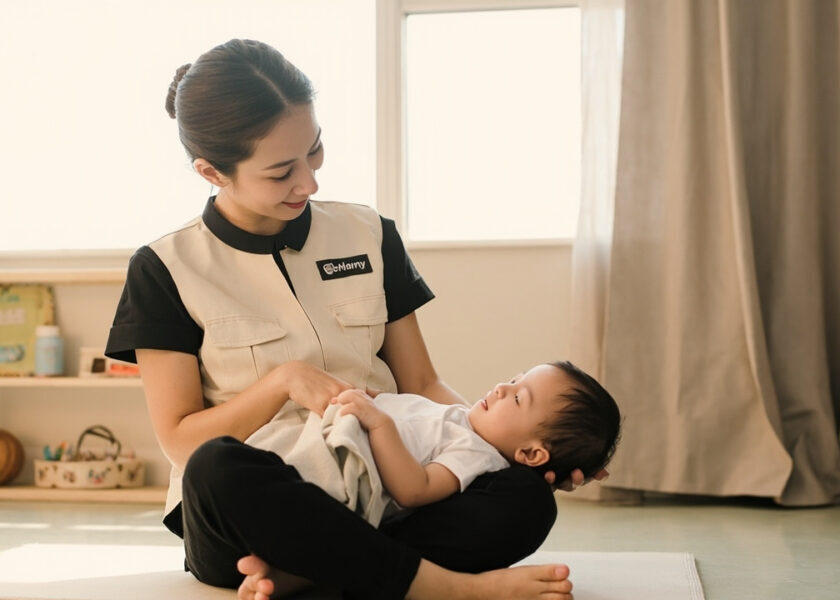
Play is often when the phone comes out most easily. KKH's September 2026 statement names displacement of physical activity, face-to-face social interaction and unstructured play as the primary concerns in younger children. The national activity guidelines encourage caregivers, when an infant is seated, reclined or lying down, to engage the infant in singing, reading, storytelling and imaginative play. [3] [4]
Law, quoted in the same report, says the best thing about these 'serve and return' exchanges is that you do not need any special knowledge or training, and she recommends reading books aloud to babies. A hypothetical example: if scrolling is your habit during the six o'clock feed-and-settle, two songs and one board book fill the same minutes without a rule to enforce. HealthHub also suggests packing a fun bag of small toys, snacks, stickers and books for outings, so a phone is not the fallback. [2] [6]
Writing it once, so a nanny or grandparent does the same
HealthHub notes that nanny services are not licensed, and advises setting ground rules from the start, including telling the nanny what you expect regarding your baby's feeding, sleeping, TV-watching and discipline. MindSG's advice is to involve the whole family in screen-time practices and to ensure that all caregivers consistently enforce the same rules on device usage. Grandparents may hold different views on care; a written page settles that faster than a conversation at handover. [9] [10]
As an optional editorial suggestion, write three lines and no more: devices away for feeds and family meals; screens off and lights dim for night-time settling; sing, read or tell a story when your baby is seated or reclined. Ask whoever does the morning shifts to sign and date the same page. Keep the reporting in proportion: the boundary for a baby under 18 months is fixed and its exception narrow, while the September 2026 findings describe differences between groups of babies sorted by parents' reported exposure rather than a proven cause. Agree the three moments, write them once, and put a song where the phone was. [1] [5] [2]
Read next
Sources
- Parent Hub: 0-2 Years – Screen Time
- Effects of screen time on young children's brain development | The Straits Times
- Growing up in a digital world: Guiding children and youths towards safe and healthy screen use
- ADVISORY & GUIDELINES
- CHILDHOOD HEALTH BEHAVIOURS CHECKLIST
- Parent Hub: 0-2 Years – Screen Time – HealthHub
- Parent Hub: 0-2 Years – Baby Sleep
- ch-api.healthhub.sg
- Mummy's off to work
- MindSG
EduNanny Editorial · AI-assisted research and writing, reviewed by our automated editorial team. Sources checked 2026-10-09. Featured image: AI-generated editorial illustration.