Responsive Toddler Sensory Play on a Short Walk
Follow your toddler’s attention with one brief sensory invitation, then use the response to decide whether to repeat, change or close the moment. Try the worked leaf example and keep the three-line note for your next walk.
A short walk can become responsive toddler sensory play without a special route or bought materials. On a walk with your toddler aged 13 to 18 months, slow down when they notice something. Describe it in a few words, make one gentle invitation, then pause. Their next look, reach or movement tells you whether to stay with the moment or continue walking.
This guide stays with toddlers aged 13 to 18 months. HealthHub’s guidance for this age group notes that toddlers develop differently and advises families to seek professional advice for concerns specific to their child’s development. During one walk, slowing, looking, ignoring or moving away can help you decide what to do next.
We bring this principle to everyday care. At EduNanny, each child’s interests and readiness guide activities. Purposeful play and suitable movement have their place alongside feeding, rest and comfort.
Choose one small, familiar feature
Choose a clear spot in a park or garden where you can remain close and supervise. Stay with your toddler’s pace instead of moving on to the next sight. One pause beside a visible patch of grass, a leaf edge, sand, a twig or a change in surface is enough to begin.
For toddlers aged 13 to 18 months, HealthHub’s outdoor sensory play examples include playing with sand, picking up leaves or twigs, walking on sand or grass, and playing with water in a shallow pool. HealthHub advises physical play in a safe, supervised environment and specifies supervision for water play. For this short activity, stay on land and choose one feature already part of your walk rather than recreating the list.
Use one word or short phrase that names what is visible, such as ‘green grass’, ‘rough leaf’ or ‘sand’. Avoid a question that needs a particular answer. Say the phrase once, then wait. Your toddler may look, reach, step closer or walk on. They do not need to touch the material. If they ignore the feature, return your attention to the walk. If they seem uncomfortable, stop the invitation and move on.
Use the notice, offer, follow rhythm
A small three-turn exchange keeps the moment responsive. Your toddler contributes first, you add one manageable response, and their next action tells you what comes next. It is a structure for the adult, not a routine the toddler must perform.
- Turn one: notice. A slower step, look, reach or turn towards a feature is enough to begin. You are noticing what may have caught their attention, not checking whether the response is “right”.
- Turn two: offer. Say one short description, point once or offer an open hand. Keep the invitation small. A look is a complete response; no touch is required.
- Turn three: follow. If your toddler looks or reaches again, repeat the phrase once or let the action continue. If they turn away, follow their movement or close the moment. Do not add another prompt merely to keep play going.
You may complete all three turns or stop after the first. The aim is not to finish an exchange. It is to let each response shape the next few seconds.
Worked example
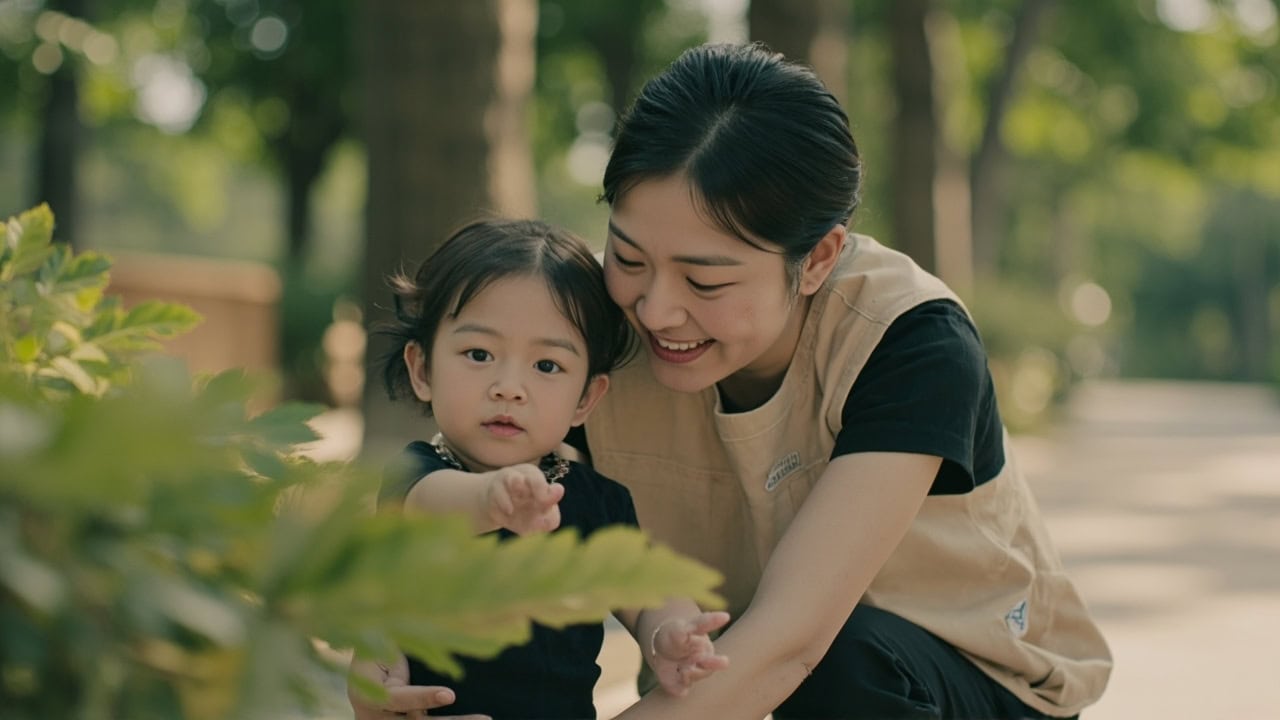
On a clear park path, a toddler slows beside textured leaves. The adult kneels close by, says ‘rough leaves’ and offers an open hand without guiding the toddler’s hand. The toddler reaches towards a leaf. The adult repeats the phrase once and waits. When the toddler looks up and continues along the path, the adult follows, leaving the leaves behind.
In this example, the renewed reach leads to one repeat, while the later movement brings the leaf moment to a close. If the toddler had moved away before reaching, the adult would continue without another prompt. On another day, leaves can become the focus again if the toddler shows renewed interest. If their attention has shifted, choose another visible feature or finish the walk.
Fill in a three-line walk note
After one pause, open your phone notes and record three short lines. Describe what happened rather than what you think it means. The note helps you choose the next invitation without turning one walk into a test.
| Three-line note | Illustrative entry |
|---|---|
| Noticed: ____________________ | Stopped and looked at textured leaves. |
| Tried: ____________________ | Reached once, then looked up. |
| Next time: ____________________ | Offer leaves again if interest returns, or notice grass instead. |
Read the three lines together. If your toddler returned to the feature, a similar invitation may be worth repeating. If they looked once and kept walking, choose something else or let the moment pass. If they showed no interest, move on without pressure.
Keep the first two lines descriptive and use the last for your next choice. Across several walks, the entries may reveal a repeated preference, but they are not scores or milestone records. A lack of interest in one feature is not a developmental conclusion; it is enough to guide your next choice.
Sources and further reading
- The Beginner’s Guide To Taking Care of Your Toddler: 13 to 18 Months · www.healthhub.sg
- Home · EduNanny
The image in this article was generated with AI for illustration. It does not show an actual EduNanny staff member, child or facility.
On your next short walk, pause at one feature your toddler notices and make a single invitation. After the walk, fill in the three-line note.