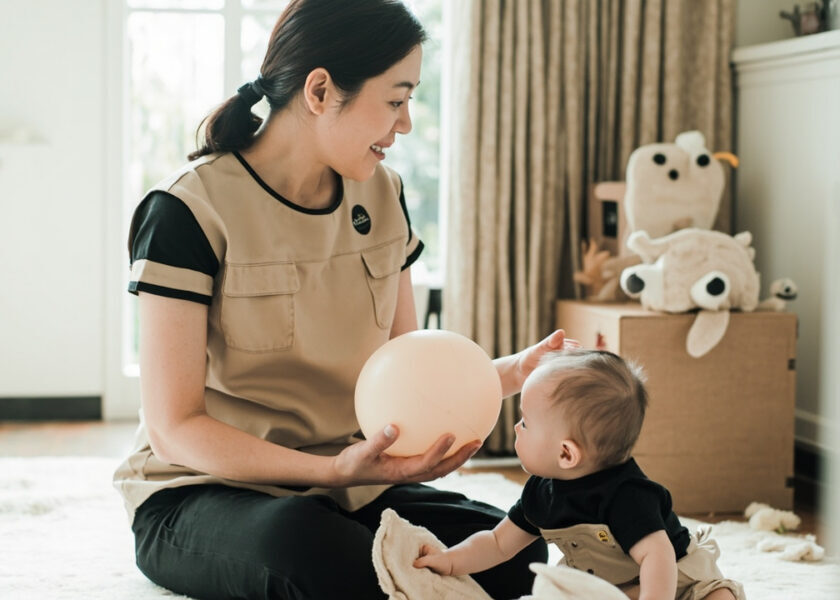
Responsive Choice Play for Your Baby at Around 9 Months
Turn a familiar board book and soft ball into a short, responsive play exchange. This step-by-step example shows how to offer two options, follow your baby's cue and pause without expecting an answer.
If your baby is around 9 months, choice play can begin with two familiar objects on the floor. Put an open board book on one side and a large soft ball on the other, within your baby’s view and your reach. Watch for a clear cue such as looking, pointing, reaching or moving closer, then follow it with one simple action. This is responsive choice play: an exchange shaped by your baby’s contribution rather than a naming test or milestone check.
The useful answer is simple: offer two familiar invitations, respond to one clear signal, and pause. You do not need a spoken answer before play continues. UNICEF’s guidance for babies at 9 months recommends following a baby’s signals and letting them lead during playtime. It also suggests sharing board books and naming an object the baby already notices, which makes responsive choice play a practical part of everyday interaction.
A small choice can make room for your baby’s contribution
Two familiar invitations are enough for the first step. A board book your baby has enjoyed before gives you something to open or turn. A large, intact soft object that your baby has already handled gives you something to move, name or simply leave within reach. Familiarity keeps the focus on noticing what your baby does now, rather than introducing several new materials at once.
Place both options where your baby can see them without holding up one as the correct answer. Let the objects rest while your baby settles. A choice does not need to happen quickly, and your baby does not need to point, crawl or use a particular word to show interest. Gaze towards an object, a turn of the head, reaching, movement or a change of attention can all give the exchange a direction.
A baby around 9 months may be crawling or pulling up to stand, so prepare a clear floor area and remain close throughout the activity. Keep loose small parts and unsuitable objects out of reach. Choose a book and soft object suited to your baby, and leave enough space for movement so that you can follow without taking attention away from supervision.
This follows the same responsive principle we describe in our EduNanny ECDA Childminding Pilot approach. We use simple experiences around what an infant is doing and showing interest in, while balancing playful engagement with comfort and willingness to join in. You can apply that idea at home by building one short interaction around the signals your baby is already giving.
Follow the cue, not a checklist
Start by watching rather than prompting. If your baby looks steadily at the book, you could turn a page. If your baby reaches towards the soft ball, you could move it slightly closer or say “ball” once. If your baby looks away, leans back or moves to another part of the room, you can ease or end the exchange. Both objects do not need to keep moving until your baby chooses.
Your response can be an action, a simple word or a brief pause. Naming should support the baby’s attention rather than become a question your baby is expected to answer. Saying “book” while the baby is already looking at the book acknowledges what has captured attention. Repeatedly asking for a point, reach or word turns a relaxed exchange into a task.
After you respond, wait and notice what happens next. Your baby may look back at you, touch the same object, shift attention or settle. Each response gives you information about this moment. Keep your next action small, and let the baby remain the source of the play’s direction.
One choice is not a measure of your baby’s development. A preference for the book is not a language milestone, and reaching for the soft ball does not tell you whether your baby’s fine-motor development is advanced. The more useful question is: what is my baby contributing now, and how can I respond without adding pressure?
Try a two-invitation play example
Use this as an illustrative activity for an awake baby around 9 months. Adapt the familiar objects, timing and supervision to what your family already knows suits your baby. The aim is to structure a short play moment, not to produce a correct result.
Worked example: a board book and soft ball
- Prepare the space. Clear a stable floor area and place a clean play mat where your baby can move safely. Sit close by. Put an open, familiar board book on one side of the mat and one large, intact soft ball on the other. Keep both visible and comfortably within reach.
- Offer both invitations. Rest your hands near your baby without pointing to either object. Avoid asking “Which one?” or moving both objects towards your baby. Give a short moment for your baby to look around.
- Notice the first clear signal. Your baby may look towards the book, point, reach for the ball, move closer to one object or turn away. Do not hurry to interpret an uncertain glance. Wait until the attention is clear enough for you to follow comfortably.
- Follow with one simple response. If your baby attends to the book, turn a page or bring it a little closer. If your baby attends to the ball, move it slightly or say “ball” once. Keep the response short.
- Pause. Let your baby look, reach, make a sound or change position. You do not need to introduce the other object. Respond again when your baby’s next signal is clear.
- End comfortably. If your baby disengages, stop without asking for another turn. At a later play moment, change only one feature, such as using a different familiar book, moving the objects a little closer or choosing a shorter time when your baby is already alert.
A short exchange can end after one response, or it can continue through several turns. Both are acceptable. Keep your observation simple: note what your baby noticed, what you did in response and whether they chose to continue or stop. That record can help you adjust the next play moment without attaching a score to your baby’s contribution.
Sources and further reading
- EduNanny ECDA Childminding Pilot · EduNanny
- Your baby's developmental milestones at 9 months | UNICEF Parenting · www.unicef.org
The image in this article was generated with AI for illustration. It does not show an actual EduNanny staff member, child or facility.
At your next calm, awake play moment, offer a familiar book and soft ball, follow your baby's first clear cue, then pause and notice.