Choosing Infant Care That Notices, Responds and Adapts in Singapore
Responsive infant care becomes easier to assess in the moments after a baby reaches, pauses or looks away. This Singapore guide turns those moments into practical questions, visit points and enrolment checks—without treating a low ratio as proof.
Two polished care folders can look equally reassuring, yet a parent may still wonder what happens when an infant stops reaching, turns away or needs comfort while another child also needs attention. The aspiration is simple: to see the caregiver notice, respond and change course without turning an ordinary moment into a scripted lesson.
That makes the search for responsive infant care in Singapore less about finding the longest activity list and more about judging the fit among a caregiver’s way of interacting, the setting and the family. It is a question no headline ratio can answer alone.
Responsive care should be visible in the next turn
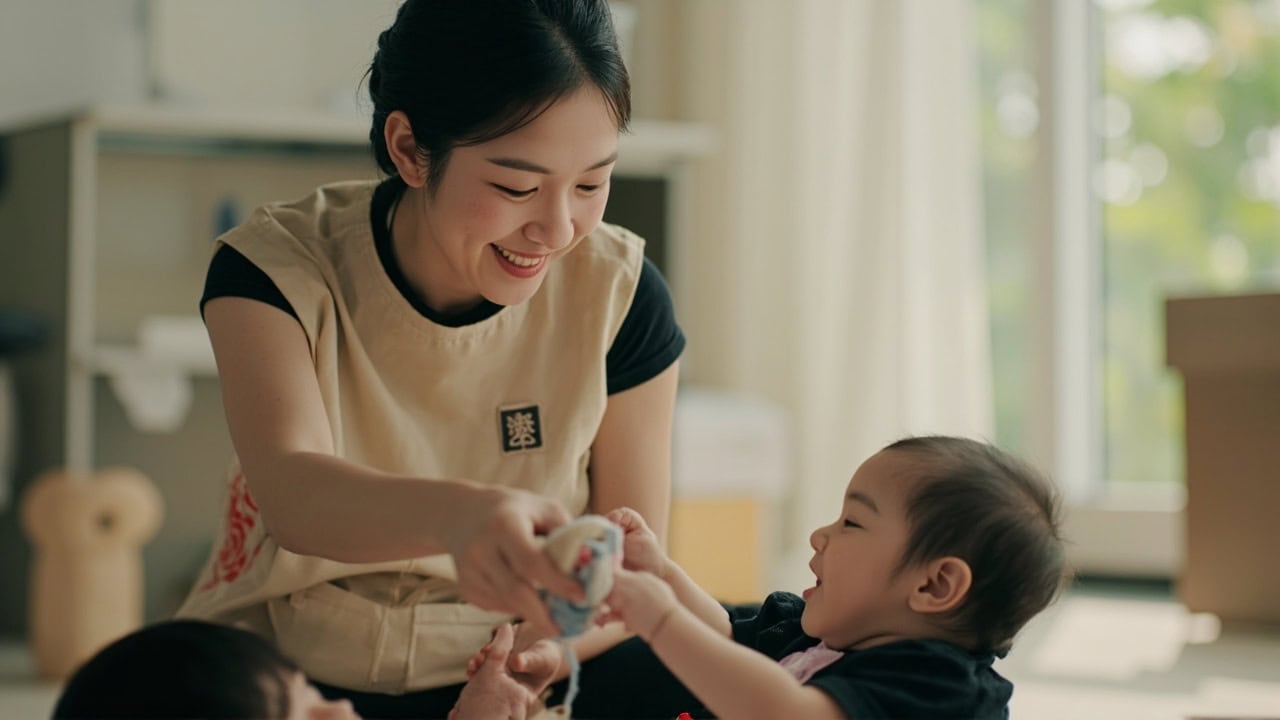
The Center on the Developing Child at Harvard University uses its guide to serve and return to describe responsive, back-and-forth exchanges in which a caring adult notices a young child’s signals and needs, responds and makes room for the child’s next contribution. In infant care, this might mean answering a vocalisation and waiting, bringing a toy into view after a reach, or noticing that an infant has turned away and pausing before offering another prompt. The important part is not the technique; it is whether the infant’s response changes what happens next.
A peer-reviewed review of responsive caregiving and opportunities for early learning examines responsive caregiving in relation to children’s learning and healthy growth. This supports the relevance of the principle, but it does not establish a validated childminder-selection checklist or a scoring system for families.
Precise language matters too. Following a colourful page may be shared looking, not evidence that an infant is reading; joining in with a song is not evidence that the infant is singing words. Caregivers should keep descriptions at the level of what was actually observed rather than attaching a developmental label to every ordinary action.
Ask the person who will actually be there
A programme can describe its approach attractively. The more useful pre-enrolment conversation may be with the caregiver expected to care for the infant, using concrete moments rather than broad claims about individual attention. Consider asking:
- How do you learn an infant’s preferences, signals and familiar routines before making fixed assumptions?
- When an infant reaches, vocalises, pauses or looks away, what do you notice and how do you decide what to do next?
- If a planned moment of play, singing or settling is not working, how do you change the approach?
- How do you decide whether an unusual moment calls for a different response or more time to observe?
- What kinds of changes do you share with parents, and how do you distinguish a recurring interest from a one-off incident?
- How do you incorporate what parents know while remaining open to what the infant communicates in care?
- How would you tell a family if the arrangement is not yet a good fit or a concern needs further attention?
These are prompts, not a pass-or-fail test. The aim is to understand the caregiver’s process: what they notice, how they interpret it, what action follows and how they revise that action when the infant responds differently.
A useful answer is specific, flexible and revisable
Strong answers are conditional. They explain what the caregiver would do in one situation and what might make them try something else. They are also observable and revisable rather than dependent on phrases such as we personalise every child.
For example, a hypothetical response might be: If an infant turns away during a song, I would pause, stay nearby and watch for another signal. If the infant re-engages, we could begin again. The example is not evidence about a particular caregiver. It illustrates a process that notices, responds and adjusts without forcing the original activity to continue.
By contrast, an answer such as We always do songs and picture cards says little about what happens when an infant disengages. Families can also ask for a recent or anonymised example of a caregiver adapting to an ordinary moment. They need not stage the infant or judge their own child during the meeting.
Responsiveness should not be reduced to a demand for a flawless performance. Babies and circumstances vary. The more useful question is whether a caregiver can explain what they notice, remain flexible and revise their approach when an interaction changes.
Read a low ratio as opportunity, not a verdict

Research on child-staff ratios in early childhood education and care identifies ratios as a key quality consideration and describes better ratios as potentially beneficial. It does not make a headline number complete proof of quality, nor does it show that a particular ratio will cause an individual infant to reach a milestone sooner.
A lower ratio may create more opportunity for brief individual interactions. With fewer infants needing attention at the same moment, a caregiver may have more chance to notice a preference, return a vocalisation, wait through a pause or adapt an activity. Even so, several infants will sometimes have competing needs. A low ratio creates opportunity; it does not guarantee continuous one-to-one attention.
For its ECDA pilot, EduNanny’s first-party information states a maximum of three infants per childminder. This is operational information, not independent evidence of developmental outcomes. Families can ask about the number usually present in a particular group, how infants are distributed, how simultaneous needs are balanced and how absences or staffing changes are covered.
A ratio should sit alongside safety, continuity, communication and the suitability of the setting. It is one part of the decision, not a verdict on it.
Make the visit an observation, not a performance
Where possible, meet the person expected to provide care and visit the actual home or community setting. A tour can show the layout, while an ordinary routine may offer more information about how the caregiver works. If the provider can accommodate it, parents may observe a routine handover or transition rather than a prepared demonstration. There is no need to stage the infant or test the caregiver with deliberate activities.
Notice whether the caregiver picks up small changes in attention, leaves room for a response and changes course without making the interaction feel rushed. It is also useful to see whether the caregiver listens to parental information, responds calmly when interrupted and explains decisions in plain language. One interaction cannot establish overall quality, just as one cheerful activity cannot.
Assess safety, continuity, handovers and the practicality of the arrangement separately. Warm interaction is important, but it cannot compensate for an unsafe arrangement or an unworkable care plan.
For families considering Singapore’s official childminding route, the Early Childhood Development Agency states that the pilot runs from 1 December 2024 to 31 December 2027 and that Singapore Citizen infants aged two to 18 months may participate. Families should confirm current eligibility and terms. This is programme information, not evidence that a particular caregiver is responsive; the questions in this article remain practical prompts.
EduNanny separately states that parents are encouraged to meet the caregiver and visit the setting, and that a five-day trial can be arranged after a visit under its pilot terms. This is a first-party service description. Confirm availability, timing and the full agreement directly before enrolling.
Weigh communication, continuity and practical fit
Ask what parents will receive and how individual progress will be observed. A useful update can describe what an infant did, the context and how the caregiver responded. It can identify a recurring interest without attaching a fixed label or turning an everyday observation into a milestone claim. An observation from care is not, by itself, a formal developmental assessment. Families can ask how concerns would be communicated and whether advice from another professional may be sought.
Settle the practical matters alongside the interaction philosophy: schedule, handovers, communication preferences, backup arrangements, the nature of the setting and the fit between caregiver and family expectations. Claims about individual attention should remain consistent with the practical realities of the group.
The strongest decision comes from coherence. The caregiver’s explanation should match their behaviour, the visit should be consistent with the setting, and the communication and practical arrangements should support the same approach to care. If the answers remain slogans, guarantees or unsupported claims about uninterrupted attention, pause and seek more detail. The goal is not a flawless interaction, but a professional whose pattern of noticing, responding and adapting fits the family.
Sources and further reading
- A Guide to Serve & Return · Center on the Developing Child at Harvard University
- Responsive Caregiving and Opportunities for Early Learning … · PubMed Central
- Child-Staff Ratios in Early Childhood Education and Care … · PubMed Central
- Childminding Pilot for Infants · Early Childhood Development Agency
- EduNanny ECDA Childminding Pilot · EduNanny
The images in this article were generated with AI for illustration. They do not show actual EduNanny staff, children or facilities.
Every family has different care needs. Speak with EduNanny to discuss care that is right for your child.