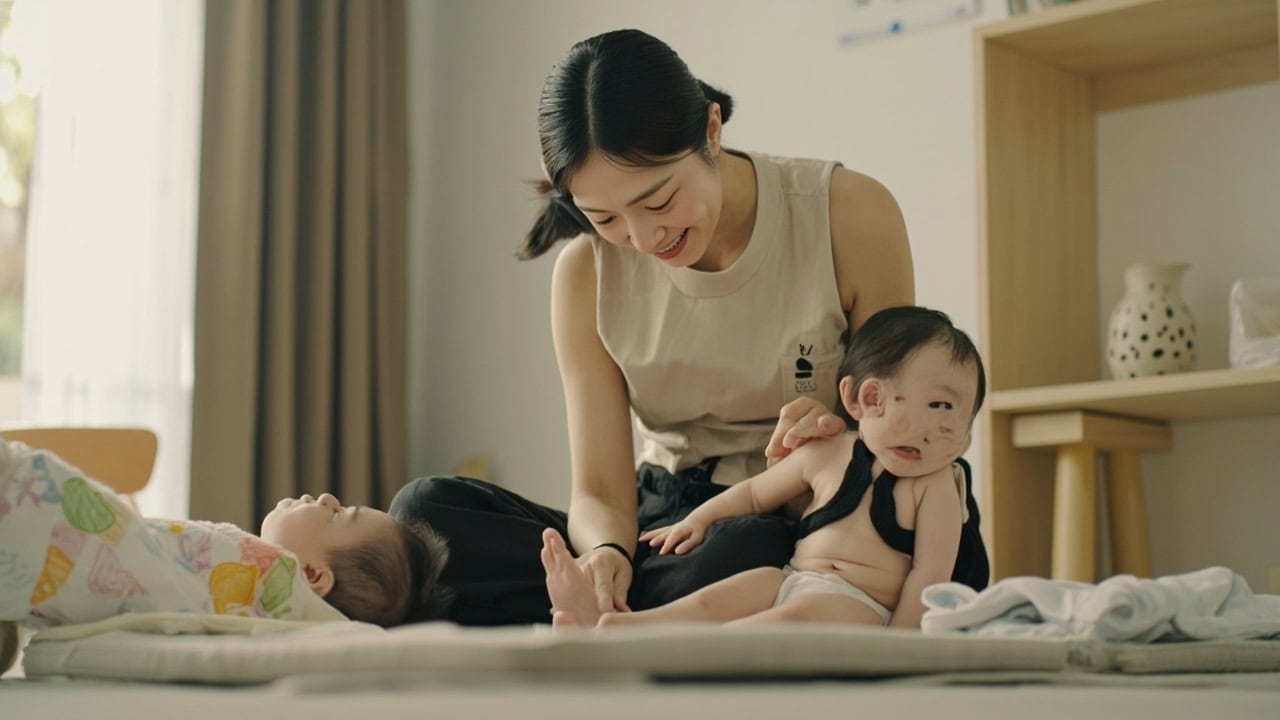
When Two Babies Need Care at Once in a Small Group
Responsive care is not uninterrupted one-to-one contact: it is the repeated act of noticing an infant’s cue, responding and returning. A small group may create room for those exchanges, but it cannot guarantee them or a developmental result.
For parents considering group infant care, a central question is practical: when two babies signal at the same time, how can each remain noticed? A broad promise of constant attentiveness may sound reassuring, but it does not explain what an adult will actually do. Individual attention is better understood as a repeated pattern of noticing, responding and returning—not uninterrupted eye contact or constant one-to-one handling.
Small-group and low-ratio infant care may create more opportunities for those exchanges because fewer cues may compete for the adult’s attention at any moment. Neither the group size nor the label alone establishes care quality or a developmental result. The useful question is how the arrangement supports reciprocal interaction while acknowledging that one childminder may be caring for several infants.
Individual attention is a pattern, not constant contact
The Center on the Developing Child at Harvard University explains that responsive caregiving gives a young child repeated serve-and-return experiences. A child sends a signal or expresses a need; a caring adult responds; the child’s reply can give the adult a new cue to answer in turn. In an infant setting, a signal might be a gaze, sound, gesture, movement or change in mood. The important feature is the back-and-forth: the adult’s next action is shaped by what the child communicates rather than by a script that ignores it.
Responsive interaction may be a look followed by a word or sound, a shared song continued after a baby looks towards the adult, or a pause while an immediate need is addressed. These are examples, not required timings. The evidence cited in this article establishes no minimum number of seconds for a high-quality exchange. It supports repeated, contingent interaction—not continuous eye contact or uninterrupted handling.
That distinction makes individual attention cumulative. An infant does not need the adult’s complete attention at every moment to benefit from being noticed. The wider pattern is whether the child can signal, receive a response and communicate again across ordinary play, rest, movement and transitions.
How to think about two cues at once
The following is a hypothetical composite, not an observed EduNanny incident or a tested protocol. One infant reaches towards a cloth book and vocalises while the other turns towards the adult with a furrowed expression. Both infants have communicated, but the illustration does not establish that they require the same response or that either cue has a predetermined level of urgency.
In this composite, the adult might verbally acknowledge the first infant, respond to the second if an immediate need is present, and return to the book exchange when possible. That sequence is only a way to make the challenge understandable. The supplied evidence does not establish a fixed order for handling two infants’ cues, how often their needs overlap or how an EduNanny childminder is required to respond in a particular moment.
The illustration is more useful as a set of parent-facing questions. Which cue appears to require an immediate response? How can the other infant also be acknowledged? What can the adult safely pause, and how can the adult return? The answers should describe an actual practice rather than merely suggest that every child receives individual care.
A single brief pause cannot, by itself, establish or disprove the quality of care. Neither does an isolated enthusiastic interaction. The cited research provides no pass-or-fail duration, and a momentary overlap between two infants’ needs should not be converted into a developmental judgement. The more relevant question is whether both infants remain safely supervised and whether responsive exchanges continue across the day.
What a low ratio can—and cannot—tell you
A 2017 systematic review of child-staff ratios identifies ratios as a key quality indicator in early childhood education and care and notes that better ratios are believed to improve outcomes. That supports taking the staffing arrangement seriously. It does not identify one universal numerical limit, prove that a particular provider causes a result or show that every infant responds in the same way.
Fewer infants may mean fewer cues competing for an adult’s attention at the same moment. That is the practical rationale behind low-ratio infant care: a smaller group may create more room to notice a subtle change in mood, follow an infant’s interest or respond during a shared routine. This is a design context, not a causal finding about EduNanny or any other provider.
Low-ratio care also does not mean uninterrupted one-to-one care. Infants share songs, books, object play, movement and transitions even in a small group. The EduNanny pilot page describes its approach as small-group and says the arrangement gives a childminder more room to notice individual cues and respond thoughtfully. That is a first-party description of the provider’s intended care, not independent evidence that the model produces a measured developmental benefit.
Even a thoughtfully designed arrangement cannot guarantee uninterrupted attention, faster milestones or stronger early capabilities. It can, at most, create more opportunities for an adult to notice and respond. The quality of those opportunities still depends on the interaction that occurs.
Shared play can still respond to each infant
Responding to infants does not mean giving every child an identical activity. During a familiar song, one baby may watch and move while another looks towards the adult. The childminder can sustain the shared routine while noticing each infant’s contribution. One infant may pause during a book while another reaches for a textured page; the adult can respond to those interests without forcing either child into the same response.
Observation should remain at the level actually seen. Looking at a picture is not the same as reading its words, and reaching towards a cup does not show that an infant can name it. Likewise, watching or moving during a song does not establish that the child understands or can sing the lyrics. Precise description protects infants from being assigned abilities they have not demonstrated.
Individualisation lies in those small adjustments. The adult notices what an infant attends to, decides what can be offered next and leaves room for a different response. It does not require a private activity every minute, and it should not become a race towards language, cognition or movement milestones.
Separating pilot facts from care claims
The official Childminding Pilot for Infants page states that the programme runs from 1 December 2024 to 31 December 2027 and that Singapore Citizen infants aged 2 to 18 months may participate. These are programme dates and eligibility facts. They do not establish how often infants’ needs overlap, prescribe a method for managing two simultaneous cues or report measured developmental outcomes.
It is equally important to distinguish an operator’s description from independent evidence. A provider can explain the care philosophy it intends to deliver, but that philosophy should not be presented as proof of a developmental effect. Similarly, an illustrative scene can help parents recognise a practical question without becoming a claim about an observed incident, a documented workflow or a guaranteed result.
Programme facts, provider statements, research findings and editorial examples answer different questions. Keeping those categories separate makes a care claim easier to assess and prevents a promising phrase from carrying more weight than the available evidence allows.
Questions that turn personal care into specifics
Before enrolment, parents can use a broad promise of personal care as a starting point for precise questions:
- What is the maximum number of infants assigned to the childminder at any one time?
- Can the number change during the day, and how is the care arrangement adjusted if it does?
- How are an infant’s cues noticed during play, rest and transitions?
- When two infants signal at once, how does the adult decide which need requires an immediate response while keeping both children appropriately supervised?
- Which aspects of the approach are binding service commitments, and which describe general care aims?
A useful answer should identify what the adult does, what the service commits to and what families may reasonably observe. If a provider uses terms such as low ratio, responsive care or individual attention, parents can ask what each term means in daily practice. Concrete examples are more informative than a slogan, while general philosophy should not be mistaken for a measurable outcome.
During a visit, parents can also look for the basic pattern of reciprocity: does the adult turn towards a cue, respond, leave room for another signal and return when possible? One exchange cannot establish overall quality. Repeated inclusion of both infants, age-appropriate engagement and calm handling of shared routines provide a more informative picture than a single performance.
A small group cannot, by itself, promise uninterrupted one-to-one contact. The most credible parent-facing account combines a transparent staffing arrangement, a clear explanation of responsive practice and a candid acknowledgement that individual attention can be shared rather than constant. For two babies, the meaningful promise is not unbroken contact, but a care approach in which neither infant becomes invisible when needs overlap.
Sources and further reading
- A Guide to Serve & Return · Center on the Developing Child at Harvard University
- Child-Staff Ratios in Early Childhood Education and Care · PubMed Central
- Childminding Pilot for Infants · Early Childhood Development Agency
- EduNanny ECDA Childminding Pilot · EduNanny by Butler
The images in this article were generated with AI for illustration. They do not show actual EduNanny staff, children or facilities.
Every family has different care needs. Speak with EduNanny to discuss care that is right for your child.