Why Quality Childcare Compounds Into Lasting Change
What Quality Childcare Actually Does Over Time
- At 3 months: Your child transitions from newcomer to active participant. Belonging becomes visible in how they move, choose, and engage.
- At 6 months: The environment begins to “travel home” with your child. New songs, new vocabulary, new ways of thinking emerge naturally.
- At 12 months: You see a fundamentally different child. More confident. More curious. More capable of navigating the world.
- The key difference: Quality care transforms children over seasons, not merely supervises them for hours.
The Nature of Ordinary Doubt
Let us begin here, with your Tuesday doubt, because it deserves honest acknowledgment rather than dismissal.
When you chose quality childcare for your child, you made a decision rooted in hope. Hope that your investment would matter. Hope that the hours you cannot be present would still count for something in your child’s development. Hope that the choice you made was the right one.
These hopes are not naive. They are the reasonable expectations of any parent who has researched, visited, and chosen carefully. And yet, between hope and certainty lies a gap that grows widest during ordinary weeks when there are no dramatic milestones to celebrate.
The truth is that real child development rarely announces itself. It happens in the quiet accumulation of days, in moments too small to photograph and too gradual to mark on a calendar. This is precisely why quality childcare can feel uncertain even when it is working beautifully.
Understanding what is actually happening during those hours you cannot see changes how you read those Tuesday photographs. It transforms quiet doubt into quiet confidence.
How Belonging Becomes Visible
When a child enters a new childcare environment, they arrive as a newcomer. A new environment is, for a young child, a foreign country. The sounds are unfamiliar. The rhythms are different. The faces do not yet carry meaning. For the first weeks, a child is essentially translating—watching, assessing, trying to understand the rules of this new world they have entered.
What quality care provides, in its earliest form, is not curriculum or activities or developmental targets. It provides safety. Not merely physical safety, though that is foundational. Emotional safety. The safety of knowing that when you cry, someone comes. When you are confused, someone explains. When you do not know where the bathroom is or how to open the snack container or what happens when the music stops, someone is there, patient and consistent and present.
When a child’s nervous system learns that an environment is predictable and responsive, the child can stop scanning for danger. They can stop expending energy on vigilance. And that energy, released, becomes available for something else entirely—it becomes available for curiosity.
At three months into care, the photographs your caregiver sends will begin to change. The child who arrived hesitantly, who hung back at the edges of play, who waited to see what would happen before committing to any action, begins to move differently. They begin to lead. Not with confidence yet, not with the certainty of a child who has been here for years, but visibly, observably different. They choose. They initiate. They move toward other children instead of away from them.
Your daughter, who once waited by the door, now runs to the block corner. Your son, who once watched from the sidelines, now joins the circle without hesitation. These are the signatures of belonging becoming visible—the internal shift becoming external behavior, and one of the earliest and most important signs that quality care is working.
The Compounding Effect of Sustained Care
At six months, something else begins to happen. The child who arrived begins to carry the environment home with them. Not literally, but meaningfully. You notice your son singing songs you have never taught him. You notice your daughter using words like “collaborate” or “experiment” in contexts that surprise you. You find yourself asking, where did that come from? And the answer, which may take you by surprise, is from there. From the hours you cannot see.
This is the compounding nature of sustained quality care. Each day in a rich, responsive environment adds to what came before. The songs build on songs. The concepts build on concepts. The social skills learned in morning play become the foundation for afternoon negotiation, which becomes the foundation for the complex collaborative projects of later months. Nothing is isolated. Everything connects.
There is a moment—and you may not recognize it when it happens—where your child stops being a passive recipient of their environment and becomes an active participant in it. Your daughter, who used to watch other children build with blocks, now approaches the block area and begins constructing something of her own. Your son, who used to wait for the caregiver to read a story, now brings a book to an adult and climbs into their lap to read it together.
These are not dramatic moments. They will not make the news. But they are the signatures of a child who has internalized the message that they belong here, that their actions matter, that this space is theirs to shape as well as to inhabit.
| Supervision | Transformation |
|---|---|
| Child is cared for and occupied | Child is growing and developing |
| Hours pass safely | Days compound into visible change |
| Activities fill time | Interactions build capability |
| Basic needs are met | Curiosity is cultivated |
| Child adapts to environment | Child shapes and leads within environment |
A supervised child is cared for. A transformed child is growing. The difference is not always visible in any single photograph or any single day. It is visible in the arc—in the comparison between who your child was in September and who they are in March.
What Quality Childminding Actually Looks Like
At EduNanny, this intentionality is woven into the fabric of how care is structured. The ECDA Childminding Pilot through which EduNanny operates is built on principles of developmental responsiveness. The small ratios, sometimes as low as one to three for infants, mean that caregivers are not merely supervising but truly observing. They notice when a child reaches a new milestone. They document growth. They communicate with you not just about what your child ate for lunch, but about what they discovered, what they tried, what they seemed curious about.
This is not accidental. It is a designed approach to childminding that treats the hours you entrust to someone else as hours of genuine developmental significance.
These practical elements matter more than they might first appear:
- Small ratios allow caregivers to truly observe and respond to individual children, not just manage groups
- Consistent caregivers build the predictability that allows children to feel safe enough to explore
- Intentional communication keeps you connected to what is happening during the hours you cannot see
- Documentation of development creates a record of growth that becomes meaningful over months and seasons
Addressing Your Real Concerns
Parents often carry specific questions. It helps to speak them plainly.
“How do I know it’s actually working?” The photographs did not lie. The laughter was real. The paint on her fingers came from genuine exploration. The story she was listening to was contributing to her language development in ways that will not show up on any test but will show up in the richness of her vocabulary when she is four, five, and six. You were right to trust what you saw. But more than that, you were right to choose an environment where what you see is worth trusting.
“Is this just watching my child while I work?” This is not about claiming to create miracles. It is about understanding that quality childminding, delivered consistently over time, produces observable results. The results are not always dramatic. They are often quiet. They live in the ordinary days, in the incremental expansions of capability and confidence, in the small shifts that, accumulated over months, add up to transformation.
“What about transparency and trust?” The communication matters because trust matters. You have given someone else the privilege of caring for your child during the hours you cannot be there. You deserve to know what those hours contain. EduNanny provides that transparency through regular updates, through documentation of development, through honest reporting that shows you both the triumphs and the ordinary beautiful days that make up most of childhood. Where deployed, CCTV measures provide additional assurance—not about suspicion, but about the kind of transparency that lets you relax into trust.
“What about the practical realities for Singapore families?” These are not small things:
- Monday to Friday care blocks that fit working parent schedules
- CDA and Baby Bonus usability that makes quality care financially accessible
- Both home-based and centre-based pathways that recognize families have different needs
- Singapore-wide relevance, because children across this city deserve the same quality of developmental care
The Internal Working Model
There is a concept in child development called the internal working model. It is the mental model a child builds of what relationships feel like, what the world expects of them, and what they can expect from others. This model is built in the earliest years, in the thousands of interactions that accumulate between a child and their caregivers, between a child and their environment.
What quality childcare provides, in its deepest sense, is an internal working model of security, of competence, of the world as a place where curiosity is rewarded, where effort leads to growth, where other people can be trusted to respond with care.
This is not a small gift. This is the gift that keeps giving across your child’s entire life. The child who has internalized that they are capable will approach challenges differently than the child who has internalized that they are not. The child who has learned that relationships are reliable will build their own relationships differently. The child who has experienced an environment of intentional, responsive care will carry that experience forward into how they engage with school, with community, with the larger world.
One Year Later: The Arc of Transformation
At one year into sustained care, parents often describe something striking. They describe a child who seems, in certain ways, like a different person from the one who first walked through those doors.
More confident. More curious. More capable of managing disappointment and celebrating joy. More able to communicate what they need and what they wonder about.
This is not magic. This is the result of hundreds of ordinary days in an environment that understood what your child needed to become who they are becoming. It is another Tuesday now, perhaps a year later. Your child is not the same child who arrived at those doors twelve months ago.
The transformation has not been dramatic. It has been ordinary. It has been the ordinary days compounding into something significant.
The laughter that became confidence. The curiosity that became engagement. The hesitation that became leadership.
You may not remember the exact moment it happened. That is the nature of real growth. It is not a single dramatic event. It is a thousand quiet days, each one building on what came before, each one contributing to who your child is becoming.
Choosing With Confidence
If you are still deciding, if you are still weighing the choice, let us offer this guidance.
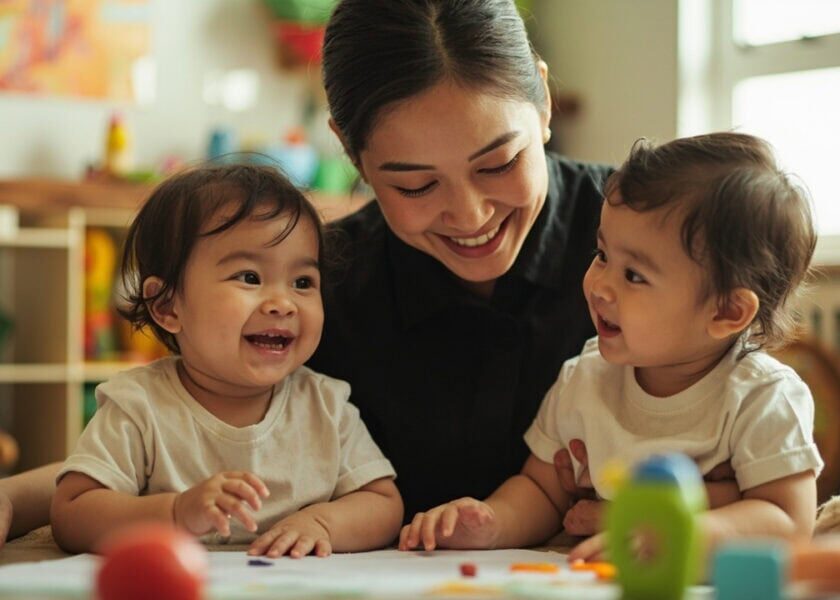
The best evidence of great childcare is quiet and ordinary. It is in the photographs that show your child mid-laugh, paint on her fingers. It is in the story she tells you about her friend who sits next to her at circle time. It is in the way she runs toward the classroom door on Monday morning, not away from you, but toward something she has come to love.
When evaluating childcare options in Singapore, look for:
- Consistent caregiver relationships that build security over time
- Small ratios that allow for genuine observation and response
- Transparent communication that keeps you connected to your child’s day
- Developmental intentionality that treats every hour as significant
- Evidence of growth visible not in single moments but in seasonal arcs
You chose EduNanny not just to solve a care problem. You chose it to give your child an environment in which to grow. Those are different things, and the distinction matters.
That is what sustained quality care does. It does not just watch your child while you work. It shapes who your child is becoming. It provides the environment, the attention, the intentional response that transforms potential into capability.
EduNanny by BUTLER is built for this purpose. Not as a service consumed, but as a developmental partnership entered into. Not just childcare, but the quiet, consistent, transformative work of raising a child who will grow into whoever they are meant to be.
The doubt you felt on that unremarkable Tuesday? Let it go.
What you chose is working. What you cannot see is real. And your child, in the hours you cannot be there, is becoming someone remarkable.
One ordinary day at a time.
At EduNanny, we believe that every family deserves access to thoughtful, development-oriented childminding that treats each child’s potential with the seriousness it deserves. Speak with our team to learn how we support families across Singapore through the ECDA Childminding Pilot, or read more about our approach to care that compounds over time.