The Truth About Leaving Your Baby: A Singapore Parent’s Honest Guide
The First Goodbye: An Honest Conversation About Infant Care in Singapore
There is a moment, unique to modern parenthood, that no one adequately prepares you for. It comes early—often far earlier than you ever imagined. It is the moment you place your child into someone else’s arms and walk away.
You have done this before, of course. You have handed your baby to a grandmother, a trusted aunt, a close friend. But this moment is different. This moment carries a weight that settles somewhere deep in your chest. This moment is the first goodbye of your infant’s formal care journey.
If you are sitting with that weight right now, I want you to know something: you are not experiencing a problem. You are experiencing the most profound expression of love that a parent can feel at this stage—the unbearable tenderness of knowing that someone small depends entirely on you, and the quiet terror of believing you might not be enough.
You are enough. And this article exists to help you understand what comes next—not to solve the ache you feel, but to help you honor it, and ultimately, to help you make decisions that your child deserves.
What This Article Covers
- Why infant care is fundamentally different from toddler or preschool care
- What attachment science tells us about formal care and your bond with your baby
- How to prepare emotionally and practically for the return-to-work transition
- What quality infant care looks like and how to evaluate it
- Red flags every parent should watch for
- How EduNanny Singapore approaches home-based childminding
The Conversation Singapore Has Been Missing
We speak endlessly about school readiness, about toddler milestones, about the grief of watching our children grow. But the earliest chapter—the one that begins when your baby is still learning what trust means, when their brain is forming connections at a speed it will never reach again—that chapter has been left in silence.
Until now. This is the honest conversation about infant care in Singapore. Not the sanitized version. Not the checklist version. The real one.
Why Infant Care Differs From Every Other Stage
Caring for an infant is not simply a matter of feeding and changing and keeping safe. It is the architecture of a human being.
The first eighteen months of life represent the most rapid and consequential period of brain development that any of us will ever experience. During this window, neural connections are forming at a rate of more than one million per second. The sensory experiences, the quality of responsiveness, the emotional tenor of caregiving—these are not incidental details. They are the foundation upon which your child’s capacity for trust, for learning, for relationship, is being constructed.
When you are choosing care for a baby, you are not choosing an environment that will occupy your child until they are ready for structured learning. You are choosing the human being who will be present for your infant’s first social smiles, who will witness the emergence of stranger anxiety, who will be there when your baby reaches for an object and discovers their own hands, when they pull themselves up and realize the world has changed.
A toddler can tell you when something is wrong. An infant cannot. A toddler has language, however rudimentary, to express discomfort, preference, fear. An infant communicates through physiology—through their breathing, their muscle tension, the quality of their cry, the way they do or do not settle in a caregiver’s arms.
This is why the ratio of caregivers to infants matters in ways that ratios for older children simply do not. In Singapore’s ECDA Childminding Pilot, home-based infant care maintains ratios of up to one caregiver to three infants. This is not an administrative preference. It is a recognition that your baby deserves a caregiver who can attune to the subtleties of their communication, who is not stretched so thin that a cry goes unheard, who has the capacity to notice when something is wrong before it becomes a crisis.
Attachment Science: What Formal Care Actually Does to Your Bond
Which brings us to the question that keeps so many Singapore parents awake at night: does placing my infant in formal care harm our bond?
The answer is this: it depends entirely on the quality of care you choose.
Here is what attachment science actually tells us. Secure attachment between a parent and child is not formed through proximity alone. It is formed through the quality of attunement, the consistency of responsiveness, and—critically—the absence of chronic, unprocessed stress in the infant’s environment.
A baby who is left with a caregiver who is warm, consistent, and responsive is not experiencing the kind of stress that disrupts attachment. A baby who is left with a caregiver who is distracted, inconsistent, or emotionally unavailable may well be.
The fear that formal infant care will somehow replace you in your baby’s heart is a misunderstanding of how attachment works. Your baby is not a vessel with a fixed capacity for connection. They are not dividing their love between you and their caregiver. What they are building, with every interaction, is a template for what relationships feel like—safety, responsiveness, trust. If their caregiver reinforces that template, it does not compete with your bond. It supplements it.
What This Means Practically
What this means, practically, is that the question you should be asking is not whether infant care is harmful. The question is: what does this care arrangement offer my child?
- Is the environment warm?
- Is the caregiver attuned?
- Is there genuine affection present, or merely task completion?
These are the questions that matter. These are the questions that will determine whether formal care supports or undermines the attachment you are building with your child.
The Return to Work: Navigating the Transition
Singapore has one of the highest female labor participation rates in Asia. Singapore mothers are ambitious, capable, and deeply invested in their careers. And Singapore mothers are also, overwhelmingly, the ones who bear the disproportionate weight of navigating the gap between parental leave policies and the realities of infant care needs.
If you are returning to work when your baby is six months old, nine months old, twelve months old—before you feel ready, before you have resolved your feelings about it—I want you to hear this: your readiness is not the measure of your child’s readiness. Your anxiety is not a sign that you are making the wrong choice. It is a sign that you care enormously about getting this right.
The transition back to work is one of the most emotionally complex periods in early parenthood. You are navigating the physical recovery of birth, the hormonal aftermath of weaning if you have chosen that path, the cognitive and emotional recalibration of being a working parent, and the grief of an intimacy that has been disrupted.
What Children Actually Need
Children are extraordinarily resilient. They adapt. What they need is not a parent who never leaves. What they need is a parent who leaves and returns, who explains and returns, who loves them and returns.
The rhythm of separation and reunion, when handled with warmth and consistency, teaches children something invaluable: that love is not diminished by distance, that the people who matter come back, that the world is safe enough to explore because someone reliable anchors them.
How to Prepare for the Transition
- A gradual approach where possible—a slow introduction to the care arrangement, a period of increasing time spent in the new environment while you remain nearby
- Choose a care arrangement where communication is expected—where you receive regular updates about your baby’s day
- Select a caregiver who understands they are not a replacement for you—but an extension of your care
- Look for transparency—updates, observations, and shared documentation of your baby’s day
The return to work is not a failure. It is a transition. And transitions, however difficult, can be navigated with honesty, preparation, and the right support.
How to Evaluate Infant Care: Quality Beyond Licensing
Licensing tells you the minimum. It tells you that a center has passed certain safety standards, that a home-based caregiver has met certain health and training requirements. These are necessary but not sufficient. Licensing is the floor, not the ceiling.
What you need to evaluate is harder to quantify but not impossible to discern.
What Genuine Quality Looks Like
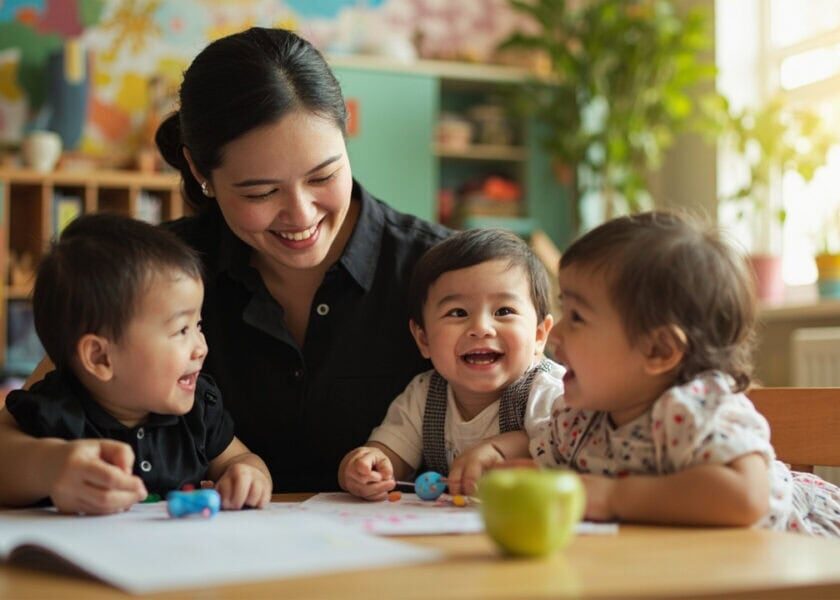
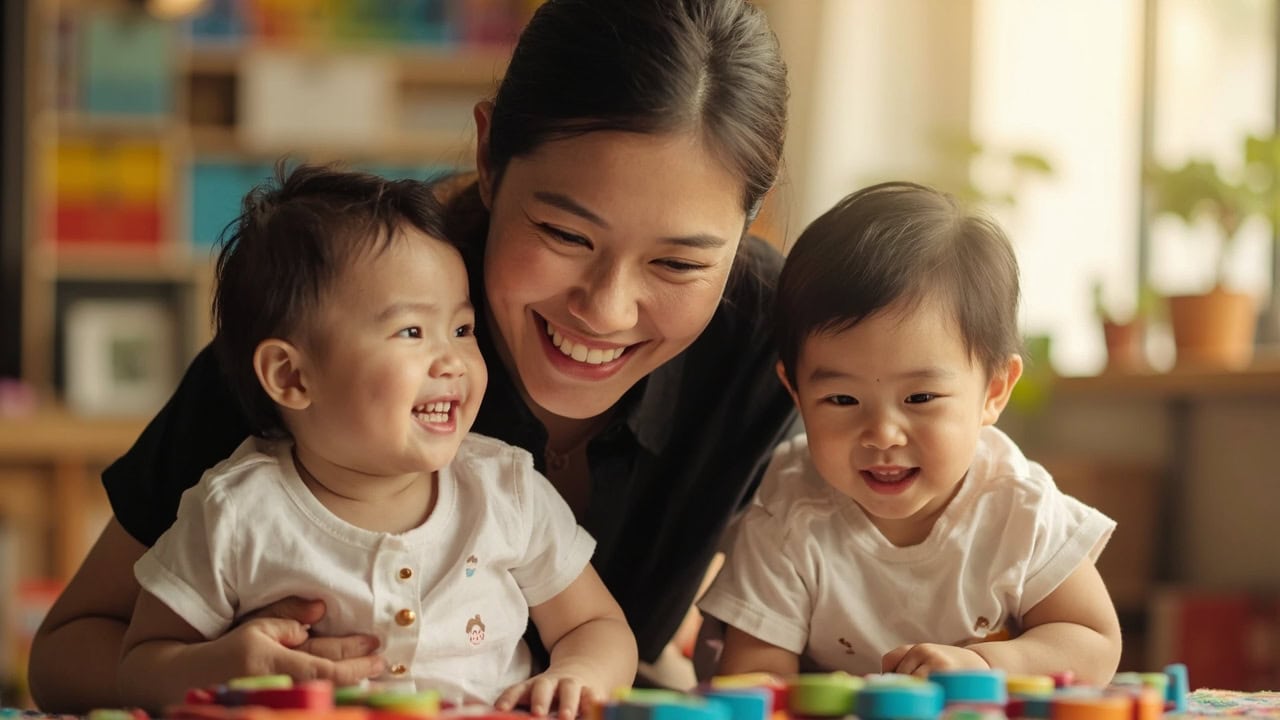
You will see it in the way the caregiver speaks to your baby. Not in baby talk—infantilizing, tuneless babble—but in the kind of warm, conversational tone that a person uses when they genuinely value the presence of the person they are speaking to. You will hear it in the way the caregiver narrates the baby’s experience: “Oh, you’re looking at the mobile. You see the colors spinning?”
This is not just pleasant noise. It is the building of language, the first lessons in the understanding that the world has meaning and that other people can help you make sense of it.
You will see it in the way the caregiver responds to distress. When your baby cries, what happens? Does the caregiver respond promptly, with comfort? Or does the caregiver leave the baby to cry, believing that this builds independence?
The research on this is unequivocal: infants who are responded to promptly in distress develop greater emotional regulation, not less. The infant who has learned that their cries bring comfort is the infant who learns to trust. The infant who has learned that crying is futile is the infant who has learned something deeply troubling about the nature of relationship.
You will see it in the physical environment. Is it clean but not sterile? Is there natural light? Is the temperature appropriate? Are there soft spaces, safe spaces, opportunities for your infant to move and explore within appropriate limits?
You will feel it in the way the caregiver speaks to you. Does the caregiver treat your questions as interruptions or as evidence of your investment? Does the caregiver share observations about your baby with genuine interest? Does the caregiver communicate with you as a partner in your infant’s care, or as a service provider fulfilling a contract?
Questions to Ask Any Infant Care Provider
- What is your caregiver-to-infant ratio?
- Will the same caregiver care for my baby every day?
- How do you handle my baby’s distress? What is your approach?
- How will I receive updates about my baby’s day?
- What does a typical day look like for an infant in your care?
- How do you support infants during the separation transition?
- What training have your caregivers received in infant development?
Red Flags Every Parent Should Watch For
- You are discouraged from visiting or calling—quality care has nothing to hide
- The caregiver speaks dismissively about your baby’s needs or your concerns
- The environment seems listless or under-stimulating—infants should have varied sensory experiences
- Crying is constant and unaddressed—this is not a sign of “toughening up”
- The caregiver cannot articulate their approach to infant development, separation, or the specific needs of the age group they claim to serve
You know your baby better than anyone. If something feels wrong, it may be wrong. If something feels right, investigate further—but also allow yourself to believe it.
Understanding EduNanny Singapore’s Approach
EduNanny is an initiative developed in direct partnership with Singapore’s ECDA Childminding Pilot. We are not a traditional childcare center, and we are not simply a matching platform. We represent something more deliberate: a home-based childminding model that brings the warmth, attentiveness, and individualized care of a dedicated caregiver into a structured, supported, and quality-assured environment.
Through the Childminding Pilot, EduNanny offers pathways that include home-based care, community-based care, and center-based care—because Singapore families are not monolithic, and the care arrangement that works for one family may not work for another.
What Remains Constant Across Our Approach
- Low caregiver-to-infant ratios of up to one to three in home-based settings
- Rigorous caregiver training in infant development and responsive caregiving
- Ongoing support and supervision for all childminders
- A philosophy of care rooted in developmental science rather than mere compliance
- Transparent communication with parents as partners, not clients
We understand that infant care carries a particular weight of trust. You are not simply hiring someone to watch your child. You are inviting a person into the most intimate period of your baby’s life. We take that trust seriously. Our childminders are vetted, trained, and continuously supported to ensure that the care they provide meets the developmental needs of infants with specificity and warmth.
Our Understanding of the Parent-Caregiver Relationship
Our childminding approach is built on the principle that we are not caring for your infant in your absence. We are caring for your infant alongside you.
Every observation we make, every milestone we witness, every moment of your baby’s day becomes part of a shared narrative that we return to you. We do not replace the parent. We extend the circle of trust that your infant is learning to inhabit.
This is the difference between care that disrupts attachment and care that supports it.
Accessibility and Support for Singapore Families
For families navigating the financial realities of quality care, we work within the pilot’s fee structures to offer affordability without compromise. We facilitate the use of available subsidies, including CDA and Baby Bonus, so that cost does not become an unnecessary barrier to quality.
We have developed tools to support communication and accessibility, including our Thomas AI Chatbot, available to help parents navigate questions about care, development, and the practicalities of childminding—so that guidance is available whenever you need it.
From Guilt to Conviction
The choice to seek quality infant care for your child is not a concession to modern life. It is not a compromise. It is not evidence that you have somehow failed at motherhood or fatherhood.
It is an act of love so profound that you are willing to examine your own fears, question your own assumptions, and make a decision that does not come from certainty but from conviction. It is the recognition that your child deserves more than one person can provide—not because you are lacking, but because human beings are meant to be raised in community, in relationship, in the village that evolution prepared us for.
You are not abandoning your infant when you place them in thoughtful, quality infant care. You are trusting. You are trusting a caregiver, yes. But you are also trusting your child—their resilience, their capacity to connect, their extraordinary ability to love multiple caregivers without dividing their heart.
You are trusting the process.
And in doing so, you are teaching your infant something that will serve them for their entire lives: that the world can be trusted, that love is reliable, and that the people who care for them are worthy of the trust you have placed in them.
That is not a small thing. That is everything.
Ready to Explore Your Options?
EduNanny Singapore is honored to walk this path with families in Singapore—not as a service provider fulfilling a transaction, but as a partner in the most important work any of us will ever do: raising the next generation.
If you are navigating infant care decisions, we invite you to learn more about our childminding approach through the ECDA Childminding Pilot. Every family’s journey is different, and we are here to answer your questions, address your concerns, and help you find the care arrangement that honors both your child and your circumstances.
You may also connect with our team directly, or learn more about who we are and what we stand for.
The first goodbye is not an ending. It is the beginning of a trust that your child will carry with them, long after these early days are over.
Thank you for trusting this conversation. Thank you for trusting your child. And thank you for trusting, when you are ready, us.