When Your Child Grows Beyond Family Care and That’s Okay
“`html
When the Arrangement That Worked Stops Working
There comes a moment — it rarely arrives with fanfare — when a parent realizes that what they have been doing is no longer quite enough. It is not a failure. It is not a crisis. It is simply a recognition that their child has grown, and with that growth comes a new set of needs, and those needs are asking something different of them.
You may have felt it already. Perhaps it was watching your toddler absorbed in a screen while dinner was being prepared, because grandparents needed a moment’s rest. Perhaps it was noticing that your child had few opportunities to play alongside other children — to learn the language of sharing, negotiation, and friendship in real time. Perhaps it was something smaller and harder to name: a sense that your child’s days, however full of love, were missing something — some structure, some spark of curiosity being gently lit.
Or perhaps it was the growing understanding that your parents, who raised you with such devotion, are now older, more tired, carrying their own aches and limitations — and that asking them to do what they once did effortlessly has quietly become a weight neither of you will name aloud.
This is the moment we want to speak to today. Not to burden you with more worry, but to sit beside you in it — because you are not alone in this moment, and because what you do next may be one of the most important decisions you make for your child.
Quick Summary: The Transition from Family Care to Professional Childcare
- Why it happens: As children grow, their developmental needs evolve beyond what informal family care was designed to provide
- The emotional reality: Singapore parents carry guilt, gratitude, and the weight of multigenerational expectations — all at once
- The reframing: Choosing professional care is not replacing family love; it is expanding what your child receives
- What quality looks like: Structured, developmentally intentional care with attentive ratios, trained caregivers, and warm environments
- The opportunity: When navigated thoughtfully, this transition often deepens family bonds rather than strains them
Why Care Arrangements Change — and Why It Feels Different in Singapore
When a new baby arrives in a Singapore family, grandparents often appear at the hospital with willing hands and generous hearts. They help fold tiny onesies, offer to watch the child so parents can return to work, and contribute to building the lives families want to give their children. This is not just practical. It is deeply relational. It is woven into who we are — how we love, how we express care across generations.
But children do not stay as babies. Their needs shift, sometimes quietly, sometimes with startling speed. A newborn needs to be held, fed, and loved — and grandparents are extraordinary at this. But a toddler needs more. They need peer interaction, structured stimulation, appropriate challenge, and the social confidence that comes from learning alongside other children. They need routines that scaffold their developing sense of security, and environments designed with their rapid brain development in mind.
The arrangement that felt so natural when the baby was small begins to strain — not because anyone has done anything wrong, but because your child has simply grown beyond what informal care was designed to offer.
In Singapore, this transition carries a particular texture. We are a city of multigenerational families, of a cultural architecture that has always understood that it takes a village. When a parent begins to feel that something is shifting, the feeling is rarely simple. It is layered. It carries love and guilt in equal measure.
It asks a parent to hold two truths at once: I am grateful beyond words for what my parents have done, and I am beginning to see that my child needs something more.
This tension is not a sign of ingratitude. It is a sign of attunement — of paying attention to what your child actually needs, rather than what you wish they needed, or what would be easiest to provide.
The Guilt Is Real — and It’s Worth Paying Attention To
When you first considered that perhaps your child would benefit from more structured, more developmentally rich, more professionally attentive care, did a voice inside whisper something like: what kind of parent am I, if I am the one who steps back from family?
Did you worry that choosing professional care meant that you were replacing the irreplaceable? That you were telling your parents — in some quiet, unspoken way — that their love was not sufficient?
Let us be very clear: the love your child receives from grandparents is irreplaceable. It is a gift. It shapes your child’s sense of security, of family, of belonging. Nothing in what follows is meant to diminish that.
And yet, love and developmental readiness are not the same thing. A child can be deeply loved and still crave more. They can feel profoundly secure with grandparents and still need peers. They can be adored and still benefit from the structured, attentive, professionally designed environment that quality childcare can offer.
These truths do not cancel each other out. They coexist — and honoring them both is what thoughtful parenting actually looks like.
Having the Conversation With Your Family
The conversation many Singapore parents avoid for as long as possible is the one with grandparents and extended family about shifting care arrangements. This conversation is difficult not because families are unkind, but because they care deeply.
Grandparents may hear this conversation as a verdict — that they are no longer needed, no longer trusted, no longer valued. Your own guilt may amplify what they are thinking, and the result is a silence that helps no one.
What if we approached this conversation differently? What if, rather than framing the shift as a replacement, we framed it honestly — as a recognition that our children have reached a stage where more is being asked, and that professional, structured, developmentally intentional care is the right next step, not because family care was wrong, but because our child has grown beyond its design?
Grandparents who have given years of loving caregiving can be invited into a new role — one of continued connection, continued presence, continued belonging — rather than pushed out of one. The child still knows grandma’s voice, grandma’s warmth, grandma’s stories. What changes is not the child’s relationship with family, but the primary architecture of their weekday care.
After the transition, grandparents often become more joyful, more relaxed, more present grandparents. The exhaustion lifts. The relationship transforms from obligation into presence, and in that transformation, something lovely re-emerges.
What Your Child Needs at This Stage — and How to Recognize Quality
Most children are more resilient than we give them credit for — and more perceptive than we often realize. They notice when we are tense. They sense when something is being held back. And they thrive when the adults around them are confident, calm, and genuinely at peace with the choices being made on their behalf.
A child transitioning from informal family care to a quality professional setting brings with them the accumulated security of being loved — by parents, by grandparents, by extended family. That security is not fragile. It does not shatter when a new caregiver enters the picture.
What it requires is not sameness, but reliability. Warm environments. Attentive caregivers. Consistent routines. Genuine responsiveness.
What Children Often Discover in Quality Professional Care
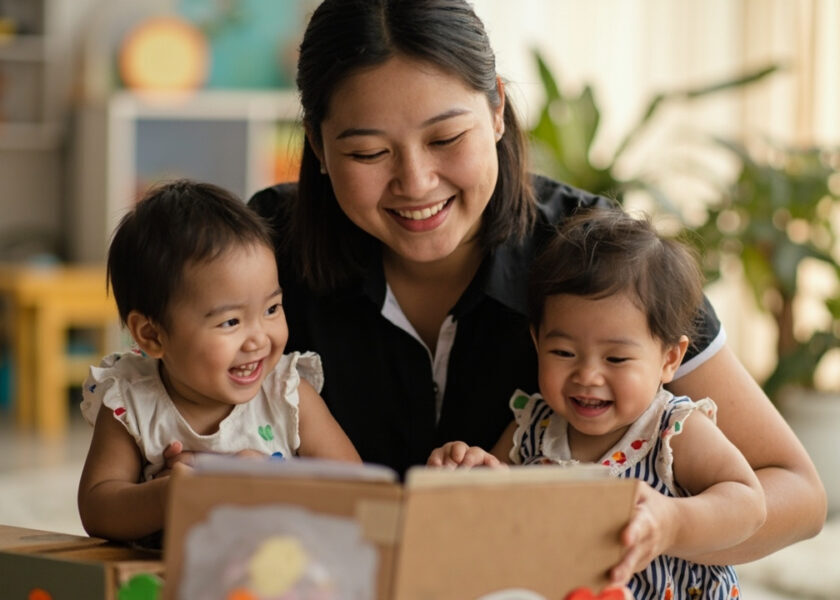
- A child who has been loved deeply at home but has had limited peer interaction begins to discover what it means to share, to negotiate, to build a tower and watch someone else knock it down and laugh together about it
- A child who has been mostly in the company of adults develops social confidence among other children, learning the intricate, exhausting, beautiful dance of early friendship
- A child whose days have been loving but unstructured begins to find rhythm — predictable transitions, meaningful activities, the gentle scaffolding of a day designed with development in mind
These are not small things. They are the building blocks of the person your child is becoming.
What Quality Actually Looks Like
Not just care, but genuine developmental readiness. When evaluating options for your child, ask yourself:
- Child-to-caregiver ratio: Are there enough attentive eyes, enough responsive hands, enough individualized attention? At this age, when neural pathways are being formed faster than they ever will again, ratio matters enormously
- Daily structure: Does it balance activity and rest, independence and support, structure and play? Young children thrive with predictability that is neither rigid nor chaotic
- Caregiver support: What do the caregivers themselves receive — training, support, professional development? Attentive caregivers need to be attended to
- Physical environment: Is it safe, warm, designed for small bodies and curious hands? The space should invite exploration while protecting your child
- Family partnership: Is there genuine communication with parents — not just daily updates that say nothing, but transparency, partnership, trust?
These are not luxuries. They are the baseline of what your child deserves at a stage when their brain is developing faster than it ever will again.
An Honest Answer to an Honest Question
We founded EduNanny by BUTLER because we believe that the transition from family care to professional care is one of the most significant — and most underserved — moments in a Singapore family’s life. We believe parents deserve more than a childcare slot. They deserve a partner who understands the emotional weight of what they are navigating, who will not judge them for making this choice, who will receive their child with warmth and intention and genuine expertise, and who will communicate with them — honestly, transparently, consistently — as they do so.
Our Approach
EduNanny operates within the ECDA Childminding Pilot, and we hold that framework not as a limitation but as a commitment. It means we work within structures that prioritize your child’s safety and development. It means that ratios are designed so that every child receives the attentiveness this age demands.
Our care runs Monday to Friday, in care blocks designed to serve families across Singapore — whether you are in the heart of the city or in the heartlands. We offer both home-based and centre-based pathways, because every family’s situation is different, and the right solution is the one that actually fits your life.
Transparency You Can Trust
Where we have deployed CCTV measures, we do so not because we distrust, but because we believe in openness. We believe you deserve to know, with confidence, what your child’s day looks like. We believe that trust is built through transparency, not secrecy. And we believe that the more you know, the more you can relax, the more present you can be when you are with your child — because the hours apart are hours in which your child is safe, seen, and well-cared for.
Support Beyond the Hours
Parenting in Singapore is demanding. The questions do not stop at the door of the childcare setting. Thomas, our AI companion, is there — accessible, knowledgeable, responsive — to help you navigate what you need, when you need it. Not a replacement for human guidance, but a complement to it, ensuring you are never navigating this alone.
Your Questions, Honestly Answered
“Am I replacing my parents’ role?”
You are not replacing your family. You are expanding what your child receives. You are adding to the village, not dismantling it. Grandparents remain grandparents — with all the joy, all the connection, all the belonging that role carries. What changes is the primary architecture of weekday care, and that change, approached with honesty and care, can actually deepen family bonds rather than strain them.
“Will my child feel abandoned?”
Children bring with them the accumulated security of being loved. That security does not shatter at the door of a new care setting. What children need is not sameness but reliability — warm environments, attentive caregivers, consistent routines, and genuine responsiveness. When these conditions are met, children do not just cope with transitions. They often flourish within them.
“Is professional care really better for development?”
Different contexts serve different purposes. Grandparents excel at unconditional love, family continuity, and emotional security. Quality professional care excels at structured development, peer interaction, and professional attentiveness. Your child does not have to choose between these. They can have both — and the best outcomes happen when families and professional caregivers work together as partners.
“How do I afford this?”
Quality should not require sacrifice. Our care is designed to be accessible within pilot fee structures. CDA and Baby Bonus can be utilized, because the financial logistics of parenting should not add another layer of anxiety to an already complex decision.
A New Chapter for Your Family
Here is what we have seen, over and over: when parents move through the guilt, through the conversation with grandparents, through the logistics and the worry and the second-guessing, and arrive at a choice made with genuine intention — they often look back and realize it was one of the best decisions they ever made.
Not because it was easy. But because it was honest. Because it put their child’s needs first, even when that required discomfort. Because it opened a new chapter — for the child, for the family, for the relationship between grandparents and grandchildren, for the parent’s own sense of peace.
The transition from family care to professional care is not a failure of love. It is the next act of it. It is your child growing, and you growing with them, into something new and more fully realized.
It is the recognition that love, to be its best, sometimes needs to be organized, structured, and supported by people who are professionally committed to doing exactly that.
Moving Forward With Confidence
If you are reading this, you are probably somewhere in the middle of this journey. Perhaps you have already had the conversation with your family. Perhaps you are still gathering the courage to begin. Perhaps you are simply trying to understand whether what you are feeling is valid — whether it is okay to want more for your child, even when that means something changes.
It is okay. It is more than okay. It is the work of paying attention to what your child actually needs, and having the courage to seek it.
You are choosing to meet your child where they actually are, rather than where they used to be. And that is not something to feel guilty about. That is something to feel quietly proud of.
What to Do Next
- If you are considering this transition, start by honestly assessing your child’s current developmental needs — and whether your current arrangement is meeting them
- If you have not yet spoken with your family, consider how to reframe this as evolution rather than replacement — an invitation into a new role, not a removal from an old one
- When evaluating care options, prioritize warmth, ratio, structure, and genuine communication with families — these are the indicators that matter most
- Trust your instincts. You know your child. You know your family. You are capable of making this decision with wisdom and love
EduNanny by BUTLER is here for that. For your child. For your family. For this chapter, and whatever comes next.
We would be honored to walk it with you.
Ready to explore what thoughtful, professionally grounded infant care can look like for your family? Connect with EduNanny by BUTLER — where your child’s development and your family’s peace of mind are held with equal care.
#singaporechildcare #infantcareSG #childmindingSG #professionalchildcare #EduNannySG #multigenerationalparenting #singaporefamilies #transitioningtocare
“`