The Quiet Grief of Successful Parenting in Singapore
The Evening Arrival Moment No One Warns You About
There is a moment that happens every evening, in homes across Singapore, that no one talks about. You have probably lived it.
You walk through the door after a full day—sometimes a harder day than you expected, sometimes a day that asked more of you than you knew you had. And there, in the doorway of the living room or the kitchen or the play area, is your child. Happy. Occupied. Deeply, contentedly themselves. Running toward you not because they need rescue, but because the day is done and they are glad to see you.
And in that moment, something unexpected moves through you. Not quite relief. Something more complicated than that. Something that feels almost like loss.
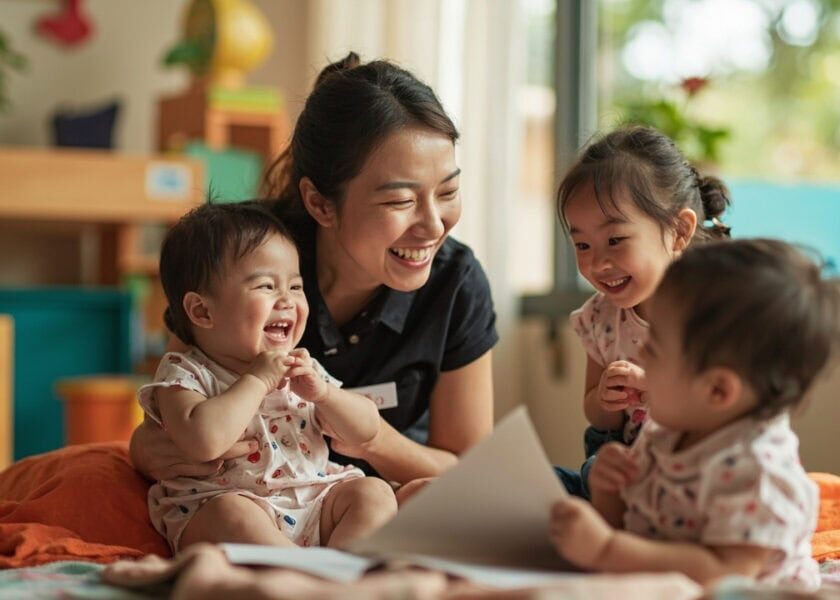
You had prepared yourself for the difficult days—the tears, the clinging, the uncertainty. But what you were not prepared for was this: the moment your child settles in. The moment they run to the caregiver when you drop them off. The moment they wave goodbye without hesitation. The moment you arrive at pick-up and find them laughing, or building something, or asleep in a cot they trust, in a place they feel safe.
You expected to feel proud. You expected to feel the relief of knowing your choice was right. And you do feel those things, somewhere beneath the surface. But what surfaces first—what catches in your throat and makes you pause in the car before you go inside—is something closer to grief.
Let us name what you are feeling. Because it deserves to be named accurately.
| What You Feel | What It Actually Means |
|---|---|
| Guilt when your child runs to the caregiver | Your child trusts the world—and that trust was built by you |
| Grief at being “needed less” | Your child can explore confidently because you gave them a secure base |
| Anxiety about being replaced | Your bond is so strong it can bear the weight of secondary attachment |
| Quiet relief that your child is happy | You chose well—you created the conditions for this comfort |
Understanding the Guilt-Relief Paradox
This is what we call the guilt-relief paradox, and it is one of the most honest, most unaddressed tensions in modern parenthood. It is the paradox that keeps Singapore working parents awake at night—not because they doubt their choice, but because the success of that choice has surprised them with its emotional complexity.
Not because your child loves you less. Not because your bond is weaker. But because the world of your child has expanded, and in that expansion, you are encountering something that no one warned you about: the strange grief of successful parenting.
Why This Feels Sharper in Singapore
Here is what makes this paradox particularly acute in the Singapore context. We live in a culture that places extraordinary weight on maternal presence. Not just in the abstract, but in the specific, everyday judgment of extended family, of friends, of neighbours.
It is the grandmother who asks why the child is in care. The auntie at the market who comments on how independent the baby seems. The raised eyebrow. The knowing smile. The gentle suggestion that perhaps you could try one more time with a different arrangement.
And beneath that external pressure is something even more powerful: the internalised belief that good parents are physically present. That presence equals love, or at least that love requires a certain quantity of proximity. That if your child needs you, you should be the one answering that need. And that if someone else is answering it—happily, confidently, with ease—then perhaps your presence is less necessary than you believed.
This is the silent weight. The one that does not appear in most parenting conversations, because those conversations tend to focus on the decision itself—whether to return to work, how to choose childcare, what the research says about early development. These are important conversations. But they do not address the moment that comes after the decision has been made and the decision has worked.
They do not address what it feels like when your child does not need you to survive anymore.
What Your Child’s Comfort at Childcare Actually Means
When your child settles happily into childcare—when they form a warm, trusting bond with their caregiver, when they run to that caregiver in the morning, when they wave at you with confidence and say goodbye without fear—this is not a referendum on your bond. It is a product of it.
This is where the research on secure attachment becomes not just interesting, but essential.
Developmental psychology tells us something that can feel counterintuitive at first: a child’s ability to bond confidently with a secondary caregiver is evidence of a primary attachment that is secure enough to bear the weight of exploration. The child who can separate well is the child who knows—deeply, in their bones—that the parent will return.
The child who can form a trusting bond with someone else is the child whose first bond taught them that the world is safe enough, that relationships are reliable enough, that love is consistent enough to be extended.
Your child does not love their caregiver instead of you. Your child loves their caregiver because of what you built. Because of the foundation you laid in those early months and years, in the moments of meeting their needs, in the consistent presence that taught them what trust feels like.
The caregiver bond is not built on the absence of your bond. It is built on the strength of it.
The Evening Arrival Moment Is Emotional Data
Think of it this way: the evening arrival moment—the one we have been circling around—is not a test you are failing. It is evidence. When your child is comfortable, content, at ease in their caregiver’s care, what you are seeing is the outcome of something you did right.
You chose a care arrangement that feels safe. You chose people who meet your child with warmth and consistency. And your child, in turn, learned to trust because you taught them how.
The guilt you feel when you see them run to the caregiver instead of clinging to you—this guilt is not a warning sign. It is the shadow side of a very good feeling, which is love. You love your child so much that the thought of them needing someone else feels like loss.
But this feeling, when we look at it clearly, is the cost of having succeeded. The parents who feel nothing at pick-up are often the parents whose children have not yet formed that secondary bond. The parents who feel this complicated, tender grief are the parents whose children are thriving in ways that require them to be less central, at least for these hours.
You Are Not Failing. You Are Being Succeeded.
This is the reframing that Singapore parents need to hear, because the cultural weight we carry is heavy and it is particular. We are told, in a thousand subtle ways, that our presence is irreplaceable—and this is true, in a sense, but not in the way we have been led to believe.
Our presence in the early years created the security that now allows our children to venture out. We are not being replaced. We are being succeeded, in the most beautiful sense of that word. Our children are growing into the world that we prepared them for.
This is what good parenting looks like when it works. It looks like a child who can separate without fear. It looks like a child who waves goodbye. It looks like a child who runs to you at the end of the day not because you are their only safety, but because you are their home base, their harbour, the person they return to after exploring the world with confidence.
The emotional truth we do not talk about at pick-up is this: the evening arrival moment is hard not because something is wrong, but because something has gone right. And that rightness asks something of us.
It asks us to hold our children’s expanding worlds without gripping so tightly that we make them small. It asks us to be the kind of secure base that can allow exploration. It asks us to love in a way that includes the caregiver, the classroom, the community of people who will help raise our children—not because we are absent, but because we are present enough to share.
What Quality Childminding Looks Like—and Why It Matters
If the evening arrival moment is hard because you are trusting someone else with the most important person in your life, then understanding what quality childminding looks like becomes essential—not just for your child’s development, but for your own peace of mind.
Quality is not a vague aspiration. It shows up in specific, observable ways.
- Consistent caregiver presence. Your child is not one of fifteen in a large room. In home-based settings, lower ratios mean attention is possible. Bonds can form. The caregiver can truly know your child’s rhythms, their cues, their needs.
- Responsive interaction. Watch how the caregiver responds when your child signals something—a need, a want, a discomfort. Quality care shows up in those moments of attunement, not just during photo opportunities.
- Transparent communication. You should know what your child’s day looked like. Not just that they ate and slept, but how they were. What they reached for. The new sound they made. The way they laughed.
- Environmental safety and warmth. The space should feel like somewhere a child can explore—not sterile, not overwhelming, but warm and organised for small bodies learning about the world.
- Trained and supported caregivers. The person holding your infant, the voice your baby associates with safety during the hours you are apart—this is not a generic role. This is a relationship, and relationships require skill, dignity, and support.
Where Quality Childminding Fits Into This Reality
Quality infant care and childminding are not just about supervision. They are about creating the conditions in which your child can thrive and you can trust—not the anxious, guarded trust that comes from hoping for the best, but the grounded trust that comes from knowing the people caring for your child are skilled, vetted, and aligned with what matters to you.
In Singapore, frameworks like the ECDA Childminding Pilot exist because families need options that are not just affordable, but genuinely good for children. The fee structures within such programmes are designed to make quality care accessible, with CDA and Baby Bonus funding usable where applicable. Financial pressure should not force families into arrangements that feel uncertain.
In home-based settings where ratios are kept low—up to one to three infants per caregiver—genuine bonds can form. The caregiver can learn your child’s cues and respond to them consistently. This is not a volume business. It is a relationship business, and relationships require the time and space to develop.
Transparency matters too: communication practices that keep you connected to your child’s day, and transparency measures that allow you to feel confident in the care your child receives. You do not have to wonder. You can know.
Your Questions, Honestly Answered
The concerns parents carry are real. They deserve honest answers, not reassurances that gloss over complexity.
“Will my child forget me?”
No. Attachment is not a finite resource that gets divided. It is built on consistency and responsiveness. The security your child feels with you is the same security that allows them to extend trust to others. Your child’s bond with their caregiver grows alongside your bond with them, not instead of it.
“What if my child cries every morning?”
Morning separation anxiety is normal, and it does not mean the care arrangement is wrong. What matters is the pattern over time. A child who cries at drop-off but is comforted quickly, who settles into play, who is happy at pick-up—this is a healthy separation. A child who cries continuously, who seems increasingly distressed, who shows signs of developmental regression—this is a different signal, and it deserves attention.
“How do I know the caregiver is really good?”
You cannot know with certainty, but you can look for evidence. Observe how the caregiver interacts with your child during visits. Ask specific questions: How do they respond when a child is upset? What does a typical day look like? How do they communicate with parents? Quality care shows up in the details.
“The judgment from family is unbearable.”
This is real, and it is heavy. The cultural pressure on maternal presence in Singapore is not imagined. It is woven into the fabric of how families operate, how communities talk, how even well-meaning relatives express concern.
What we can offer is this: the research is clear. Children do not need perfect parents. They need secure attachment. They need a home base that is stable enough, loving enough, and consistent enough to allow them to venture out. They need parents who can tolerate the grief of being needed less, because that grief is the cost of raising a child who can eventually leave the room, the home, and the harbour—confident that they will return.
Questions Worth Asking When Choosing Infant Care
If you are in the process of researching childcare options, these questions can guide what matters most—not as a checklist, but as a framework for discernment.
- Observe the caregiver-child interaction. During visits, watch how the caregiver responds to your child. Do they get down to the child’s level? Do they follow the child’s lead? Do they notice the small moments—the reaching, the exploring, the attempts at communication?
- Ask about communication practices. How will you know what your child’s day looked like? Is there a daily update? Will you receive photos? What is the expected response time if you message during the day?
- Understand the ratio and environment. How many children per caregiver? Is this a home-based setting or a centre? What does the space feel like for a small child?
- Inquire about training and support. What qualifications do caregivers have? How does the organisation support their ongoing development? Are caregivers vetted thoroughly?
- Ask about transparency measures. Is there CCTV? How are concerns escalated? What does the on-boarding process look like for new families?
- Trust your instincts. After the visit, notice how you feel. Not just whether the logistics make sense, but whether this feels like a place where your child could thrive. Your gut is not unsophisticated—it is integrating a lot of information.
The Permission You Deserve to Hear
You are not failing. You are not being replaced. You are not a lesser parent because your child loves someone else.
You are a parent whose child trusts the world enough to love it. And that trust did not appear from nowhere. It was grown in the soil you prepared.
Monday to Friday, across Singapore, families are making this work. They are waking up early, travelling across the island, building careers and raising children in a city that does not slow down for either. And they are doing it with the help of caregivers who become, in the best cases, trusted partners in their children’s lives.
The guilt-relief paradox is not a flaw in your parenting. It is evidence that you are paying attention. That you love deeply enough to feel the weight of your child’s expanding world. That you chose something that worked, and that working meant change, and that change—even good change—asks something of us.
Your child’s trust in their caregiver is built on your trust. Your child’s ability to explore is built on the security you provided. Your child’s easy comfort at childcare is not a quiet betrayal. It is a signal—a quiet, strong signal—that the foundation is solid. That the bond you share is secure enough to bear the weight of their world growing larger.
We live in a time when parenting has become both more complicated and more judged than ever. The pressure to be present, to be intentional, to be informed, to be enough—it does not let up. It intensifies.
And yet the research is clear. Children do not need perfect parents. They need secure attachment. They need a home base that is stable enough, loving enough, and consistent enough to allow them to venture out. They need parents who can tolerate the grief of being needed less, because that grief is the cost of raising a child who can eventually leave the room, the home, and the harbour—confident that they will return.
That is the work. That is what it looks like when it works.
And you are doing it.
If you are navigating the emotional complexity of returning to work while raising an infant in Singapore, and you are looking for a care arrangement where your child can thrive and where you can feel genuinely confident in the people caring for them, EduNanny is here to be part of that journey. Not the primary bond—that is yours and only yours. But a trusted extension of it. A secondary caregiver who meets your child with the warmth and attention you would choose for them, who communicates with you honestly, who understands that the hours they spend with your child are not just a service. They are a responsibility, and a privilege.
Learn more about EduNanny’s approach to quality childminding, or reach out to begin a conversation about what your family needs.