What Quality Early Care Actually Produces at School Entry
The Quick Answer for Busy Parents
Here is what decades of child development research—and what we have observed at EduNanny—tells us:
- The first five years matter more than any other developmental window. The brain builds neural pathways faster during this period than at any other time in life.
- Quality early care produces measurable differences at school entry. Children who receive intentional, enrichment-oriented care arrive at Primary 1 or preschool more confident, more socially capable, and more emotionally regulated.
- These skills compound over time. Emotional regulation makes social learning possible. Social fluency makes classroom participation natural. Language exposure makes reading accessible. These capabilities do not stay hidden in childhood—they grow and accumulate.
- The investment is already showing results. For parents who chose quality care: the choice you made was not just a childcare decision. It was a foundational one for your child’s trajectory.
Read on for the full explanation of why this is true, what it looks like in practice, and how it connects to the care your child receives at EduNanny.
Where Development Begins: The First Five Years
Let us begin where development begins: in the first years of life, when everything is still forming and nothing is yet fixed.
The science here is not new, but it is still remarkable in its implications. The first five years of a child’s life represent the most intensive period of brain development they will ever experience. Neural pathways are being built at a speed that will never be matched again. Language acquisition happens faster in these years than at any other point. Emotional regulation begins here—in the quality of responsiveness a child receives, in the consistency of their environment, in the presence of adults who are attuned to their needs and patient with their overwhelm.
What this means, practically, is that early childhood is not simply a phase to be endured before the “real” learning begins. It is the phase during which the capacity for all future learning is constructed. The metaphors are apt: it is the foundation, and the foundation determines what can be built upon it. It is the soil, and the soil determines what can grow.
The returns on this investment do not stay hidden in childhood. They compound. They show up, unmistakably, in the classroom, on the playground, in the way a child speaks to their teacher, in the way they respond to frustration, in the way they approach a new challenge—with curiosity instead of fear, with resilience instead of retreat.
What EduNanny Graduates Look Like at School Entry
So when we ask whether quality early care matters, we are really asking: do children who receive intentional, developmentally-rich early care arrive at school differently than they would have otherwise?
The answer, drawn from the observable outcomes of children who have walked through EduNanny’s doors and out into Singapore’s classrooms, is yes. Decisively, consistently, and beautifully yes.
Emotional Regulation: The Quiet Confidence of Knowing They’ll Be Okay
When an EduNanny child enters primary school or preschool for the first time, something is already different about them. It is not necessarily something that can be reduced to a test score or a ranking. It is more fundamental than that.
They walk into the classroom, and they are not overwhelmed. The newness of the environment, the presence of twenty other children, the authority of the teacher at the front of the room—none of this registers as threat. It registers as interesting. It registers as a space where they belong.
This is emotional regulation at work, developed through years of being in an environment where their feelings were named, where their distress was met with calm, where they learned that overwhelming emotions are temporary and that the adults around them are reliable.
Social Fluency: Knowing How to Be With Others
They turn to the child sitting next to them, and they do not freeze or cling to their parent’s hand. They extend themselves socially, tentatively at first, then with growing ease. They know how to share. They know how to wait. They know how to read the signals of another child’s mood and respond appropriately.
These are not skills that appear spontaneously at age six. They are skills that were cultivated in the daily rhythms of quality care, in the guided interactions with peers, in the patient facilitation of caregivers who understood that social fluency is not innate—it is taught, practiced, and refined.
Language: A Tool, Not Just a Medium
They speak, and their language is clear, rich, and confident. They have been spoken to—truly spoken to, with full sentences and genuine engagement—for years. They have been read to. They have been listened to. Their attempts at communication have been met with interest rather than dismissal.
The result is a child who arrives at school with language as a tool, not just a medium. They can express themselves. They can ask questions. They can follow complex instructions and articulate complex ideas.
Motor Readiness: The Body’s Contribution to Learning
They move through the physical space with a kind of embodied confidence. Their gross motor skills are developed through active play and guided movement. Their fine motor skills are refined through art, through manipulation of objects, through the small tasks of self-care that caregivers encourage with patience.
When they pick up a pencil, they grip it properly. When they navigate a staircase, they do so with balance and awareness. Motor readiness is often overlooked in conversations about school readiness, but anyone who has watched a child struggle with the physical demands of a classroom—cutting, writing, sitting upright—knows how critical it is.
A Love of Learning Itself
And beneath all of this, there is something harder to name but impossible to miss: a genuine, intrinsic orientation toward discovery. EduNanny children have been in environments where learning was framed as play, where curiosity was rewarded, where asking “why” and “how” and “what happens if” was met with encouragement rather than impatience.
They arrive at school already believing that learning is good. That it is safe to not know something, because the not-knowing is an invitation to find out.
EduNanny children arrive at school entry not just ready to meet the academic curriculum, but ready to inhabit the role of student—confident but not arrogant, capable but not anxious, socially fluent but not performative, emotionally regulated but not repressed, and above all, ready.
How It Happens: The Practice Behind Quality Care
You may be wondering how this happens. What is the mechanism? What does quality early care actually do, day in and day out, that produces these outcomes?
The answer lies in a philosophy that distinguishes intentional early care from conventional childcare—not because conventional care is without value, but because quality care makes a deliberate choice about what early care is for.
Enrichment-Oriented Care
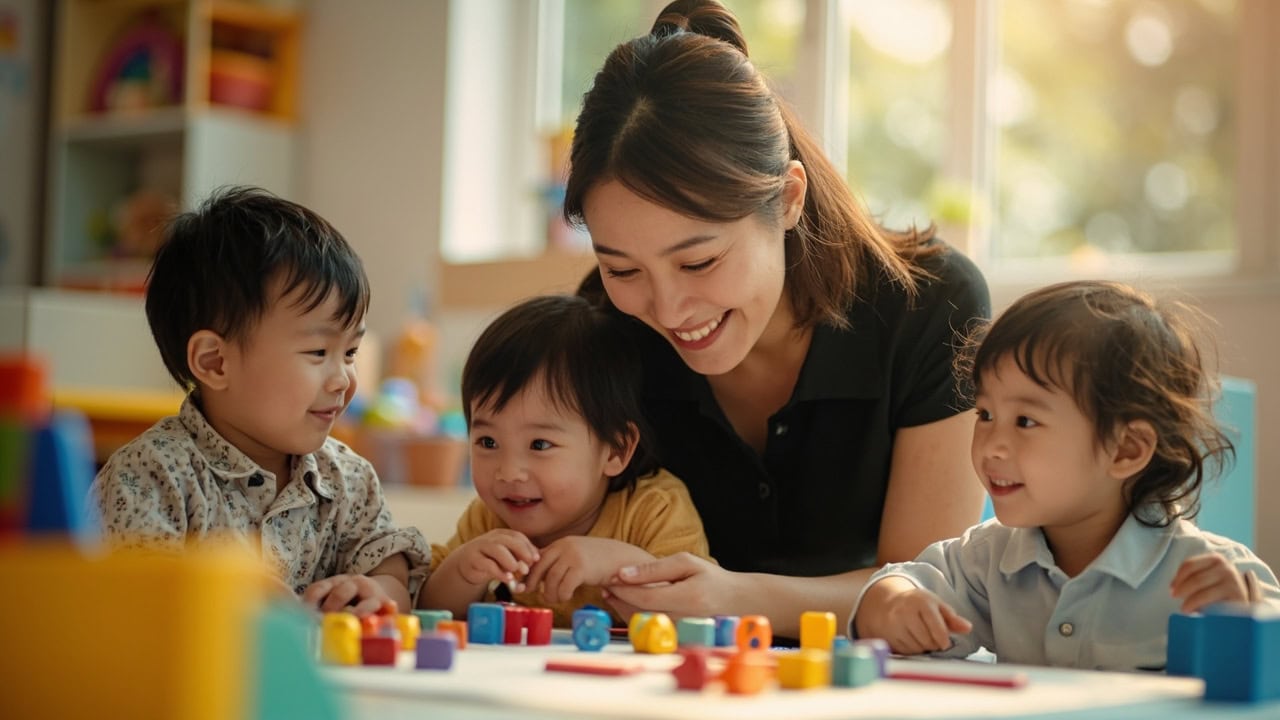
At EduNanny, the infant and toddler are not simply being watched. They are being observed, engaged, and guided. Every interaction is an opportunity for development. Every routine—the feeding, the diapering, the transition between activities, the arrival and departure of a parent—is a learning moment.
Caregivers do not simply keep children safe and comfortable. They stimulate. They respond. They scaffold. They name what the child is experiencing and model the language for what the child cannot yet express.
This is enrichment-oriented care: care that takes seriously the developmental potential of every moment, and treats the infant as a full human being deserving of intentional, responsive interaction.
What This Looks Like in Practice
Caregiver-to-infant ratios are designed to allow for genuine attentiveness. When a caregiver is responsible for one, two, or at most three infants, they can observe closely, respond promptly, and engage meaningfully. There is no triage of needs, no waiting for a distressed child to calm before they can be attended to. The child is seen. The child is known.
The environment itself is structured to invite development. It is not a room simply filled with toys, but a carefully considered space where visual stimulation, motor exploration, language exposure, and social interaction are woven into the architecture of daily life.
Communication with parents is consistent and transparent. Families receive updates, observations, and insights about their child’s day. Parents are kept informed so they can extend the learning at home and support their child’s development more fully.
Accessible by Design
EduNanny operates as part of the ECDA Childminding Pilot, which means it is structured to serve families across a range of economic circumstances. Key practical details for Singapore families:
- Fee structures are designed to be affordable within the pilot framework
- Payment mechanisms include the use of CDA funds and Baby Bonus where applicable
- Care arrangements run Monday through Friday, with options for both home-based and community or centre-based pathways
- The model reflects the reality of Singapore’s working parents—not care designed in abstraction, but care designed for the lives that families actually live
The Answer to the Question You Carried
Will this actually matter?
Yes. It already has.
You made a choice. You made a meaningful financial and emotional investment. You chose to prioritize the early years, to believe that what happened before your child could speak in full sentences or tie their own shoes would shape who they became. That choice was not without cost. It required resources, tradeoffs, and a kind of faith in something that could not yet be proven.
And now, when your child walks into their first classroom, you are watching for evidence. You are watching to see whether the investment paid off. Whether the long days apart were worth it.
This is not vanity. It is not pressure. It is a deep, human need to know that what you did mattered to the person you love most.
Here is what we want you to know: it did. Not because we are here to sell you on EduNanny, but because we have seen it. We have watched children walk out of quality early care environments and into the world, and we have seen what is different about them. The confidence that is not bravado. The social ease that is not learned performance. The language that flows with richness and clarity. The motor coordination that makes physical tasks effortless. The love of learning that makes school not a gauntlet to be survived but a garden to be explored.
The Long Game
The choice you made mattered. The hours you spent working so that your child could be in a place of quality care—the meals you ate quickly, the commute you made tired, the moments you missed that you will never get back—all of it compounded.
- The child who is confident in Primary 1 will be confident in Primary 4.
- The child who loves learning in preschool will approach secondary school with curiosity instead of dread.
- The child who learned to regulate their emotions in a responsive care environment will carry that capacity into adolescence, into adulthood, into their own relationships and their own challenges.
This is the long game of early childhood. And you played it.
For the Parent Still Deciding
If you are still weighing your options, still touring spaces and comparing fees, still wondering whether quality care is worth the investment—here is the clearest way we can frame the choice before you:
It is not simply a choice between childcare providers. It is a choice between two approaches to the early years: one that is passive and one that is intentional.
Passive care keeps children safe and comfortable. Intentional care shapes who they are becoming. The evidence is clear about which produces children who arrive at school ready—ready to learn, ready to belong, ready to thrive.
When you choose quality, enrichment-oriented care, you are not just outsourcing supervision. You are investing in your child’s developmental trajectory. You are giving them the gift of a foundation built to last.
What EduNanny Is
EduNanny is not a babysitting service. We say this not to disparage babysitting—every family needs support—but to be honest about what we are. We are a developmental partner. We are a place where infants are seen, where toddlers are guided, where children are prepared for the world they will inherit.
The caregivers are not simply attentive; they are trained, supported, and equipped to understand what they are doing and why. The environment is not simply clean and safe; it is thoughtfully designed to invite growth. The communication is not routine; it is genuine, transparent, and grounded in trust.
For the parent who has already chosen: you chose well. The question you carried was fair, and the answer is unfolding before you every day—in your child’s curiosity, in their confidence, in the way they look at the world like it belongs to them because, quietly and powerfully, you made sure it would.
Not because they are special. Because they were loved, carefully, in the years that mattered most.
Ready to Learn More?
If you are considering EduNanny for your child, we invite you to schedule a visit. See our environments, meet our caregivers, and ask us anything about how we support your child’s development from infancy through the early years.
The early years are brief. They are also foundational. Let us walk this path together.