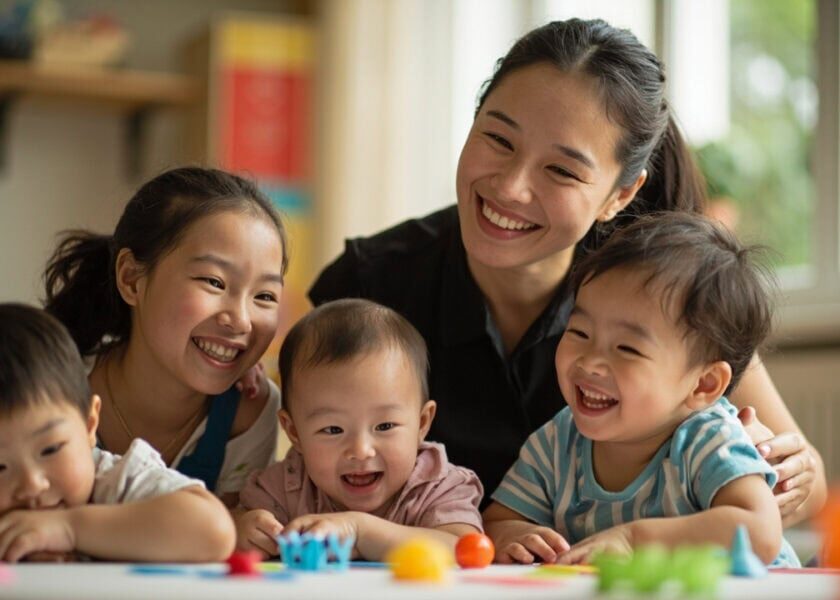
What Happens Inside Singapore’s Best Childcare Is Building Your Child’s Brain
The Hidden Curriculum: What Is Actually Happening Inside Quality Childcare
When a child enters a quality early care setting, she is entering a world that has been carefully considered from the ground up. Every surface she touches, every sound she hears, every interaction she has is part of a deliberate developmental architecture.
This is what we mean when we talk about the hidden curriculum in quality childcare. It is the sum of all the decisions made about a child’s environment, relationships, and daily experiences — with the explicit purpose of supporting how her brain grows, how she learns to communicate, how she understands herself in relation to others, and how she begins to make sense of the world.
Most parents, when they visit a childcare centre, look for the obvious things. Is it clean? Is the staff ratio reasonable? Does the teacher seem warm? These are important markers, but they only reveal the surface layer. Beneath that surface, in the rooms where children spend their days, there is a sophisticated system of developmental support operating continuously — often invisibly — even during moments that look like simple play.
Sensory Exploration: Where Neural Wiring Begins
Consider the sensory environment. In quality infant and toddler care, the physical space is not simply decorated. It is engineered.
The lighting is calibrated to reduce harsh glare while maintaining alertness. The textures available to a child are varied and purposeful, offering different tactile experiences that stimulate nerve development in the hands and fingers. The soundscapes are managed — not sterilised — because children need to learn to focus amid some background noise, just as they will need to do in school and eventually in the workplace.
Even the way objects are arranged on shelves matters. A child who can see, reach, and choose her own materials is developing a very different set of skills than a child who is simply handed something to occupy her time.
This is sensory-rich development, and it is happening in every moment a child moves through a well-designed environment. Her neural pathways are being wired not by flash cards or academic drills, but by the simple, profound act of exploring a world that has been set up to teach her through her senses.
- She learns about weight when she lifts a wooden block.
- She learns about cause and effect when she drops something and watches it fall.
- She learns about permanence when a toy rolls under the table and she looks for it — building the cognitive foundations for understanding that things exist even when she cannot see them.
All of this is learning. It looks like play because it is play. But it is play with purpose.
Language-Rich Interactions: The Conversations That Build Brains
In the first three years of life, a child’s brain is extraordinarily receptive to language. She is building the neural infrastructure that will support all future communication, literacy, and abstract thinking.
What she needs during this critical window is not just exposure to words, but rich, responsive, back-and-forth interaction with adults who are attuned to her communications and who expand her language in meaningful ways.
Quality caregiver-child interactions provide this naturally and consistently. When a childcare teacher notices a toddler pointing at a butterfly and says, “You see the butterfly! It has orange wings with black dots. It is fluttering in the flowers,” she is doing far more than naming an insect. She is:
- Building vocabulary
- Introducing descriptive concepts
- Modelling sentence structure
- Showing the child that her interests and communications matter and are valued
When a caregiver narrates a child’s actions back to her — “You are putting the red block on top of the blue block. You are building a tower” — she is reinforcing language connections that the child is beginning to form on her own.
In quality childcare settings, this kind of language-rich interaction is understood as a core developmental practice. Caregivers are trained to narrate, to expand, to respond, and to engage children in genuine conversation even before those children can form complete sentences.
Social-Emotional Learning Through Guided Peer Experience
A child in quality childcare is not simply developing her mind in isolation. She is learning, every day, how to be a person in relation to others. This learning does not happen automatically simply because children are placed in the same room. It happens when skilled caregivers observe, guide, and facilitate peer interactions in ways that build social competence gradually and supportively.
When a toddler reaches for another child’s toy and the caregiver steps in — not to scold but to scaffold — saying, “I see you want the truck. Sara is playing with it right now. Here is another truck you can use while you wait” — the child is learning something profound:
- Her desires are legitimate
- Other people’s feelings matter
- There are ways to navigate social situations that respect everyone involved
- Adults can help resolve conflict without removing the learning opportunity
These are not lessons that can be taught through worksheets or instructions. They are lessons that must be lived, experienced, and processed with the support of a knowledgeable guide.
Children in quality childcare also learn to read social cues, to share, to take turns, to express frustration in words rather than actions, and to recognise that other children have needs and desires just as they do. These are the foundational skills of emotional intelligence, and they are being built in the daily rhythms of a well-run early care environment — often in moments that seem unremarkable to the untrained observer but represent significant developmental leaps for the child.
Purposeful Play: Learning Disguised as Fun
Play is not a break from learning. Play is learning.
When a child builds a tower and watches it fall, she is conducting an experiment. When she pretends to feed a doll, she is developing narrative thinking and empathy. When she rolls a ball back and forth with another child, she is building turn-taking skills and understanding reciprocity. When she paints with her fingers instead of a brush, she is exploring texture, colour mixing, and cause-and-effect in ways that stimulate sensory and motor development simultaneously.
Purposeful play — the kind that happens in quality childcare — is structured not in the sense of being rigid, but in the sense of being thoughtfully designed to offer the right level of challenge, the right mix of materials, and the right level of caregiver support to move the child forward in her development.
Parents who understand this can look at their child’s afternoon and see not a gap to be filled with enrichment classes, but a rich developmental environment that is already doing the work. Quality childcare, when it is genuinely quality, is not a placeholder. It is a foundation.
What Quality Childcare Looks Like: A Practical Guide for Parents
Understanding the hidden curriculum is one thing. Recognising it in practice is another. Here is how the dimensions of quality care translate into observable, everyday moments.
The Environment as Teacher
- Are materials accessible at the child’s eye level? Can she choose what she plays with?
- Is the space calm and ordered, with varied textures and sensory options available?
- Are there quiet corners as well as active spaces?
Language as a Two-Way Street
- Do caregivers narrate what is happening, not just direct it?
- Are they responding to the child’s cues — pointing, babbling, interest — with words?
- Do children appear to be engaged in genuine back-and-forth interaction, not just being talked at?
Guidance Over Control
- When conflicts arise between children, does the caregiver step in to scaffold rather than simply stop the behaviour?
- Are children given language for their emotions — “I can see you are frustrated” — rather than just told to stop?
- Do children seem comfortable approaching caregivers, not just compliant in their presence?
Observation in Action
- Does the caregiver seem to know your child’s rhythms, preferences, and emerging interests?
- Is there any form of developmental tracking that you, as a parent, can access or discuss?
- Does communication from the centre go beyond eating and sleeping updates to include glimpses of your child’s engagement and development?
Addressing the Doubts Singapore Parents Carry
“Is my child just one of many?”
In settings where observation is a genuine practice and not just a box to tick, your child is seen. Her progress is tracked. Her needs are known. The care she receives is calibrated to who she is, not simply to what time of day it is.
Low ratios are not a luxury — they are the structural condition that makes personalisation possible.
“Enrichment classes feel like they are doing more”
It is understandable why parents feel this way. Enrichment classes produce tangible outputs — a certificate, a performed song, a visible skill. The hidden curriculum produces something quieter and harder to capture: a brain that wires itself well, a child who knows how to navigate social complexity, a learner who is curious and self-directed.
These are harder to photograph. They are not less real.
“I should be doing more myself”
Choosing quality childcare is not a compromise. It is an investment in your child’s developmental architecture at a time when that architecture is most malleable and most in need of rich, intentional support.
Quality childcare does not replace what you are doing at home. It complements and amplifies it. You have not outsourced your parenting. You have extended it into a space where your child can receive the kind of developmentally rich care that works alongside what you are doing every day.
“How do I know if the centre is actually good?”
Look beyond the surface markers. Ask about caregiver training. Ask about ratios. Ask whether observation is part of their practice and how they share it with parents. Visit at different times of day if you can.
Watch how caregivers interact with children when no parent is watching. The quality of those unscripted moments will tell you more than any tour or brochure ever could.
Your Role as an Informed Observer
Here is a simple shift that can change how you experience childcare drop-off and pick-up.
When you pick up your child at the end of the day, instead of asking only what she ate or how long she slept, begin to notice the quality of her engagement. Does she seem curious about things around her? Does she initiate interaction? Does she seem comfortable with the caregiver — not just compliant, but genuinely connected?
When she brings home artwork, ask not just what it is, but what she was doing when she made it, what she chose, what she said about it.
These are the small windows into the hidden curriculum that reveal the depth of what is happening. You are not meant to audit your childcare provider. But you are meant to be an informed observer — a partner in your child’s development who can see what is happening and celebrate it.
When you understand that your child is building neural pathways through sensory exploration, developing language through rich caregiver interaction, learning social-emotional skills through guided peer experience, and constructing cognitive foundations through purposeful play, you can look at your childcare arrangement with different eyes.
You can see not supervision, but education. Not babysitting, but building.
What EduNanny Is Designed to Be
EduNanny, a service operating within the ECDA Childminding Pilot under the BUTLER framework, is built on the understanding that quality early care deserves to be honoured with genuine operational commitment — not just good intentions.
Whether care is delivered through home-based or community-based pathways, the principles that define quality remain consistent:
- Low ratios that allow for personalisation and genuine observation
- Trained caregivers who understand developmental science and apply it daily
- Environments designed to support learning rather than merely occupy time
- Transparent communication with parents that goes beyond routine updates
- Observation as a practice — tracking your child’s developmental trajectory, not just her daily schedule
The practical dimensions matter too. Monday to Friday care blocks that align with real working lives. Fee structures within the pilot framework designed to make quality care accessible. The ability to use CDA funds and Baby Bonus contributions, because financial logistics should not stand between a family and the care their child deserves.
These are not marketing claims. They are the operational commitments that define what EduNanny is designed to be — a service that recognises parents have made a significant choice and owes them the evidence of why that choice matters.
Choosing Infant Care in Singapore: Key Quality Markers
| Dimension | What to Look For | Why It Matters |
|---|---|---|
| Sensory Environment | Accessible materials, varied textures, calm and ordered space with choices available | Neural wiring through exploration, not instruction |
| Language Interaction | Caregivers narrate, expand, and respond — genuine two-way engagement | Vocabulary and communication foundations built daily |
| Social-Emotional Guidance | Scaffolding over scolding; children given language for emotions | Emotional intelligence built through lived experience |
| Developmental Observation | Your child’s trajectory is tracked; communication reflects genuine knowing | Care calibrated to who she is, not just her schedule |
| Purposeful Play | Materials designed for challenge and discovery; caregiver support present but not intrusive | Cognitive foundations built through meaningful play |
| Ratio and Training | Low caregiver-to-child ratios; caregivers trained in developmental frameworks | The structural condition that makes everything else possible |
The Final Truth
The most valuable thing quality childcare offers is not a service feature or a ratio guarantee. It is the assurance that when your child is in a well-designed care environment, she is in a space where learning is not left to chance, where development is not assumed but observed, documented, and supported — and where every routine, every interaction, and every material in the room has been considered with her growth in mind.
You have not outsourced your parenting. You have extended it.
Your child is learning. She is building herself, day by day, in ways you may not always be able to see but that are real, significant, and lasting. And you, by making the choice to seek out quality care and by developing the understanding to see what is happening there, have become exactly what your child needs you to be: an informed, confident, and loving partner in her development.
That is no small thing. And it deserves to be recognised.
If you are exploring infant care or childminding options in Singapore and want to understand how EduNanny’s approach honours the principles described in this article, we invite you to start a conversation with our team. The right care for your child is closer than you think.