The Critical Difference Between Childcare and Developmental Care
The Silence Behind Every Parent Walking Away from Childcare
There is a particular silence that lives behind every parent walking away from childcare.
It is not the silence of distrust. Most parents in Singapore have come to trust the centres, the caregivers, the people who hold their children’s hands and wipe their tears. That trust is real and earned. But there is a quieter question that lingers beneath it—a question that does not speak its own name.
It goes something like this: What is actually happening in those hours? Is my child just safe, just occupied, just waiting? Or is something unfolding in there that I cannot see?
Your three-year-old cannot answer this question. Your eighteen-month-old certainly cannot. They will come home with paint on their fingers and songs in their heads, and when you ask what they did today, they will give you fragments—a colour, a name, a half-remembered rhyme. You will feel warmth watching them. But you will not feel certainty.
And certainty, for a parent in the early years, is not a luxury. It is the ground you want to stand on.
This is the tension we want to name today. Because it deserves to be answered—not with reassurance alone, but with understanding. Once you understand what quality care actually looks like, you will never see childcare the same way again.
The Science Behind Those Critical Early Years
Recent decades of research in early childhood development have given us something extraordinary: a window into what is actually happening inside those hours you cannot see.
We now understand, with a clarity that would have seemed impossible a generation ago, that the first thousand days of a child’s life are not merely a prelude to development. They are development.
The neural pathways that will govern language. The motor coordination that will govern movement. The social circuits that will govern how your child comes to understand themselves in relation to others. These are not waiting to be assembled later. They are being assembled now—in every interaction, in every response, in every moment when a caregiver notices what a child is reaching for, literally or figuratively, and offers the exact scaffolding that allows them to reach a little further.
This is not a metaphor. It is the architecture of early childhood itself, and it operates whether we are intentional about it or not.
What “Building” Actually Looks Like
The problem is that most of this architecture happens invisibly.
A child learning to say their first words is not just acquiring vocabulary. They are building the neurological infrastructure for thinking, for reasoning, for understanding nuance and managing frustration, for expressing what they need.
A child learning to stack blocks is not just developing coordination. They are constructing the spatial awareness that will later support mathematics, the persistence that will later support resilience, the pride that will later support a healthy sense of self.
A child learning to navigate the social world of other children—sharing, waiting, feeling the weight of disappointment and the lift of delight—is not just passing time. They are building the emotional regulation systems that will govern how they manage stress, form relationships, and move through the world for the rest of their lives.
The Four Connected Domains
Developmental science organises early childhood growth into four interconnected domains:
- Language and communication — vocabulary, listening skills, conversational ability
- Motor development — gross motor (running, climbing) and fine motor (grasping, drawing)
- Social-emotional development — empathy, self-regulation, relationship-building
- Cognitive development — problem-solving, attention, logical thinking
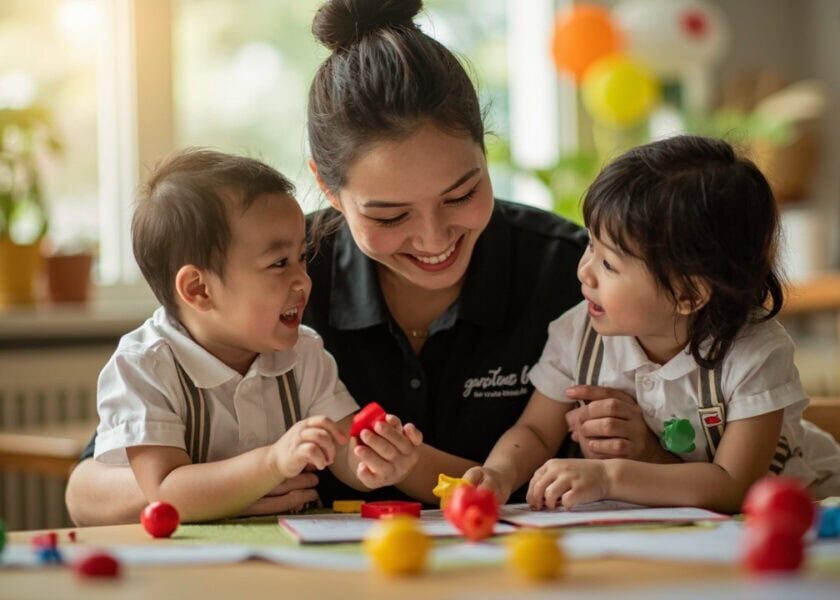
These domains are not separate departments running in parallel. They are woven together. A child who is physically active at the sensory table is simultaneously refining grip strength (fine motor), experimenting with cause and effect (cognitive), and navigating turn-taking with another child (social-emotional). A story circle is language practice, attention training, and emotional modelling all at once.
This interconnection is why quality care cannot focus on one domain in isolation. It must see the whole child—and respond to the whole child in every moment.
A Developmental Ecosystem, Not a Holding Service
What we are describing, when we step back and look at it whole, is not a list of practices. It is an ecosystem.
A developmental ecosystem is one in which every element is connected, every interaction carries potential, every moment is seen as an opportunity rather than simply a passage of time. In such an environment:
- A morning circle becomes language practice, fine motor work, and social learning at once.
- A sensory table becomes cognitive exploration and fine motor refinement.
- Quiet story time becomes vocabulary expansion, attention training, and a model for the pleasure of listening and being present.
This is what separates quality childcare from mere childcare. It is not a checklist of activities. It is a way of seeing children—seeing them as whole, capable, growing people who deserve environments designed for their flourishing, not just their safety.
And when you understand this, a different question emerges. Not “Is my child safe?” but “Is my child growing?” Not “Who is watching my child?” but “Who is witnessing my child?”
There is a difference. And it matters enormously in the early years.
Supervision Versus Nurturing: Why the Difference Matters
This is where the distinction between supervision and nurturing becomes not a philosophical point but a practical one.
What Supervision Does
Supervision keeps a child safe. It ensures they do not wander, do not hurt themselves, do not feel alone. This matters. Safety is the foundation. But safety alone is a floor, not a ceiling.
A childcare setting that offers only supervision is meeting a minimum standard. Your child is protected. They are fed, changed, watched over. But “watched over” is not the same as “nurtured.”
What Intentional Nurturing Does
Intentional nurturing begins with safety and builds upward from there. It asks:
- What is this child trying to do right now?
- What skills are they practising without knowing they are practising?
- Where are they in their developmental journey across each domain?
- What would move them forward in a way that feels natural, supported, encouraging rather than pressured?
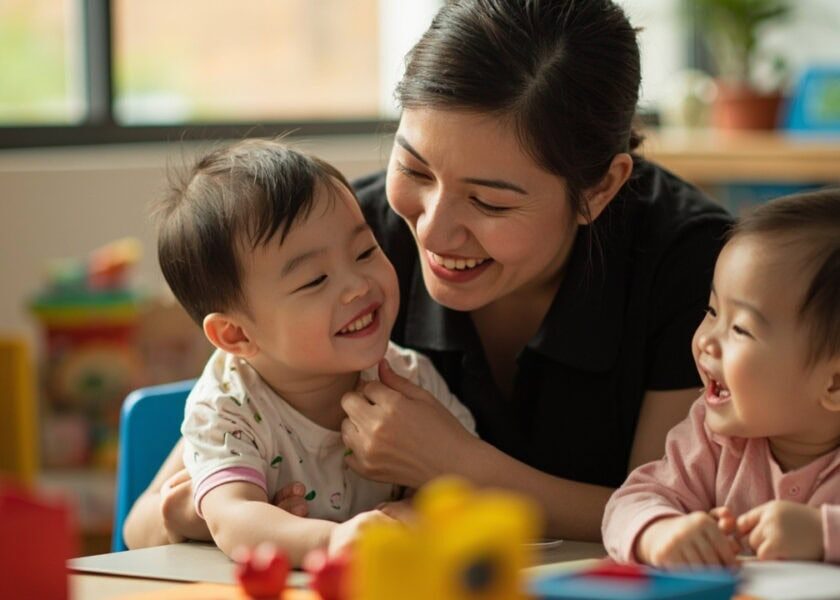
A trained caregiver in an intentional environment notices when a child is on the verge of a language burst—when they are listening more attentively, when their babbling is taking on conversational rhythm, when a little extra narrating of the world around them might give them the words they need to express what they are feeling.
That caregiver does not simply hand the child a toy when they cry. They pause. They observe. They offer language for an emotion the child has not yet learned to articulate. In that pause, something is happening: the child is learning that their feelings have names, that they can be understood, that communication is a bridge, not a wall.
The same is true for motor development. It is not enough to provide space for children to move. Intentional care means noticing the child who is ready to climb a little higher, the child whose balance is shifting in a way that signals a new gross motor skill approaching. It means arranging the environment to invite growth. Being present without hovering. Encouraging without rescuing. Allowing struggle without abandoning.
The Social-Emotional Dimension
In the social-emotional domain—the area that may matter most and receive the least explicit attention in many childcare settings—intentional care is perhaps most visible and most transformative.
When a caregiver notices a child withdrawing from the group, they do not simply leave the child alone. They sit nearby. They offer proximity without pressure. They model social engagement in a way that is inviting rather than intrusive.
When conflict arises between two children over a toy, an intentional caregiver does not simply adjudicate. They use the moment as a teaching one—helping each child name their feelings, see the other’s perspective, find a resolution that preserves dignity.
These are not interruptions to the childcare day. They are the childcare day. They are where development actually lives.
What to Look For: Evaluating Quality Childcare in Singapore
We know this is not how childcare is typically framed. Typically, the conversation is about logistics: availability, convenience, cost, safety records. These things matter, and they should be considered. But they are the starting point, not the destination.
The destination is this: Your child deserves to be known. Not just watched. Known—in their rhythms, their preferences, their emerging strengths, their quiet vulnerabilities. Known by people who are trained not just to keep them safe but to see them whole.
Questions to Ask Any Childcare Provider
When evaluating childcare options in Singapore, consider asking these questions—not as a checklist, but as windows into how the programme thinks about development:
- How do caregivers observe and track development across language, motor, social-emotional, and cognitive domains?
- What training do caregivers have in early childhood development—not just childcare, but actual developmental science?
- How is the daily schedule designed to support developmental goals, not just routine?
- How do you communicate with parents about what is happening and what the child is working on?
- What does a typical day look like, and how does each activity serve a developmental purpose?
- How do you handle moments when a child is frustrated, withdrawing, or in conflict with another child?
- What is your child-to-caregiver ratio, and how does that allow for individual attention?
The answers to these questions will tell you whether you are looking at a developmental ecosystem or a holding service. Listen not just for what they do, but for how they think about why they do it.
Common Concerns, Answered Honestly
“Will my child actually develop, or just pass time?”
In an intentional care environment, your child is not just occupying hours. Every interaction, every activity, every moment of the day is an opportunity for growth. The difference between passing time and building development lies in the intentionality of the caregiver and the design of the environment.
“How will I know what is happening if my child can’t tell me?”
Your child may not have the words to describe their day, but you should not be left to guess. Quality childcare includes regular communication with parents—not just “they had a good day,” but actual observation notes, developmental updates, and partnership in tracking your child’s growth. You should never feel like a stranger to your own child’s experiences.
“Is developmental care just a marketing term?”
It can be, which is why you should look for specifics. Ask about training. Ask about ratios. Ask to see how a typical day is structured and why. Ask how caregivers handle specific developmental moments. If a programme cannot answer these questions with specificity and insight, the developmental language may indeed be superficial. If they can, you are likely looking at the real thing.
“What if I feel guilty for not doing this myself?”
You are making a choice to entrust your child to professionals who are trained to do exactly what your child needs. That is not a failure of parenting. It is an act of love—choosing the best environment for your child’s growth, even when it is hard to walk away. The most important thing you can give your child in the early years is not constant presence. It is an environment that sees them, supports them, and builds them up.
EduNanny: Intentional Care Within the ECDA Framework
This is the philosophy that has shaped what we have built at EduNanny.
EduNanny operates within the ECDA Childminding Pilot, a framework designed to bring quality, intentional care to families across Singapore. We offer both home-based and centre-based pathways, recognising that families are not all the same, and that flexibility is not a compromise but a necessity in modern Singaporean life.
Small Ratios, Big Difference
Our infant ratios are intentionally small—up to one to three—which means your child’s caregiver is not dividing attention across a room. They are present, attentive, able to observe and respond in real time to the small moments where development is actually happening.
When a caregiver knows only three children, they can notice when one child’s babbling is taking on new rhythms, when another’s balance has shifted in a way that signals a new walking stage approaching, when a third is struggling with a social moment that needs gentle guidance. This is not possible in a setting where one adult watches over seven or eight infants simultaneously.
Accessibility Within Quality
Quality care should not be a privilege available only to families with unlimited resources. Our fee structures are designed to be accessible within the pilot framework, and we work with families to make the process simpler—including support for CDA and Baby Bonus usability. Financial complexity should not be a barrier to quality care.
Transparency as Partnership
We know that transparency is not optional when it comes to your child. We have implemented communication and observation measures, including CCTV where deployed, so that you are not left in the quiet uncertainty we described at the beginning of this article.
You can see what is happening. You can receive updates. You can be a partner in your child’s day, not a stranger to it.
The Deeper Standard
But the structural choices—small ratios, accessible fees, communication systems—are only the scaffolding for something deeper.
What EduNanny actually offers is a philosophy made visible. It is the belief that every child in our care is a whole person with a developmental trajectory that deserves to be understood, supported, and celebrated. It is the belief that caregivers are not merely attendants but trained professionals who know how to read development, who can scaffold growth in real time, who understand the interconnection of language, motor, social-emotional, and cognitive development—and who bring that understanding to every single interaction with every single child.
When your child is with EduNanny, they are not in a holding service. They are in a developmental ecosystem, tended by people who see what is happening and respond with intention.
The Choice That Underlies All Other Choices
You are not just choosing a place for your child to be. You are choosing an environment that will either support or miss the most critical developmental windows your child will ever experience. You are choosing whether those thousand days—the days that cannot be recovered, the days that are already passing—are filled with intentional nurture or merely benign presence.
That is not a small choice. It is the choice that underlies all other choices.
There is a generation of Singaporean children growing up right now whose neural architecture is being shaped by the environments we provide for them. Whose language skills are taking root. Whose motor confidence is emerging. Whose understanding of themselves as social beings is forming in the interactions they have with caregivers and peers.
These children will carry what happens in these early years with them for the rest of their lives—not as memories they can recall, but as foundations they will never have to think about because they are simply there. Solid. Reliable. Strong.
This is what quality care gives a child. Not just a safe place to be while parents work. A launching pad for everything that comes after.
If you are a parent in Singapore carrying that quiet question—whether your child is developing or just passing time, whether those hours are building something or just filling them, whether you are making the right choice—we want you to know something.
That question is not a weakness. It is a sign of love. And it deserves an answer.
Your child deserves to be seen—across every domain, in every moment, with intention and care and professional expertise. They deserve to be known by people who understand what is happening in those critical early years and who refuse to let them pass unobserved, unsupported, unnoticed.
That is what we have built at EduNanny. That is what we offer. And that is the promise we make to every family who trusts us with the most important work there is: growing a child.
If you are ready to move from quiet uncertainty to informed confidence, we invite you to connect with us and learn more about what intentional care can mean for your family.
Because the early years are not a rehearsal. They are the performance.