What Your Child Is Really Telling You After Drop-off
The Question That Lingers After Drop-off
There is a moment, familiar to many parents in Singapore, that arrives quietly — usually on a Tuesday morning, somewhere between the handover at the gate and the drive to work. The centre looks fine. The caregiver smiled. Your child seemed okay. And yet.
There is a small, persistent question that stays with you through the commute, through the first hour of meetings, through the lunch break when you catch yourself wondering: Is my child truly all right?
You are not a bad parent for wondering this. You did the research. You visited the options. You asked the questions that mattered — about ratios and qualifications, about how they handle the difficult moments. You made what felt like a thoughtful, considered choice.
And still, the question remains.
Here is what I want you to know: this question deserves a real answer. Not a dismissive reassurance that everything is fine, nor a clinical checklist that reduces your child’s experience to developmental metrics. It deserves the kind of answer that comes from paying close attention — to behaviour, to relationship, to the small signals that children send long before they have the words to explain what they feel.
Loving your child deeply means that this question will not go away easily. It is not a flaw in your parenting. It is evidence of your care.
Beyond Happy: What Thriving Really Means
Here is something that many parents discover only over time: the obvious signs of distress are not the ones that matter most.
A child who cries at drop-off is giving you a clear signal — one that caregivers and centres have protocols to address. But a child who has learned to comply, to perform okay-ness, to adapt to expectations without complaint — that child may be invisible in all the ways that matter. Not because anyone means to miss them, but because compliance looks so much like contentment from the outside.
The difference between a child who is happy and a child who is thriving matters enormously. Happiness is a feeling, context-dependent and moment-to-moment. A child can be happy in the shallow sense — entertained, distracted, comfortable — and still not be engaged in the deeper work of growing. Thriving is something else.
Thriving is the child who is not just tolerating the environment but actively participating in it. It is the child forming real bonds, testing real boundaries, encountering real challenges, and emerging with new capacities.
Signs of Genuine Engagement
A child who is merely compliant will often look passive. They will go along with activities, follow instructions, seem pleasant and agreeable in ways that feel reassuring.
But a child who is truly engaged — genuinely interested in the world around them — will show something different:
- They will initiate. They will bring things to your attention, ask questions in their own way — through gesture and sound and expression — about what is happening around them.
- They will express preference and displeasure in equal measure. A truly engaged child will sometimes resist, push back, show you clearly what they do and do not like.
- They are active participants, not passive recipients. They are explorers of their world, not just occupants of it.
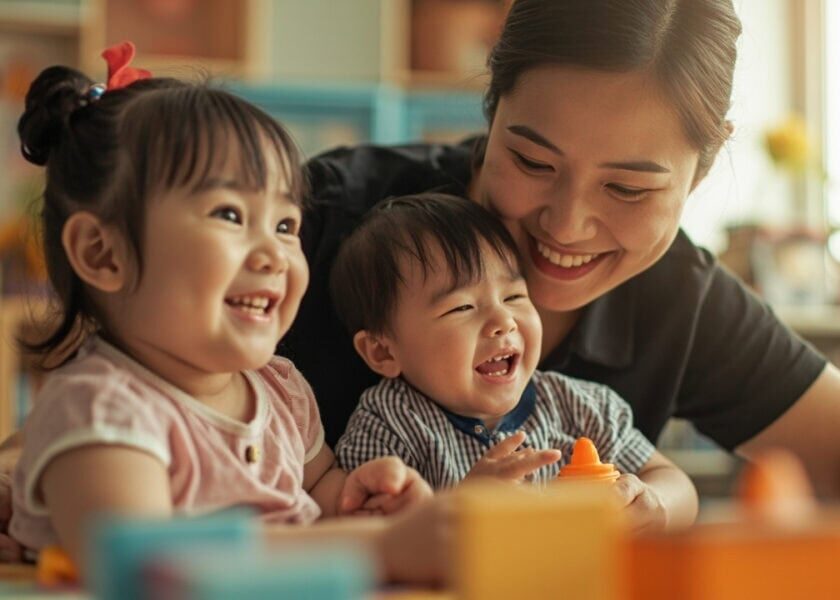
At pick-up, a thriving child might run to show you something — a drawing, a toy they found, a discovery they made. They might not want to leave. They might look forward to returning. This is not because the childcare has replaced you, but because it has become a meaningful part of their world — a place where they have stakes, relationships, and ongoing stories.
The child who is merely safe and occupied will often be neutral about the experience. The thriving child has opinions. Strong ones. And that is a good sign.
Surface Calm vs. Genuine Thriving
| Surface Happiness | Genuine Thriving |
|---|---|
| Calm and compliant at pick-up | Eager to share discoveries; shows you things unprompted |
| Follows instructions without resistance | Expresses preferences, sometimes pushes back |
| Neutral about the experience | Has opinions; does not want to leave |
| Passes through the day without incident | Initiates interaction, brings things to attention |
| Entertained and distracted | Curiously exploring, testing boundaries |
The Relationship at the Heart of It All
Singapore parents often carry a particular anxiety here, shaped by cultural context and the competitive pressures that define so much of modern parenting in this city. There is a worry that if your child bonds too strongly with their caregiver, something is being lost — some irreplaceable connection that should remain exclusively yours.
This worry is understandable. It deserves to be met with honesty rather than dismissal.
The Truth About Attachment
Here is the truth: a child’s capacity to form multiple warm, secure relationships is not a threat to the parent-child bond. It is an expansion of it.
Your child does not have a finite capacity for love and trust. They have a developing capacity — one that grows stronger the more it is used. A child who can bond deeply with a caregiver is a child who has internalized a secure base, and that secure base, paradoxically, includes you.
The anxiety about caregiver attachment often comes from a deeper, more vulnerable place: the fear that you are replaceable. That your child does not need you as much as you thought, or hoped, or needed them to need you.
This fear is real, and it is worth sitting with gently. But the reality is that the caregiver does not replace you. She extends the circle of safety your child has learned to expect from the world.
The Best Arrangements Work Together
The best childcare arrangements are not about finding someone to do your job while you are away. They are about creating a second secure environment — one with its own warmth, its own rhythms, its own relationship — that works in harmony with the first.
When your child is comfortable in both settings, when they feel genuinely held wherever they are, something remarkable happens: they become more confident, not less. They are not anxious about where they are because they trust the environment they are in, and they know you will return to one you trust equally.
Singapore’s Parenting Context
Let me share something I have observed working with families across Singapore — the particular weight that parents here carry in all of this.
There is an intensity here that cannot be overstated. The pace of life, the expectations around academic achievement, the economic pressures that shape so many family decisions — all of it creates a context in which parenting feels high-stakes in ways that can be exhausting.
At playdates and parenting groups, the comparisons creep in. Who is ahead in language. Who has moved to solid foods faster. Who is showing signs of early this or emerging that. It can feel like your child’s development is a performance with judges you cannot see, and every observation, every report, every casual comment from a caregiver becomes loaded with meaning.
The signs of genuine thriving are not the same as the signs of competitive acceleration. A child who is meeting every milestone early is not necessarily thriving more deeply than a child who is meeting them on schedule with curiosity and joy.
Milestones as Felt Experience
Developmental milestones are useful guideposts. They give us something concrete to look for, something measurable to track. But milestones as felt experience — the lived sense of a child becoming more capable, more curious, more connected — that is something richer and harder to quantify.
When a child masters a new skill, what you are really witnessing is not the achievement itself but the confidence that comes with it:
- The glow of knowing “I did something new.”
- The willingness to try again.
- The quiet pride that shows in posture and expression, the way they seek your eyes to share the discovery.
This is what thriving looks like. It is not a checklist. It is a felt quality of engagement with the world, a sense that your child is not just growing but experiencing growth as something rewarding.
What Quality Childminding Actually Looks Like
When you are researching infant care in Singapore, it is worth understanding what distinguishes an arrangement that merely keeps your child occupied from one that creates the conditions for genuine flourishing.
The Observation Advantage
Quality observation is at the heart of this distinction. It is not enough to know that a child was safe, fed, and entertained. What matters is understanding how they were — their emotional quality, their level of engagement, the subtle shifts that reveal something about their wellbeing.
Good observation requires:
- Consistent attention — the same caregiver or small team, day after day, building familiarity
- Individual focus — attention to each child’s patterns and what they reveal
- Informed interpretation — understanding typical development well enough to recognize when something significant is happening
- Shared understanding — communication with parents that goes beyond “everything was fine”
Why Smaller-Scale Care Makes a Difference
Within the ECDA Childminding Pilot, home-based and community-based care offers distinct advantages. The intimate scale means lower ratios, more individualized attention, and rhythms that can adapt to each child’s needs rather than demanding that each child adapt to the group.
With fewer children to attend to, caregivers can notice what they might miss in a larger setting:
- The child who is quiet when they should be engaged.
- The moment of frustration that passes quickly in a busy room but reveals something important about what a child is working through.
- The relationship deep enough to recognize not just what a child does but who they are becoming.
Transparency Without Surveillance
Communication between caregiver and parent is essential — you should know what is happening in your child’s day, not in exhaustive detail that becomes another item on your to-do list, but in meaningful glimpses that help you understand your child’s experience and connect it to what you see at home.
This is not a system built around surveillance or documentation for its own sake. It is a system built around the conviction that when parents are genuinely informed, they worry less. Not because they are told that everything is fine, but because they develop the capacity to see that — through shared observation, through consistent communication, through the evidence that accumulates over months and years — their child is truly thriving.
From Worry to Confident Trust
There is a shift that happens in parents who find this kind of arrangement. It does not happen overnight. It is gradual, built across countless small observations and interactions.
But at some point, usually without fanfare, the morning worry softens. The question that used to linger — Is my child all right? — begins to change. It becomes less urgent, less fraught, less like a demand for reassurance and more like quiet curiosity.
You find yourself asking not Are they surviving? but What did they discover today?
This shift is available to every parent who finds the right partnership — one built on genuine observation, developmental intentionality, and the kind of transparency that builds trust rather than requiring it blindly.
EduNanny is built on this belief — on the conviction that every child deserves to be known. Not just cared for. Not just kept safe. But truly known. And that parents deserve to see that knowledge reflected back to them, in observation, in communication, in the quiet accumulation of evidence that their child is not just settling, but flourishing.
The question you carry is a good one. The love behind it is real. And it is possible — with the right partnership, with genuine observation, with time — to move from that quiet morning worry to a steadier, more grounded trust.
Not blind trust. Not naive trust. But the kind of trust that comes from seeing clearly and caring deeply.
Your child is telling you more than you might realize. We are here to help you hear it.
If you are looking for a childminding arrangement in Singapore that prioritizes genuine observation, developmental warmth, and the kind of trust that grows from real knowledge, we invite you to learn more about EduNanny and what thoughtful, development-oriented care can look like for your family.