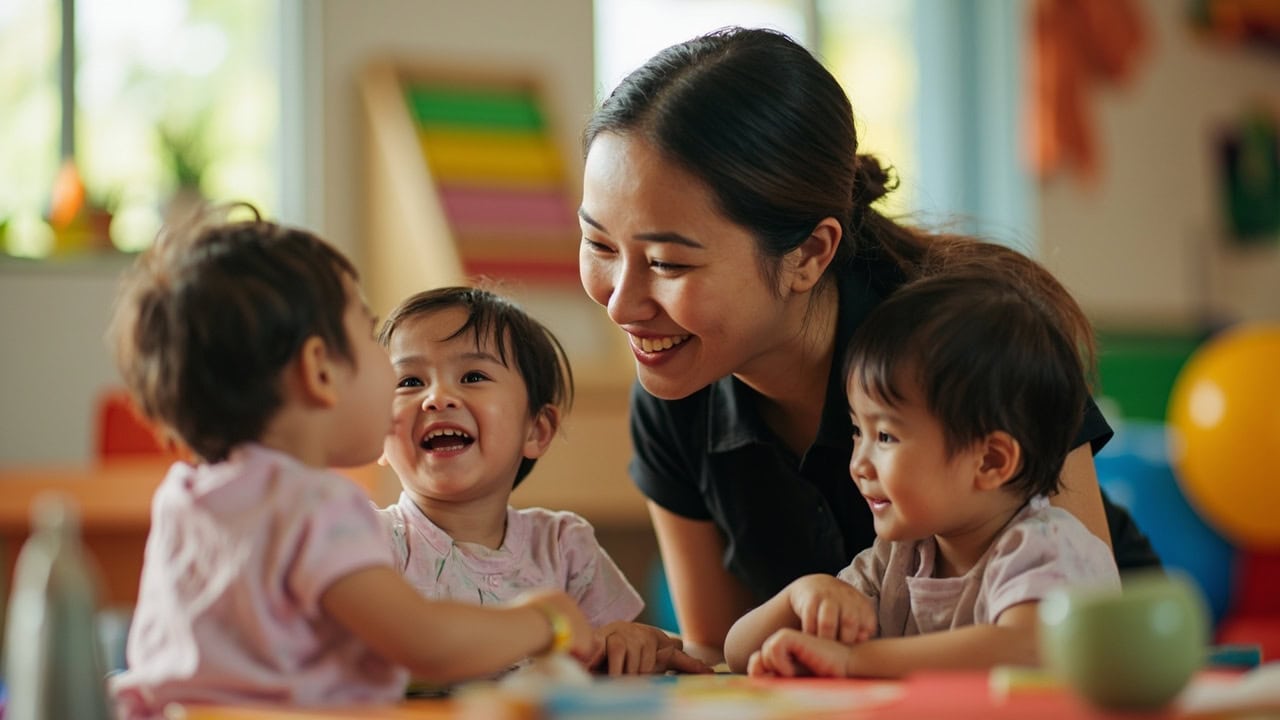
Beyond the Tour: What Real Childcare Quality Looks Like for Singapore Families
The Question Behind Every Tour
We live in a city that prizes transparency, efficiency, and measurable outcomes. Singapore parents are among the most research-informed, question-asking, checklist-comparing caregivers in the world. We tour facilities with the rigor of venture capitalists. We ask about curriculum frameworks, teacher qualifications, food sourcing, and camera systems. We leave visits armed with brochures, price sheets, and the firm intention to make a decision based on evidence.
And yet, when we drive away from that first drop-off, something in us knows that the most important things cannot be photographed, cannot be printed in a prospectus, and cannot be verified by asking the right questions on a scheduled observation visit.
What we want to know—what we have always wanted to know—is something deeper. We want to know: Who will my child be with when they are not performing? Who will they be with when the door closes, when the parent tour has ended, when the day settles into its ordinary rhythms? What does care look like when no one is evaluating it?
This is not an unreasonable fear. It is, in fact, the most fundamental question of early caregiving: Can I trust the people who are with my child when I am not there? And how can I possibly know?
The answer, I have come to believe, is not hidden. It is not locked behind closed doors or accessible only to those with special insider knowledge. The answer is visible, if we know where to look—and if we are willing to trust what we see when we look with care.
What Genuine Caregiving Quality Looks Like
Presence: Where Attention Actually Goes
There is a particular quality of presence that distinguishes genuine caregiving from competent performance. It is difficult to name, but you know it when you see it. It is the difference between a caregiver whose attention is fully inside the room with the children and one whose energy is partially elsewhere—already thinking about the next transition, already managing impressions, already preparing for the observation.
You can see this most clearly during transitions.
During arrival: When a child arrives in the morning, is the caregiver already looking toward the door, or are they crouched at the level of the children, already engaged? When the class moves from one activity to another, is there a gentle rhythm, a sense that the pace is set by the children’s needs rather than the schedule’s demands?
During challenges: When something goes wrong—a toy falls, a small conflict emerges, a child begins to unravel—where does the caregiver’s gaze go? Does it go to the child who needs help, or to the adult who might be watching?
Presence is not a state of perfection. Caregivers are human. They have difficult days, moments of distraction, times when they are simply tired. What distinguishes genuine presence is not the absence of these moments but what happens in their wake: whether the caregiver returns, whether they re-engage, whether they notice that they have drifted and choose to come back.
What it sounds like: Listen to how a caregiver speaks to the children in their care. Not the performative warmth—the “outdoor voice” that turns on when parents are near—but the real register, the one that emerges in ordinary moments. Is there genuine back-and-forth, or is it mostly direction? Do the children have space to respond, to be heard, or is the conversation always moving toward an outcome?
What it feels like: Watch how a caregiver physically positions themselves with a child. Do they sit at the child’s level, or do they remain standing, overseeing from above? When a child runs toward them, do their arms open, or do they simply gesture toward the next activity? In the early years, before language has fully developed, children read the world through proximity, touch, and gaze. They know, in their bodies, whether an adult is truly with them.
Warmth: The Difference Between Care and Performance
One of the most important distinctions any parent can learn to see is the difference between warmth and performance.
Performed warmth has a quality of uniformity. It is consistent across situations, smooth, and directed. It turns on when needed and turns off when the performance is over. A caregiver who is performing warmth will be equally warm to every child, equally attentive to every parent, equally animated in every interaction. The performance is rehearsed, and it is meant to be observed.
Genuine warmth is different. It is responsive, specific, and particular. It recognizes that children are individuals with distinct needs, moods, and rhythms. It fluctuates—not because the caregiver is inconsistent, but because it is real.
A genuinely warm caregiver might be playful with one child and quietly reassuring with another, might give more physical closeness to a child who is having a difficult day and more independence to one who is ready for it. The warmth is not aimed at an audience; it is aimed at the child.
Seeing it in distress: You can see this difference most clearly in how a caregiver responds to a child’s distress. A performing caregiver will soothe efficiently, will calm the child quickly, will return to the task at hand. This is not wrong—but it is a managed response, one that prioritizes resolution over attunement.
A genuinely warm caregiver will often slow down. They will wait longer before intervening. They will watch the child’s face, not just the behavior, and will respond to what they see there. The comfort they offer may not be the fastest route to calm, but it is the most present.
This is the difference between care that is performed and care that is lived. And it is visible, if you know how to look for it.
Specific Observations: The Evidence of True Attention
When you pick up your child at the end of the day, pay attention to what the caregiver says. Not just “She had a good day” or “He was great”—these are evaluations, not observations. Listen instead for specificity. Listen for the moments that the caregiver noticed, the small details that reveal they were truly watching.
“She spent a long time today trying to fit that small cup inside the larger one. She was so focused.”
“He asked to look at the book about dogs again. He keeps going back to the page with the golden retriever.”
“He was really tired today. I kept finding him little quiet spots where he could just sit.”
These specific observations are not just pleasant updates. They are evidence—proof that the caregiver was present, that the child was known as an individual, not just managed as one of a group.
Notice, too, how caregivers speak about children when children are present. “She doesn’t like to share” said in front of the child is a very different statement than “We’re working on sharing today”—the first is a label, the second is a narrative, and the difference matters enormously to the child who is listening.
The Mundane Is Sacred
In childcare, the mundane is sacred. This is a truth that most parents sense but that few outside the profession fully articulate.
The extraordinary moments—the birthday celebrations, the performances, the special visitors—these are the moments that photograph well, that make parents smile, that generate positive feedback. Every childcare environment can produce extraordinary moments. They require effort, planning, and coordination, and they are designed to be seen.
What requires something else—what requires genuine caregiving—is the ordinary. The diaper change. The meal that is refused. The transition from indoor play to outdoor time. The moment when a child is tired and needs comfort but does not yet have the words to ask for it.
These are the moments where quality lives or dies. And they are the moments that no tour can reveal, because tours do not happen during diaper changes.
How caregivers handle the small necessities: Watch, if you can, how a caregiver responds to resistance. Is there a rhythm to it, or is there urgency? When a child resists being changed, does the caregiver find a way to engage them, to narrate, to make it a moment of connection rather than a battle of wills? When a child spills something, does the caregiver respond with exasperation or with the quiet steadiness that communicates that this is normal, that it is okay, that they are not going to lose their calm over a knocked-over cup of water?
How caregivers handle waiting: Watch how a caregiver occupies waiting time. Children wait—a lot. They wait for transitions, for attention, for their turn. Is this dead time, a pause between activities, or is it also inhabited, also present? Do children wait alone, or do they wait with an adult who is using the time to connect, to observe, to be?
This is where the real work of caregiving happens. Not in the extraordinary, but in the ordinary, repeated, quietly holy moments that make up the bulk of a child’s day.
Curiosity and Ratios: What Makes Quality Possible
You cannot manufacture curiosity. This is one of the most important things about quality in early caregiving, and it is also one of the most difficult to evaluate on a tour.
Curiosity is not the same as knowledge. A caregiver can be trained to recite developmental milestones, can be equipped with curriculum guides and activity plans, can demonstrate an impressive understanding of child development in an interview.
But curiosity is different. Curiosity is a stance toward the child as a person, a willingness to be surprised, to notice what is new, to follow the child’s lead rather than impose the adult’s agenda.
You can see curiosity in the questions a caregiver asks. Not about the child’s development or behavior—”Is she walking yet? Does he use words?”—but about the child as a person. “What did she do this morning? What was she excited about?” These questions reveal a caregiver who wants to know the whole child, not just the childcare-compliant version.
You can hear curiosity in unexpected moments. When a child does something surprising, does the caregiver engage with it? “Look at how you’re holding that—tell me what you’re thinking.” Or does the caregiver redirect? “That’s not a car. Cars go on the road.” One response is curious; the other is corrective.
Curiosity shows in what a caregiver does not know. A curious caregiver will say, “I don’t know—let’s find out together.” A non-curious caregiver will supply the answer, will redirect the child to something known, will close the door on the unexpected rather than open it.
In a high-quality environment, children are allowed to be unpredictable. They are allowed to take the play somewhere new, to ask questions that have no easy answers, to be interested in things that are not on the lesson plan. This is only possible when the caregivers holding the space are genuinely curious about what children might show them.
Why Ratios Matter
There is a relationship between time and attention, between ratios and responsiveness, that is worth understanding clearly.
When a caregiver is responsible for too many children, the quality of attention necessarily changes. This is not a criticism of individual caregivers—it is arithmetic. When you are outnumbered, you learn to manage rather than to attune. You learn to see behavior rather than need, to respond to volume rather than to whisper, to prioritize safety over connection. These are not failures of character or care—they are adaptations to impossible conditions.
The ECDA Childminding Pilot, which EduNanny participates in, maintains ratios of up to one caregiver to three infants. This is not an accident. This ratio exists because research and experience have shown that it is in this space—the space between one and three—that genuine attunement becomes possible.
It is here that a caregiver can notice the small shift in a child’s mood before it becomes a cry. It is here that comfort can be immediate rather than delayed, that play can be supported rather than supervised, that the mundane can be transformed into connection.
When you visit a childcare environment, ask about ratios—not just in general, but for the specific room your child will be in, for the specific hours your child will be there. Do ratios change during different parts of the day? Who covers breaks and how are transitions managed? These are not intrusive questions. They are the questions of a parent who understands that attention is finite, that quality requires time, and that time is structured by ratios.
Trusting Your Own Observations
You already know more than you think you do.
This is not a platitude. It is an observation, grounded in years of watching parents evaluate care. When you spend time with your child, you learn them—not through formal study, but through the accumulation of small moments, the gradual accumulation of familiarity. You know their moods, their thresholds, their tells. You know when they are hungry before they ask for food, when they are overwhelmed before they melt down, when they need closeness and when they need space.
This knowledge is not inferior to professional knowledge. It is different knowledge—embodied, intimate, accumulated over time through devotion rather than training. And it is exactly the kind of knowledge that allows you to read quality when you see it.
When you observe a caregiver with your child, you are not starting from zero. You are bringing your knowledge of your child to the observation. Trust that knowledge. If something feels off, name it. If a caregiver’s energy does not match your child’s, that is information. If a caregiver speaks to your child in a way that feels misaligned with who your child is, that is data.
Too often, we dismiss these observations as anxiety. We tell ourselves that we are too close, too protective, too invested to see clearly. But this is not true. Your observation is one data point among many, and it is a data point that no one else can supply. The caregiver who tells you that your child is “fine” cannot tell you what your child felt when they woke up from their nap. Only you know that.
What Quality Environments Invite
A quality childcare environment does not ask you to suppress your observations. It invites them. It creates space for conversation, for questions, for the ongoing exchange of knowledge between the people who know your child best.
When you ask a caregiver about your child’s day and they cannot tell you anything specific, that is a problem. When you share something about your child’s evening and the caregiver does not connect it to anything, that is a problem. The relationship between parent and caregiver should be a relationship of mutual curiosity—each person contributing their piece of the picture.
This is what transparency means, in the end. Not just cameras and reports, though these have their place. Transparency means that what happens during the day is not a mystery. It means that you can ask and receive answers. It means that the caregiver is a partner in knowing your child, not a gatekeeper of information.
What EduNanny Offers
EduNanny was built on a simple premise: that Singapore parents deserve more than competence. They deserve connection. They deserve caregivers who are not just trained and certified but present and curious, who know their children as individuals, who value the ordinary moments as much as the extraordinary ones.
This is why EduNanny participates in the ECDA Childminding Pilot, offering both home-based and community or centre-based pathways. It is why we maintain the ratios we do—not because regulations require it, but because we believe it. We believe that attention is not a luxury but a necessity, that the first years of life deserve more than efficient management, that the relationship between caregiver and child is the foundation on which everything else is built.
- Monday to Friday care blocks designed to meet the real rhythms of working families.
- Transparent practices, including communication measures, because trust is built through openness, not secrecy.
- Affordable support within pilot fee structures, with CDA and Baby Bonus fund eligibility.
- Singapore context: we are here, for Singapore families, understanding these pressures, these children, this city.
We know that Singapore parents carry particular burdens. The cost of living, the pressure of dual-income households, the competing demands of career and family, the guilt that comes with leaving your child in someone’s care and the guilt that comes with staying home and wondering if you are giving enough.
We do not pretend these burdens do not exist. We cannot lift them entirely. But we can offer something in response to them: caregivers who are worthy of your trust, environments that honor the importance of what they are doing, a structure that makes quality possible.
How to Evaluate Care When You Visit
If you are currently researching childcare options, here are the concrete steps you can take to evaluate quality:
- Visit during ordinary times. Tours are designed to show you the best. Ask if you can observe during regular hours, not just during special activities.
- Watch transitions. Arrival time, cleanup time, naptime transitions—these reveal where attention actually goes.
- Ask specific questions. Instead of “How’s my child doing?” try “What was she drawn to today?” or “What frustrated him?” Specific questions invite specific answers.
- Notice what caregivers say about other children. Listen to how they speak about children not present. This reveals how they think about the children in their care.
- Ask about ratios. For what hours? For what days? Who covers breaks?
- Pay attention to how your questions are received. Are they welcomed or deflected? A quality environment has nothing to hide.
- Trust your gut during pickup. If something feels off, name it and ask. If the answer doesn’t satisfy you, that is information.
The Threshold Is Not a Wall
When you leave your child at the door of their childcare space, you are doing something brave. You are doing something that feels impossible—trusting someone else with the thing you love most in the world, while you go to do the things you must do.
The fear that lives in that moment is not weakness. It is love. It is the appropriate response to the stakes of what you are doing.
But here is what we have seen, over and over again, in the families who have walked through our doors: the fear does not have to be the final word. It can be the beginning of something else.
What you are doing when you drop your child off—if you do it with intention, if you choose well, if you keep looking and asking and noticing—is not abandonment. It is the beginning of your village. It is the beginning of a network of people who will hold your child, who will teach them, who will come to love them in their own way. It is the beginning of a relationship that can sustain you and your child through the long years ahead.
The closed door does not have to be a wall. It can be a threshold—a place where one kind of care ends and another begins, both of them real, both of them necessary.
You are not leaving your child with strangers when you leave them with us. You are building a family of sorts, an extended circle of care, a network that can help your child grow. And you are part of that network too. Your observations, your questions, your knowledge of your child—all of it belongs here. All of it is welcome.
So when you stand at that threshold, when you feel the fear, when you wonder if you have made the right choice—know that you are not alone. Know that you are doing something difficult and necessary. Know that there are people on the other side of that door who are paying attention, who are noticing your child, who are treating the ordinary moments as if they matter, because they do.
And know that you can always look closer. You can always ask. You can always trust what you see.
If you are ready to explore what genuine, present, curious caregiving looks like for your family, we invite you to begin the conversation with EduNanny. We are here to answer your questions, to show you our spaces, and to help you find the care that feels right.
Your child is worth looking closely for.