Why Quality Childcare Looks Nothing Like Supervision
What Quality Childcare Actually Looks Like
Here is what matters most when evaluating infant care or childminding in Singapore:
- Structured daily rhythms give children the security to explore and learn
- Intentional activities — sensory play, language-rich interaction, movement, rest — build development in measurable ways
- Quality care means your child is engaged, not merely supervised
- The right childcare partner creates continuity between your morning goodbye and evening reunion
- You deserve visibility into the day — not surveillance, but genuine transparency
Inside a Quality Childcare Day
Let us take you inside a day of quality childcare. Not in the abstract. In the specific, ordinary, quietly extraordinary moments that make up your child’s hours away from you.
The Morning Greeting
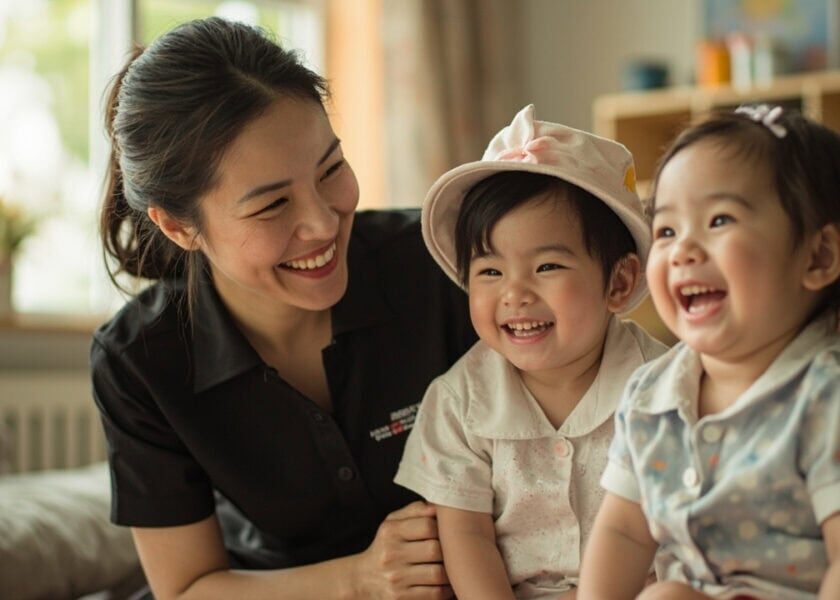
You arrive in the morning. A caregiver kneels or sits, eye level with your child. Your child’s name is spoken with warmth, with genuine recognition. There is a small ritual here — a greeting that belongs to this place, separate from home, belonging to the day ahead.
Your child is crossing a threshold, from the world of family into the wider world, and this greeting says: you are expected here. You belong.
Learning Through Sensory Experience
Then the morning unfolds. Sensory work begins — water, sand, textured fabrics, safe objects from the everyday world. A wooden spoon. A plastic container. A soft brush.
Your child learns through their hands, through nerve endings firing, through neural pathways forming in the architecture of a brain that is building itself, day by day, from the raw material of real experience. This is not play as entertainment. This is play as curriculum. Quiet, purposeful, and deeply developmental.
Language Taking Root
A caregiver speaks. Not only to direct, but to narrate. You are holding the blue cup. The water is cold. You poured it yourself.
Language is taking root in your child’s mind, not through a screen, not through a flashcard, but through the back-and-forth of real human exchange. Your child hears their own name in sentences. They hear the names of things. They hear the music of a voice that responds to them, that treats their gestures as communication, their sounds as language worth answering.
Movement with Intention
Movement follows. Crawling games. Supported standing. Gentle balance activities. Physical development is not left to chance. It is designed into the day, woven in with intention, because bodies grow strongest when movement is part of the rhythm.
Your child’s core strengthens. Their coordination sharpens. They learn the pleasure of their own physical capability, one small achievement at a time.
The Quiet Gift of Rest
And then, rest. A quiet room. A familiar sequence. A dimmed space that signals something important — that this world is safe enough to sleep in. That the body can let go here. That calm is not only possible, it is protected.
This is the beginning of self-regulation, not through instruction but through the consistent experience of a world that holds your child with care, even when their eyes are closed.
The Social Layer
There is also the social layer. Your child beside another. Not yet sharing, not yet taking turns — but noticing. Reaching. Watching. Learning that another person exists with their own responses, their own presence.
This is the earliest architecture of social intelligence, built not in a lesson but in the ordinary miracle of being with others.
The Rhythm That Builds Security
This is what a quality day looks like. Not supervision. Not babysitting. A carefully designed architecture of intentional moments, each one building on the last, each one preparing your child for the next.
It is built on a foundation that may be invisible to the untrained eye but is unmistakable once you know what to look for: rhythm, predictability, the same sequence of experiences, adapted for age and stage, day after day.
This is not rigidity. This is how young children learn that the world is reliable — that they can anticipate what comes next, and that what comes next is safe. Security is not given through words. It is given through the unchanging shape of a day that your child can begin to trust.
What most parents discover, once they find the right partner in care, is that the question transforms over time. It stops being about what is happening and starts becoming I can see what is happening. You notice it in small ways — the way your child settles into the morning greeting, turns confidently toward the caregiver, moves into the room with the ease of a place that is familiar and safe. You notice it when they come home: not depleted, not overstimulated, not quietly distressed beneath a brave face. Ready to play, ready to connect, ready to be your child in the way you most want to be their parent.
What Your Child Is Building
What your child is building, in these daily rhythms of quality care, is not only a set of skills. They are building an inner architecture of security, curiosity, and confidence that will carry them into every room they ever enter.
- Curiosity, because they have been in an environment that responded to their interests, that offered novelty within safety, that treated their questions — even the pre-verbal ones — as worth answering.
- Confidence, because the day has had a shape they could anticipate, and they met each transition and came out safely on the other side.
- The capacity to connect, because they have been with attentive caregivers and other children in a setting designed to teach them — through experience, not instruction — that the world is interesting and that other people are worth knowing.
These are not small things. They are the inner resources your child will carry into school, into relationships, into every new and challenging moment ahead. And they are built not in a single grand gesture, but in ten thousand ordinary days — in a greeting, a song, a spilt cup of water turned into a lesson in cause and effect, a small hand held across a room, a nap in a quiet room where the light comes through just so.
Quality childcare means the childcare day and your home evening are not separate worlds. They are one developmental rhythm, interrupted by a commute. When your child has been genuinely engaged during the day — stimulated, rested, nurtured in a structured environment — they come home ready to connect. Not depleted. Replenished. Ready to play, to be curious, to settle into your arms with the full, comfortable trust of a child who has had a good day.
EduNanny by BUTLER: Your Partner in Daily Care
EduNanny by BUTLER was built on exactly this understanding. We are part of the ECDA Childminding Pilot — which means our programme operates within Singapore’s national framework for quality, safety, and accountability in infant and childminding care. This is not an afterthought. It is the foundation.
Our programme offers both home-based and centre-based pathways, depending on what suits your family. We maintain ratios of up to one to three for infants, so that every child receives not just supervision but genuine, individual attention — the kind of responsive care that research tells us makes a measurable difference in early development.
Within the pilot structure, our fees are designed to be accessible, with CDA and Baby Bonus funding usable in applicable settings — so that quality care is not only available to those with considerable means.
We believe that what you cannot see should not have to be taken on faith. Our programme incorporates practical communication tools that give parents real visibility into the day — not surveillance, but genuine transparency. Because when you can see the rhythm, you can trust it.
Questions Parents Ask About Infant Care
Am I failing my child by working?
You are not. You are providing. You are building the life your family lives. But the hours apart carry developmental, emotional, relational weight — and they deserve the same intention you bring to the hours together. The right partner in care does not replace your role. It extends your care during the hours you are apart.
How do I know quality when I see it?
Look for rhythm. Predictability. A caregiver who kneels to meet your child’s eye. Language that responds, not just directs. Activities that feel purposeful, not just time-filling. And observe your child — before and after. Do they settle into the morning greeting? Do they come home ready to connect? These are the signs that speak louder than any brochure.
Is the cost worth it?
Quality early care is an investment in your child’s development and in your own peace of mind. Our fees are structured with accessibility in mind, and CDA and Baby Bonus funding can be used in applicable settings. The question to ask is not just the cost, but what your child is receiving in return — and whether the hours apart are hours well spent.
What if something goes wrong?
We operate within the ECDA Childminding Pilot framework, which means our programme meets national standards for safety and accountability. Our caregivers are trained and supported, and our communication tools keep you informed throughout the day. You should never feel that your child is beyond your reach or understanding.
What should I look for when evaluating childcare?
- Observe the morning greeting. Does the caregiver kneel to eye level? Is your child’s name spoken with warmth and recognition?
- Notice the rhythm. Is there a predictable sequence to the day? A well-structured day is not rigid — it is reliable.
- Listen for language. Are caregivers narrating, not just directing? Do they respond to your child’s sounds and gestures as if they matter?
- Watch for purposeful activity. Sensory play, movement, social interaction, rest — each should be present and intentional.
- Ask about communication. What visibility do you have into the day? The right programme will give you genuine transparency.
- Check the ratios. For infants, a ratio of one caregiver to three children or fewer means individual attention, not just supervision.
A Final Word
So when you ask yourself — at the door, in the car, at your desk — what are they doing right now? — let this be your answer.
They are being seen. They are being greeted by name. They are learning through their hands. They are hearing language that responds to them. They are moving their body with purpose and delight. They are resting in a place that feels safe. They are noticing another child, another voice, another way of being in the world.
And the person holding all of this together, day after day, is a caregiver trained and supported within Singapore’s national framework — someone who chose this work not as a job but as a calling, someone who understands that the smallest moments carry the greatest weight.
EduNanny by BUTLER is a daily partner in your child’s development. We bring structured, intentional care to every hour we are trusted with your child. We give you the visibility and transparency you need to move through your own day with peace of mind. And we hold the evening-to-morning rhythm alongside you — because the story of your child’s development does not stop at the childcare door, and we know that.
When you bring your child to EduNanny, you are not leaving them in someone’s care. You are placing them in a place where every greeting, every activity, every moment of rest has been considered. Where the rhythm of the day is not an accident but a curriculum. Where your child is not merely minded. They are developed.
Every single day. With patience. With intention. With genuine love for the work of early childhood.
And you can see it for yourself.
Ready to Learn More?
We welcome you to visit us, ask questions, and see our daily rhythm in action. Because choosing childcare is one of the most important decisions your family will make — and you deserve to make it with confidence, clarity, and the full picture in front of you.
Connect with us today to learn more about how we approach this work, or explore our programme overview to understand what quality, ECDA-aligned childminding looks like in practice.