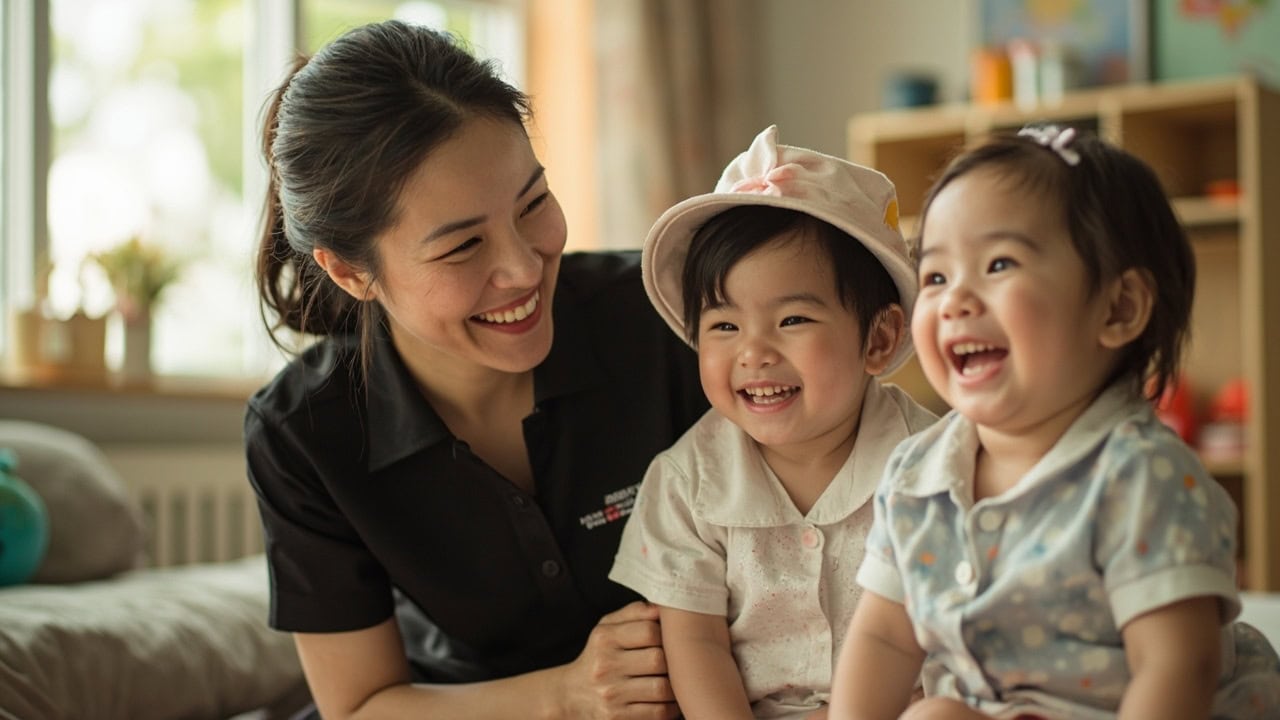
Reading the Signs Your Child Is Thriving in Quality Childcare
That Quiet Moment at the End of the Day
There is a moment familiar to every parent who has handed their child over to someone else’s care. It happens on the drive home, somewhere between the office car park and the childcare centre. The traffic slows you down. The weight of your workday settles in. And then, as you approach those familiar doors, something surfaces — a half-second pause where the question forms almost before you can think it.
How was her day? Was she okay? Was she more than okay?
You chose this centre. You visited, you asked questions, you trusted your instincts. You made a decision you felt confident about. And yet, something in you still wonders.
That wondering is not doubt. It is the voice of a parent who cares deeply, and it does not go silent just because you have made a good choice. It goes quiet sometimes — but it is always there, listening for signals.
This article is about those signals. Not about choosing childcare — you have already done that important work. But about what happens after, in the daily experience of knowing, with genuine confidence, that your child is not just safe, not just supervised, but truly thriving.
What Quality Childminding Actually Looks Like
Before you can recognise what quality care looks like, it helps to understand what it is not.
Supervision means a child is watched. Meaningful care means a child is known. These are fundamentally different experiences, and the differences become visible once you know what to look for.
In a room where children are merely supervised, you might see a child who is physically safe but emotionally adrift. She may be quiet, compliant, largely unnoticed. She may cry briefly and then stop — not because she has been comforted, but because she has learned that crying does not bring a response.
In a room where meaningful care is happening, you will see something different. You will see a child who is calm — not because she has been silenced, but because she feels secure. You will see a caregiver who notices the slight change in a child’s expression before she begins to fuss. Who offers a drink of water not because it is scheduled, but because the child’s voice has a particular quality that signals thirst. Who gets down to a child’s eye level and waits — not to redirect, not to correct, but to attune.
What Responsiveness Teaches Your Child
When a caregiver reads a child’s cues and acts on them with warmth, she is doing something that extends far beyond childcare. She is teaching that child, in the most primal and important way, that her needs matter. That she is worthy of attention. That the world is a place where reaching out gets a response.
That is the beginning of trust — and from trust, everything else grows. Language, social connection, emotional regulation, the confidence to explore. All of it has its roots in this early experience of being known.
The Role of Routine and Rhythm
Routine, for a young child, is not a cage. It is a compass. It tells her where she is, what comes next, and that the world is predictable enough to be safe and interesting enough to be exciting.
When a child knows that morning circle time comes after breakfast, and that snack time follows the morning walk, and that there is always a story before nap — she is not being controlled. She is being oriented. She is learning the rhythm of the day, and in that rhythm, she is learning to trust.
This routine is not rigid but responsive. It is not simply scheduled but intentional — built on warmth and attunement, which makes it one of the most powerful developmental tools a young child can have.
How to Read Your Child’s Daily State
Here is something practical that you can begin using today. When you pick up your child from childcare, pause for a moment before you ask anything. Look at her.
What does she look like? Not just physically — though that matters too. Is there ease in her body? Does she make eye contact? Does she seem glad to see you, or does she seem relieved in a way that hints at something heavier?
These are not diagnostic tools. They are pieces of information, available to you every single day, once you know how to read them.
Signs of a Child Who Is Flourishing
A child who is genuinely thriving in care will show you something specific:
- Curiosity. She reaches for things, explores, tries. She is engaged, but not overstimulated.
- Security. She can be soothed, because she has learned that soothing is possible.
- Warmth. She has begun to form a genuine attachment not just to you, her parent, but to the people who care for her during the day.
That last point might sound surprising. Does that mean she needs them more than me?
No. It means the opposite. It means she has been in an environment secure enough to allow her to love more than one person. A child who can attach warmly to a caregiver is a child whose developmental needs are being met. This is a sign of health, not a sign of replacement.
What Your Child’s Behaviour Tells You
Watch for these daily indicators:
- Does she run to a particular caregiver in the morning, or approach with hesitation?
- Has a new word appeared since the weekend?
- Does she hold her cup now with a steadiness that was not there a month ago?
- Does she mention the caregiver’s name, or talk about activities from her day?
- Is she sleeping well, eating well, showing signs of regulation rather than persistent fussiness?
These are not coincidences. They are your child sending you information — and the right childcare environment doing the same thing, in its own language.
Questions to Ask at Pickup
- What was the highlight of her day?
- How did she sleep today? Was there anything unusual?
- Did she discover anything new — a sound, a texture, a movement?
- How did she respond to the other children?
- Was there anything I should know about — any concerns, any moments of fussiness, any signs of something worth watching?
Ask these questions with genuine curiosity. Expect answers that are specific, honest, and meaningful. If the answers feel generic, that is information too.
EduNanny by BUTLER: Daily Partnership in Practice
What I have been describing — this commitment to attentive, responsive, daily care — is not a wish list. At EduNanny, it is an operational standard.
EduNanny operates under the ECDA Childminding Pilot, which means that care has been built within a framework prioritising the individual attention your child deserves. The ECDA Childminding Pilot represents Singapore’s growing recognition that quality childminding is not a convenience — it is a vocation. This framework gives structure and dignity to the role of caregivers while ensuring that families receive care that meets developmental standards.
For EduNanny, this means accountability to clear standards of practice, not just in initial enrollment but in the daily delivery of care.
Individual Attention That Actually Matters
With ratios of up to one caregiver to three infants, every child in EduNanny’s care receives a level of individual engagement that larger settings simply cannot provide. This is not a marketing claim. It is a structural reality that shapes every single day.
Caregivers at EduNanny are trained professionals who understand infant development with precision and care. They know that a six-month-old who is not yet reaching for objects needs different engagement than a twelve-month-old who is beginning to walk. They are not guessing. They are responding with informed, intentional warmth.
Home-Based and Centre-Based Pathways
EduNanny operates across both home-based and centre-based pathways, giving parents the flexibility to choose the arrangement that best fits their family. Whether that is care in your own home or in a dedicated community setting, the standard of responsive, individualised care remains consistent.
Communication as a Quality Indicator
When you pick up your child from quality childminding, you should expect to be told something. Not just that she ate well or slept well, though those things are noted. You should expect a caregiver who can tell you about her morning. The way she reached for a toy today with both hands. The sound she made when she discovered a new texture. The moment she fell asleep with her hand curled against a favourite blanket.
That kind of detail is not incidental. It is evidence. It is proof that someone was present, that someone was paying attention, that your child was not a number in a room but a person being known.
EduNanny maintains communication and transparency measures, including CCTV where deployed, because openness is not just a reassurance for parents — it is a reflection of values. The door to your child’s day is always open, not just literally but in spirit.
Addressing Real Parent Concerns
Singapore families navigating infant care have legitimate questions. Let me address the most common ones directly.
Affordability
We understand that childcare costs are a real and pressing concern. EduNanny operates within pilot fee structures designed to make quality childminding accessible, and we are committed to ensuring that financial constraints do not become a barrier to the care your child deserves.
For those eligible, CDA and Baby Bonus schemes are applicable, providing practical pathways to making quality care work within a family’s budget. Singapore families deserve access to childcare that is not just available, but excellent — and EduNanny is here to be part of that solution.
The Caregiver’s Role
The role of the caregiver is one of the most consequential and underappreciated professions in our society. A great caregiver is not just someone who keeps children safe. She is a child’s first teacher, her first playmate, her first translator of the world.
She is the person who sits on the floor and names what a child is looking at. Who claps when a toddler stacks two blocks, because she knows that from two blocks come three, and from three come towers, and from towers come the foundations of engineering. Who sings, who narrates, who makes eye contact and smiles — and means it.
At EduNanny, caregivers are not just employees. They are partners in your child’s development.
Technology as Support, Not Replacement
EduNanny is building tools that reflect the same commitment to attentive, responsive care — not just in person, but in communication. The Thomas AI Chatbot is designed to support parents and caregivers alike, answering questions, providing guidance, and ensuring that the partnership between home and childcare remains strong and ongoing.
Technology, used well, does not replace human connection. It reinforces it. And that is exactly how EduNanny approaches it.
The Peace That Comes from Knowing
There is a quiet anxiety that lives in the space between dropping your child off and picking her up. Every parent knows it. The question is not how to eliminate that anxiety — because it comes from love, and love always carries a thread of care.
The question is how to replace uncertainty with knowledge. How to turn that vague wondering — How was her day? — into a clear, grounded understanding that she was engaged, that she was responded to, that she was seen.
The answer is this: you learn to read the day. You learn to notice what your child shows you when you walk through those doors. You learn to trust your own instincts while building a partnership with the people who care for her during the week.
Once your child is in care, you enter a different kind of relationship with childcare — one that unfolds over months and years, not in a single tour or enrollment conversation. The caregivers at EduNanny see themselves as an extension of your family, not a replacement for it. Their job is not to raise your child without you. Their job is to partner with you in raising a child who is secure, curious, and ready for everything that comes next.
Monday through Friday, in those care blocks that hold your child’s day together, there is a rhythm — responsive, intentional, built on warmth. When that rhythm is consistent and attunement is present, it becomes invisible in the best possible way. Your child simply thrives, and you simply know.
You have already chosen well. Now, the work — if we can even call it that — is to stay present, to stay curious, and to trust what you see.
Your child is telling you every day that she is okay. Learn to hear it, and you will find something remarkable: the anxiety that once felt sharp will soften into something else. Something quieter. Something that looks a lot like peace.
Begin the Conversation
EduNanny is here to walk that road with you — not just at enrollment, not just on the tour, but every single day. In the mornings and the afternoons. In the routine and the responsiveness. In the small moments that are, in truth, everything.
Because that is where a child’s future is built. Not in the grand gestures. In the ordinary, extraordinary days.
If you are researching infant care or childminding in Singapore and want to understand what daily partnership looks like — what it feels like to drop off your child and leave with genuine peace of mind — EduNanny welcomes the conversation. Not just about enrollment, but about what it means to trust someone with the most important work there is: caring for your child while you cannot be there yourself.
Visit eduNanny.sg to learn more about the ECDA Childminding Pilot, our home-based and centre-based pathways, and how we communicate with parents every single day.
Your child’s daily thriving is not a mystery to be hoped for. It is something you can learn to see — and something the right childcare partner can help you understand.
EduNanny is a trusted Singapore childcare and childminding service operating under the ECDA Childminding Pilot. To learn more about our approach to quality infant care, visit our website or get in touch with our team.