The Science of Choosing Infant Care for Singapore’s Youngest Learners
Why This Decision Feels So Heavy
There is a particular kind of worry that belongs only to parents of infants. It is not the worry of later years—the schoolyard concerns, the friendship dramas, the academic pressures that accumulate as children grow. It is something quieter and, in some ways, more profound.
It is the worry that settles when you leave your baby in someone else’s arms for the first time and drive away knowing that your child cannot tell you what happened. Your infant cannot come home and say, “Today was good” or “Something felt wrong.” There is no verbal record. There is only your baby’s silence, your imagination, and the uneasy knowledge that this small person is more vulnerable and more rapidly changing than they will ever be again.
If you have felt this worry, I want you to know that it is not a sign of doubt in your decision. It is a sign that you understand something true about what you are doing. You are placing your child’s most formative window—the architecture of their developing brain—in someone else’s hands. And that is a weight worth feeling.
The Science of the First 18 Months
In the first eighteen months of life, a baby’s brain forms approximately one million new neural connections every single second. That is not a metaphor. It is a rate of construction that will never be matched again.
By the time your child celebrates their second birthday, they will have formed more neural connections than they will ever need again in their lifetime. After this period, the brain shifts from rapid construction to refinement—strengthening useful connections and pruning unused ones. The foundation is being built now.
The quality of those connections—their strength, their organization, their capacity to adapt and respond—will lay the foundation for everything that follows. How your child manages stress. How they learn. How they form relationships. How they eventually think and feel and navigate the world as an adult.
In Singapore, where early childhood education is increasingly emphasized and competition begins earlier than in many other countries, it can be tempting to look for the same markers of quality you might use for a preschool: colorful classrooms, structured activities, academic preparation. But infants do not need curriculum. They are not building resumes. They are building brains.
What Actually Builds Infant Brain Architecture
The primary medium of infant brain development is not flashcards or educational toys designed for older children. It is the experience of being responded to.
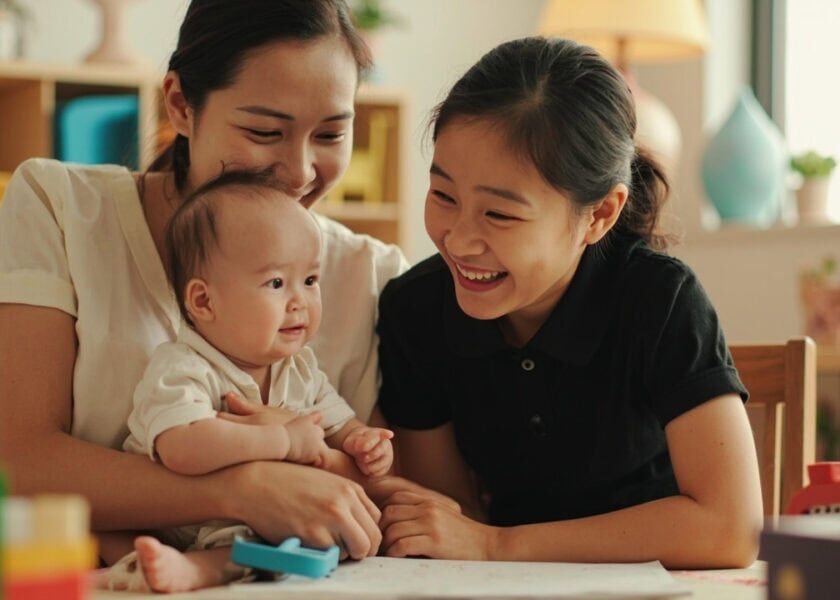
When a caregiver notices the shift in body tension that signals hunger before the baby cries, and responds to that signal, something profound is happening. When a reaching hand is met with closeness before distress escalates, the infant learns that the world is a responsive place. When a caregiver narrates the mundane moments of care—”I’m going to pick you up now,” “Let’s change your diaper”—they are not just passing time. They are teaching their infant that they exist in relation to others, that their signals matter, that communication works.
These micro-interactions are not incidental to infant development. They are its primary medium. The brain is not developing in parallel to these experiences. It is developing through them.
A responsive, attuned caregiver during this period is not simply providing comfort. They are contributing to the actual architecture of your child’s stress response system, their capacity for emotional regulation, their future ability to focus, to trust, to connect. Early experiences do not merely influence development—they literally shape the brain’s structure.
What Quality Looks Like in Infant Care
Most parents apply the wrong evaluation criteria when looking for infant care. It is natural to look for the same things you would look for in a preschool setting—the colorful walls, the alphabet posters, the structured activities. But infants need something almost impossible to manufacture or fake: a quality of human presence that notices before responding, that narrates the mundane moments of care as though they matter—because they do—that holds a baby with the kind of full presence that communicates safety at a level deeper than words.
When evaluating infant care, there are four dimensions that research consistently shows matter most for development. These are drawn from decades of developmental psychology and neuroscience research, applied to the specific needs of infants rather than older children.
1. Attunement Density
Attunement density describes the frequency and quality of a caregiver’s attunement to an infant’s signals—not just when the baby cries, but in the countless moments before crying. Infants communicate constantly through their bodies: the raised eyebrow, the stillness, the slight stiffening of the body, the turning away.
A caregiver who is attuned reads those communications, responds to them, and in doing so teaches the infant something profound: that their signals matter, that the world is responsive, that they can trust their body to connect them to what they need. This is the beginning of emotional regulation. It happens in infancy.
When you visit an infant care setting, ask yourself: Do caregivers narrate what they are doing? Are they at eye level with infants rather than hovering above? Is there a calmness in the room that suggests caregivers have the capacity to be responsive rather than just managing a group?
2. Caregiver Stability
This is not a soft preference. It is a developmental requirement. Infants form attachments as a biological process. These attachments are not sentimental—they are neurological. They shape the systems in the brain that manage fear, that process reward, that enable connection.
When an infant is moved between caregivers frequently, those systems are disrupted. Research on attachment has consistently shown that the number one predictor of secure attachment is not the personality or warmth of caregivers—though those matter. It is consistency. A small number of consistent, attuned caregivers is developmentally superior to a larger number of rotating faces, no matter how well-meaning those faces may be.
When evaluating infant care programs in Singapore, a smaller team of dedicated caregivers who have been with the program for years will, all else being equal, serve your infant better than a larger team with high turnover.
3. Sensory and Motor Environment
Infants learn through their bodies. They are not passive recipients of care. They are active explorers who need space to move, to reach, to roll, to eventually crawl and pull themselves up. They need surfaces that are safe for exploration, that allow them to see the world from different angles, that give them the physical experience of being securely contained.
A quality infant care environment is thoughtfully designed for the specific developmental needs of a body that is learning to exist in space. Tummy time should be supported. Reaching should be encouraged. The environment should offer variety in texture, light, and position—while remaining safe and calm.
4. Communication With Parents
A quality infant care provider understands that parents of infants carry a particular kind of anxiety. They have chosen to leave their most developmentally vulnerable child in care, and they need to know that the choice was right.
Transparent, regular, thoughtful communication is not an add-on. It is part of the care itself. Parents of infants need to know what happened in their child’s day, not in the abstract but in the specific: how they slept, how they ate, what moments of alertness looked like, what their face showed when they saw their familiar caregiver in the morning.
You cannot support what you cannot see. And your infant cannot tell you.
A Practical Framework for Evaluating Infant Care in Singapore
During the Visit: Observe Before You Ask
- Watch how caregivers interact with infants who are not currently seeking attention. Are they narrating what they are doing? Are they at eye level rather than hovering above? Is there a calmness in the room that suggests caregivers have the capacity to be responsive rather than just managing?
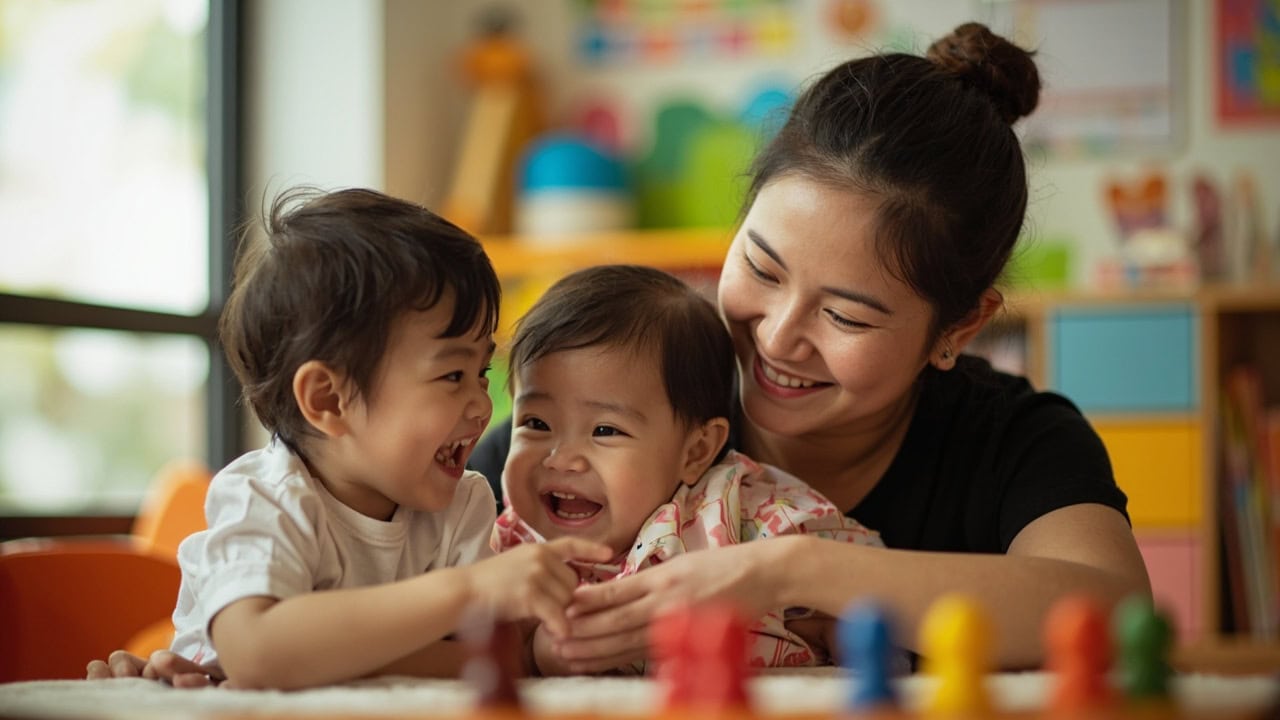
- Watch the infants themselves. Are their bodies relaxed when they are being held? Do they make eye contact? Do they show any recognition of specific caregivers? These are not guarantees of quality, but they are meaningful signals.
- Notice the environment. Is there space for movement? Are there opportunities for infants to explore on their terms, with support? Is the lighting natural or softened? Is there a variety of textures and positions available?
Questions to Ask
- How long have the primary caregivers been with the program?
- What is the ratio of caregivers to infants? (In Singapore, ECDA regulations specify minimum ratios, but quality programs often exceed these minimums.)
- What does a typical day look like in terms of routine and responsiveness?
- How is the environment designed to support early motor development?
- What happens when a caregiver is sick or needs to take leave?
- How do you communicate with parents about their infant’s day?
- Can parents observe or visit unannounced?
These are not intrusive questions. They are the questions that reveal whether a program has thought carefully about what infants actually need.
Signs Your Baby Is Thriving
The evaluation does not end at enrollment. After you have made your choice, watch your infant in the evenings and on days at home. Your infant is telling you, in the language of their body, whether the architecture being built feels like a good place to grow.
- Quality of alertness: A thriving infant is curious, engaged, and interested in their surroundings when awake—not persistently fussy, not glazed or overstimulated.
- Relaxation in the body: A baby who feels safe will soften into a caregiver’s arms rather than stiffening or arching away.
- Recognition and anticipation: Watch for the way they respond to familiar caregivers—brightening, reaching, settling. Wariness of strangers is developmentally normal and actually a positive sign.
- Small communications: The smiles that reach their eyes. The reaching hands. The softening that happens when they are picked up by someone who knows them. These micro-signals are your infant’s report card.
What EduNanny Offers: A Partner for This Window
EduNanny was built on a simple but profound conviction: that the invisible architecture of infant development deserves the same rigor and intentionality that we would bring to any other critical period of human growth.
We understand that infants do not need the same things as toddlers, that the metrics for quality in infant care are distinct, and that the stakes of getting it right—or getting it wrong—are not evenly distributed across the years of childhood.
Developed through the ECDA Childminding Pilot, our approach has been shaped by standards that take infant development seriously as a discipline. We offer both home-based and community-based pathways, because families in Singapore have different needs and different contexts, and the right setting matters.
Our caregiver-to-infant ratios are designed to make attunement possible—by structure, not by aspiration. We have built communication protocols that keep parents informed not just about what happened but about what their infant’s day revealed about their development. Where we have deployed additional transparency measures including CCTV access, we have done so because we believe parents of infants deserve the kind of visibility that makes trust possible.
We know that for many families, the cost of quality care is a real consideration. We have structured our fees within the pilot framework to be accessible, and we support families in accessing available subsidies and government schemes, including the use of Child Development Accounts and Baby Bonus funds. This is not a side note. It matters that the families who need thoughtful infant care most are not priced out of accessing it.
But the reason EduNanny exists is simpler than any of these features. It exists because infants deserve caregivers who understand what is happening in those early months, who have been trained to observe and respond, who know that a moment of attunement is not a small thing but a building block of everything that will follow. And because parents deserve partners who take this responsibility with the seriousness it demands.
Trust What You Already Know
If you are a parent in Singapore evaluating infant care, you deserve more than generic information about what to look for. You deserve to understand why this period is different, what quality actually looks like in practice, and how to recognize it when you see it. You deserve to be treated as someone capable of understanding the science and applying it to your own child’s life.
One of the most common concerns parents raise is whether they are being “too anxious” or “overthinking” the decision. Let me be clear: you are not. The concern you feel is proportional to what is at stake. The fact that you are reading an article like this, asking these questions, is itself evidence that you are taking this window seriously. That matters.
Quality infant care that meets the developmental needs of your child requires small ratios, stable caregivers, thoughtful environments, and robust communication. These things cost money. But they should not be accessible only to families with significant means. When evaluating infant care options in Singapore, ask about subsidies and schemes that may be available. The Child Development Account and Baby Bonus funds exist precisely to make quality care more accessible.
The first eighteen months are not a rehearsal. They are the performance. Every moment of responsive care, every consistent presence, every calm and attentive interaction is contributing to the person your child will become. That is not a burden. It is a privilege.
And you—who know your infant’s cries and smiles, who know the particular way they relax when they feel safe, who have been learning their language since the moment they were born—are already more qualified to recognize quality than you might think. Trust that knowledge. Find partners who take this work as seriously as you do. And know that in choosing to care deeply about these early months, you are already doing something extraordinary for your child.
If you are evaluating infant care options in Singapore and want to understand how EduNanny approaches this critical window, we welcome the conversation. We are happy to answer your questions, share our approach, and help you think through what quality infant care looks like for your family.
Because your infant’s future is being built right now. And it deserves nothing less than your full attention—and ours.