What Your Child Actually Needs Before Primary One in Singapore
The Moment Every Singapore Parent Dreads
There is a moment — you may have felt it already, or you are feeling it now, or you will feel it soon — when the primary school question stops being theoretical and becomes a calendar reality. A friend mentions her daughter is already on a waitlist. A Facebook group shares the P1 registration timeline. Someone at the playground says, almost casually, that their three-year-old has started phonics.
And in that moment, something shifts. The future stops being abstract and becomes immediate, concrete, and a little bit urgent.
You feel it even if you are not consciously thinking about it. It is the shadow that falls over every childcare decision you have made — or are about to make. The unspoken question sitting beneath conversations with infant care teachers, behind the 11pm Google searches, beneath the guilt you feel when someone asks whether your child is “learning” enough.
That question is deceptively simple: Will my child be ready?
Not ready in the way we use the word loosely. Ready. For the classroom. For the noise and structure and pace of Primary One. For the social landscape of school life. For the cognitive demands that Singapore’s education system is known — and sometimes feared — for. Ready in a way that lets your child walk through those school gates and feel, as much as any six-year-old can, that they belong there.
This article is about that question. Because it deserves a real answer — not a reassuring platitude, not a sales promise, but a thoughtful, honest exploration of what school readiness actually means, where it comes from, and why the childcare choices you make in these early years are not a compromise between warmth and preparation. They are the preparation.
What School Readiness Actually Means
Let us start with the thing that no one tells you plainly: the anxiety you feel is real because the stakes are real. Singapore’s primary school environment is demanding. Class sizes are large. The transition from a small, familiar childcare setting to the scale and pace of Primary One is significant.
Parents here are not being paranoid when they worry about whether their child will cope. They are being prudent.
Somewhere along the way, the conversation about school preparation narrowed to a single dimension: academic content. Does your child know their letters? Can they count to twenty? Do they recognize sight words?
These things matter, and a good childcare programme will gently build early literacy and numeracy foundations. But if you stop the conversation there, you are only describing the surface of what Primary One actually demands. You are describing about a third of what your child will need.
The Capacities Primary One Actually Requires
Think about what a six-year-old actually does in a school day. They:
- Sit in a seat for extended periods and are expected to regulate their energy
- Shift attention between different activities — from reading to group discussion to physical exercise
- Navigate social dynamics with twenty-nine other children who are also learning how to navigate them
- Manage frustration when something is difficult
- Ask for help when they need it
- Wait. Share. Adapt when a routine changes unexpectedly
- Regulate big emotions in a room full of people who are not their family
These are not soft skills bolted on to the real work of education. These are the work of education.
Emotional regulation, sustained attention, social confidence, the ability to learn from discomfort, the curiosity that makes a child lean in rather than pull away when something is new — these are the capacities that determine whether school is a place where your child thrives or merely survives.
How Development Actually Works: The Cascade Effect
Here is a concept in child development that has been extensively studied but remains insufficiently understood by the parents who need it most: the idea of the developmental cascade.
Consider how this works in practice:
- A child who develops strong fine motor control through hands-on play and sensory exploration is also building the hand-eye coordination they will need for writing
- A child who learns to manage separation anxiety in a trusted, responsive childcare environment is building the emotional resilience they will need to sit through a forty-minute assembly without panic
- A child who is read to every day, who hears rich and varied language, who is spoken to with respect and interest, is not just developing a vocabulary — they are building the auditory processing, listening stamina, and comprehension foundations that every subject in Primary One will demand
The capacities are not separate. They flow into each other. And they are all being built right now, in every day that your child spends in an environment that is warm, responsive, and developmentally rich.
What Quality Childcare Actually Looks Like
This is what separates quality childcare from mere supervision.
In a truly excellent infant care or childminding setting, nothing is accidental. The daily schedule is thoughtfully sequenced to alternate between active and quiet periods, group socialisation and independent exploration, structured learning activities and free play that is anything but unstructured in its developmental purpose.
The caregiver is not just present — they are attuned. They notice when a toddler is on the verge of a meltdown and intervene before it escalates. They narrate a baby’s world in rich, descriptive language during feeding and dressing. They create a safe base from which a child can explore confidently, knowing that someone attentive is always nearby.
This attuned caregiving is not a luxury. It is the mechanism through which every other developmental outcome is achieved.
- A child who feels secure does not spend their cognitive energy on fear and vigilance
- A child who trusts their caregiver is free to explore, to try, to fail, to try again
- A child who has learned to be soothed is a child who has learned to regulate
- A child who can regulate is a child who can learn
Why Quality Care Does Not Look Like Primary One
There is a version of early childhood preparation that deserves to be named clearly — and distinguished from what quality care actually is.
It is the version that substitutes academic pressure for developmental richness. That asks a four-year-old to sit through formal instruction sessions and complete worksheets. That conflates early knowledge with early readiness. That treats a child’s growing brain as a vessel to be filled rather than a foundation to be built.
This model does not work. Not because academics are bad — they are not. But because a child’s brain at four and five is wired for certain kinds of learning and fundamentally not ready for others. Forcing formal academic content onto a developing mind that is built for sensory exploration, imaginative play, and social-emotional learning does not accelerate development. It redirects it. It often produces children who know more facts but feel more anxious, who perform on tests but struggle in classrooms, who have been trained rather than prepared.
The childcare environment that prepares your child for Primary One does not look like Primary One. It looks like:
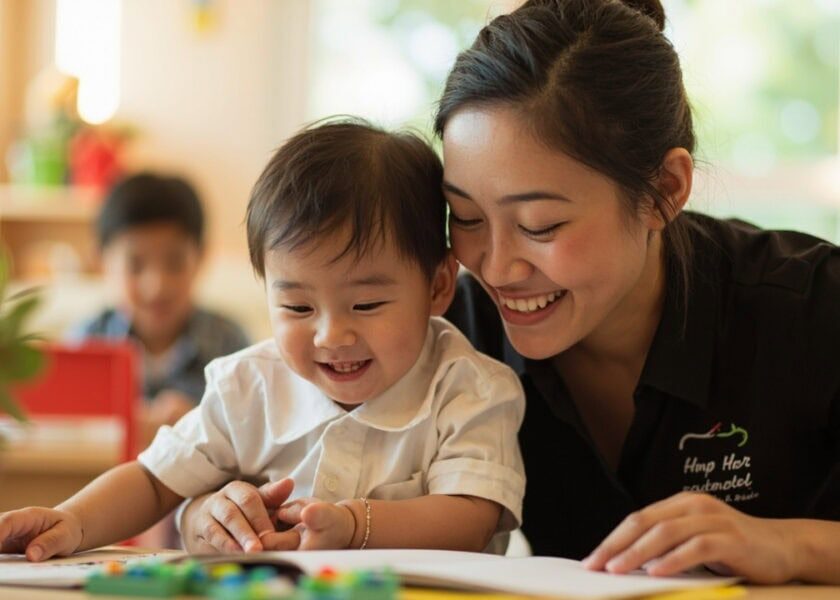
- A caregiver sitting on the floor, following a child’s lead while gently expanding their thinking
- Blocks and sand and water and paint — the raw materials through which a child builds spatial reasoning, problem-solving, fine motor control, and the foundational mathematics of quantity, pattern, and sequence
- Circle time — because sitting in a group, listening to others, taking turns, and raising your hand are not natural skills, they are learned ones
- Story time that is long and unhurried — because comprehension, vocabulary, attention span, and a love of learning are built one story at a time
When this work is done well, your child will arrive at Primary One knowing their letters and numbers — not because they were drilled, but because they were genuinely curious about the world and someone helped them make sense of it. They will arrive as a child who wants to learn, who trusts that learning is something they can do, and who has the emotional and social tools to navigate the experience with curiosity rather than dread.
Signs You Can Actually Look For
As your child approaches the age where Primary One becomes a concrete horizon rather than a distant future, there are concrete, observable signs that your child’s developmental foundations are in place. These are not things you need to wait for a formal assessment to know. They are things a paying-attention parent can see every day.
Attention and Engagement
Watch whether your child can sustain attention on a single activity for a reasonable length of time — not rigidly, but meaningfully. A four-year-old who can become absorbed in building a block structure or listening to a long story is building the attention capacity that Primary One will require.
Emotional Regulation
Watch whether your child can manage mild frustration — not perfectly, not without tears, but with increasing ability to calm themselves and try again. Watch whether they can articulate what they feel, not just feel it. The child who says “I am angry because Arjun took my toy” has a capacity for emotional regulation that is worth more than any workbook.
Curiosity and Learning Drive
Watch whether your child is curious. Whether they ask questions. Whether they show interest in learning new things — whether they point at words on signs and ask what they say, whether they want to know why the sky is blue or where the ants are going. A child who is curious is a child who will learn.
Social Confidence
Watch whether they can approach other children, share, take turns, resolve small conflicts with words rather than fists or tears alone.
Physical Coordination
Watch whether they can hold a pencil with a functional grip, cut with scissors, climb, run, balance. Motor development and cognitive development are not separate systems. They are deeply intertwined.
The Caregiver Relationship
Watch the relationship between your child and their caregiver. Because if your child is secure with the person caring for them — if there is warmth and trust and genuine mutual affection — then your child is building the internal working model of what a caring relationship looks like. And that model will carry them through the rest of their lives.
For the Working Parent: Releasing the Guilt
There is a guilt in Singapore parenting that is almost uniquely pervasive. It is the guilt of the working parent — the sense that by entrusting your child to someone else’s care, even for the best of reasons, you are somehow failing them.
You are not.
You are not failing your child by working. You are not failing your child by choosing a childcare arrangement that allows your family to thrive financially and practically. You are doing what millions of thoughtful, loving parents do every single day.
But guilt is not always rational, and knowing it is irrational does not always make it go away. So let us offer something more useful than reassurance — let us offer you a reframe.
The question is not whether your child is in childcare. The question is what that childcare is doing for your child while they are in it.
Here is the truth that research is unambiguous about: the quality of the caregiving environment matters more than the quantity of time a parent spends with a child, within a wide and normal range. A child who spends eight hours a day in a warm, responsive, developmentally rich environment with a caregiver who is attuned and skilled is, in measurable developmental terms, better supported than a child who spends twelve hours a day with a parent who is exhausted, stressed, and present but not emotionally available.
This does not diminish the irreplaceable role of parents. It illuminates it. Your role is not to be your child’s everything. Your role is to be their most important person — and to surround them with people and environments that support the developmental journey you have begun with them.
That is not a compromise. That is wisdom.
Where Trusted Childcare Makes the Difference
These early years are not a preliminary stage to the real work. They are the real work. And the people who do this work — the caregivers, the childminders, the infant care teachers — deserve to be treated not as workers filling a gap in the market, but as the skilled, thoughtful professionals they actually are.
Programmes operating under Singapore’s ECDA Childminding Pilot sit within a regulated framework designed to ensure safety, caregiver suitability, and developmental appropriateness. This matters because it means your child’s care is held to standards that protect them — standards built for these critical early years.
The best childcare arrangements offer genuine responsiveness to how different children learn and grow. Some thrive in a familiar home environment with a dedicated caregiver. Others benefit from the social richness of a group setting. Quality care adapts to your child’s needs rather than expecting your child to adapt to a rigid model.
For infant care, low caregiver-to-child ratios are profound in their practical meaning. A ratio of one caregiver to every three infants means your baby is not one of ten. Every cry is noticed. Every developmental milestone is tracked. Every need is met with the responsiveness that a developing brain requires to form the secure attachment that underlies every future relationship and every future learning capacity.
Communication matters too. Parents deserve to know what their child is doing, how they are feeling, and what they are learning. Regular updates, transparent reporting, developmental progress tracking, and clear channels for questions between caregivers and families — these are not extras. They are the foundation of a trust-based relationship that benefits your child above all.
Access to quality developmental care should not be a privilege. Practical financial tools like CDA funds and Baby Bonus exist to make this more possible for more families — and the best programmes are designed with this accessibility in mind.
When the right support is in place, you will see it in the moments when your child discovers something new, when they run to their caregiver with a painting they made, when they come home using a word you did not teach them and a confidence you did not expect. Those moments are evidence. They are proof that your child is being loved and prepared at the same time.
Your Child Has Already Begun
Here is what I want you to carry with you as you make this decision.
You are not choosing between loving your child and preparing your child. These are not two different things pointing in opposite directions. They are the same thing, pointing forward.
Every moment of attuned, responsive, developmentally rich care is simultaneously an act of love and an act of preparation. Every story read, every frustration gently soothed, every motor skill encouraged through play, every social moment facilitated with skill — all of it is love. And all of it is readiness. For school. For life. For everything that comes next.
The question is not whether quality childcare can prepare your child for Primary One. It can. It does. When it is done with the skill, the intentionality, and the heart that these early years demand, it is the single most powerful thing you can do for your child’s future in school and beyond.
The question is whether you can trust that. Whether you can release the anxiety long enough to see what is actually being built in those early years, in the small hands and the growing minds of your children.
I believe you can. I believe you already do, in the moments when you watch your child discover something new, when they run to their caregiver with a painting they made, when they come home using a word you did not teach them and a confidence you did not expect.
In those moments, you are already seeing the evidence. You are already knowing, in your bones, that your child is being loved and prepared at the same time.
Your child is not waiting to begin. Your child has already begun. And everything you are doing — every choice, every decision, every moment of trust you extend to the people who care for your child — is shaping the person they will become.
That is not a small thing. That is everything.
Interested in learning more about quality childminding and infant care options for your family? Connect with our team to explore the right pathway for your child.