How Singapore Parents Build a Childcare System for Their Whole Family
“`html
The Gap No One Is Talking About
You are not simply choosing a childcare arrangement. You are navigating between an infant who needs sensory richness and physical closeness, a toddler who needs structured play and social exploration, and perhaps an older child who needs increasing autonomy and the kind of care that prepares them for the demands of school.
Each child exists at a different point on the developmental map. Each one requires something specific.
And yet they are bound to one another by something deeper than shared genetics or a shared bedroom. They are bound by the knowledge of each other. By the way an older sister looks out for her younger brother. By the way a toddler mimics their elder. By the private language siblings develop when left to their own devices, the alliances they form, the small wars they wage and resolve.
When you introduce childcare into this ecosystem, you are not making a decision for one child. You are reshaping the landscape in which all of them grow.
The conventional wisdom tells you to evaluate your options, assess the curriculum, consider the environment, meet the caregivers. All of that matters. But for a family with siblings, the question that sits beneath all those practical considerations is something more vulnerable:
Will my children still know each other? Will they still belong to each other? Will the time they spend apart erode the bond they are building together?
The research on sibling relationships tells us something important. Siblings are not simply people who happen to share a home. They are each other’s first peers, first rivals, first collaborators. They learn conflict resolution across a sibling relationship. They learn loyalty. They learn how to be seen by someone who did not choose them but cannot leave them either.
The sibling bond, when it is good, becomes a bedrock of emotional security that extends well beyond childhood. And even when it is complicated, it is formative in ways that no other relationship quite replicates.
When siblings are placed in different care arrangements, parents worry, with good reason, about what is lost. These fears are legitimate. But they can also be reframed.
The question is not whether siblings will remain connected. They will. The question is whether your childcare arrangements actively support that connection or inadvertently undermine it.
A good childcare arrangement for siblings does not try to replace siblinghood. It honors it. It creates space for each child to develop as an individual while remaining anchored in the knowledge that they are part of something. It shares updates that help parents weave a narrative for one child about the other’s day. It thinks about sibling play not as a distraction from learning but as a context in which learning deepens.
Logistics, Rhythm, and the Reality of Multi-Child Family Life
Singapore families face a logistical reality that families elsewhere often do not. The progression from infant to toddler to preschool to primary school is not simply a matter of time. It is a sequence of transitions, each of which brings new care arrangements, new pickup schedules, new people to meet and trust.
For families with multiple children, these transitions do not happen in sequence. They happen simultaneously. You may be navigating your infant’s first separation while your older child enters Primary One while your middle child ages out of one programme and into another.
Consider the Singapore timeline: your eldest may be approaching the transition to secondary school or beginning to think about planning years down the road. Your middle child is settling into primary school routines. Your youngest is still in infant care or transitioning to toddler care. Each of these stages requires different attention, different conversations with different caregivers, different rhythms of the day.
Family Rhythm as Architecture
Every family has a rhythm, whether they name it or not. It is the pattern of mornings and evenings, of who is where and when, of the rituals that anchor the day. Breakfast together when possible. Dinner together when possible. The car rides, the handovers, the moments of transition where one world ends and another begins.
When you have one child, you learn this rhythm and you adjust it. When you have multiple children in multiple care arrangements, the rhythm becomes architecture. You are not just managing schedules. You are building a system that holds your family together across the complexity of modern Singapore life.
The families who navigate this best are not the ones who have found a way to simplify. They are the ones who have found care partners who understand the system they are building and actively support it. Who communicate across arrangements. Who adapt when one child’s needs shift. Who see the family, not just the individual child in front of them.
When Grandparents Are Part of the System
For many Singapore families, grandparents play a significant role in the childcare ecosystem. They may help with pickup and dropoff, provide care on certain days, or step in during transitions between formal arrangements.
With multiple grandchildren, this role becomes more complex. A grandparent may love all their grandchildren differently and struggle to show up fairly. They may find themselves stretched between different households, different expectations, different developmental needs to navigate.
When your childcare system includes grandparent involvement, it needs to be acknowledged as part of the family rhythm, not hidden as an informal arrangement that everyone just “figures out.” Good childcare coordination means understanding where grandparents fit, what they can sustainably offer, and how their involvement intersects with formal care arrangements.
What Quality Childcare for Siblings Actually Looks Like
When we talk about childcare quality for siblings, we are talking about something specific. It is not primarily about curricula or facilities. It is about whether care arrangements understand the family as a system.
Here is what that looks like in practice:
- Individual attention: When a caregiver knows only two or three children, not thirty, each child is seen as an individual. Your infant is not a category. Your toddler is not a developmental stage. They are specific people with specific temperaments, preferences, and needs.
- Communication that builds connection: Updates that help parents hold the narrative of their children’s days, not just individual children’s days. When you know that your toddler heard about his baby sister’s morning, the connection between their separate worlds becomes tangible.
- Flexibility across transitions: When one child’s needs shift, the care arrangement can adapt. When the family rhythm changes, the caregiver is part of solving the puzzle, not another obstacle to navigate.
- Consistency as the foundation of trust: The same caregiver, day after day. Not a rotating cast of strangers. For young children, and especially for siblings in separate arrangements, consistency is the foundation on which security is built.
There is also a question that every second child asks without asking. It is not spoken in words. It is asked in the way a younger sibling looks toward the door when an older sibling is picked up. It is asked in the way a middle child wonders if her place in the family is as clear to the world as her older brother’s.
The question is: where do I fit?
And the answer is not found in any single childcare arrangement. It is found in the family culture you are building. In the way you speak about each child. In the way you hold space for their differences while affirming their belonging. In the way your care arrangements, across all their complexity, are expressions of love, not just logistics.
When siblings thrive together, even in different care settings, something extraordinary happens. Each child knows that they are loved specifically. Each child knows that they are part of something larger. The evidence of this is found in the way a four-year-old shares her snack with her baby sister. In the way a seven-year-old explains the world to his younger brother. In the way siblings, given the right foundation, become each other’s first teachers, first confidants, and first witnesses to who they are becoming.
Addressing What Parents Actually Worry About
Will my children still feel connected if they’re in different arrangements?
They will, if your care arrangements actively support that connection. This means caregivers who know about each other. Updates that mention siblings. The knowledge, held by each child, that their sibling is nearby or at least accounted for. A two-year-old who knows his baby sister is nearby carries a different kind of security than a two-year-old who has no knowledge of where his sibling is at all.
How do I ensure each child gets what they individually need?
Each child needs something different, and no single arrangement will serve all of them equally. What matters is that each arrangement is chosen with that specific child in mind, and that you as a parent maintain the ability to see each child as an individual, not just as part of a sibling set. Good caregivers reinforce this by sharing observations about each child specifically, not generically.
The coordination is already overwhelming. How do I add another arrangement?
This is exactly why flexibility matters more than a perfect fit. When your infant is in one arrangement and your toddler is in another, when your older child is finishing primary school and your younger one is beginning preschool, the ability to coordinate, to adjust, to find a rhythm that serves everyone is invaluable. The right care partner joins your family system in progress rather than requiring you to reshape your system around them.
How do I trust someone with all of this?
Trust is the currency of childcare. Every parent who hands their child to someone else is making a deposit into an account they hope will not be depleted. For parents with multiple children, trust is not a single deposit. It is a ledger with multiple entries, and the entries are interconnected.
When you trust one caregiver with your infant, that trust is shaped by what you know about how your toddler is being cared for. When you trust a programme with your older child, that trust is colored by whether the system as a whole is holding. The pieces do not exist in isolation. They form a web, and the strength of the web is only as good as its weakest strand.
This is why transparency matters. Communication is not an add-on. It is infrastructure.
EduNanny Singapore: Built for This Complexity
EduNanny Singapore, a service from BUTLER, operates within the ECDA Childminding Pilot. This matters for what it represents. It is not a large centre responding to volume. It is a home-based and community pathway that brings care into relationship.
The infant ratios are designed around attention, not efficiency. The caregiver-to-child relationship is built for consistency, which is the foundation of trust, which is the foundation of everything else. And the flexibility of Monday to Friday care blocks means that families can construct a system rather than simply filling a slot.
For families with siblings, this adaptability is not a luxury. It is a requirement.
EduNanny’s approach recognizes the interconnected nature of sibling wellbeing and the practical reality of multi-child family life. They are not administering a programme. They are joining a family system in progress.
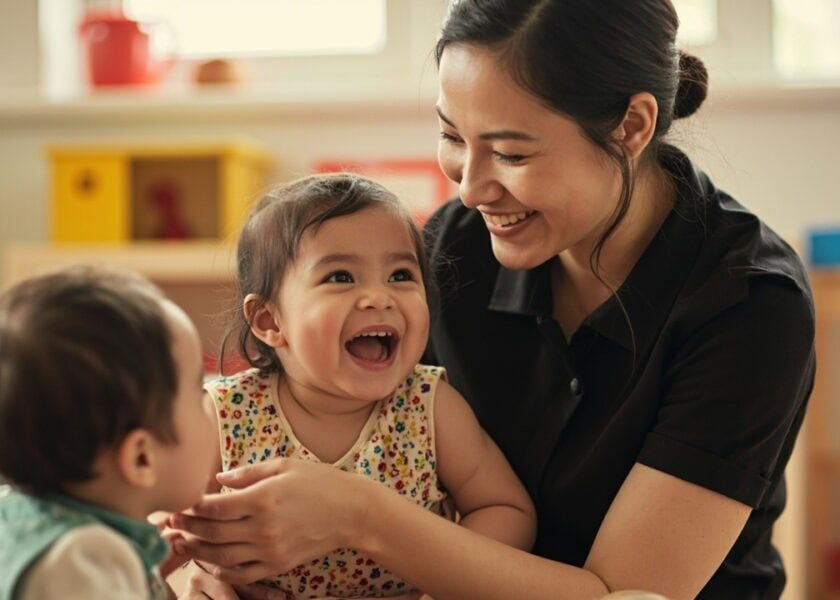
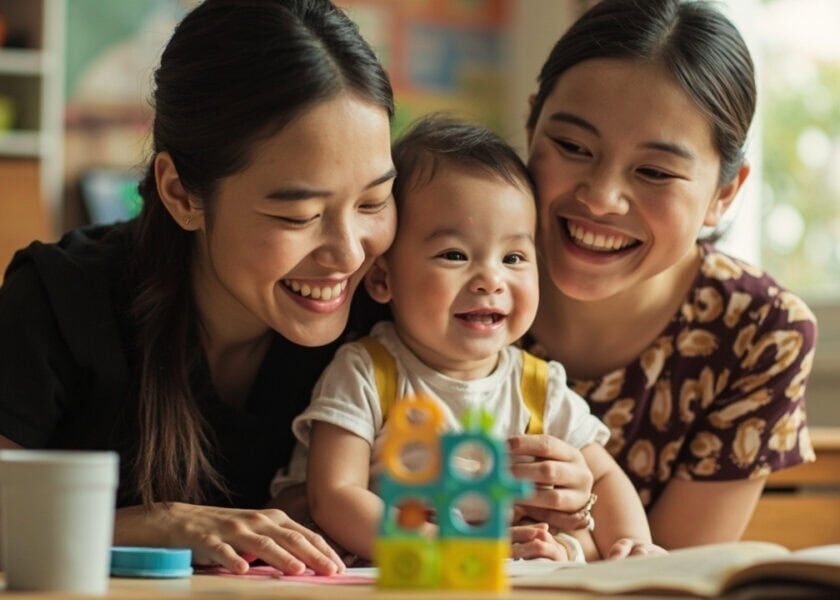
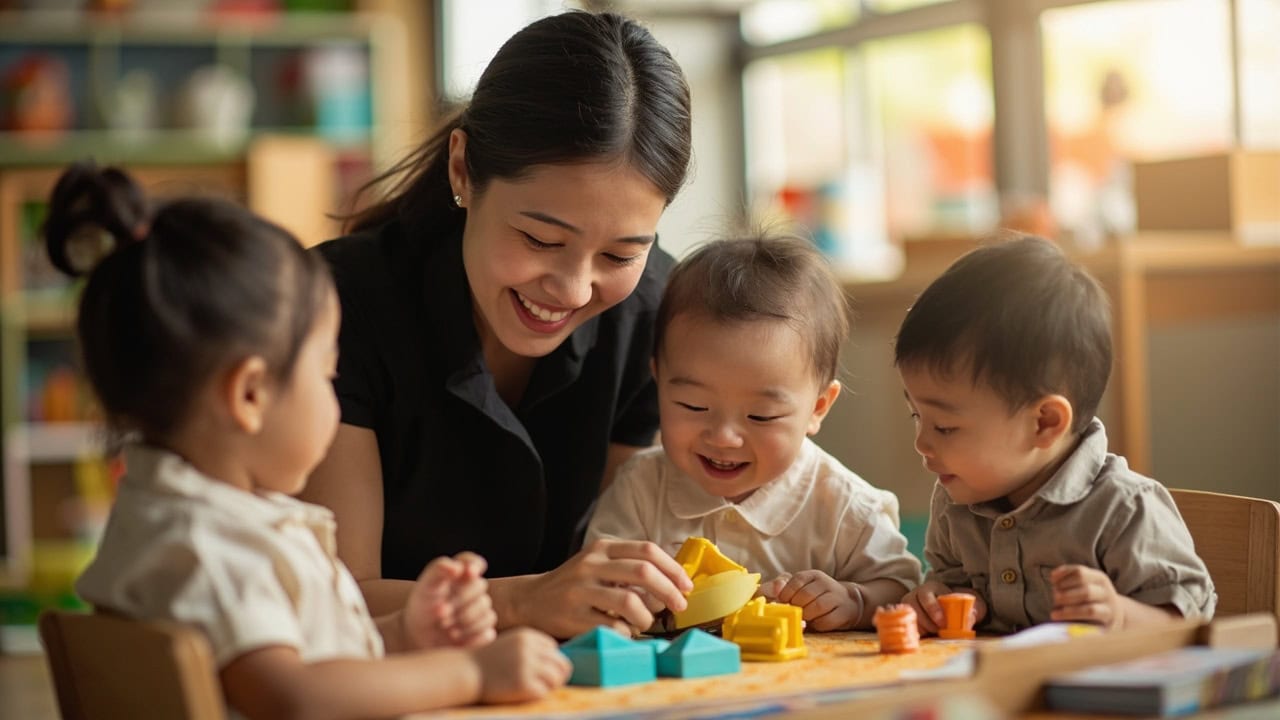
In home-based and community care, your child is not one of forty. Your child is one of one, two, or three. The attention is different. The bond that forms is different. And for siblings who may be in different arrangements during the day, knowing that each of them is known, that each of them is seen as an individual, that each of them matters in a one-to-one ratio—this is the kind of care that allows parents to exhale.
There is something else worth noting. The financial architecture of childcare in Singapore is complex, and families with multiple children feel that complexity acutely. The usability of CDA and Baby Bonus across arrangements, the accessible fee structures that make home-based care a realistic option—these details matter in ways that no promotional material can fully capture.
When your second child needs care and your first child is in school and your budget is real, these are not minor considerations. They are the difference between a plan that holds and a plan that buckles. EduNanny Singapore operates within this reality, not apart from it. Their approach accounts for the full picture of what a Singapore family actually faces.
Building a Care System That Holds Your Family Together
If you are raising more than one child in Singapore, you are already doing something remarkable. The decisions you are making are not simple. The coordination you manage daily would overwhelm most people. The love you carry for each of your children, distinct and specific and fierce, is an act of devotion that the world rarely acknowledges because it happens quietly, in the margins of ordinary days.
There is no perfect arrangement. There is no childcare decision that will resolve every tension or answer every question. But there are care partners who understand the weight you are carrying and who can share it. There are systems designed not to simplify your life but to support the complexity you are already managing.
There are people who will know your children, all of them, as individuals who happen to be siblings, who belong to each other, who are building the bond that will anchor them for decades to come.
EduNanny Singapore is one such partner. Rooted in the ECDA Childminding Pilot, built around the realities of Singapore family life, designed for the multi-child families who have been underserved by a childcare industry that assumed one child was enough to think about.
They see what you see. They understand what you carry. And they are ready to walk beside you as you build the care system that serves your whole family.
The siblings in your home are already learning from each other. They are already forming the bond that will outlast your daily decisions. Your task, and it is a beautiful one, is to give them the foundation on which that bond can grow.
Childcare is never just about the child. It is about the family. It is about the future you are building, one sibling relationship at a time.
Ready to explore how EduNanny Singapore can serve your whole family?
If you are navigating childcare for more than one child and want to discuss how EduNanny Singapore might fit into your family’s system, reach out for a conversation. There are no easy answers, but there are people who understand the questions.
“`