The First Educational Decision That Shapes Your Child’s Future
That Quiet Moment When You Realise Your Child Is Being Shaped
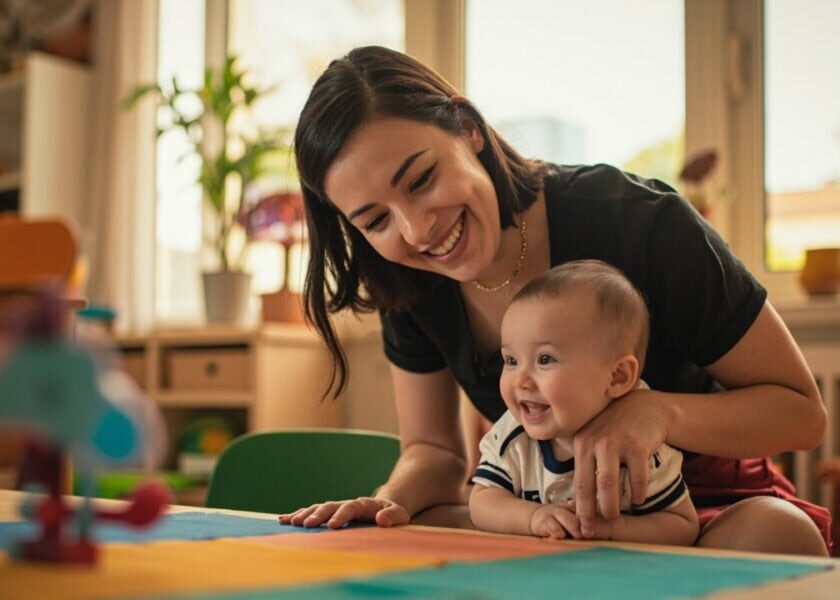
There is a moment — quiet, unremarkable by most measures — that most Singapore parents will recognise. You are watching your child play. They are building something with blocks, or negotiating who gets the red cup, or refusing to share because they have not yet learned that sharing does not mean losing.
And in that ordinary moment, something crosses your mind. Not a worry. Something closer to a recognition. You are not just watching someone you love be cared for. You are watching someone you love be shaped.
That thought is the beginning of everything.
Because in Singapore, we have become extraordinarily good at thinking about education. We think about it when we choose a preschool. We think about it when we consider enrichment classes. We think about it when Primary 1 registration opens and we watch the race for school places with the intensity of seasoned strategists. We are a city of parents who care deeply, plan carefully, and invest enormously in our children’s futures.
This is something to be proud of. It is also something worth looking at a little more closely — because there is a gap in that thinking, a gap so consequential that it quietly shapes everything that follows.
The Gap Most Singapore Parents Have Not Yet Seen
Most Singapore parents do not yet see that the decisions made in the earliest years — the ones that feel logistical, practical, even mundane — are not childcare decisions at all. They are educational ones. The first ones. And they matter more than we have been conditioned to believe.
Let me say that again, because it is easy to nod at it and then move on. The first decisions you make about who cares for your child are not babysitting logistics. They are the opening chapter of your child’s educational story.
Think about a five-year-old walking into Primary 1 for the first time. What do they actually need to succeed — not just academically, but as a human being who will spend the next several years in a formal learning environment?
- The ability to sit still and attend
- The capacity to wait their turn, manage frustration, and recover from mistakes
- The vocabulary to understand what the teacher is saying and the confidence to speak up when they do not
- The physical stamina to get through a school day
- Genuine curiosity about what they are going to learn next
- The social fluency to navigate friendships, conflicts, and the quiet social arithmetic of a classroom full of other small people just like them
Now let me ask you something. Where do those skills come from?
They are not taught in Primary 1. They are not even fully taught in K2. They are built — brick by brick, interaction by interaction — over the first three, four, five years of a child’s life.
They are built in the thousands of small moments between a child and the person who cares for them: moments of being heard, being guided, being allowed to struggle and then encouraged to try again. They are built when a child learns that their feelings are valid but that their behaviour has boundaries. They are built when someone narrates the world back to them in rich, precise language — and watches for the spark of recognition that means learning is happening.
Executive Function: The Foundation That Compounds
Developmental psychologists call this the foundation of executive function. It is one of the most researched areas in all of child development — for a simple reason: children who enter school with stronger executive function, the ability to focus, to regulate impulses, to adapt when plans change, do better.
Not just in their first year. Not just in primary school. Research consistently shows these early foundations compound. They grow. They shape not just academic outcomes but a child’s entire relationship with learning — whether they see themselves as someone who can figure things out, or someone who finds school hard and stops trying.
The Five Foundations Quality Early Care Builds
Let me walk you through what quality early care actually builds. Not flashcards or academic drilling. Something far more profound and far less discussed.
1. Language: The Architecture of Thought
In the first three years of life, a child’s brain is building the architecture for all future communication at a speed it will never again achieve. The words a child hears, the complexity of those words, the back-and-forth of real conversation — these are not niceties. They are the scaffolding of thought.
Children who are spoken to, listened to, and engaged with in rich, responsive language in their early years arrive at school with vocabularies, comprehension foundations, and the social confidence to participate in class discussions. This does not happen by accident. It happens when a caregiver narrates the world, asks open questions, repeats and expands what a child says, and treats every utterance from a two-year-old as something worth responding to seriously.
2. Emotional Regulation: The Skill That Determines Everything
This is the one I want you to sit with for a moment. A child who cannot manage frustration will struggle in group work. A child who cannot recover from a small embarrassment will lose confidence fast. A child who has never learned that big feelings are okay but that we manage them — that we breathe, we talk, we ask for help — will spend their school days in a state of quiet or not-so-quiet overwhelm.
Emotional regulation is not something children are born with. It is something they learn, in relationship with the adults around them, over and over, in small moments of guidance that feel ordinary but are anything but.
3. Curiosity: The Deepest Gift and the Least Discussed
Curiosity is not passive. It is not something that just exists in children like a fixed trait. It is cultivated or extinguished.
A child who has been encouraged to explore, to ask why, to touch and taste and investigate the world — who has been met not with “don’t touch that” but with “what do you notice?” — arrives at school already in love with learning. They do not need to be taught to want to know things. They already do.
And that is not a soft benefit. That is the single greatest predictor of a child’s long-term academic engagement that I know of.
4. Physical Coordination and School Stamina
We underestimate this one. A full school day — walking between classrooms, sitting at desks, managing meals and breaks and transitions — requires a surprising degree of physical capability and endurance.
Children who have been active, who have had space to run and climb and balance and fall, are not just healthier. They are more available for learning. Their bodies are ready to support their minds. This is not trivial.
5. Social Confidence: Built, Not Discovered
Social confidence is built in small, supervised interactions where a child learns to share, to negotiate, to assert, to apologise, to include someone who has been left out. These are not things children figure out on their own. They are skills. They require models, guidance, and — this is key — a safe environment where mistakes are allowed and adults are there to help when the social world becomes too big to navigate alone.
Why This Matters More in Singapore
Here is what is most striking when you talk to Singapore parents. Almost all of them understand, in their bones, that they want their child to be ready for school. To be confident. To be curious. To be able to cope.
Many are already planning enrichment activities, language exposure, motor skills development. They are doing everything they can.
And yet, when you ask them where those skills are being built right now — today, this month, this year — the answer is often unclear. Or worse, it is assumed that preschool will handle it. That school readiness begins at four or five. That there is time.
There is not as much time as you think.
We are raising children in one of the most academically rigorous educational environments in the world. Singapore parents carry an extraordinary amount of pressure. You are navigating school rankings, CCA commitments, the costs of enrichment, the expectations of extended family, and your own internal compass telling you that you want better for your children than what you had.
All of that investment, all of that planning, all of that ambition for your child — it works better when it has a foundation. And that foundation is not built in Primary 1. It is not built in K2. It is built in the years before, by the people who hold your child in the most formative seasons of their development.
What Quality Childminding Actually Looks Like
Let me take a moment to talk about the word “childminder,” because it carries a weight in Singapore that it does not carry elsewhere, and I think we need to reclaim it.
In many parts of the world — in the UK, in parts of Europe, in Australia — a childminder is a respected, trained, regulated professional who provides early years education and care in a home setting. It is a profession with dignity, with standards, with recognition.
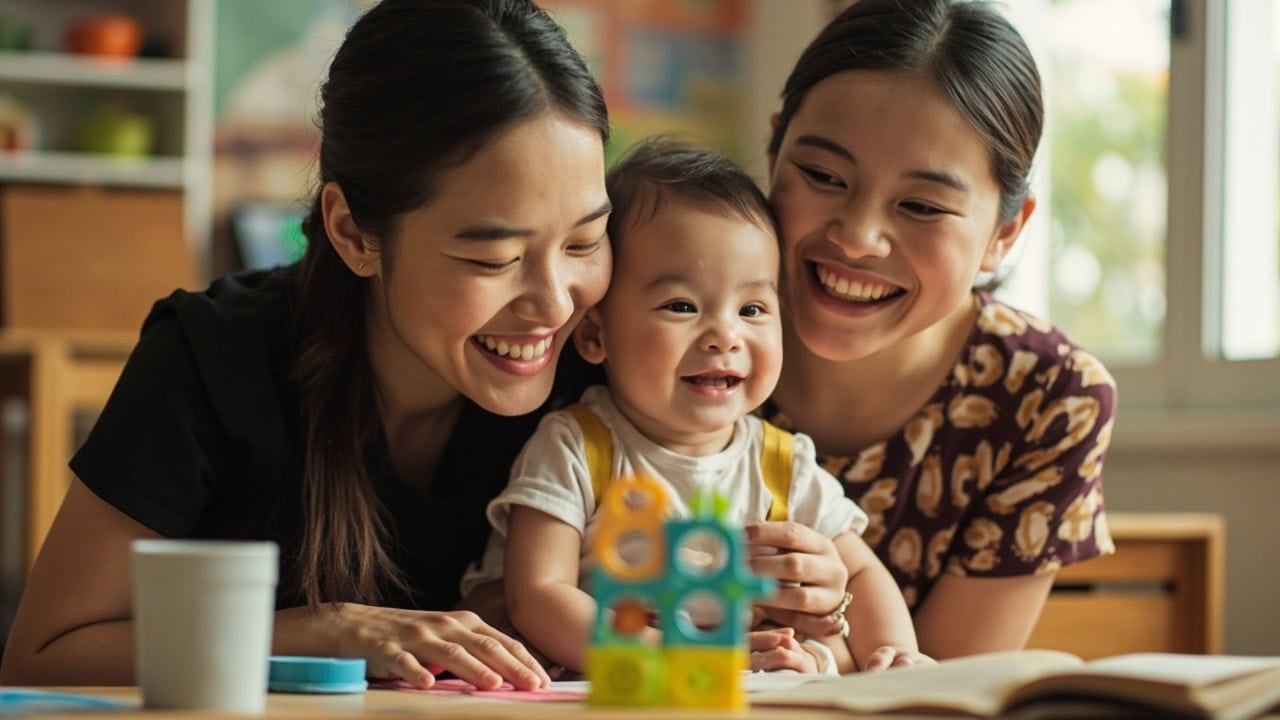
EduNanny operates under the ECDA Childminding Pilot, offering home-based childminding. Your child is cared for in the environment where they are safest and most grounded, with a dedicated, trained caregiver rather than the rotating dynamics of a larger centre.
The pilot maintains up to a one-to-three infant ratio. This is not a marketing figure. It is the difference between a caregiver who can truly observe, respond to, and nurture your child’s individual developmental trajectory, and one who is simply managing a room. That ratio is a philosophy made tangible.
Care operates Monday to Friday, in structured blocks, with transparency built into the model. Communication tools and observation measures give parents real insight into what is happening in their child’s day — not a daily report that everything was fine, but actual windows into development, growth, and the small milestones that might otherwise pass unnoticed.
Questions Singapore Parents Actually Ask
“Is home-based care really as good as a centre?”
Research consistently shows that the quality of the individual caregiver matters more than the setting. A dedicated caregiver in a home environment with a low ratio can provide richer individual attention, more responsive interactions, and deeper observational insight than is possible in a larger group setting.
“How do I know what is happening during the day?”
Transparency matters. Quality childminding arrangements include regular communication — not just “my child had a good day” but actual insight into what your child was exploring, how they interacted with peers, what frustrated them and how they managed it. This is information that helps you continue your child’s development at home.
“We are already doing enrichment. Is this really necessary?”
Enrichment activities are wonderful. But they are usually one or two hours a week. Your child’s daily experience — who they spend their days with, how they are spoken to, what their emotional environment feels like — is built in the other 160+ waking hours each week. Quality early care is not competing with enrichment. It is the foundation that makes enrichment meaningful.
A Practical Guide: What to Look for in Infant Care
You are not choosing a childcare provider. You are choosing the environment in which your child’s relationship with learning is first formed. You are choosing the person who will, for a significant part of your child’s waking hours, be the adult who shapes their understanding of what the world feels like.
So when you ask yourself what to look for in early care, ask not just “Is my child safe?” — though of course that is the foundation.
- Is my child being seen?
- Is someone paying attention to who they are becoming?
- Does this caregiver narrate the world back to my child in rich language?
- Do they help children manage big emotions, or just redirect behaviour?
- Is curiosity encouraged here, or compliance?
- Are children allowed to struggle and try again, or are they rescued?
- Is there space for physical movement and outdoor exploration?
- Does this person communicate clearly and regularly about my child’s development?
Safety is the floor. The ceiling is what matters most.
The First and Most Consequential Educational Choice
That quiet moment. Watching your child play. Realising that what you are witnessing is not passive. It is not neutral. It is the very beginning of who they will become.
Every parent who reads this far is already holding something important: the understanding that your child matters. That their future is not something that just happens to them. That the choices you make — even the ones that feel mundane — are acts of love and investment in ways that will echo for years.
The childcare decision you make today is not a logistics decision. It is the first and most consequential educational choice you will ever make for your child. And it deserves to be made with the same seriousness, the same care, and the same love that you bring to every other part of raising them.
At EduNanny Singapore, this is the belief that shapes everything — that early care is not babysitting logistics. It is the most important educational foundation your child will ever have. A foundation built on warmth, responsiveness, developmental intentionality, and the quiet certainty that your child is being held by someone who sees them.
Your child is not just being cared for. They are being shaped. Make the first chapter count.
Curious about what thoughtful, development-focused childminding looks like in Singapore? Speak with the EduNanny team or learn more about their approach.