The Pickup Window That Reveals Your Child’s True Development in Singapore
The Silence in the Car: What Your Child Shows You at Pickup Reveals How They’re Really Growing
There is a particular silence that fills a car on the morning drive to care. You know it. That quiet where your child is buckled in behind you, and your mind is already halfway to the office, but also still here, in this car, with this small person who cannot yet tell you what their day will hold.
You hand them over. You watch them disappear through a door. And then you drive away, and for the rest of the morning, there is a low hum of wondering beneath everything else you do. How are they? Are they upset? Are they engaged? Are they safe? Are they growing?
This silence is not unfamiliar to parents in Singapore. It is so common that we have almost learned to normalize it, to fold it into the ordinary cost of modern parenting. We tell ourselves that this is simply what it means to work, to provide, to be part of a household where two incomes matter.
And yet, that hum of wondering does not go away. It sits there, quieter on some days, louder on others, asking a question that no amount of rational reassurance fully answers: What is actually happening during all those hours?
We talk about trust, about gut instinct, about finding someone warm and capable. We look for signs at pickup, for clues in our child’s face, for reassurance in a quick report from the caregiver. These things matter. But I want to suggest that we have been asking the wrong question. We have been so focused on what we can see at the end of the day that we have overlooked something far more important: the framework of observation, intention, and developmental intelligence that determines what is happening during all the hours we are not there.
The First Thousand Days: Why These Years Matter More Than We Realize
Let us begin with what we know about the early years, because the science here is not subtle. The first thousand days of a child’s life, from conception to roughly age three, represent a period of unprecedented brain development. Neural connections are forming at a rate that will never be matched again.
Language acquisition, emotional regulation, motor skills, cognitive flexibility, social bonding—these are not merely happening during these years. They are being built, brick by brick, in ways that will shape the architecture of a human being for decades to come.
The Singapore government has recognized this. The infant care subsidies, the Child Development Account, the Baby Bonus scheme—these are designed not merely as financial supports but as acknowledgments that investing in early childhood is investing in human capital, in family stability, in the future of this society.
And yet, knowing this intellectually is very different from experiencing it as a parent making a daily decision about who will care for your child while you are at work. The paradox of early childhood development is that it is both extraordinarily important and largely invisible. You cannot see synapses firing. You cannot observe the moment when a child learns to regulate their frustration, or discovers that words can carry meaning, or realizes that the world is a place where certain people reliably return.
These things happen in the quiet hours, in the interactions between a child and a caregiver who is paying attention, and they happen whether or not anyone is documenting them.
The question, then, is not whether development is occurring. The question is whether anyone is paying close enough attention to understand it, nurture it, and communicate it to the people who love that child most.
Supervision vs. Developmental Care: The Difference That Changes Everything
Consider what supervision looks like. At its best, supervision is safe. It ensures that children are fed, changed, kept from harm, and occasionally entertained. A supervised child is a child who is not in danger. This matters enormously. No parent should apologize for wanting their child to be safe. Safety is the foundation upon which everything else is built.
But safety, by itself, does not require expertise. It does not require training in child development. It does not require an understanding of developmental milestones, of responsive caregiving, of the difference between a child who is meeting benchmarks and a child who may need additional support.
Safety is the floor, not the ceiling.
Developmental care operates from a different premise entirely. It assumes that every interaction with a young child is an opportunity for growth. This means several things simultaneously:
- When a caregiver sings a nursery rhyme, they are not merely passing time. They are supporting language acquisition, tonal recognition, and the bonding hormone response that comes from synchronized musical interaction.
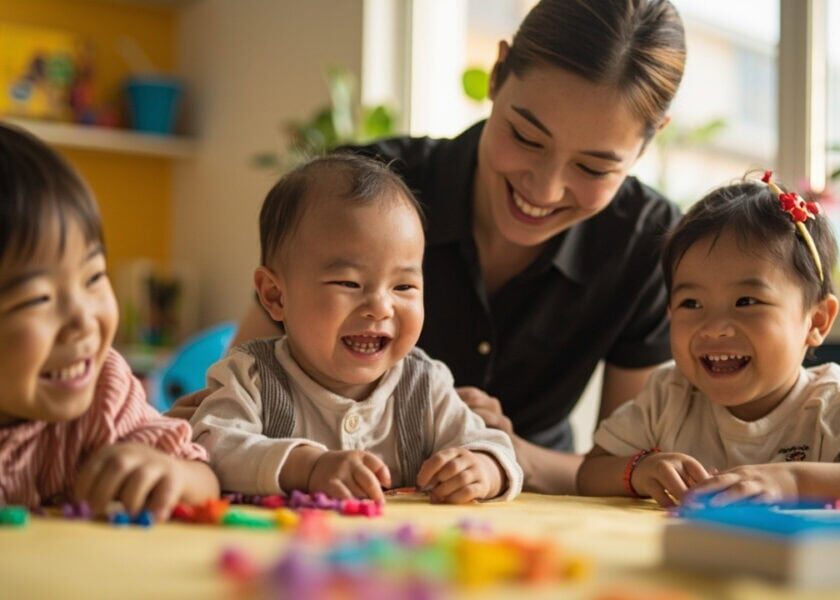
- When a caregiver notices a child struggling to stack blocks, they are not merely witnessing frustration. They are observing fine motor development, persistence, and problem-solving in real time—and thinking about how to scaffold that learning in a way that builds confidence without creating pressure.
- When a caregiver responds to a child’s babbling with meaningful engagement, they are nurturing communication skills that will form the basis of language.
This kind of care requires training. It requires intentionality. It requires a structured framework for observation that goes beyond the casual and becomes systematic. And critically, it requires documentation, because what is not recorded is often not remembered, and what is not remembered cannot be communicated, and what cannot be communicated cannot become part of the partnership between caregiver and parent.
At EduNanny, caregivers are not positioned as interchangeable workers filling a function. They are trained professionals who have chosen the work of early childhood development as a calling. They understand child psychology, developmental pedagogy, responsive caregiving techniques, and the specific developmental milestones that matter in the first three years of life. They are educators in the deepest sense of the word, engaged in the most important learning that any human being will ever undertake.
What Developmental Care Looks Like in Practice
At EduNanny, infant ratios are kept deliberately small—up to one to three in infant care settings. This means that a caregiver is not juggling six or eight children at once, racing from diaper change to feeding to soothing to activity. They are present, they are attentive, and they have the cognitive and emotional bandwidth to notice.
They notice that a particular child is developing a fascination with dropping objects and watching where they fall—a developmental milestone related to spatial awareness and causality. They notice that another child is becoming more verbal and is beginning to use sounds deliberately to request rather than merely to express. They notice the child who is withdrawn one morning and wonder about teething pain or disrupted sleep, adjusting their engagement accordingly.
This noticing is not accidental. It is trained. It is expected. It is part of what EduNanny calls developmental intelligence, and it represents the fundamental difference between a caregiver who is doing a job and a caregiver who is practicing a profession.
Communication That Transforms Trust
EduNanny employs multiple channels for keeping parents informed. These include direct communication from caregivers, structured updates that document developmental progress, and where deployed, transparency measures such as CCTV access that allow parents to see into the care setting directly.
This is not about surveillance. It is about partnership. When a parent can glance at a live feed and see their child engaged in a sensory activity, laughing at a caregiver’s silly song, or calmly exploring a new toy, something shifts. The wondering stops. The hum of anxiety quiets. The trust deepens because it is no longer based on faith alone but on sight.
When this observation becomes systematic, parents receive actual information about what their child has been exploring, discovering, and mastering. Instead of wondering whether their child had a good day, they learn what made that day good from a developmental perspective:
- Was it the sensory bin activity that supported fine motor skills?
- Was it the group story time that built pre-literacy awareness?
- Was it the free play sequence that allowed for autonomous problem-solving that develops executive function?
Communication at this level also means that concerns are raised early and collaboratively. If a caregiver notices that a child’s gross motor development seems delayed, they do not wait for the parent to discover it. They document, they flag, they discuss. This kind of proactive developmental monitoring is not about creating worry. It is about creating opportunity. Early identification of developmental needs means early intervention, and early intervention changes trajectories.
The ECDA Childminding Pilot: A Recognized Pathway
The ECDA Childminding Pilot represents the formal recognition that home-based and community-based childcare is not a lesser option but a legitimate pathway with distinct advantages. For infants, in particular, a home-based setting can offer a scale of care that is simply impossible in larger centre environments. The intimacy of the setting, the consistency of the caregiver relationship, the reduced exposure to illness that comes from smaller groups—these are not minor benefits.
EduNanny participates in this pilot, which means their service operates within a framework of regulatory oversight that ensures accountability while preserving the flexibility and responsiveness that makes home-based care distinctive. It also means that fees are structured within the pilot framework, making quality developmental care accessible to families who might otherwise assume this level of attention is reserved for those with significantly higher budgets.
Addressing the Guilt That Hovers
I want to pause here and address something that many parents feel but few say aloud, because the silence around it is damaging.
There is a guilt that hovers over working parents in Singapore. It is not universal, but it is common, and it is often unspoken. It is the feeling that by choosing to work, you are somehow choosing something less than full presence for your child. It is the whisper that says maybe you should be the one singing the morning songs, maybe you should be the one noticing the new word, maybe you should be the one there when the milestone arrives.
Here is what I want to say to that whisper, and I want you to hear this clearly: the choice to work is not a choice against your child. It is a choice made for your family, for your future, for the life you want to build together.
And the choice to seek excellent care for your child while you work is not an admission of inadequacy. It is an act of love. It is the recognition that your child deserves more than distracted, stressed, resentful parents. It is the understanding that financial stability, professional fulfillment, and personal wellbeing are not selfish concerns but family concerns, because children thrive when the adults in their lives are thriving too.
But—and this is the critical point—that act of love is only complete when the care you choose is worthy of it. When you hand your child to a caregiver, you are not just outsourcing parenting. You are inviting someone into the sacred work of nurturing your child’s development.
You deserve to know that this invitation is received with the seriousness it deserves. You deserve evidence, not just promises. You deserve a framework of observation and documentation, not just warm assurance. You deserve developmental intelligence, not just supervision.
A Practical Framework for Choosing Quality Care
If you are evaluating childcare options in Singapore, here are the questions that matter most:
- What is the caregiver-to-child ratio? Smaller ratios mean more attention, more observation, more opportunity to notice developmental milestones as they happen.
- How is development tracked? Is there a systematic approach to observation and documentation, or is it left to individual caregiver initiative?
- What does communication look like? Do parents receive regular updates? Are these updates specific and evidence-based, or vague reassurances?
- What training do caregivers receive? Are they trained in child development, or simply in safety and basic care?
- How are concerns raised? Is there a structured process for flagging developmental observations to parents, or do you have to discover issues yourself?
- Is the service part of recognized frameworks? Participation in initiatives like the ECDA Childminding Pilot indicates regulatory oversight and accountability.
The answers to these questions will tell you whether you are choosing supervision or developmental care. Both have their place. But if you want more than the floor—if you want your child to be not just safe but nurtured, not just watched but seen—then you need to ask the questions that reveal the framework behind the care.
Your Child Is Growing. They Deserve Care That Sees Them Fully.
There is a moment, every parent knows it, when your child does something that startles you with its newness. They say a word you have not heard before. They solve a problem in a way that suggests a logic you did not know they possessed. They show you, in a single gesture, that they are becoming someone more complex, more capable, more themselves than they were yesterday.
This moment does not happen only in your presence. It happens in the care setting, in the hours you are away, in the interactions with caregivers who are paying close attention.
And when those caregivers are operating from a framework of developmental intelligence—when they are trained to notice, document, and nurture—that moment is not lost. It is recorded. It is shared. It becomes part of the picture that you, as a parent, are building of your child’s growth.
This is what EduNanny offers. Not just childcare. Not just supervision. A developmental partnership. A systematic commitment to understanding your child. A professional framework for observation that transforms daily care into growth evidence.
When you drop your child at care in the morning and drive away, the hum of wondering can be quieter. Not silent, because you will always wonder, because that is what love does. But quieter, because you know what is happening.
You know that trained eyes are watching. You know that developmental milestones are being tracked. You know that your child is not just supervised but seen. You know that when you pick them up, the report you receive will be specific and informative, a window into their day that helps you understand who they are becoming.
And here is what is most beautiful about this approach: when developmental concerns arise, they are not surprises. They are not shocks discovered at a pediatric checkup when months have passed without anyone noticing. They are observations, documented, tracked, and shared. They are the beginning of early intervention rather than the beginning of worry.
A peace of mind that comes not from hoping that your child is okay, but from knowing that someone is paying attention, someone is keeping track, someone cares as much as you do about who your child is becoming.
The hours you are apart do not have to be a gap in your knowledge. They can be a window into your child’s development. They can be a space where growth happens, documented and understood, by people who have made it their profession to notice.
If you are ready to learn more about how EduNanny Singapore approaches developmental infant care—about their trained caregivers, their observation frameworks, their participation in the ECDA Childminding Pilot, and how they can support your family’s needs—reach out to begin a conversation.
Your child is waiting to show you who they are becoming. Let someone help you see it.
#EduNannySingapore #InfantCareSG #ChildmindingSingapore #EarlyChildhoodDevelopment #DevelopmentalCare