Beyond the Guilt: What Science Reveals About Working Parents and Early Development
The Moment Every Working Parent Knows
There is a moment, and if you are reading this, you probably know it well. It arrives without warning in the middle of an ordinary workday—your phone stays silent, your inbox demands attention, and somewhere across the island, in a room filled with morning light, your child is taking a first step, or saying a word for the first time, or simply looking up from play with an expression you will never witness in person.
You are not there.
And in that small, still ache, a question forms that every working parent eventually asks: Am I missing something that cannot be given back?
It is not a question born of guilt. It is a question born of love. And it deserves an honest answer—not a dismissal of your worry, but a deepening of your understanding.
What follows is that answer. It begins with what science has revealed about the early years, continues with what quality care actually looks like, and ends with a reframe that every working parent in Singapore deserves to carry home at the end of the day.
The Architecture of the Early Years
In the first six years of life, a child’s brain builds itself with a speed and intensity that will never be repeated. By the time a child turns six, more than one million new neural connections form every single second. This is not metaphor. This is measurement.
The quality of those connections, the pathways they create, the scaffolding that will support thinking, feeling, learning, and relating for the rest of a lifetime—all of it takes shape during a window that closes long before a child enters primary school.
What builds that architecture? Not flashcards. Not screen time. Not even the expensive toys that line store shelves with promises of developmental advantage. What builds a child’s brain in these years is profoundly, irreducibly human: responsive interaction. The back-and-forth between a child and a caring adult. The exchange of gaze, of voice, of touch, of attention.
The moment when a baby reaches for something and a caregiver notices and responds—in that noticing, a circuit fires, a connection forms, a foundation deepens for everything that comes after.
This is why the early years matter. Not as a matter of parenting philosophy or the latest trend in child-rearing. It matters because the brain is literally constructing itself, and the material it uses is not abstract knowledge but the texture of human relationship and sensory experience.
What Science Tells Us About Caregivers
Here is what often goes unsaid in conversations about early childhood development, and what I think you need to hear: that responsive interaction, that warmth, that attunement, does not come from a single source alone.
The research is clear on this, and it offers profound relief to parents who worry that time apart from their child means time lost in terms of connection.
Children are not vaults that require a single combination to open. Children are ecosystems.
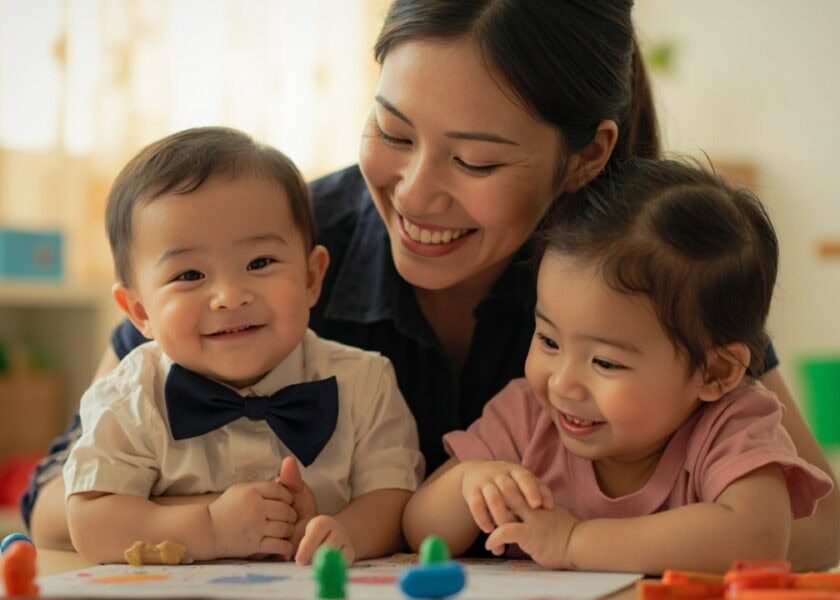
Healthy ecosystems are rich with multiple sources of care, of attention, of love. What matters is not that one person fulfills every developmental need in isolation. What matters is the consistency of warmth, the quality of responsiveness, the presence of attunement across the relationships that a child enters.
When a child has secure attachment to more than one consistent, loving caregiver, they do not become confused or divided. They become resilient. They learn that the world contains people who can be trusted, who will respond, who will keep them safe. They carry that knowledge forward as a foundational sense of security that colors every other relationship they will ever form.
This is not a compromise. This is abundance.
It is precisely here that the conversation about quality infant care shifts from what is lost to what is possible. When you choose a caregiver or a care arrangement that brings genuine developmental intentionality to those hours you cannot be present, you are not outsourcing your child’s growth. You are widening the world in which your child grows.
What Quality Infant Care Actually Looks Like
There is a persistent cultural narrative that suggests any care outside the home is a lesser choice, a fallback, a concession to circumstance. That narrative is not supported by the science.
What the science supports is something far more nuanced and, I think, far more freeing: children thrive when they are surrounded by warm, responsive, developmentally engaged adults, and the number of those adults—provided the quality is there—is a gift rather than a dilution.
When Caregiver Ratios Are Kept Intentionally Low
In a setting where one caregiver is responsible for too many infants, the simple mathematics of attention means that responsive interaction becomes harder to sustain. When that ratio is kept low, when a caregiver can give their full presence to a small number of children, the quality of engagement deepens.
Your child is not a name on a list. Your child is a person with a name, a temperament, a rhythm of hunger and tiredness and curiosity, and that person deserves to be known. The ratio of adult attention to infant need is a ratio of love, and love does not scale without loss.
When Language Is Woven Through the Day
In the first three years of life, a child’s brain is uniquely prepared to absorb the sounds, rhythms, and structures of language. This is not a passive process. The brain is building circuits specifically for the languages it hears, pruning away the ability to hear distinctions it does not need, strengthening pathways that will support comprehension and eventually production.
What builds these circuits is not silence or passive exposure. What builds them is rich, responsive language interaction: narration, conversation, song, the naming of things, the repetition of sounds, the back-and-forth of early communication that looks nothing like adult speech but contains within it the seeds of everything that comes after.
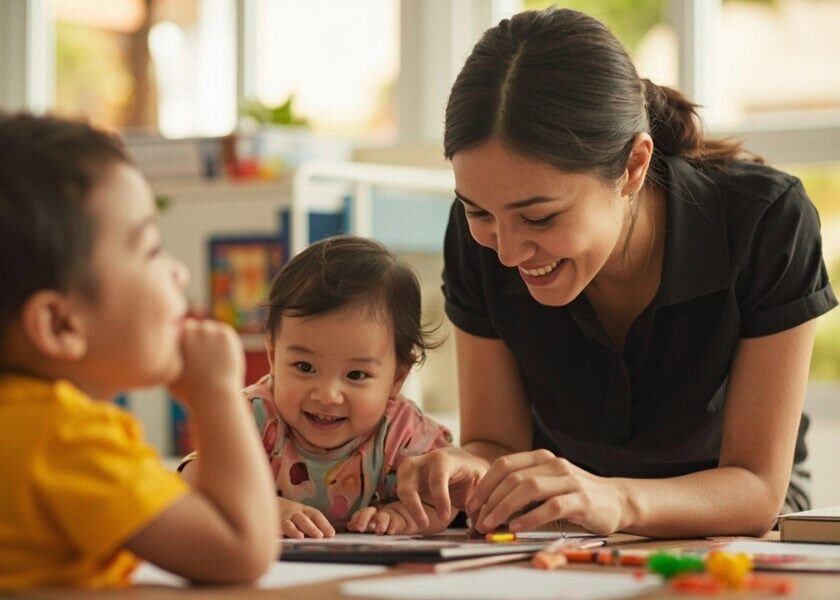
In quality infant care, language is woven through the day. The caregiver narrates the moment: this is the blue ball, look how it rolls. The caregiver responds to babbling as if it were conversation, because to the infant, it is. The caregiver sings, reads, describes the world in a stream of gentle, intentional language that the child’s brain receives like rain receives the earth.
When Sensory Development Is Treated as Foundational
A child’s experience of the world in the first years of life is overwhelmingly sensory. Everything arrives through the body: the texture of a blanket, the smell of a meal, the feel of being held versus being placed down, the quality of light in a room, the sound of a voice versus the sound of traffic.
The brain is learning to integrate these sensory inputs, to make meaning from them, to build a coherent picture of reality through the physical self. This is why infants who are given rich sensory environments—who are allowed to explore with their hands and mouths and whole bodies, who experience a variety of textures and temperatures and movements—develop more robust sensory processing systems than those raised in sensory poverty.
Quality infant care attends to this intentionally. Outdoor time matters, not for the sake of being outdoors but for the sake of the sensory complexity that nature provides: the changing light, the variety of surfaces, the movement of air, the sounds of birds and voices and wind. Active play matters, not as exercise but as sensory integration, as the body learns what it can do in three-dimensional space.
What to Look For When Choosing Infant Care
- Ratio: How many infants per caregiver? Lower ratios mean more responsive interaction, more attunement, more genuine knowledge of your child as an individual.
- Language environment: Is language woven through the day, or does it happen only at designated times? Do caregivers narrate, sing, respond to babbling, and engage in back-and-forth communication?
- Sensory intentionality: Is outdoor time prioritized? Is active play valued? Are infants given rich sensory experiences, or are they spending excessive time in swings, bouncers, or screens?
- Emotional attunement: Do caregivers notice frustration before it escalates? Do they name emotions? Do they respond to infants as full emotional beings?
- Communication: Will you know how your child’s day went? Are there systems in place to keep you informed—not as surveillance, but as partnership?
- Transparency: Are there visible measures in place that help you trust the environment your child is in?
- Philosophy alignment: Do the caregivers understand why they do what they do? Is there a developmental science behind the routines, or just tradition?
These are the questions that separate quality from adequacy. These are the questions that will help you feel not just comfortable with your choice, but confident in it.
EduNanny: A Thoughtful Approach to Developmental Care
EduNanny operates within the ECDA Childminding Pilot, and this matters for reasons beyond policy. The pilot reflects a growing recognition in Singapore that families need flexible, high-quality options for infant and toddler care that meet them where they are—whether that is home-based support or centre-based pathways.
Within this framework, EduNanny has built its methodology around the developmental science described above. Caregiver ratios reflect best practice: small numbers that allow for genuine attunement, for the kind of responsive interaction that builds brain architecture. The training and approach of EduNanny caregivers are oriented not toward supervision alone but toward intentional development, understanding that every routine, every interaction, every moment of the care day is an opportunity to support growth.
The practical elements that parents rightly care about are in place with transparency and trust at the center. Communication channels keep you informed about your child’s day, not as a transaction but as a partnership. In settings where safety measures are deployed, they serve not surveillance but assurance—a visible commitment to the security that your child needs and that you need for your peace of mind.
Fee structures within the pilot are designed to make quality care accessible. CDA and Baby Bonus usability means that the financial architecture of Singapore’s family support system works for you, not against you, when you choose this path. These are not small things in a city where the cost of living weighs heavily on families.
EduNanny is not a stopgap. It is not a lesser option for families who cannot access something better. It is a thoughtfully designed response to the question of what it means to provide developmental infant care in the context of modern Singapore family life, and it takes seriously both the science of what children need and the reality of what parents face.
Your Role: Amplifying What Care Builds
Here is where your role becomes extraordinary. Because language development does not pause when your child leaves care and comes home to you. In fact, some of the most powerful language-building moments happen in the ordinary, unremarkable spaces of home life.
Bath time becomes a language laboratory. You name body parts, describe the sensation of water and warmth, narrate the splash and the slipperiness of soap in language that feels like play.
Meal time offers the back-and-forth of feeding and being fed—a rhythm of turn-taking and communication. More? All gone? Good girl. Look at the rice, see how it falls?
Bedtime, with the intimacy of a story read aloud, a song sung, a day recalled in simple language, creates neural pathways that are strengthened precisely because they happen in the context of your relationship with your child.
The caregiver builds during the day. You extend at home. And in that extension, something remarkable happens: the language environment of your child’s world doubles, enriches, deepens. You are not competing with your child’s care arrangement. You are amplifying it.
Home is where you can complement the sensory development that happens in care. The backyard or the park near your HDB flat becomes a sensory laboratory. Even the simple act of dressing and undressing a child can be a moment of sensory description: this shirt is soft, look how it stretches, now we put your arm through. You are not recreating the care environment at home. You are creating a second layer in the same ecosystem, and that layering is exactly what a developing brain needs.
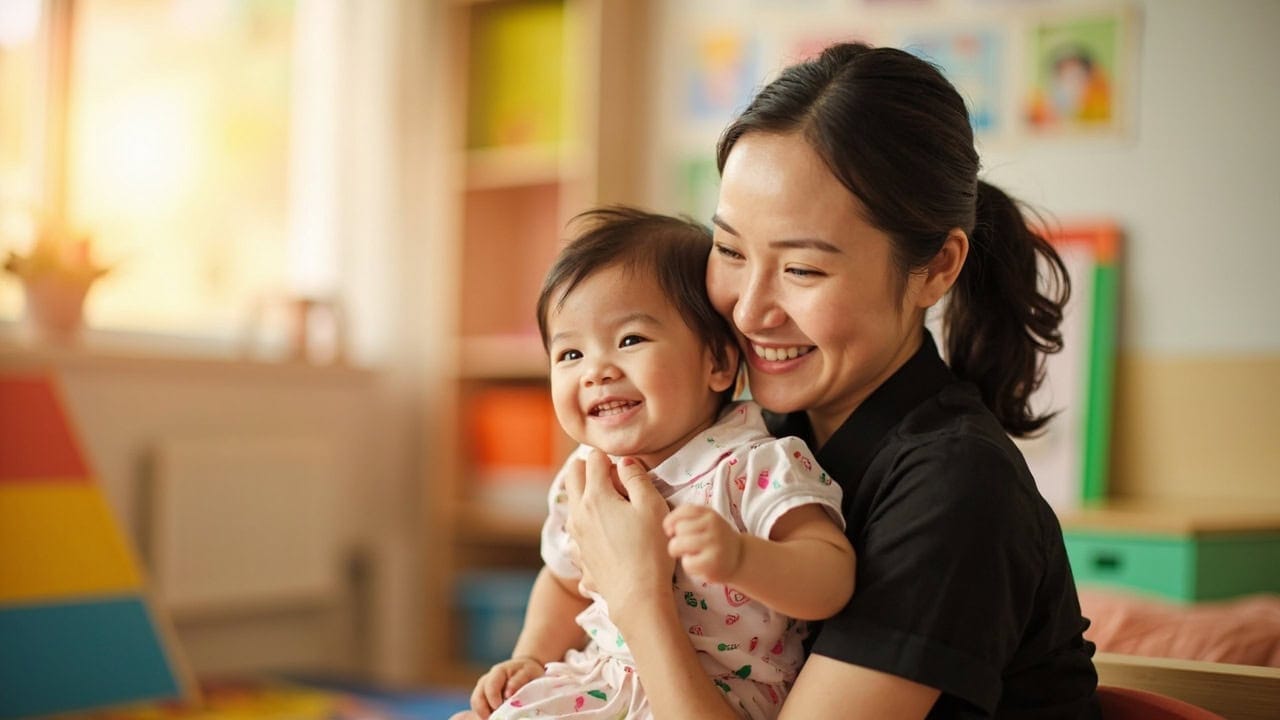
Your child knows you. Your child knows you with a knowledge that predates memory, that lives in the body, that is not dependent on the number of hours spent in proximity. When you come home at the end of the day, and your child looks up, and something shifts in their face—that is recognition. That is bond. That is attachment working exactly as it should.
But here is what quality care does that is less visible but equally important: it helps your child develop the emotional vocabulary and regulation capacity that makes your connection richer over time, not thinner. In settings where caregivers are attuned—where they notice a child’s frustration before it becomes a tantrum, where they name emotions and offer comfort before a child can do this for themselves—children are building the capacity to understand and manage their inner world.
When you pick up your child and ask how their day was, and they are too young to answer with words but their body tells you something, and you learn to read that body, you are entering their emotional world. When you notice they are clingy and you do not take it personally but respond with extra warmth, you are teaching them that their feelings are safe with you. When you say I can see you are feeling frustrated, you are naming what they cannot yet name, and in that naming, you are building a bridge between their experience and their capacity to understand it.
This is attachment working across time and across caregivers, and it is not weaker for being distributed. It is stronger.
The Reframe You Deserve
There is a story we tell ourselves, sometimes silently, sometimes in the comments of parenting forums at 11pm, sometimes in the weight we feel when we drop our child at care in the morning. The story goes that we are doing something less than ideal. That we are compromising. That we are, in some fundamental way, failing to be the parent our child deserves because we cannot be present in the way we imagine a non-working parent could be.
That story is not true.
It is not true because the research does not support it. It is not true because the developmental outcomes of children with working parents who choose quality care are indistinguishable from those of children with stay-at-home parents, provided the care quality is high and the home environment remains warm and engaged.
But more than that, it is not true because it mistakes the nature of what children actually need.
Children do not need a parent who is present in body at every moment. Children need a parent who is present in mind, in attention, in love, in intentionality. They need a parent who shows up when they are present and who finds ways to bridge the gap when they are not. They need a parent who is growing in their own understanding of child development, who asks good questions, who seeks quality, who brings their full self to the relationship even when that self is tired, even when that self is distracted by the thousand other demands of a working life in Singapore.
Being a working parent is not a deficit. It is a choice, made out of love, often out of economic necessity, sometimes out of a desire for professional fulfillment that is not incompatible with parental fulfillment. And that choice, when paired with quality care and intentional home presence, gives your child something that only-children-with-only-parents cannot access: a wider world. Multiple warm relationships. Exposure to different ways of being, different rhythms, different caregivers who each bring something valuable to your child’s developing sense of what the world contains.
Your child is not losing you by gaining this. Your child is gaining the world by having you as the anchor, the constant, the one who comes home, the one who is irreplaceable not because of hours spent but because of the quality of presence you bring to the hours you have.
The anxiety does not fully dissolve, because you love your child and love does not come without ache. But what can happen, what I have seen happen for parents who find the right care arrangement, is that the anxiety transforms.
It becomes less a question of am I failing and more a question of how can I be present even when I am not there. And that question has answers. Practical answers. Daily answers that you can take home and implement not as homework, not as another thing on the list, but as natural extensions of the relationship you already have with your child.
Bath time is language building. Meals are connection. Bedtime is storytelling that builds the brain. The park is sensory enrichment. Reading your child’s body when you pick them up is emotional attunement that you are offering.
Every moment of intentional presence you bring—whether in person or through the knowledge you gain about your child’s day—is building the architecture of their future.
Being a parent in Singapore is not easy. The hours are long, the costs are real, the expectations from family and society and yourself are high. But you are doing something extraordinary. You are raising a human being in the most critical window of their entire development, and you are doing it with intelligence, with intention, with love that persists even across the distance that work creates.
That matters. That is enough. And with the right support, it can be more than enough.
It can be everything.
If you are ready to explore what quality developmental care can look like for your family, we invite you to learn more about EduNanny’s approach to infant care and childminding in Singapore. You are also welcome to connect with our team or learn more about who we are.