The Quiet Signs of Quality Every Singapore Parent Should Notice
What Quality Childcare Actually Looks Like
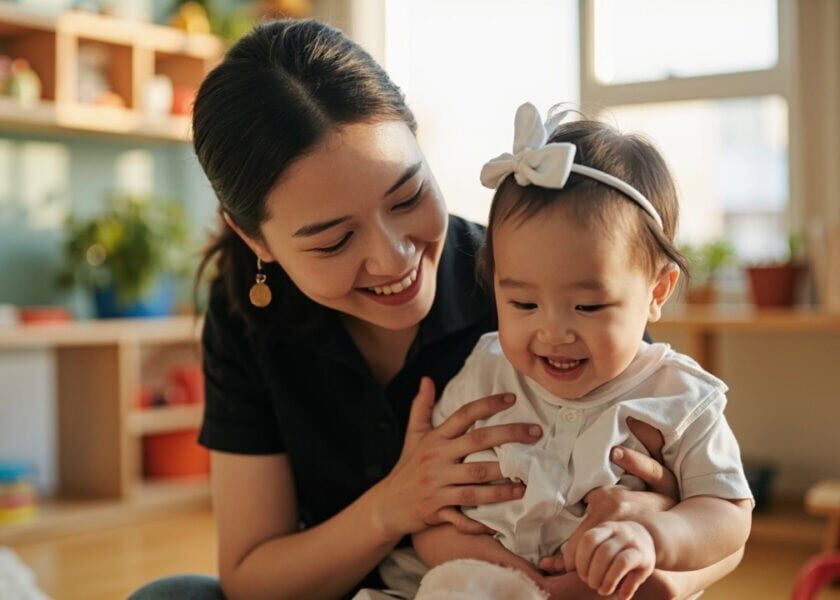
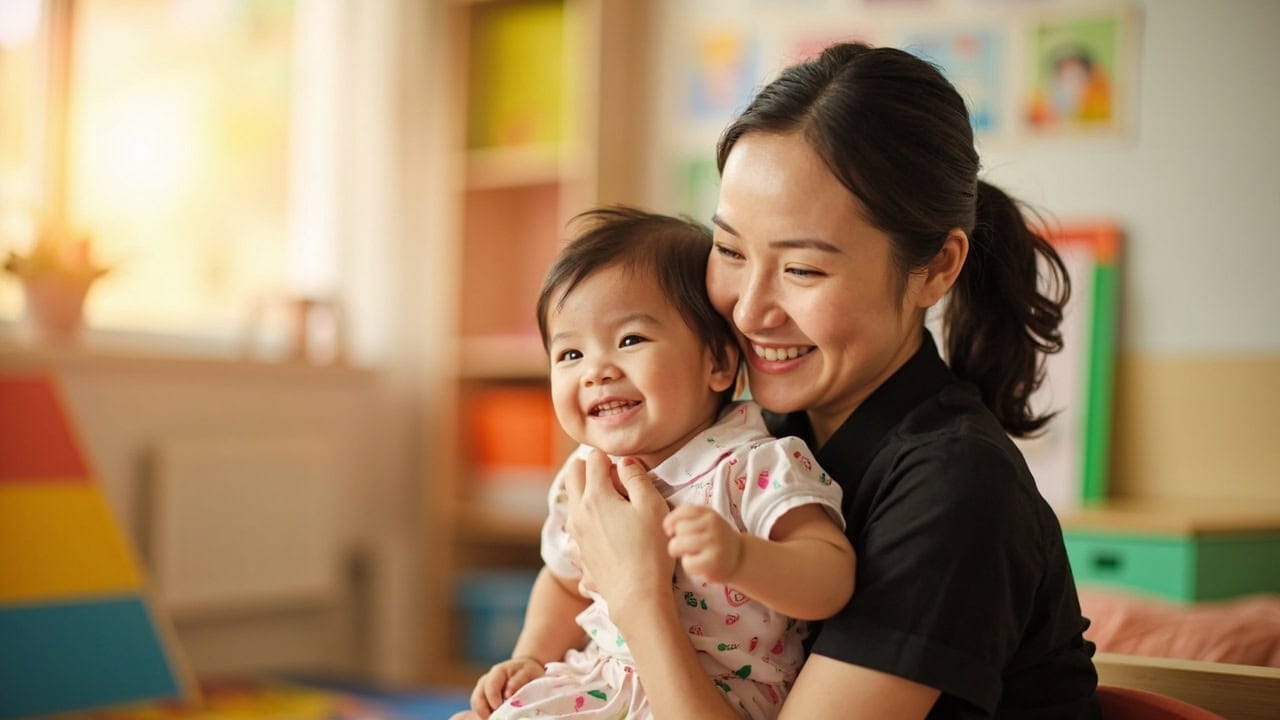
Imagine standing in a childcare centre for the first time. The lights are warm. The walls are colourful. Toddlers play with blocks near the window while a caregiver kneels beside them, speaking softly. Everything looks friendly. It looks safe. But a quiet question surfaces: how do I actually know if this is good?
You walk through the space. You notice the cleanliness, the child-sized furniture, the carefully arranged activity stations. You watch a teacher read to a small group. You see your child smile at a new toy. Still, the question remains: what is actually happening here? Is my child being cared for—or being grown?
That gap between what looks fine and what is genuinely good is where most Singapore parents live when searching for childcare. We want more than supervision. We want our children’s days to matter.
Here are the key indicators of quality you can observe during a visit: a calm, predictable daily rhythm; caregivers who extend play strategically; intentional physical and sensory experiences; rich conversation that builds vocabulary; calm, attuned responses to emotional moments; and individualised communication about your child’s development. If a centre demonstrates these elements, you are looking at genuine developmental support—not just watchful supervision.
This guide will help you close that gap—not with a checklist, but with a framework for seeing. Because when you understand what quality actually looks like in the architecture of a day, you stop relying on surface impressions and start recognising what is really happening for your child.
The Rhythm of the Day: Why Structure Creates Security
Most parents never think to ask: why does the structure of a day matter so much for a young child?
There is a reason we call it rhythm. Rhythm is not a schedule printed on paper. Rhythm is the felt sense of predictability that allows a child to relax into their day, to know what comes next, to trust that after snack time comes story time, and after story time the caregiver will wash hands before lunch.
This predictability is not about control. It is about security.
For infants and toddlers, the world is overwhelmingly large. They have not yet developed the cognitive architecture to navigate uncertainty with ease. What their developing brains require is a surrounding structure that says: this is safe, this is consistent, we know what to expect.
In a childcare environment with intentional rhythm, children do not just behave better. They explore more freely. They engage more deeply. They are available for learning precisely because they are not expending energy on anxiety and vigilance.
Watch a child in a classroom with well-designed rhythm. Notice how, as the morning progresses, the child becomes more engaged, more curious, more willing to try new things. That is not accidental. That is the child settling into the safety of predictability and using that stability as a launchpad for discovery.
Consider what happens in a day that lacks intentional structure. Children are moved from one activity to another without transition. There is no sense of flow. Meals come at irregular intervals. Caregivers change without warning. The day becomes a series of disconnected moments, and the child spends energy not on learning, but on simply surviving the uncertainty.
When you visit a childcare centre, ask yourself: How do the children move through their day? Is there a sense of calm predictability? Or is there constant redirection, transition battles, the sense that nobody quite knows what comes next?
When you find a centre with strong rhythm, you are seeing the first layer of quality—the foundation upon which everything else is built.
Learning Through Play: What It Actually Looks Like
There is a phrase used often in early childhood education: learning through play. It has become so familiar that it risks losing its meaning. Let me be specific about what it actually looks like—and why it is profoundly different from what we used to think of as education.
When a toddler stacks blocks, they are not just playing. They are building neural pathways that will later support mathematical thinking, spatial reasoning, and problem-solving. When a one-year-old pours water from one container to another, they are developing scientific concepts: volume, capacity, cause and effect. When two-year-olds engage in dramatic play—pretending to cook, to visit the doctor, to care for a doll—they are developing executive function, empathy, language, and the ability to understand other people’s perspectives.
This is learning through play. It is not a softening of education. It is education, fully realised, at the developmental stage where children are actually capable of absorbing it.
Here is what distinguishes a quality childcare environment from a mediocre one: in a quality environment, every moment of play is understood as an opportunity for development.
The caregiver does not simply watch children play. The caregiver watches, observes, and then strategically enters the play to extend it—to ask a question that deepens thinking, to introduce a small challenge that builds persistence, to name an emotion that builds emotional vocabulary.
A child who is happy is not necessarily a child who is learning. Happiness is wonderful. Happiness is necessary. But if your child’s day consists entirely of free play with minimal intentional adult engagement, your child may be kept busy without being genuinely grown.
The question is not whether your child is happy in childcare. The question is whether your child is being thoughtfully challenged, supported, and extended throughout the day.
Physical, Sensory, and Language Development
In the first three years of life, the child’s body is the primary vehicle for learning. This is not metaphor. This is neuroscience.
A child’s brain develops in response to physical experience. When a baby crawls across different surfaces—smooth floor, textured mat, grass outside—her brain is building sensory maps that will later support reading, mathematics, and spatial awareness. When a toddler climbs, jumps, and runs, she is developing the proprioceptive sense—the body’s awareness of itself in space—that underlies coordination, balance, and eventually handwriting.
In a quality childcare day, you will see intentional physical development woven throughout. There will be time for large motor play—not just a brief stint on a playground, but extended, varied opportunities to run, climb, jump, and explore physical challenges appropriate to each child’s developmental stage.
There will also be careful attention to fine motor development: the pincer grasp needed to pick up small objects, the hand strength needed to manipulate playdough, the finger dexterity needed to turn pages.
Watch a group of one-year-olds at a well-designed sensory table. You might see water, sand, rice, or beans—simple materials that invite exploration. Notice what the caregiver does. Does she simply watch? Or does she narrate what the children are doing, ask questions, introduce new vocabulary, model new ways of interacting with the materials?
The difference between passive observation and intentional facilitation is the difference between a child who is playing and a child who is learning through play.
By the age of three, a child’s vocabulary development is strongly predictive of later academic success. Children who are exposed to rich, varied language in the early years arrive at school with thousands more words in their vocabulary than children who were not.
The neural pathways for language are established in the early years. Once that window closes, they become far more difficult to develop. Listen to a caregiver in a quality childcare environment. You might hear her say:
“I see you are building a tower. It is very tall. What do you think will happen when you add one more block on top?”
She is not filling silence. She is building language. She is introducing words like “tall,” “add,” “top.” She is modelling sentence structure. She is showing the child that her thoughts are valued by responding to them.
Compare that to a caregiver who speaks only to direct behaviour: “Sit down.” “Don’t touch that.” “Share with your friend.” These are not negative interactions. They are necessary. But alone, they do not build language. A child who hears only directives all day is not receiving the rich language exposure that will serve her throughout schooling and beyond.
When you observe a childcare environment, listen. What do you hear? Is there conversation? Is the caregiver talking with children, not just at them? Are new words being introduced? Are questions being asked?
Social-Emotional Development: How Children Learn to Be People
In the early years, children are not just learning facts and skills. They are learning how to be people. They are learning how to recognise and manage their own emotions. They are learning how to regulate when upset, how to wait when they want something immediately, how to express frustration without hurting others.
These are not soft skills. These are the foundational competencies that will determine how well a child navigates relationships, handles stress, and functions in a community throughout their entire life.
In a quality childcare environment, social-emotional development is not left to chance. It is intentionally scaffolded.
When a toddler has a tantrum—and they will, because that is developmentally appropriate—the caregiver responds not with punishment or dismissal, but with calm, steady presence. She names the emotion. She acknowledges the frustration. She helps the child put words to what is happening inside:
“You are feeling angry because it is time to clean up and you want to keep playing. That is hard. I am here with you.”
This kind of response does several things at once. It helps the child feel understood. It teaches vocabulary for emotions. It models emotional regulation. And it shows the child that difficult feelings are manageable, that they do not have to be afraid of their own emotions.
Over time, with consistent scaffolding, children develop what we call co-regulation—the ability to borrow calm from a caring adult until they can generate calm themselves. This is one of the most valuable gifts a childcare environment can give a child.
You can observe this in any childcare centre. Watch how caregivers respond to children’s emotional moments. Is there patience? Is there attunement? Does the caregiver seem to genuinely see the child behind the behaviour? Or is there impatience, quick fixes, dismissal?
The way a caregiver engages with a child’s emotional world tells you almost everything you need to know about the quality of that environment.
Observation, Communication, and What Parents Can Evaluate
In a truly excellent childcare environment, caregivers are watching your child. Not just supervising. Not just keeping them safe. Watching with intention, noticing developmental milestones, tracking progress, identifying areas where your child might need additional support or challenge.
This means that when you receive updates about your child’s day, those updates are informed by genuine observation. You are not receiving a generic report that could apply to any child in the class. You are receiving insight into your child’s specific experience—what she was drawn to, what challenged her, how she interacted with peers, what she learned.
Communication between caregiver and parent is not an administrative task. It is a partnership in your child’s development. When you drop your child in the morning, that caregiver knows your child—not just her name, but her temperament, her interests, her current developmental focus. And at the end of the day, you receive information that helps you continue that developmental work at home.
Evaluating childcare is not about finding perfection. There is no perfect centre, because centres are made of people, and people are imperfect. What you are looking for is not flawlessness. What you are looking for is intentionality—a place where someone has thought carefully about how children develop, where the daily experience is designed with that development in mind, where caregivers are not just present but purposefully engaged.
When you walk into a childcare environment, ask yourself:
- Do I see intentionality here?
- Is there a rhythm that feels calm and predictable?
- Is play being used as a vehicle for learning?
- Are children being physically challenged and sensory engaged?
- Is language being built throughout the day?
- Are emotions being named and supported?
- Are caregivers observing and responding to individual children?
- Is there genuine attention to development, not just supervision?
Quality is not exclusively found in premium-priced programmes. Intentionality, strong caregiver training, and developmentally informed practice can exist at various price points. What matters is the thoughtful design of the daily experience and the knowledge of the caregivers—not the cost of the facility.
If caregivers can articulate what learning is happening and why, that is a strong indicator of intentional practice. Ask how they document learning. Request specific examples of how play connects to developmental goals.
Happiness is necessary but not sufficient. A child can be happy in an environment that is essentially entertainment without genuine developmental value. Look beyond the smiles. Ask about the daily structure. Observe caregiver-child interactions. Trust your instincts, but also trust the framework—because when you know what to look for, you will see more than surface impressions.
EduNanny: Quality Childcare for Singapore Families
EduNanny by BUTLER was built on a simple but profound belief: every child deserves quality care that genuinely supports their growth. We know that Singapore parents face real pressures—long working hours, demanding careers, the need for affordable, reliable childcare that does not require sacrificing developmental quality.
We built EduNanny to meet that need, not with a one-size-fits-all solution, but with an approach that recognises the importance of individualised attention and intentional care design.
EduNanny participates in the ECDA Childminding Pilot, which means our home-based and community pathways are designed with the highest standards of quality in mind. Our infant ratios—up to one caregiver for every three infants—ensure that your child receives the focused attention that developmental science tells us is essential in the early years.
Our fee structures are designed to be affordable within the pilot framework, and we are pleased that CDA and Baby Bonus funds can be used, making quality care accessible to more Singapore families.
We operate Monday to Friday care blocks because we know that parents need reliability. And because we believe that consistency is not just convenient—it is foundational to the security and development that we have discussed throughout this guide.
When you choose EduNanny, you are choosing a team that understands child development as deeply as you understand your own child’s needs. Our caregivers are not just trained. They are educated in the science of early childhood.
They understand the rhythms that create security. They know how to use play as a vehicle for learning. They are intentional about language, about sensory experience, about social-emotional scaffolding. They observe, they document, they communicate.
We also believe in transparency. Where CCTV measures are deployed, they serve not as surveillance, but as assurance—giving parents the confidence that comes from knowing exactly what is happening in your child’s day.
For those moments when you have questions—when you wonder about your child’s development, when you want guidance on how to continue at home what we are doing in our care—we have developed tools to support you. Because parenting and childminding should not be lonely endeavours. They should be partnerships.
We understand the unique pressures you face. The commute, the long working hours, the cost of living, the desire to be present even when work demands are real. You are not looking for excuses. You are looking for solutions that do not require you to compromise on what matters most.
That is why EduNanny exists—not as a compromise, but as a genuine option for families who want both reliability and quality, accessibility and excellence.
We invite you to visit us. To see our environments. To speak with our caregivers. To ask the hard questions and expect thoughtful answers. To experience what intentional, developmentally informed care actually looks like in practice.
Moving Forward: Seeing Quality for Yourself
Every day, in childcare environments across Singapore, children are either being supervised or being grown. Both look similar from the outside. Both involve children who are safe, fed, and content.
But only one of them is building the architecture of a lifelong learner, an emotionally intelligent human being, a child who will carry the foundations laid in these early years into everything they become.
The difference is not visible in a happy photograph or a clean facility or a friendly face at pickup. The difference is invisible until you know how to see it.
It lives in:
- The rhythm of the day
- The intentionality behind the play
- The language a caregiver uses when she thinks no one is listening
- The way a child’s frustration is met with steady presence rather than quick dismissal
- The careful observation that says: we see your child, not just as a student in our class, but as an individual whose potential we are honoured to support
You deserve to know what is happening in your child’s day. You deserve partners in your child’s growth. And you deserve the confidence that comes from understanding—not blind trust, but informed confidence.
The next time you walk into a childcare centre, you will see differently. You will notice the rhythm. You will listen for language. You will watch how caregivers engage with children’s emotions. You will look for the intentional design that separates supervision from growth.
And when you find it, you will know. Not because someone told you it was good. But because you can see it for yourself.
Take the next step. Speak with our team. Schedule a visit. Ask about our approach, our caregivers, our philosophy, and our practices. See for yourself what intentional care looks like when it is built on genuine expertise and deep respect for both children and parents.
Your child deserves to be seen, supported, and grown. And you deserve to know that this is happening—not hope for it, but know it.
EduNanny is here to make that possible.