What Your Child’s Day at Childcare Really Looks Like
The Morning Handover: What Really Happens When You Leave Your Child at Childcare
There is a moment every morning that most parents in Singapore know intimately. The handover. The brief exchange at the door. The small rituals of settling — a kiss, a reassurance, a glance back over one shoulder as you walk away knowing your child is in someone else’s hands.
And then you leave. And the question arrives, unbidden and familiar: what is happening in there, right now, while I am not there?
It is not a question of distrust. Most parents do not doubt their childcare provider’s intentions or goodwill. The question is something quieter, something more specific. It is the hunger to understand what a day actually contains. Whether your child is engaged, curious, safe, growing. Whether the hours apart are hours well spent.
You are not looking for a report card. You are looking for something harder to name: proof that your child’s day has had substance. That it has been a real day.
This article is about that question — and about what quality childcare has learned in answering it, not with promises, but with an open door.
Quick Summary: What a Quality Childcare Day Actually Contains
- Morning arrival — a trained caregiver reads your child’s emotional state and adjusts their welcome accordingly
- Intentional free play — materials are chosen for developmental purpose, not just to fill time
- Small caregiver ratios — up to 1:3 for infants, enabling genuine attunement rather than mere supervision
- Group time — age-appropriate songs, stories, and repetition that build language and social connection
- Rest and meals — treated as social and developmental opportunities, not schedule checkpoints
- Afternoon activities — outdoor time, process-focused art, and guided conflict resolution
- Pick-up evidence — the tiredness that comes from engagement, not overstimulation, is the real sign of a quality day
A Morning in Quality Childcare: Walking Through the Door
Walk through that door with us, if you will, and imagine what you might see.
It is eight in the morning. The environment has been prepared with intentionality — the kind that separates routine from rhythm. Lighting is adjusted. The space is organized not for aesthetics but for inquiry: low shelves with open-ended materials, soft corners that invite both activity and rest, a sensory table positioned where natural light catches the water or sand or rice that will occupy small hands and concentrated minds over the next hour.
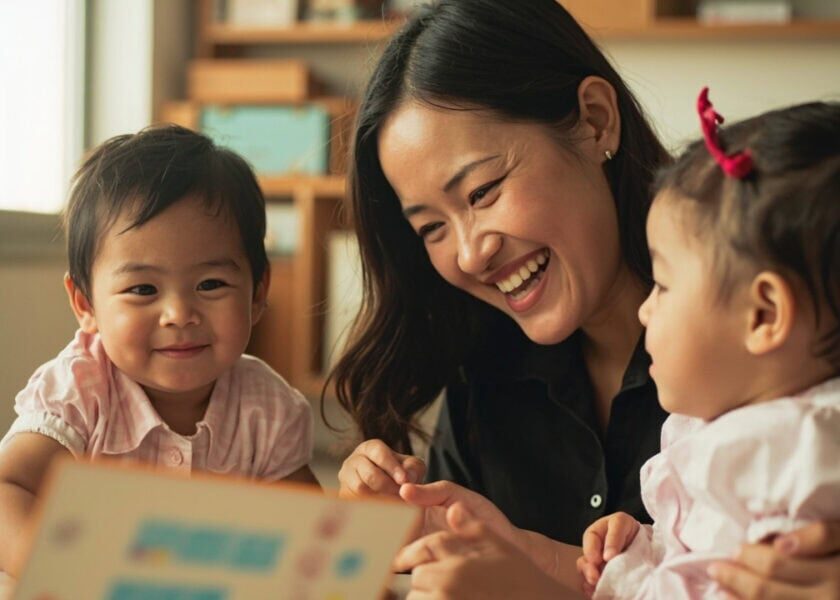
Your child, let us say she is twenty months old, is being welcomed in. Not with a formula. With attention. The caregiver kneels to her level. Speaks her name. Notes how she is arriving this morning — the energy in her step, the grip on her mother’s hand, the way she looks toward the familiar shelf where yesterday she spent twenty minutes transferring blocks from one container to another.
That observation is not incidental. It is the beginning of the day.
This is what most parents do not see: the assessment that happens in the first five minutes of arrival, when a trained caregiver reads the child like a text. The child who needs a slow entry is given a slow entry. The child who is bursting with energy is met with movement. The child who is clinging is held, briefly and firmly, before the business of the day begins.
This responsiveness is not instinct. It is trained. It is the difference between supervision and care.
Caregivers trained in quality infant and toddler frameworks understand something many parents intuitively feel but rarely see articulated: infant and toddler care is not a lesser form of education. It is education at its most foundational, its most consequential, its most delicate.
The first thousand days of a child’s life — from birth to roughly age three — are not a warm-up for school. They are the architecture of everything that follows. Neural pathways are forming at a pace that will never be replicated. Attachment patterns are being established. The capacity for regulation, for curiosity, for trust, for empathy — these are being built in real time, in the interactions that happen dozens of times a day.
Intentional Free Play and Group Time
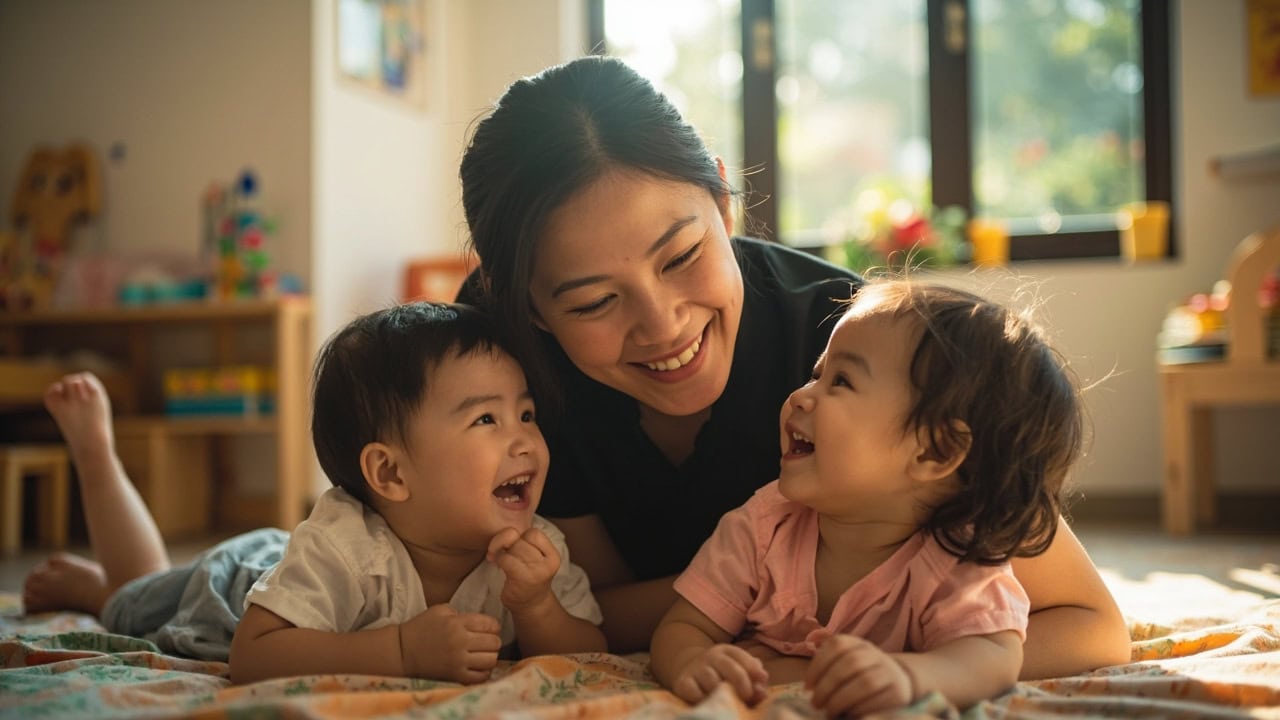
At nine, there is free play. Not aimless. Intentional. The environment has been set up to invite exploration: a ramp and balls, a basket of fabric squares for sensory sorting, a low mirror where a toddler can watch their own face, a play kitchen with wooden fruits.
The caregiver moves through the space not as a director but as a responsive presence — narrating what she sees, naming emotions she notices, sitting alongside a child who is working on something hard, remaining quiet when quiet is what the moment needs.
This is where development happens. In the sustained attention a child brings to pouring water from one jug to another forty times until the motion is mastered. In the negotiation that happens when two children both want the red truck. In the frustration and the recovery. In the moment a child looks up to check if the caregiver saw what they just accomplished.
At half past ten, there is group time — brief, age-appropriate, warm. A song with hand movements. A story held open so small faces can see the illustrations. The repetition of familiar words that builds language in ways that feel like play.
For infants, it is exposure — to sound, to social attention, to being part of a group. For toddlers, it is more: listening, participating, learning that their voice belongs in a room.
Why Small Ratios Matter: The Mathematics of Attunement
You may wonder, at this point, about ratios. About numbers. About how one person can possibly hold this kind of attention for multiple children throughout a full day.
In quality infant and toddler care settings, the ratio of caregivers to children is deliberately kept small — up to one to three for infants. This is not a luxury. It is a structural necessity for the kind of care we are describing.
You cannot attune to a child’s emotional state, notice the developmental leap they are attempting, respond to an infant’s first distress call with specificity, if you are responsible for six, seven, or eight children at once.
Small ratios are the condition under which quality becomes possible. They are also the condition under which parents can genuinely know who is caring for their child — not a rotating cast, not a stranger brought in to cover a shift, but the same familiar faces, day after day, building the consistency that infants and toddlers require to feel safe enough to explore, to learn, to grow.
Programmes like the ECDA Childminding Pilot make this possible — taking childminding seriously, not as babysitting, not as a stopgap, not as a lesser option, but as a profession worthy of training, support, and recognition.
Parents sometimes ask whether home-based childminding can deliver the same developmental richness as a centre. The answer is yes, when the conditions are right: when the environment is prepared, when the caregiver is trained, when the ratio is honored, when the daily structure follows the principles of quality infant and toddler care.
Quality is not determined by the building, but by the intention, training, and attention within it.
The Rest of the Day: Lunch, Rest, and Afternoon Exploration
It is nearly noon. Lunch has been prepared — a meal that children may or may not eat with enthusiasm, because feeding young children is its own complex negotiation, and a good caregiver knows when to encourage and when to step back.
The table is a social space. Food is shared. Conversation — or the toddler version of it — flows around the table. A child who has been struggling with a peer interaction all morning sits next to the caregiver and feels the day reset.
After lunch, rest. Not because schedules demand it, but because developing brains require it. The room darkens slightly. Soft music or white noise. The ritual of sleep — a cot, a familiar sheet, a small hand held briefly until eyes close. For some children, this is easy. For others, it requires patience and presence. The caregiver stays until the room is settled, checks the monitor, and notes who slept well and who did not — information that will shape the afternoon’s pacing.
And then the afternoon begins again, different from the morning in texture and temperature, carrying children through the remaining hours with the same intentionality.
There is outdoor time, weather permitting. Grass and sky and the sensory richness of the natural world. There is art — not product-focused, not about outcomes, but process-immersed. Paint in a bag. Chalk on a tray. Sticks and glue and torn paper. Fine motor skills developing without the child knowing they are developing anything.
There is a moment of conflict — two children reaching for the same toy — and the caregiver does not swoop in to solve it. She stays close, observes, and when intervention is needed, she names what she sees. She gives the language of negotiation to children who do not yet have it.
This is emotional coaching. This is social learning. This is what happens in a quality day when no parent is watching.
What Your Child Shows You at Pick-Up
You are back at the door now. It is five-thirty, or perhaps six. The caregiver hands your child to you, and you see immediately — because parents always see — that something has happened today.
Your child is not tired in the wrong way. Not listless, not overstimulated, not shut down. She is tired in the right way — the tiredness that comes from having engaged fully with the world.
There is something in her eyes that was not there this morning. A satisfaction. A completion. She may not have language for what she did today, but her body knows. Her play at home tonight will be different. She will reenact something she learned. She will use a word she did not know this morning. She will reference a face or a song or a moment that mattered.
Your child is showing you that she lived a real day.
When the day is well-made, parents do not need to be convinced. They can see it. They feel it. The child arrives home different — not better, not transformed beyond recognition, but more present, more engaged, more alive to her own experience.
What Singaporean Parents Carry: Addressing the Real Concerns
Let us be honest about something Singaporean parents carry in their bones, even when they do not say it aloud.
The cost of childcare in this city is real. The pressure on dual-income households is relentless. The expectations placed on parents — to work, to produce, to remain competitive, to raise children who will somehow thrive in one of the world’s most demanding educational environments — are immense.
And woven through all of it is a quiet, persistent guilt: the sense that leaving your child in someone else’s care is somehow a failure of love.
Quality childcare does not offer reassurances about working motherhood or the dignity of career parents. Those conversations have been had. They are important. But they are not this conversation.
This conversation is about what happens when parents are given a window into the substance of quality care. When they see not just that their child is safe, not just that they are supervised, but that they are engaged, growing, challenged, delighted, and held by a trained professional who takes this work as seriously as any teacher, any doctor, any engineer.
When parents understand what they are actually purchasing — not hours of babysitting, but hours of development — the guilt loosens its grip. Not because it was irrational to begin with, but because it is being met with something real.
What EduNanny Singapore Does: A Description of Practice
EduNanny Singapore was built on a simple conviction: that infants and toddlers are not waiting to become people. They are people. Right now. Complete with curiosity, capacity, emotion, and the urgent drive to make meaning of the world around them.
Every interaction in the first three years of life is shaping the adult they will become. Every hour matters.
EduNanny was designed to honor that urgency — not with anxiety, not with pressure, but with respect. With trained caregivers who understand child development. With environments that invite inquiry. With daily rhythms that balance structure and spontaneity. With communication that keeps parents informed without overwhelming them. With ratios that make quality possible.
Where technology tools are deployed, they serve parents, not replace caregivers. You can ask questions at midnight when your child has a rash you cannot identify. You can use them to track developmental milestones, to find resources, to feel less alone in the enormity of raising a small human. These are additions to human care, not replacements for it.
The caregiver remains the centre of everything. Her eyes on your child. Her hands steadying a first climb. Her voice naming the emotion no one else has noticed. Her patience in the long afternoon when everything is hard.
Choosing Infant Care in Singapore: What to Look For
When researching childcare options, here are the questions that matter most:
- How does the caregiver respond to your child at arrival? Quality care begins with attunement — watching how your child is received on arrival tells you everything about the day ahead.
- What is the child-to-caregiver ratio? For infants, a maximum of 1:3 allows for genuine responsiveness. For toddlers, 1:4 to 1:5. Anything higher makes quality difficult to deliver.
- How is the environment prepared? Low shelves, open-ended materials, natural light, and organized chaos signal intentionality. Crowded shelves stocked with plastic toys signal something else.
- What does a typical day actually look like? Ask for specifics. The answer should include free play, group time, meals, rest, and outdoor time — rhythm matters.
- How does the programme communicate with parents? You should never feel you need to guess what happened during the day.
- Is the caregiver trained? Frameworks like the ECDA Childminding Pilot professionalise the work. Training matters.
- Who will actually be caring for your child? Consistency is foundational for infants and toddlers. Ask about staffing.
The Question Answered Over Time
The question we began with — what is happening in there, right now, while I am not there — is not a question that can be answered in a pamphlet or a website tour or a settling-in session. It is answered over time, in the accumulation of small moments that add up to trust.
It is answered when your child runs to the caregiver in the morning without hesitation. When she uses a word at home she learned in the group circle. When she asks to go to “the playground” and means the outdoor space where she learned that grass is soft and sand is granular and other children are both frustrating and necessary. When she sleeps well at night because her day was full enough to exhaust her in the right way.
Quality childcare is not an apology for your absence. It is an extension of your love.
Your child is living more than a day in quality care. She is building a life. And that responsibility deserves to be taken seriously — by the people who provide the care, and by the parents who choose it.
When you can finally see behind the door — when the daily rhythm, the intentional environment, the trained responsiveness, and your child’s own evidence all align — the question does not disappear. But it quietens.
Because you know now. You have seen it. And you can trust what you see.
Understanding what happens during the day is the first step toward making a confident choice. Every child deserves a real, rich, intentional day — and every parent deserves to trust where their child spends it.
Explore EduNanny Singapore to learn more about quality childminding and childcare, or get in touch to discuss what the right arrangement might look like for your family.