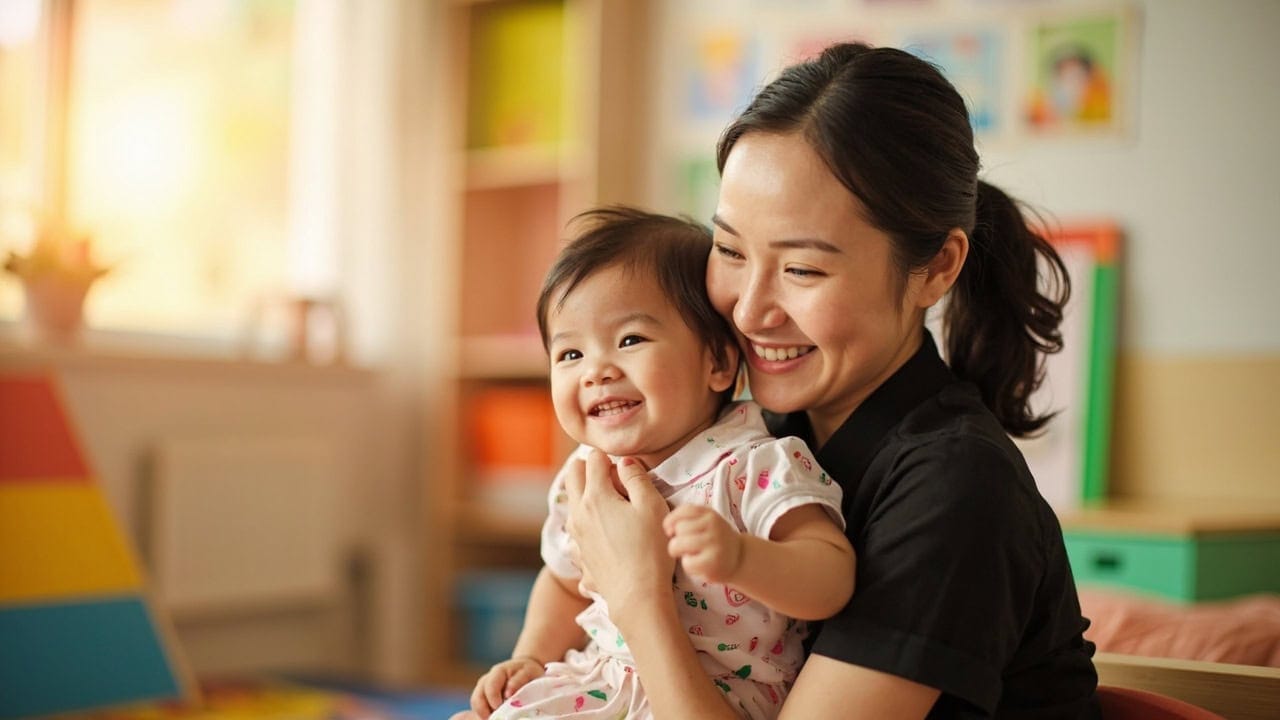
The Art of Reading Your Child’s Growth Story
There Is a Moment Every Parent Recognises
You are watching your eleven-month-old stack blocks. She places one on top of another, pauses, then reaches for a third. She looks up at you with an expression that seems to ask: did you see that?
Or perhaps it is your two-year-old negotiating a turn on the swing, using words she did not know three months ago. Perhaps it is something quieter still—the quality of your child’s focus during play, the way she moves through a room, the particular sound she makes when she is thinking hard about something.
You are watching. You know this matters. But you are not certain what it means.
This is the experience I want to speak with you about today—not because it is a problem to solve, but because it is a doorway to something important. It is the moment where attentive parenting meets its quietest challenge: the gap between observation and understanding.
A Quick Summary for Busy Parents
- Singapore parents observe their children exceptionally well, but many feel uncertain about what their observations actually mean
- The challenge is not a lack of information—it is the absence of a developmental framework to interpret what you see
- Quality childcare does more than keep a child safe; it teaches parents to read their own child’s growth with confidence
- EduNanny was built to bridge this gap through trained caregivers who observe development and share that understanding with parents
- The goal is not a monitored child—it is a parent who is equipped to understand their own child
The Language Singapore Parents Are Missing
Singapore parents are exceptionally attentive. The parents I speak with observe their children with remarkable care. They track sleep patterns and feeding schedules. They notice the texture of their child’s stool, the quality of their child’s skin, the rhythm of their child’s cries. They are, by any measure, deeply present.
But here is what I have learned from years of working alongside families: observation is not the same as understanding. Noticing is not the same as reading.
A parent can watch their child every day and still feel uncertain about what they are seeing. They can know, in a general sense, that development matters—and still feel lost when it comes to interpreting their own child’s specific trajectory. They know their child is growing. They are not sure if they are reading that growth correctly.
Without this language, parents second-guess themselves. They wonder if their child is on track. They wonder if the childcare is working. They wonder if they are paying enough attention, catching enough signals, doing enough.
They search online, which offers a thousand answers and no framework for knowing which one applies to their child. The result is a low hum of uncertainty that never quite resolves—because they have not been given the tools to resolve it.
What Understanding Your Child Changes
When you understand your child’s development, you relate to your child differently. You are not just reacting to behaviour. You are reading it. You are seeing the meaning behind the action, the growth behind the moment.
This changes parenting from something that feels uncertain and defensive into something that feels grounded and confident. Not because you have all the answers, but because you have a framework for asking the right questions.
It changes the way you spend your evenings after childcare. You are no longer wondering anxiously whether your child had a good day. You know, because you have been given language to understand what you saw. You can see the growth that happened while you were apart.
And when something concerns you—when you notice that your child’s language seems to have plateaued, or that your child’s behaviour has shifted in a way that worries you—you have a partner to turn to. You can ask. You can discuss. You can bring your observation to someone who has the training to interpret it.
The Developmental Domains Where Reading Matters Most
Language Development
Language development does not happen in a straight line. It is not simply a matter of hearing more words and saying more words. There is a structure to it—a predictable sequence of milestones that build upon one another.
When children begin babbling, that is not random noise. That is the groundwork for speech. When they begin pointing and gesturing before they have words, that is not a delay. That is communication developing through a different channel.
A parent who understands this framework can watch their child’s language journey with clarity. They can celebrate the babbling as the foundation it is. They can respond to gestures as meaningful communication, not as a substitute for words.
Motor Development
In motor development, there is a sequence. Rolling, then sitting, then crawling, then standing, then walking. But within that sequence, there is enormous variation. Children develop in their own time, through their own bodies, with their own particular strengths and preferences.
A parent who knows the sequence can appreciate their child’s progress without comparing it anxiously to other children. They can see their child moving forward on their own trajectory, and that is enough.
Social-Emotional Development
In social-emotional development, there are stages that matter enormously, even though they are easy to overlook. The way a child attaches to caregivers. The way a child begins to show empathy. The way a child learns to manage frustration, to wait, to share, to navigate disappointment.
A parent who understands these stages can respond to their child’s behaviour with insight rather than frustration. They can see the tantrum not as manipulation but as a developmentally appropriate expression of emotions that the child does not yet have the capacity to regulate.
What EduNanny Offers
EduNanny is built on the recognition that this kind of partnership requires structural support—not just good intentions.
The ECDA Childminding Pilot creates the conditions for quality observation and communication. With ratios of up to one caregiver to three infants, our caregivers have the time and attention to notice what matters, to track what develops, to see patterns that only become visible through consistent presence over time.
Our care blocks run Monday through Friday, providing the regularity that developing minds and bodies depend upon. We offer both home-based pathways, where our caregivers come to your family, and community and centre-based options that create rich environments for observation and growth.
We understand the realities of Singapore family life. Pilot fee structures are designed to make quality care accessible, and CDA and Baby Bonus funding mechanisms are integrated into our approach—so that financial considerations do not prevent families from accessing the kind of care that transforms parenting into understanding.
Our caregivers are not babysitters. They are trained observers who understand the trajectory of early childhood development across its key domains: language, cognition, motor skills, and social-emotional growth. They notice things. They track patterns. They know what to look for and how to interpret what they find.
When a caregiver at EduNanny tells you that your child is making progress in language, that observation is grounded in a specific framework. It connects to a larger picture of how language develops, what typically comes next, and where your child sits within that progression.
This is not intuition. It is professional knowledge, applied with care—and shared generously with the parents who deserve to understand their own child.
Common Concerns, Direct Answers
“Will I lose connection with my child if someone else cares for them?”
The research on attachment is clear: what matters most is the consistency and quality of relationships, not the number of caregivers. A child who has secure attachment to parents does not lose that attachment by also forming bonds with trained, responsive caregivers. In fact, children often develop greater social confidence when they experience warm, consistent care outside the home.
At EduNanny, we do not replace your relationship with your child. We deepen your capacity to understand your child. The more you know about what happens during the day, the more connected your evening conversations become.
“How do I know if my child is truly on track?”
You know because you have a partner who can translate what you see. Developmental milestones are guideposts, not checkpoints. What matters is the direction of travel and the consistency of engagement, not a single data point. Our caregivers observe your child daily, across time, and can help you understand whether the path your child is on is healthy.
“Is this only for children with developmental concerns?”
No. This framework is for every parent. You do not need a problem to benefit from understanding your child’s development. In the same way that financial literacy helps every family—not only those facing financial difficulty—developmental literacy helps every parent. Understanding what typical development looks like across its domains gives every parent more confidence, more joy, and more connection.
“What if I disagree with what the caregiver observes?”
That conversation is welcome and important. Developmental observation is not a verdict—it is an interpretation, offered in partnership. We expect parents to ask questions, to share their own observations, and to discuss differences of perspective. That dialogue is where understanding deepens.
The Partnership That Grows Over Time
When your child begins at EduNanny, we are observers of your child’s development alongside you. As your child grows, something changes. You begin to internalise the framework we use. You start to see your child’s growth through the same lens.
In the beginning, you may rely on us to interpret what you see. As months and years pass, you need us less for translation and more for confirmation, for perspective, for the partnership of people who know your child as well as you do.
You become fluent in your child’s development. You become confident in your reading of your child. You no longer need permission to trust what you see.
This is the gift that quality childcare offers. Not a child who is cared for. A parent who is equipped.
And this is what EduNanny is committed to: equipping you to understand your own child. To read the signals with confidence. To know what growth looks like, what it means, where it is headed. To be the kind of parent who understands—not perfectly, not completely, but deeply, meaningfully, in ways that matter.
Practical Guidance: Choosing Infant Care in Singapore
If you are currently researching childcare options, here are the questions I would encourage you to ask—not as a checklist, but as a framework for thinking about what truly matters.
- How does this arrangement help me understand my child? The best childcare does not just report what happened. It helps you understand what it means.
- Who are the caregivers, and what training do they have? Trained observers see differently than untrained ones. They notice patterns, track trajectories, and can articulate what they observe in a developmental context.
- What is the caregiver-to-child ratio? Small ratios allow for the kind of consistent observation that makes patterns visible. This is not a luxury—it is a structural necessity for quality developmental partnership.
- How does this arrangement support my child’s regularity? Developing minds and bodies depend on predictable rhythms. Consistency in care creates the conditions for both observation and healthy development.
- How will we communicate about my child’s development? You deserve more than daily reports that say “she had a good day.” Ask for specific observations, connected to developmental frameworks, that help you understand what you are seeing.
- Does this feel like a partnership? Trust your instinct. The best childcare relationship feels collaborative, transparent, and respectful of your role as your child’s primary parent. You should feel like a partner, not a customer.
The Story That Is Unfolding
If you are considering childcare for your family, I would invite you to think about what you are really looking for. You are looking for someone who will keep your child safe. Yes. You are looking for someone who will be reliable and warm. Yes.
But beneath those practical needs, there is something deeper. You are looking for someone who will help you know your child. You are looking for someone who sees what you see and understands what it means.
EduNanny is that partner. We are here to watch your child grow and to give you the language to understand that growth. We are here to celebrate milestones with you and to bring perspective to uncertainty. We are here to be the steady presence that helps you see your child more clearly, more confidently, more completely.
To understand your child is one of the most profound gifts a parent can receive. It is the gift of seeing your child as they truly are—not as a project, not as a standard, but as a unique person whose development has its own meaning, its own trajectory, its own story.
Your child’s story is unfolding. We are here to help you read it.
EduNanny offers infant care and childminding services under the ECDA Childminding Pilot. Our caregivers are trained observers who partner with parents to help them understand their child’s development across language, motor, cognitive, and social-emotional domains. To learn more about our approach and how we support Singapore families, we invite you to reach out and begin a conversation.