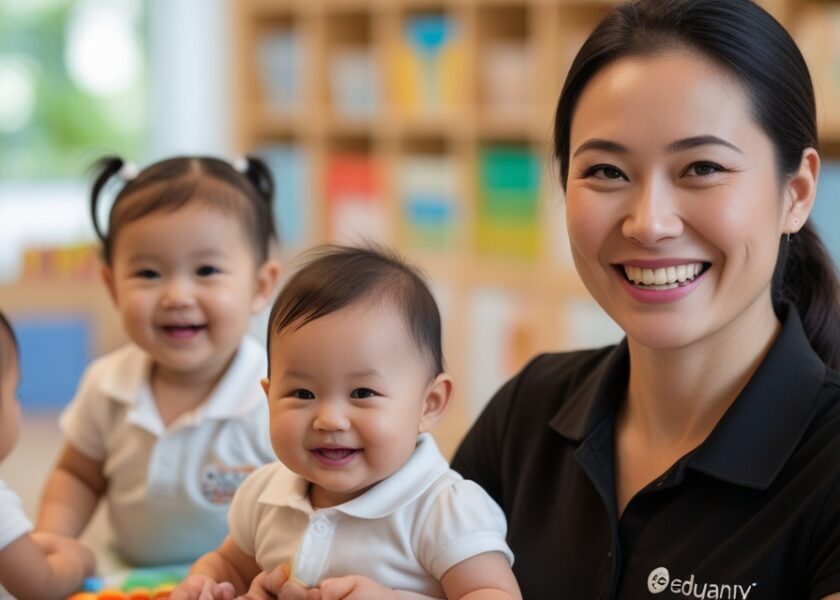
Why Singapore Parents Are Choosing Sustained Childcare Partnerships
The Question Beneath Every Decision
When you walk into a childcare centre or meet a childminder for the first time, you are doing something important. You are assessing, comparing, trying to read between the lines of a tour and a conversation to understand what life will actually look like for your child — and for you — in the weeks and months ahead.
But here is what most childcare conversations miss. The decision you are making is not really about today. It is about eighteen months from now. Two years. Three. It is about whether the care your child receives at six months old will still be the right care when they are two, full of questions, discovering the social world, and growing in ways that require someone who truly knows them.
Singapore parents understand this intuitively. You are navigating demanding careers, ambitious goals, and the practical logistics of a city that moves quickly. You want your child to be safe, to be stimulated, to be loved. But beneath all of that, there is a quieter, more persistent fear: that childcare might end up being transactional. That the warmth you see on a first meeting might not be sustained. That you might find yourself, a year down the road, searching again.
This fear is not irrational. It reflects a genuine gap in how most childcare is structured. And it is exactly the gap that a different kind of approach — one built around sustained partnership rather than rotating arrangements — is designed to close.
What Actually Drives Child Development
Through years of walking alongside families through the earliest and most formative years of their children’s lives, one truth has become clear: the most consequential variable in child development is not the facility. It is not the program. It is the depth and stability of the relationship between your child and the person caring for them.
That relationship, sustained over time, is the invisible engine of everything else.
When that relationship is shallow, everything built on top of it becomes fragile. Curriculum activities feel performative. Developmental milestones are observed but not understood. Your child is cared for, but not known.
When the relationship is deep — when it has had time to compound — something extraordinary happens. Your child does not simply feel safe in that moment. Your child begins to feel safe in the world. The caregiver becomes not a replacement for you, but an extension of the emotional architecture you are building together. Your child learns that people can be trusted, that care can be consistent, that the world has reliable textures.
This is not a soft, sentimental idea. It is one of the most practically consequential truths in early childhood development.
Rotating Care vs. Sustained Partnership
Consider what happens in a rotating arrangement. A child who moves between multiple caregivers — even capable and caring ones — is expending enormous psychological energy on adaptation. Every new face requires recalibration. Every transition asks a young child to rebuild a sense of safety from scratch.
The developmental energy that could be going toward exploration, toward language, toward the quiet cognitive work of early childhood is instead being spent on survival. This is not a criticism of any individual caregiver or service. It is simply an observation about what continuity costs and what its absence demands.
Now consider what happens when that same child has one consistent caregiver over eighteen months, over two years. The caregiver knows that your child is not simply hungry but hungry in a particular way, after a particular kind of morning. They know that the slight withdrawal before lunch is not a problem but a pattern — tied to tiredness, easily managed with a quiet adjustment.
They know your child’s rhythms, your child’s language for things that are not yet words, your child’s way of seeking comfort when comfort is needed. This knowledge is not incidental. It is the difference between caregiving that merely supervises and caregiving that truly nurtures.
Why Sustained Care Matters
- The key variable is not the facility. Research and experience both point to the depth and stability of the child-caregiver relationship as the most consequential factor in early childhood development.
- Continuity compounds. When a child has one consistent caregiver over months and years, developmental gains accumulate in ways that rotating care simply cannot replicate.
- Rotating care has real costs. Every new caregiver asks a young child to rebuild safety from scratch, redirecting psychological energy away from exploration and learning.
- Quality care is a partnership. The best childcare grows with your family, adapts to your child’s changing needs, and gives you back the emotional space to be present when you are together.
- Choose for the long run. The early years are not a phase to get through. They are a foundation to build upon.
The Parent Experience: What Sustained Care Gives You Back
There is a particular exhaustion that comes from childcare uncertainty — a low-grade anxiety that persists even when you are not consciously thinking about it. It shows up as the mental checklist you run before every meeting. The WhatsApp messages you reread three times. The guilt that surfaces without warning when your child seems clingier than usual after a weekend apart.
This exhaustion is not weakness. It is the entirely rational response to a system that has not given you a reason to fully trust it.
What sustained quality care gives you is not just peace of mind in the abstract. It gives you back the cognitive and emotional space to be fully present when you are with your child. It gives you the rare and precious feeling of knowing that the care your child is receiving is not a compromise but an extension of the values you hold most deeply.
It looks like communication that builds over time into something genuinely informative. It feels like the kind of peace that lets you focus at work because you are not wondering, constantly, whether today was okay. It looks like a caregiver who can tell you not just what your child ate for lunch but how their relationship with food has shifted over the past four months.
It feels like the moment you realise your child has learned something not because of a class or a curriculum, but because of the patient, consistent presence of someone who has been there every day.
What to Look for When Choosing Infant Care in Singapore
If you are evaluating childcare options, here are the questions that matter most — beyond the tour, beyond the prospectus, beyond the first impression:
- Ask about caregiver continuity. Will your child have one primary caregiver, or will care be shared across multiple people? How long is the typical assignment?
- Observe the quality of communication. Can the caregiver tell you something specific about your child’s rhythms, preferences, or patterns? Or is the conversation停留在 general observations?
- Consider the ratio. How many infants per caregiver? Smaller ratios enable deeper knowledge and more responsive care.
- Think about the timeline. Are you choosing for today, or for the next two to three years? Does the arrangement have the structure to sustain quality over that time?
- Notice how the caregiver responds to your child. Is there recognition? Warmth that feels genuine? Does your child seem to know them?
- Ask about development, not just activities. A good caregiver will be able to tell you not just what happened, but what is developing. What has changed over the past few months. What your child is becoming.
How EduNanny Is Built for Sustained Partnership
EduNanny by BUTLER was built with this vision in mind. We are not a service you choose once and evaluate at the end of a contract. We are a partnership that grows with your family, structured to sustain the kind of care that compounds over time.
We are proud to operate as part of the ECDA Childminding Pilot, working within a framework that recognises the critical importance of quality, consistency, and safety in the years that shape a child most profoundly. This is not a pilot in the sense of something provisional or untested. It is a commitment to demonstrating what sustained, intentional, relationship-centered childcare can look like in Singapore.
Our approach to sustained partnership is reflected in the way we design our service from the ground up:
- Small ratios. We maintain ratios of up to one to three infants, because we believe that small numbers are not a luxury. They are the condition under which real knowledge of a child becomes possible.
- Monday to Friday care blocks. Structured for families who are building a long-term plan, not navigating a short-term gap.
- Accessible financing. Fee structures designed to be affordable, with straightforward options to use CDA funds and the Baby Bonus CDA Grant.
- Transparent communication. Built on genuine partnership. Where CCTV measures are deployed, they serve not as surveillance but as trust — a mutual acknowledgment that both family and caregiver are invested in the same outcome.
Can quality really be sustained over years, not just months?
It can — but only if the structure supports it. In rotating arrangements, even the most dedicated caregivers are limited by the simple fact that they cannot know a child deeply because they have not had the time. In a sustained partnership, knowledge accumulates. Attachment deepens. The developmental gains that seem small in any single week become significant over years.
What if something changes? What if we need to adjust?
We understand that families evolve. What we offer is not a rigid arrangement but a partnership that is designed to adapt as your child grows and your family’s needs shift. Our commitment is to be the kind of partner that holds, that deepens, that grows alongside you across the years that matter most.
Is this affordable for the average Singapore family?
We have deliberately designed our fee structures within the pilot to be accessible, and we have made it straightforward for families to use CDA funds and the Baby Bonus CDA Grant. We believe that the choice for sustained quality care should not be a luxury reserved for those who can afford premium pricing.
Choose for the Long Run
This is what we mean when we talk about the invisible architecture of trust. It is built not in single moments but in thousands of them. In the caregiver who remembers that your child takes comfort in a particular song. In the observation noted down and shared with you. In the way a child runs toward their caregiver on a Monday morning, not with anxiety but with recognition.
These moments are invisible precisely because they are so consistent. You only fully feel their weight when you encounter their absence — in a system that resets every year, in an arrangement where no one has been there long enough to truly know your child.
If you are a parent in Singapore making this decision, we want to invite you to choose for the long run. Not just for the immediate need, however pressing that need may be. Not just for the tour or the trial or the first impression.
Choose for what you want the care to look like in two years, in three years, when your child is running into their caregiver’s arms with the easy recognition of someone who knows them well.
We know the weight of the question you carry. Will this hold?
We cannot promise you certainty, because no relationship, however well-structured, can promise that. But we can promise you this: everything we build at EduNanny by BUTLER is designed with that question in mind. Every ratio, every communication practice, every structural choice reflects our commitment to being the kind of partner that holds, that deepens, that grows alongside you across the years that matter most.
The early years are not a rehearsal. They are the foundation. And foundations built on sustained, quality, relationship-centered care are the ones that children carry with them long after the caregiving years are over — not as memory, exactly, but as something deeper. As the quiet confidence that the world can be trusted. As the deep-seated sense that they are known. As the emotional architecture that will shape everything they become.
Choose for the long run. Choose the kind of partnership that compounds. Choose care that stays excellent as your child develops.
This is what EduNanny by BUTLER is here to offer. And this is what your child, and your family, truly deserves.
We invite you to speak with our team about what a sustained partnership could look like for your family. No pressure, no obligation — just a real conversation about what you need and how we might serve it. Reach out through our contacts page, or learn more about us and our approach to quality childminding in Singapore.