Stronger Parents, Thriving Children: The Singapore Guide to Quality Childcare
Where It All Begins: The Space Between What We Want and What We Need
Let me begin where most parenting conversations in Singapore begin — not in a clinic or a library, but in that complicated, tender space between what we want for our children and what our lives actually require of us.
Many of you are managing careers, businesses, responsibilities that matter to you and to your families. Many of you grew up in households where grandparents provided that web of care that made everything feel possible. You remember being dropped off at grandmother’s flat on the way to school. You remember afternoons when an auntie next door watched you while your parents worked late. You remember feeling safe, loved, held — and you also remember that those arrangements were simply part of life, unremarkable, woven into the fabric of how Singapore families worked.
That world has changed. Not completely, not irrevocably, but enough that the arithmetic of family life no longer adds up the same way. Grandparents may still be involved, but they may also be working themselves, or living across the island, or simply exhausted from having already raised their own children. The village that once raised our children has scattered.
And so we find ourselves making choices that our parents never had to make — choosing who will care for our infants, our toddlers, the small people we made and love more than we knew it was possible to love.
The Fear That Deserves to Be Named
In that choosing, something in us goes quiet and afraid.
It is not weakness. It is not overthinking. It is the most fundamental thing inside you firing at full strength: the need to be necessary to your child. The terror of being replaceable to the one person in this world whose love you cannot bear to lose.
You look at a capable, warm, attentive caregiver and a part of you — the part that remembers your own childhood, the part that has read too many articles on the internet at two in the morning — wonders: will my child prefer her? Will my child need me less? Will I have given away something that I can never get back?
This fear is real. It is shared by parents across Singapore, across cultures, across every economic and educational background. And I want to tell you something that might sound counterintuitive at first, something that will take a moment to settle in your mind, but something I know to be true from both research and from watching families flourish:
Your child will not need you less because of quality childcare. Your child will need you more — in a different way, for a different purpose, and with a depth that surprises you.
The Science That Changes Everything
The science of attachment tells us something remarkable. When psychologists first began studying how children form bonds, the dominant idea was simple: babies attach to one person, usually the mother, and that bond is fragile, easily disrupted, and threatened by any competing attachment.
For a long time, this is the story we told. It is the story that has kept generations of parents awake at night, convinced that every hour away from their child was an hour that might damage something irreplaceable.
But the science has evolved.
What we now understand, through decades of careful observation and study, is that children do not attach to one person like a vessel with limited capacity. Attachment is not a zero-sum equation. Children form multiple, meaningful attachments — what researchers now call an attachment network — and these relationships support and complement each other rather than compete.
A child who has a consistent, warm, responsive relationship with a caregiver is not dividing their capacity for love. They are building it. They are learning that the world is a place where people can be trusted, where needs are met, where comfort is available, where someone will come when they call.
That learning does not reduce their attachment to you. It amplifies it.
What This Looks Like in Practice
Think about it this way. A child who has learned to trust — who has experienced consistent warmth from multiple caregivers — walks through the world with a quiet confidence that says: I am held. I am known. People will catch me.
That child is not anxiously scanning every room for one specific face. That child is open. Receptive. Ready to delight in your return not because they have been deprived, but because they have been filled.
They greet you not with the desperate hunger of scarcity, but with the full, generous joy of a child who has learned that love is not rationed — and who now has even more to give you when you walk through the door.
This is the reframe that matters. It is not just reassurance. It is the truth.
What Quality Care Actually Looks Like
Now, let me be very clear about something, because this is where precision matters. What I am describing does not happen with just any caregiver. It happens with quality care — when the person holding your child is warm, attuned, consistent, and present in the way that young children need.
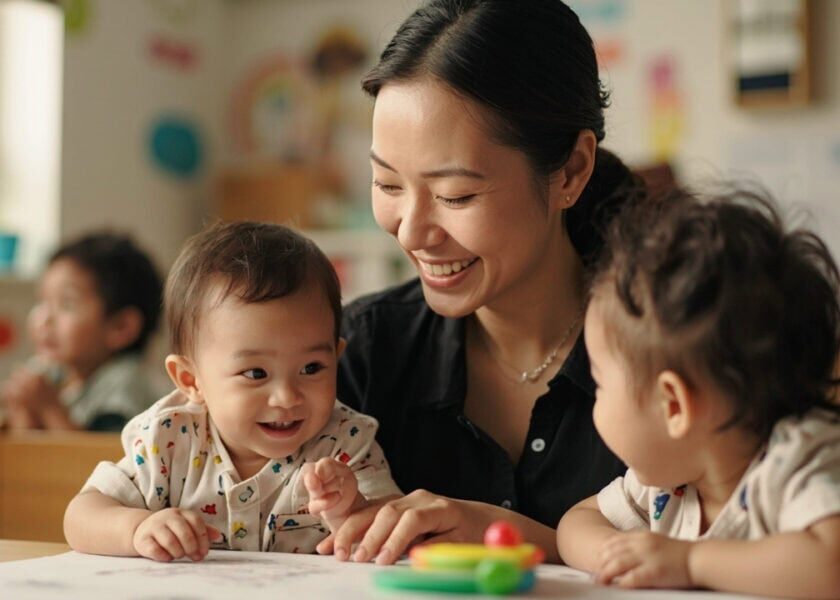
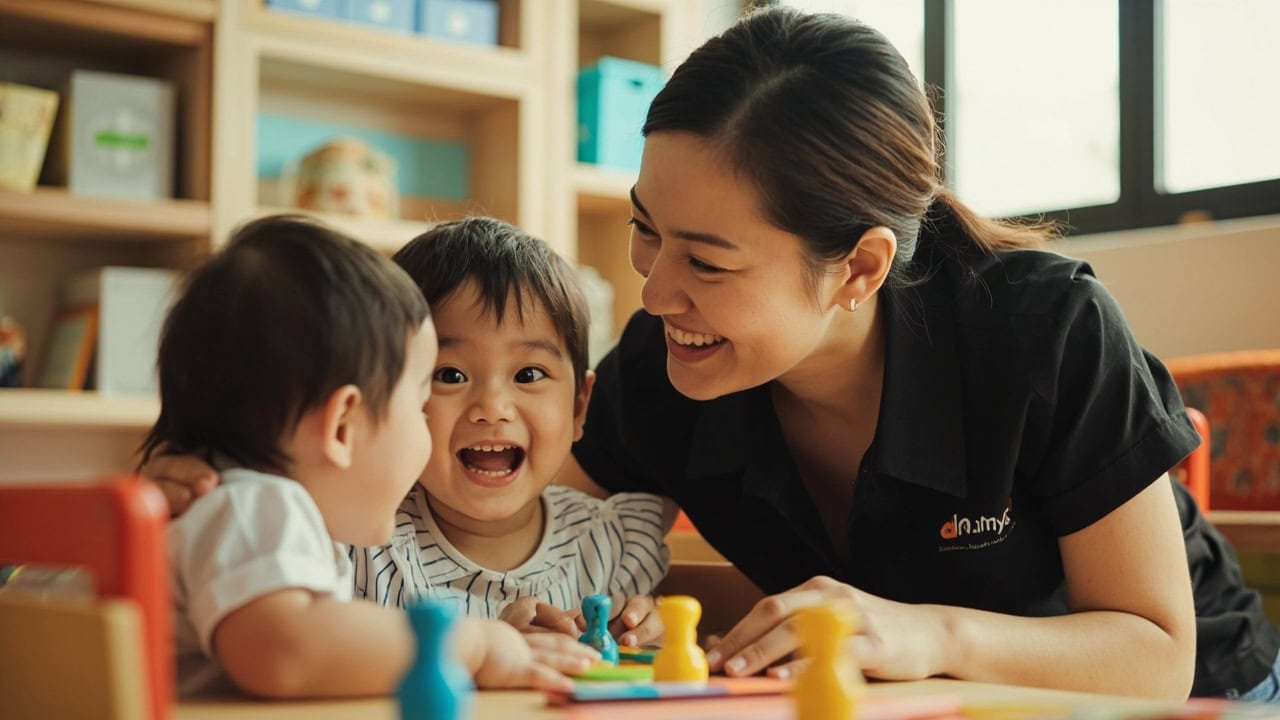
It happens when your child is not one of twelve in a room, desperately trying to be noticed. It happens when someone looks at your baby and truly sees them — notices what makes them calm, what makes them laugh, what their small face looks like when they are tired versus hungry versus curious.
Quality care is not a deposit box of needs, where children are fed and changed and watched but never truly seen. It is not a numbers game, where your child is one of many competing for limited attention. It is a relational experience — a place where your child is known, where their laughs are noticed, where someone remembers that they sleep better with the window slightly open, or that they reach for comfort differently when they are tired.
Here is what quality care looks like, day to day:
- Responsive attention — someone who responds to your baby when they cry, not out of obligation but out of genuine attunement
- Rich language exposure — a caregiver who talks to your infant, because they know that language is wiring itself long before first words emerge
- Gentle predictability — routines that teach a child what comes next, so that predictability becomes a kind of love
- Individual recognition — the kind of attention that makes your child feel not just watched, but seen
When this happens, your child begins to build what developmental psychologists call a generalized sense of security — an understanding that relationships are safe, that people can be relied upon, that the world is fundamentally trustworthy.
That foundation does not replace your role as parent. It makes your role possible.
The Parent You Become When You Stop Doing It All Alone
Because now, when you come home — tired, perhaps, from a full day of your own work, your own demands, your own responsibilities — you are not the sole source of your child’s emotional regulation. You are not the only person who can comfort them.
You are freed, in the best possible sense, to be the parent you became when you chose to bring a child into this world.
You can be present in a way that is intentional, not anxious. You can play without the background hum of exhaustion. You can listen without the pressure of being the only one who ever listens. You can parent from a place of overflow rather than depletion.
This is what quality care gives you back.
Guilt-Driven Presence vs. Confident Presence
I want to speak directly to something that I know many of you feel: the guilt. The quiet, persistent guilt of separation. The sense that if you are a good parent, you should be the one there, every moment, especially in those early years when everything feels so fragile and important.
Guilt-driven presence — the kind of presence that comes from a place of obligation, anxiety, and self-sacrifice — is not better for your child than confident, supported presence.
Your child does not need you to be there constantly. Your child needs you to be there fully. And you cannot be there fully when you are running on empty, when you are resentful of the career you gave up, when you are present in body but absent in spirit because you have nothing left to give.
There is a version of you — the version that comes home after a day of work you are proud of, a version that has had adult conversations, that has used your mind, that has had the chance to miss your child and therefore to arrive with all that love backed up and ready — that is a better parent than the version of you who never leaves, who has lost the edges of yourself in the all-consuming work of childcare, who shows up every day but shows up depleted.
You deserve permission. Permission to stop carrying the story that leaving your child is a failure. Permission to believe that the parent you are becoming — the one who chooses quality care because you want your child to thrive, because you want yourself to thrive, because you believe that a family is not defined by who provides the most hours but by who loves the most intentionally — is exactly the parent your child needs.
What to Look For: Choosing Quality Care in Singapore
Working alongside Singapore families, I have seen a pattern again and again: the parents who choose quality care and partner with it thoughtfully are not less attached to their children. They are more available. More patient. More capable of meeting their child with genuine presence instead of dutiful obligation.
They arrive home ready to play, ready to listen, ready to notice. They are not haunted by the fear that their child prefers someone else, because they understand that love is not a competition. They are part of an attachment network, and they are the center of it — not because no one else is allowed in, but because they are the emotional anchor, the place where the child returns not because they must, but because they want to, because home is where the deepest knowing lives.
EduNanny operates from a conviction that families are not weakened by support — they are strengthened by it. As part of the ECDA Childminding Pilot, they are committed to standards that go beyond minimum requirements, to pathways of care that are structured, safe, and built with Singapore’s children in mind.
Whether care is delivered in your home or through community-based and centre-based pathways, the principles are the same:
- Ratios that allow for genuine attention — up to one-to-three for infants, so every child receives the kind of individual attunement that builds security
- Environments that are warm and responsive — spaces designed for how infants actually experience the world
- Caregivers chosen for their capacity to love what they do — supported with ongoing training so they are always growing in their ability to see and respond to the children in their care
- Communication and transparency — so you are never left guessing whether your child was happy, fed, or held
Where CCTV measures are deployed, they are deployed not because anyone doubts the caregivers, but because trust is built through openness, not through closed doors.
EduNanny understands that choosing care is not just an emotional decision — it is a logistical one, embedded in the reality of how Singapore families actually live. Monday to Friday care blocks are structured to support the rhythms of working parents. Pilot fee structures are designed to be accessible, removing cost as an unnecessary barrier to quality. CDA and Baby Bonus are usable for childcare expenses — because the financial architecture of parenting should make your choices easier, not harder.
Ask any question you need to ask a potential provider: How do they handle separation anxiety? What does a typical day look like for an infant? How do they communicate with parents? The answers will tell you whether what they offer matches what your child actually needs.
Choosing With Confidence: A Path Forward
Here is what I want you to carry with you as you explore your options in Singapore — whether you are returning to work, adjusting to a new family reality, or simply recognizing that raising a child was never meant to be done alone:
- Your fear comes from love — and love deserves to be redirected, not fed. Let it rest.
- Quality care expands your child’s world — it does not shrink your place in it.
- You are looking for partnership — not a replacement, not a backup, but a team who sees your child the way you do.
- The parent who shows up whole is more valuable than the parent who shows up exhausted — every time.
- You are already enough — the choice to seek support is not an admission of failure; it is evidence of wisdom.
What kind of parent do you want to be when you walk through your door at the end of the day?
Not the parent who is counting the hours you spent away. Not the parent who is defending your choice or proving your worth. Not the parent who arrives depleted and distracted by everything you did not finish.
The parent who is there. Fully there. Ready to receive the child who has been building trust in the world all day, and ready to add your love to everything they have already received.
That parent is not diminished by quality care. That parent is made possible by it.
You Are Exactly the Parent Your Child Needs
Quality childcare is not a compromise. It is not a concession to circumstance. It is an act of love — by you, for your child, and by every person who joins you in the work of raising them.
It is the choice to give your child more: more safety, more stimulation, more consistent responsiveness, more experience of a world that is warm and trustworthy.
And it is the choice to give yourself more: more capacity, more clarity, more chance to be the parent you imagined before the doubt crept in.
The best thing you can do for your child is to be whole enough to love them well. And sometimes, love means asking for help.
EduNanny Singapore is here to walk beside you through the early years — those precious, unrepeatable years when your child is building the foundations of who they will become. To partner with you. To learn from you. To tell you every day what your child discovered and how they laughed and what new thing they tried with their hands.
And to remind you of what you already know, deep beneath the worry:
You are exactly the parent your child needs. Your child is lucky to have you. And choosing quality care does not make you less of a mother or a father — it makes you more of one.
It makes you the parent who showed up, not just in body, but in spirit. The parent who built a village. The parent who understood that love is not about proximity. It is about presence.
Welcome to EduNanny. We are honored to be part of your family.
Ready to explore what partnership in care looks like for your family? Reach out to EduNanny Singapore to learn about infant care and childminding pathways — in-home, community-based, and centre-based options designed to support you and your child from the very beginning.