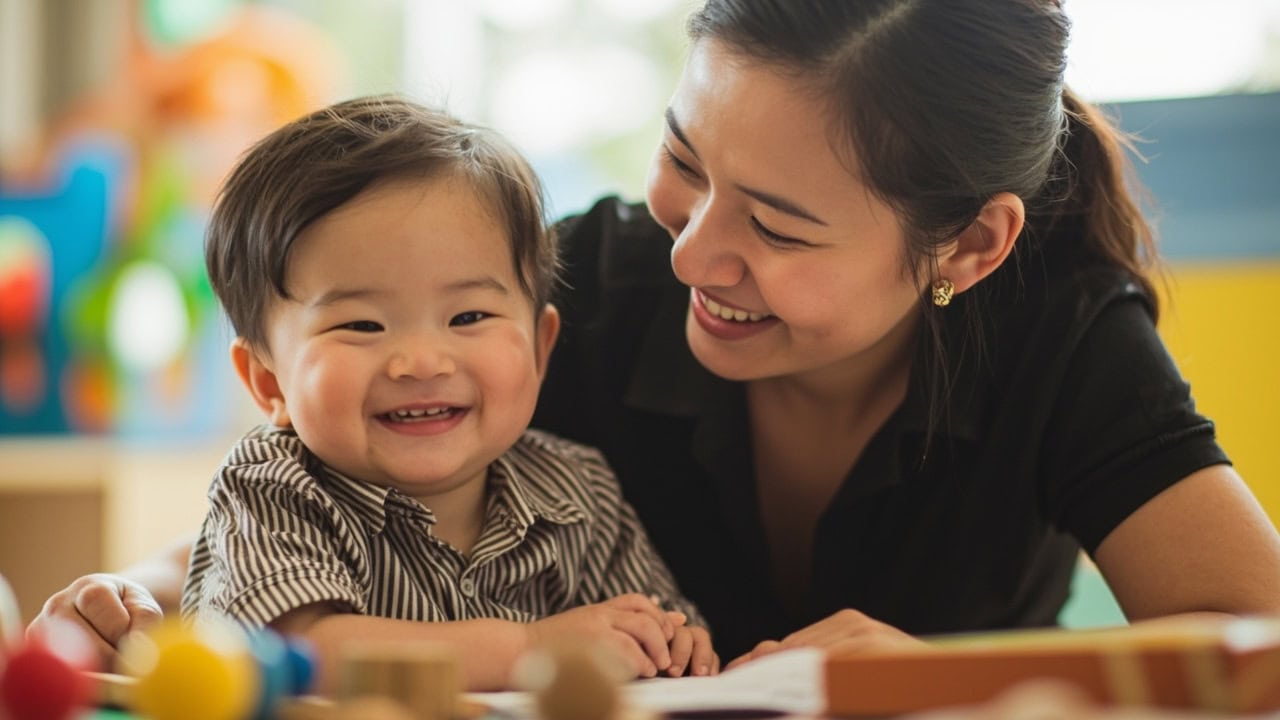
The Quiet Evolution Every Singapore Parent Goes Through When Childcare Begins
The Quiet Shift Nobody Names
There is a moment, and you will know it when it comes. The morning drop-off that once required courage becomes almost ordinary. The second week. Maybe the third. Your child has stopped crying at the door — not because the separation has become easy, but because something else has shifted. And that something else is not in your child. It is in you.
Nobody tells you about this moment. Nobody prepares you for what happens inside you after the decision has been made, after the centre has been chosen, after the first tearful mornings have blurred into something quieter. You did the research. You weighed the options. You made the call. And then, somewhere in the weeks that follow, you realise that the most significant change is not about the childcare at all.
It is about you. This is what nobody really talks about — not the childcare you chose, but the parent that choosing it creates.
You remember what it was like before. The weight of it. Not just the physical exhaustion of those early months, though that was real and heavy, but the other weight too — the one that comes from being the only person who knows exactly how your baby likes to be held, which songs settle her, why she is crying when she is crying. You were the centre of that small universe, and while it was exhausting, there was a clarity to it. You were the one. The only one.
And then, one morning, you hand your child to someone else. For the first few days, you do not think about yourself at all. You are too busy managing the logistics, the guilt, the tiny human screaming in your arms. But then something changes.
The screaming stops. Your child looks at this new person, and something passes between them — not trust, not yet, but curiosity. Acceptance. The beginning of a relationship you are not part of. And you feel something you did not expect. Not relief, exactly. Or rather — yes, relief — but also something else. A strange, unnameable grief for a version of yourself that no longer exists.
This is the first layer of the shift, and it is disorienting precisely because it is unspoken. We talk so much about what children feel when they begin childcare — the separation anxiety, the adjustment period, the new bonds they form. But we rarely acknowledge what parents feel when they begin letting go. That grief is not weakness. It is not doubt. It is the mark of a parent who loved deeply enough to feel the weight of change.
Reading Your Child Differently
Here is what happens next, if you let it. Slowly, over weeks and then months, you begin to notice something unexpected. You start to read your child differently. Not worse. Not with less love. But with a new kind of attention.
When you pick her up at the end of the day, you find yourself asking different questions. Not just “Did she eat? Did she sleep? Did she cry?” — though you ask those too — but “What was she interested in today? What did she reach for? What made her laugh when I wasn’t watching?”
You are no longer the sole witness to her life. You are becoming an interpreter. A translator of signals that come to you through another person’s voice. Holding two truths at once: that you know your child better than anyone, and that there are things about her that exist only when you are not there.
You learn to read the transfer of energy that happens when the caregiver hands her over — the way your daughter melts into you differently after a day of independence. You learn to ask questions that open a window rather than a door. You learn that presence is not only physical, and that love, when it is mature, learns to stretch.
Trusting someone else with your child is not a single act but a practice. Every morning you hand her over with something less than perfect certainty, you are building a new kind of muscle — the muscle of letting go without letting go of love.
Holding Two Truths at Once
Somewhere along the way, you will feel both things at once. Relief and guilt. Freedom and distance. Pride and something that feels suspiciously like failure. You will pick up your child after a long day and feel such profound gratitude for the break that you almost cry, and then, moments later, feel a sharp pang of remorse for that very gratitude. You will wonder if something is wrong with you.
Hear this clearly: you are not doing this wrong. What you are feeling is not a sign of ambivalence or inadequacy. It is the sound of a parent in transformation. It is the perfectly human experience of holding two truths simultaneously — of loving your child so fiercely that sharing her feels like loss, and of loving yourself enough to need breathing room.
The parent who feels relief when her child starts childcare is not a parent who does not love her child. She is a parent who has been carrying weight for a very long time and who is beginning, tentatively, to set some of it down. The parent who feels grief when her child reaches for a caregiver is not a parent who cannot share. She is a parent who has been the centre of someone’s world and who is learning to love from a slightly different distance.
This is not a failure of attachment. This is the evolution of it.
Your Peace of Mind Is Part of Her World
Here is what is so often missed in the conversation about childcare quality: a parent’s peace of mind is not a luxury. It is not a bonus feature. It is part of the developmental environment.
A child feels the difference between a parent who is present with anxiety and a parent who is present with calm. A child thrives not only in the direct care she receives, but in the security of knowing that the people who love her are not fracturing under the weight of loving her.
When you find childcare you can trust — when you walk out the door in the morning and something in your chest unclenches, just a little — you are not abandoning your child. You are creating space for her to attach to another caring adult, which is a gift. You are teaching her that love can be shared, that the world contains trustworthy people, that she does not need only you.
And you are doing something equally important: you are teaching yourself that you are not the only person who can meet your child’s needs, and that this is not a threat to your role as her parent but an expansion of it.
This is the shift that transforms parents from surviving to thriving.
What Quality Childcare Looks Like in Singapore
In Singapore, the landscape of early care has shifted significantly in recent years. There are more pathways now than ever before — home-based arrangements that bring a caregiver into your own space, community-based settings that offer small ratios and intimate environments, centre-based programmes that provide structure and curriculum. Each of these pathways has something to offer, and each family will find the one that fits.
When evaluating any arrangement, there are a few practical markers that matter enormously:
- Ratios and attention: For infants, smaller ratios mean more individual attention. A one-to-three ratio is not a marketing claim — it is a meaningful difference in how closely your child’s signals can be read and responded to.
- Transparency: When you are learning to trust someone else with your child, you need more than good intentions. You need to be able to see, to ask, to know that the environment is safe. Where measures like CCTV are in place, they are not there to create surveillance — they are there so that you can trust with your eyes open, which is a deeper trust than trust with your eyes closed.
- Communication: The relationship between parent and caregiver is a bridge. The quality of the information that crosses that bridge — daily, honestly, without spin — determines how safely the whole arrangement feels.
- Consistency: Young children need predictable, warm responses to feel secure. An arrangement where caregivers are stable and routines are consistent gives your child the safety to explore and attach, which is the whole point.
- Flexibility: The right arrangement is the one that aligns with your actual life — your work, your home, your rhythm — not the one that fits an idealized schedule.
Addressing What You Are Actually Worried About
It is worth naming the fears directly, because if you are like most parents considering this step, you have probably had at least a few of them at 2am.
“Am I abandoning my child?”
No. What you are doing is creating a village. The research on child development is consistent: children form healthy attachments not just to their parents but to other consistent, warm, responsive caregivers. What you are giving your child is another person who knows her, celebrates her, and holds her safely. That is not abandonment. It is one of the most generous things a parent can offer.
“What if the caregiver doesn’t understand her the way I do?”
They won’t — and that is not the point. No one will understand your child exactly the way you do, and that includes grandparents, partners, and teachers. What matters is that the caregiver reads her signals with care, communicates honestly with you, and responds to her with warmth and consistency. Over time, this shared understanding — this gentle triangulation between you, your child, and the caregiver — creates something richer than any single relationship could offer alone.
“I feel guilty for wanting a break. Is something wrong with me?”
Nothing is wrong with you. You have been carrying an enormous weight, and the moment you begin to set some of it down, it is entirely natural to feel both gratitude for the relief and grief for what that relief represents. These are not conflicting emotions. They are the two sides of the same coin — love, stretched wide enough to include other people.
“How do I know I can really trust them?”
Trust is built through evidence, not faith. Look for arrangements that offer transparency — regular updates, open communication, visible safety measures. Ask the hard questions. Observe how the caregiver interacts with your child on a trial basis. Trust with your eyes open, and give yourself permission to walk away if the fit is not right. You are not looking for perfection. You are looking for a good enough, trustworthy person who will love your child well when you are not there.
The Parent You Are Becoming
The parent who emerges on the other side of this transition is not a lesser version of the parent she was before. She is a more complex one. She has learned something that many parents never have to learn until much later in life, if at all: how to love without possessing, how to protect without controlling, how to be needed without being the only one who meets the need.
This is not easy. It requires a kind of daily courage that does not look heroic from the outside. It looks like mornings when you do not want to let go but you do anyway. It looks like conversations with caregivers where you ask the hard questions and listen to the answers even when they are not what you hoped. It looks like coming home at the end of a long day and sitting with the strange ache of missing someone who is right there in the next room, because you were apart and the apartness matters.
But here is what also happens. You start to notice that you are becoming someone who is more curious than anxious. Who asks better questions. Who listens more carefully. Who has been changed not by the loss of proximity but by the practice of trust.
Somewhere along the way, you realise that the parent you are becoming is not less present than the parent you were. She is differently present. More spacious. More secure in her role because she no longer defines it by exhaustion or sole responsibility.
For families in Singapore navigating this transition, the right support can make all the difference. EduNanny Singapore, operating within the ECDA Childminding Pilot, offers infant care and childminding through pathways designed around real family needs. With small ratios that allow your child’s signals to be read closely, and home-based care options that bring warmth into familiar surroundings, the arrangement adapts to your family rather than the other way around.
EduNanny sees itself not as a replacement for you, but as an extension of the family web. The caregivers are not stand-ins. They are bridges — holding your child during the hours you need to work, to breathe, to return to yourself, and then handing her back so the relationship between you and your daughter deepens precisely because you are no longer the only person in her world.
Communication and transparency are built into the model — not as extras, but as foundations. You can ask. You can see. You can trust with your eyes open. And that trust, freely given and quietly earned, is one of the most powerful things you will ever model for your child.
Whether you are still in the research phase, in the middle of that ambiguous second or third week, or further along and recognising something you have never heard named — the parent you are becoming deserves to be seen. The pride you feel in yourself is earned.
The parent who can let go with trust is not less present. She is present in a way that most people never have to learn — powerful, spacious, and whole. She has discovered that love, when it is truly confident, does not need to be the only love. It just needs to be the first love, the home base, the place the child returns to with stories and laughter and the quiet certainty that whoever else may hold her, she belongs to someone who will never let her go.
Ready to explore your options? Connect with EduNanny Singapore for a no-obligation conversation about your family’s needs. We are here to listen before we offer anything else.