Beyond Settled Understanding the Real Signs of Child Thriving
The Question Is a Sign of Love
Before we go further, let us be clear about something important: the question itself is not a sign of doubt. It is a sign of love.
A parent who asks whether their child is truly thriving has moved beyond the baseline of care and into the territory of genuine investment. They are not second-guessing their decision. They are deepening their attention.
And that deepening is exactly where we want to meet you — because this is the kind of attention that quality developmental childcare is designed to reward.
What the First Thousand Days Actually Mean
When you bring your child to quality childcare, you are not simply outsourcing logistics. You are entering into a relationship with an environment built around the most important developmental years of your child’s life.
The early years — often called the first thousand days — are when the architecture of learning, emotional regulation, and social belonging is laid down with a speed and permanence that later years cannot replicate. This is not a softening of the message. It is the message.
The early years are not a prelude to the real story. They are the story.
And yet, for all of this knowledge, most parents receive very little in the way of tools to read what is actually happening. They are given photos. They are given daily reports. They are told their child ate well, slept well, had a good day.
These are not nothing. They are gestures of care and transparency that matter. But photos of a smiling child and notes about nap times do not quite answer the question of whether the foundations of a confident, curious, emotionally secure person are being laid in those small, warm, unobservable hours.
Settled or Thriving: The Distinction That Changes Everything
There is a distinction worth making at the outset, because it is the one that most parents sense but rarely have the language to name. It is the distinction between a settled child and a thriving child.
What a Settled Child Looks Like
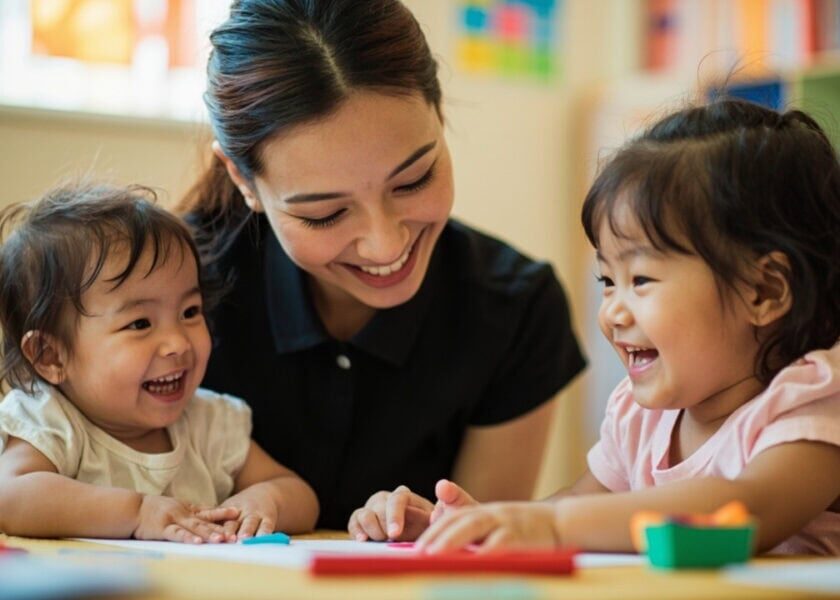
A settled child has adapted. They are not distressed. They have learned the rhythms of the environment, they know who their caregiver is, they feel safe enough to play, to eat, to rest.
This is genuinely valuable. Adaptation is a skill, and for a young child to adapt to a new environment with confidence rather than fear is a meaningful achievement. A settled child is not failing. A settled child is doing something real and important.
What a Thriving Child Looks Like
But settling is not the ceiling. It is the floor.
A thriving child has done all of this — and then something more. A thriving child does not just accept the environment. They use it. They stretch into it. They reach for what it offers.
The signs of this reaching are not dramatic. They are quiet, specific, and deeply observable — but only if you know where to look. What we want to offer you is not a checklist, but a way of seeing. A set of lenses through which the ordinary moments of your child’s day become legible — not as data, but as evidence. Evidence that the person you are raising is not merely tolerating their world, but expanding into it.
The Observable Dimensions of Thriving
Social Confidence: Navigating the Room
Consider the dimension of social confidence. You will not see a thriving toddler give a speech. What you will see is something far more informative.
You will see a child who, six months ago, needed several minutes of careful watching before entering a room full of other children — and who now walks in, glances briefly at the space, and finds a place in it. Not with bravado. Not with loud declaration. But with a settled, deliberate ease that tells you something has shifted internally.
This child has learned that social spaces are navigable. That other children are interesting rather than threatening. That there is a role for them in a group, even if it is a small one, even if it lasts only a few minutes.
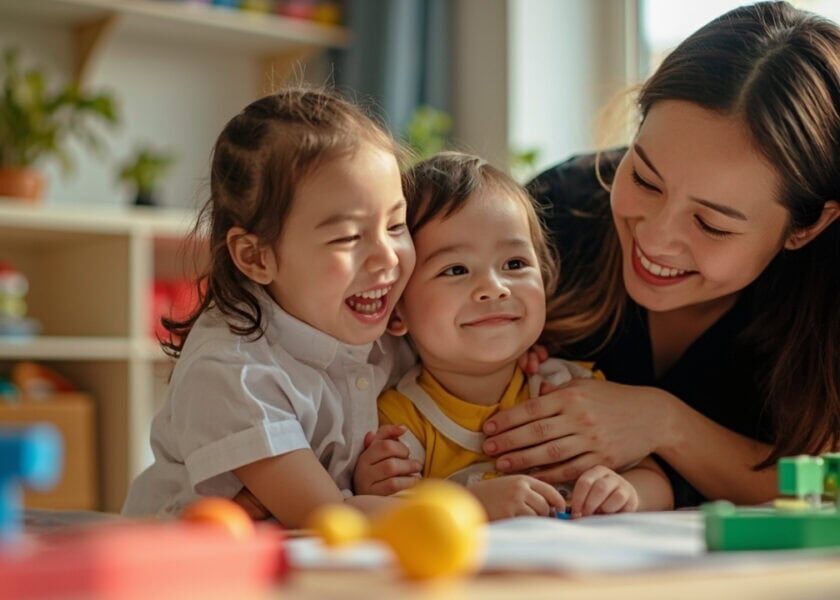
At quality home-based settings, this kind of development does not happen by accident. It happens because the environment is built to make it possible — where the group is intimate and the relationships are consistent, where a child comes to know the same faces day after day and can build genuine social trust.
Curiosity: The Body That Reaches
Think about curiosity — a word so often used that it has almost lost its meaning. But curiosity in a very young child is not an abstraction. It is a posture.
It is:
- The angle of a body bending toward something new
- A hand extended toward a texture that has never been touched
- A pause at the threshold of a room — not because the child is uncertain, but because they are taking in something that interests them
- A question in a language that has not yet become words — a particular sound, a pointing, a turning back to check whether the adult in the room is also seeing this thing that has caught their attention
When your child shares their discovery with you, not because they have been taught to share, but because the discovery was genuinely exciting enough to pull them toward you in communication — that is curiosity alive and active.
That is a mind that is open, that is seeking, that is building the neural pathways that will later support sustained attention, genuine interest, and the capacity to learn not because learning is required but because it is irresistible.
Emotional Regulation: The Pause That Matters
There is another dimension that is both harder to see and more important than most parents realise. It is the dimension of emotional regulation — and it is, in many ways, the most revealing indicator of whether a child is truly thriving or simply comfortable.
Emotional regulation is not the absence of big feelings. A thriving child will still cry. They will still become frustrated. They will still have moments of overwhelm that look, from the outside, like setbacks.
But here is what you will notice if you watch closely over time: the recovery is faster. The return to equilibrium is more complete.
- The child who once needed twenty minutes to recover from a disappointment now needs five
- The child who once responded to frustration with pure instinctual reaction is beginning to show a pause — a breath between the feeling and the response
And that pause is one of the most important things a human being ever learns to grow.
This is deep work. It happens not through instruction but through relationship — through the experience of having big feelings and being met with calm, consistent, compassionate responses from the same adult or adults over and over, until the child’s nervous system begins to internalise the message that feelings are survivable, that help is available, and that the world is safe enough to feel things in.
Language Warmth: Reaching for Words
Every parent knows the milestone of first words, and every parent celebrates it with the joy it deserves. But the language of a thriving child extends far beyond vocabulary. It is:
- The quality of their listening — the way they tilt their head, the way they pause before responding
- Their comprehension — which outpaces their expression in ways that can be startling: the child who understands a complex instruction delivered in a calm, natural tone, and responds to it not out of obedience but out of genuine comprehension
- The warmth of their communication — the child who uses not just words but tone, gesture, eye contact, and that particular expression of delight that says, “I am trying to tell you something, and I want you to understand”
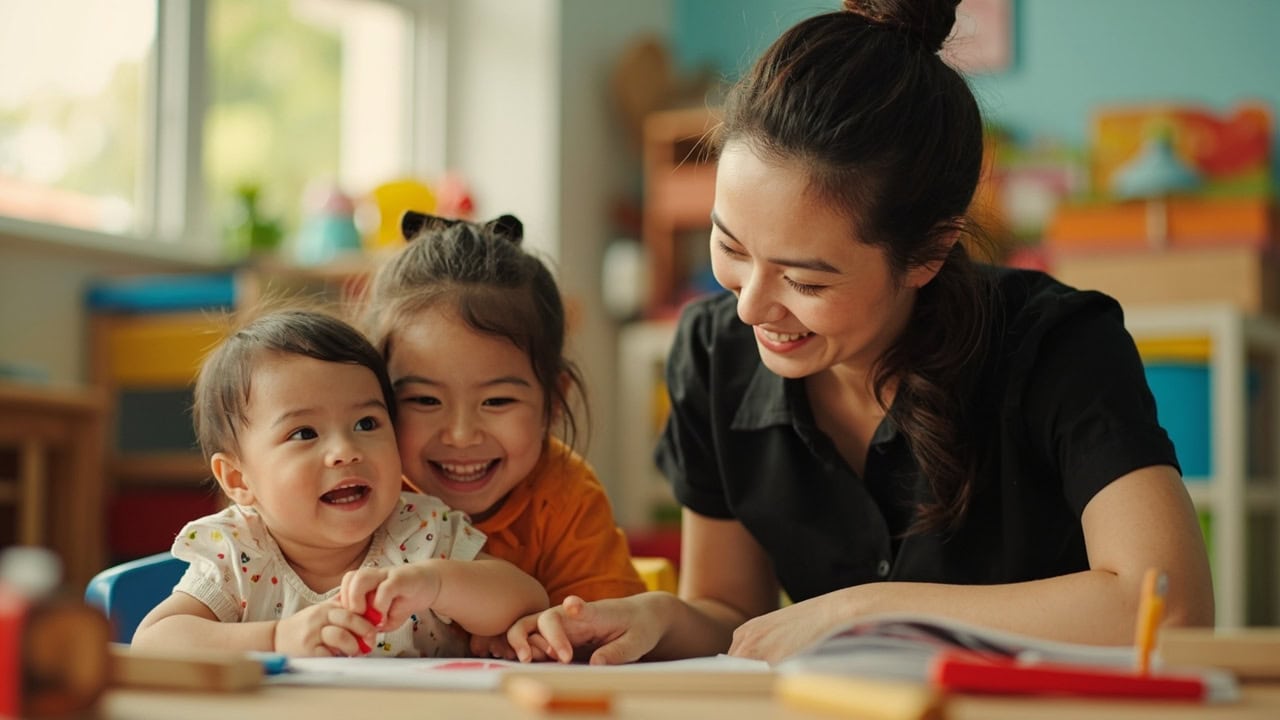
In quality home-based settings, language development is woven into the daily texture of care rather than treated as a separate curriculum. Educators talk with children throughout the routines of the day: during feeding, during dressing, during the quiet moments of transition between activities.
This constant, warm, reciprocal verbal interaction is one of the most powerful drivers of language development in the early years. It is amplified in small-group settings where each child receives a genuine share of that verbal attention rather than competing for it.
Relational Security: Walking In Without Looking Back
There is one more dimension that parents feel most profoundly but find hardest to articulate. It is the quality of relational security — and it shows up in the way a child moves between their caregiver and their parent at the beginning and end of the day.
You have seen it. A child who, in the first weeks of childcare, clings. Who sobs at drop-off, who clings to your leg, who looks back at you with an expression that feels like an accusation.
This is normal. It is also, paradoxically, a sign that your child is capable of deep attachment — which is the foundation of all the other development we have been discussing.
But watch what happens over time, in a quality environment:
- The child who was clinging begins, gradually, to hesitate at the door rather than cling
- Then to glance back
- Then to wave
- Then, on a good day, to walk in with something that almost resembles eagerness
Not because they do not love you, but because they have learned that the environment they are entering is a good one. They have learned to hold two truths at once: I love my parent, and I also trust this place.
When your child walks into their childcare setting and does not look back — not from indifference, but from settled confidence that says “I know where I am, and I am glad to be here” — that is relational security made visible. And it is the prerequisite for every other form of thriving we have discussed, because a child who is anxious about their attachment cannot fully invest their energy in curiosity, in social exploration, in language, in the slow hard work of learning to manage their emotions. The security comes first.
What Makes This Kind of Thriving Possible
All of this — all of it — depends on the quality of the adult in the room. Not just the quality of the curriculum, not just the quality of the physical environment, but the quality of the human being who is with your child when you are not there.
The ECDA Childminding Pilot Framework
At EduNanny, this understanding shapes everything. EduNanny operates within the ECDA Childminding Pilot, a government-recognised framework that sets standards for home-based and community-based childcare in Singapore. This is not regulatory box-ticking. It is a system designed to create exactly the kind of conditions we have been describing: low ratios, trained and supported caregivers, consistent environments, and a focus on developmental quality rather than mere supervision.
What Low Ratios Actually Mean
In home-based settings under this framework, ratios of up to one infant to three caregivers mean that your child is known. Not managed. Not supervised. Known.
The caregiver knows their rhythms, their preferences, their vulnerabilities, their joys. And that knowledge is not incidental. It is the mechanism through which all of the thriving indicators we have discussed are made possible:
- Curiosity is ignited by a caregiver who notices what captures a child’s attention and builds on it
- Emotional regulation is learned from a caregiver who stays calm when the child cannot
- Language blooms in the presence of an adult who genuinely wants to understand what this small person is trying to say
Making the Invisible Visible
Quality childcare does more than care. It makes the invisible visible — and this is where genuine care meets the practical need for trust.
If you are a parent, you deserve to know what is happening with your child during the hours you are apart. Not in vague terms. Not in the form of a single photograph with a caption that could mean anything. But in a way that lets you see the developmental narrative that is unfolding — the small progressions, the moments of breakthrough, the everyday evidence that your child is not just being kept but being grown.
Interpretive Understanding
In settings where observation, documentation, and regular updates are part of the educator’s daily practice, parents receive something rarer and more valuable than footage: interpretive understanding.
The educator who has spent six hours with your child can tell you not just what happened, but what it meant. Which moments were significant. Which small shifts matter and why. This transforms the daily update from a courtesy into a window.
A Practical Guide: What to Look For
Here is what we hope this conversation has given you. Not a definitive answer, because your child is not a problem to be solved. But a new quality of attention. A set of lenses through which you can look at your child — at drop-off, at pickup, in the bath, at breakfast — and see evidence of thriving that you might have been missing.
At Drop-Off: Watch the transition. Does your child move toward the caregiver with increasing ease over time? Hesitation is normal in the beginning. What you are looking for is the gradual shift from clinging to glancing, from glancing to waving, from waving to something that approaches genuine comfort. Notice the body: is it tense or relaxed? The body tells the truth that words cannot.
At Pickup: Observe the reunion. Does your child greet you with the particular warmth that says “I am glad you are here, and I am also glad I had somewhere good to be”? This is very different from the flat relief of a child who has simply been waiting to leave. Listen for sharing: is your child trying to tell you something about their day? Not just what they had for lunch, but something that excited them, something they discovered, something they want you to see?
Over Time: Track emotional recovery. When big feelings happen — and they will — does your child return to baseline faster than they did three months ago? Watch social navigation: can your child enter a room full of children and find their place in it? Look for curiosity: does your child reach for things, point to things, turn back to share discoveries? These are the signatures of a mind that is open and seeking.
Questions to Ask Your Childcare Provider
When you are evaluating infant care options in Singapore, here are questions that go beyond the surface:
- How do you observe and document my child’s development on a daily basis? Look for answers that talk about intentional observation, not just daily logs.
- What does a typical day look like in terms of caregiver-child interaction? You want to hear about conversation, responsiveness, and relationship — not just schedules and activities.
- How do you support emotional regulation when my child is distressed? The answer should reference consistent, calm responses from familiar caregivers — not punishment, isolation, or generic “comfort.”
- What is your ratio, and why does that ratio matter for my child’s development? You want a provider who can explain the connection between small numbers and quality attention.
- How will you help me understand what is happening during the day? Look for educators who can interpret what they see, not just report what happened.
The Honest Answer About Choosing Childcare
We know that choosing childcare is one of the most consequential decisions a Singapore parent makes. It is not just about logistics. It is about entrusting someone with the most important person in your life during the most important years of their life.
No article, no tour, no conversation can give you absolute certainty. What good information can do is this: it can help you ask better questions. It can help you see more clearly. And it can help you trust what you observe when you walk through the door at pickup — not just the reassurance, but the evidence.
The evidence that your child is not just tolerating their world but inhabiting it fully. The evidence that they are, in the truest sense of the word, thriving.
All of this — the ratios, the training, the communication tools, the government recognition — all of it is in service of something that cannot be measured on a balance sheet or a checklist. It is in service of the child. Of your child. Of the small, fierce, extraordinary person whose face you see in the morning light and whose voice you hear at the end of the day and whose future is being shaped, right now, in the hours you cannot see.
You chose this. And you chose well. Now watch — and see what they do with it.
When you see them — because you will see them, if you look — you will know something that no milestone chart and no daily report can give you.
You will know that the place you chose for your child is a place where your child is not merely kept but known. Not merely cared for but seen. Not merely safe, but in the richest and most meaningful sense of the word, growing.
That is what EduNanny is here for. Not just to hold your child while you work. But to help you see your child — clearly, confidently, and with the kind of wonder that they deserve.
The kind of wonder that every child earns simply by being alive at an age when everything is new and every day is a small, extraordinary act of becoming.
If you are a parent in Singapore exploring infant care or childminding, we invite you to connect with EduNanny to learn more about what intentional developmental care looks like in practice.
Visit EduNanny Singapore — where thoughtful care meets the first thousand days.