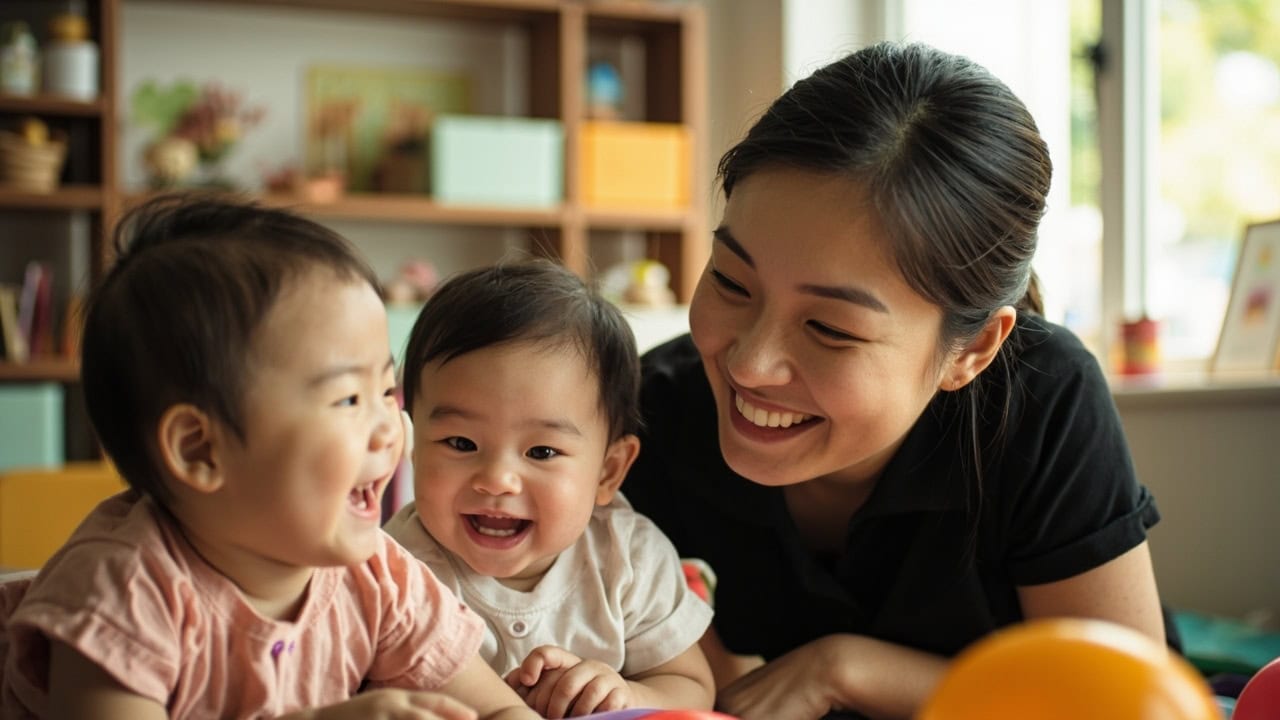
What Quality Infant Care Looks Like for Singapore Families
The Silence Before Childcare
There is a particular kind of silence that falls over a Singaporean parent in the weeks before their child begins childcare. It is not the silence of peace. It is the silence of a mind turning over the same questions again and again, searching for an answer that feels certain enough to step into.
Will my child be okay? Will they know I am thinking about them? Will they feel abandoned, even for a few hours? Is this the right choice, or am I choosing convenience over my instincts? What will other parents think? What will my mother-in-law say?
If you have felt this, I want you to know something right now. You are not experiencing weakness. You are experiencing love so clear and so present that your body does not know how to hold it without weight. The doubt you feel is not evidence that you are making the wrong decision. It is evidence that you care so deeply about getting this right that you will not let yourself glide past it unexamined.
This article walks through what quality infant care actually looks like in Singapore, how to evaluate it beyond the brochure and the facility tour, and what questions to ask when you visit. Because you deserve to make this decision with clarity—and your child deserves care that sees them clearly.
Why Your Doubt Is Not Your Enemy
The instinct that keeps you awake at night, the one that makes you walk through childcare centres with your guard up, the one that makes you google search terms at midnight and second-guess every recommendation you receive—that instinct is your most reliable guide. It is the part of you that will recognize quality when you see it, even when you cannot articulate why.
Trust it.
We live in a culture where the decision to return to work, to share your child’s early days with someone else, is still shadowed by quiet judgment. Grandparents ask if the caregiver will love your child the way they would. The unspoken question beneath many conversations about infant care is: are you doing enough?
Let me answer that directly. You are doing enough. Your love for your child is not measured in hours. It is measured in the attention you bring to this decision, in the seriousness with which you approach this choice, in the fact that you are here, reading this, trying to find clarity. That is parenting. That is what good parents do.
What Quality in Infant Care Actually Looks Like
Quality in infant care is not a feature list. It is not the number of learning corners in the classroom or the brand of the high chairs. It is not even the number of certifications hanging on the wall, though those matter too. Quality in infant care is a felt experience.
It is the way your child responds to their caregiver in the first few weeks—not with polished performance, but with small, real signals of comfort. The way they settle faster each day. The way they reach for their caregiver with the same easy trust they reach for you. The way the caregiver speaks not just to you about your child, but to your child about their own world—narrating what they are doing, naming what they see, meeting their eyes with genuine presence.
That presence is not something you can audit with a checklist. But you can feel it. And if you are paying attention, you will know when it is there, and you will know when it is not.
The Four Signs of Genuine Attunement
When you strip away the marketing and the metrics, here is what good infant care actually looks like:
1. Small Groups, Genuine Attention
When an infant’s world is limited to the faces and voices they encounter each day, the ratio of caregivers to children is not a regulatory checkbox. It is the architecture of safety and attention. One caregiver for every three infants in a quality infant care setting is not a luxury—it is a baseline that allows for genuine attunement.
It means your child is not one of twelve crying in a corner. It means your child’s individual rhythms—their hunger cues, their need for stillness or stimulation—can actually be noticed and honoured.
2. Consistency and Secure Attachment
Children under two do not adapt well to a rotating cast of characters. They need to form secure attachments, and secure attachments require repetition. The caregiver who has been with your child for six months knows the difference between a tired cry and a hungry cry. They know your child reaches for comfort differently than the child next door. They know how to soothe your specific child because they have spent enough hours together to learn their language.
3. Honest Communication
Not polished daily reports full of pre-written activities, but real updates—how your child slept, what made them laugh today, what they resisted, what surprised them. It looks like a caregiver who tells you when your child had a hard morning, not because they want you to worry, but because you deserve to know, and because that transparency is the foundation of the trust you are both building.
4. Responsive, Not Scheduled Development
The best infant care does not force a two-month-old to hit developmental milestones on a schedule. It creates an environment where each child can unfold at their own pace, with support that matches where they actually are. Development is not a product to be delivered. It is organic, responsive, and individual.
Choosing Childcare Is Choosing Partnership
When you choose childcare, you are not just choosing a schedule. You are choosing trust. You are saying: I believe this person, this place, will hold what matters most to me in the world.
That is an act of courage. And it is one that Singaporean parents are rarely given permission to name.
The best infant care arrangements are not transactions where you hand over your child and receive reports and activities in return. They are collaborative relationships where your knowledge of your child is respected, where your questions are welcomed, where the caregiver sees themselves not as a replacement for you but as an extension of your care during the hours you are apart.
Questions to Ask Before You Choose
When you visit a centre or meet a caregiver, slow down. Watch not the walls but the interactions. Here are the signals that matter:
- Notice how the caregiver kneels to an infant’s level. Observe whether they narrate what they are doing. Notice whether they put down their phone when a child approaches.
- Notice whether they speak about the children in their care with warmth that is specific—not generic praise, but details. Watch how the children move through the space. Are they comfortable? Are they exploring? Do they seek out the caregivers, or do they avoid them?
- Listen to the texture of the answers. Does the caregiver speak about your child as an individual? Do they remember details from previous conversations? Do they seem nervous when you ask the hard questions, or do they seem relieved that you are asking them?
Care Built Around This Understanding
EduNanny by BUTLER was built around exactly this understanding. We are not a childcare service that happens to care about babies. We believe the first thousand days of a child’s life are not a waiting period before real learning begins. They are real learning. They are the foundation upon which everything else is built.
The people we place in those first thousand days must be extraordinary—not because they hold the right certifications alone, but because they have the character to hold this responsibility with the gravity it deserves.
We participate in the ECDA Childminding Pilot, reflecting our commitment to raising the standard of home-based and centre-based infant care across Singapore. Through this programme, we offer families access to small-group care with ratios that allow for genuine attunement—up to one caregiver for every three infants in our infant care settings. Our care blocks run Monday through Friday, giving working parents the reliable rhythm their families need to plan around.
Many of our home-based pathways include transparent measures where deployed, including communication platforms and CCTV access, so that you can stay connected to your child’s day. We believe transparency is not a feature—it is a responsibility we owe to every family who entrusts us with their child.
We know that cost is a real concern for Singaporean families. We have designed our pilot programme to be accessible, and CDA and Baby Bonus funds can be used where applicable. We do not believe quality infant care should only be accessible to those with significant means.
A Final Word to the Parent Still Reading
Here is what I want you to carry with you.
The doubt you feel is not your enemy. It is your intelligence speaking. It is your love demanding that you pay attention, that you do not settle, that you find the right fit for your child and your family—not the one that looks best on Instagram, not the one that meets the minimum standard, but the one where your child can flourish and you can breathe.
Above all, listen to yourself. Not the anxious voice that catastrophizes every possibility, but the deeper voice—the one that has been right about your child all along. You know your child. No checklist, no certification, no centre director can replace that knowledge. Your role is not to defer to experts about your own child. Your role is to find the partner who will honour and supplement the expertise you already carry.
Choosing childcare is not a failure of devotion. It is an act of devotion—one that says: I want my child to have more than I alone can provide, and I will find the people who can provide it with me.
If you are ready to have a real conversation about what infant care can look like for your family—honest, practical, grounded in what your child actually needs—we are here. Not with a sales pitch, but with a genuine conversation. Because you deserve clarity, and your child deserves care that sees them clearly.
And that is what we do.
EduNanny by BUTLER is a Singapore-based infant care and childminding service committed to quality, developmental care, and transparent family partnerships. Learn more about us or get in touch to start a conversation about what care looks like for your family.