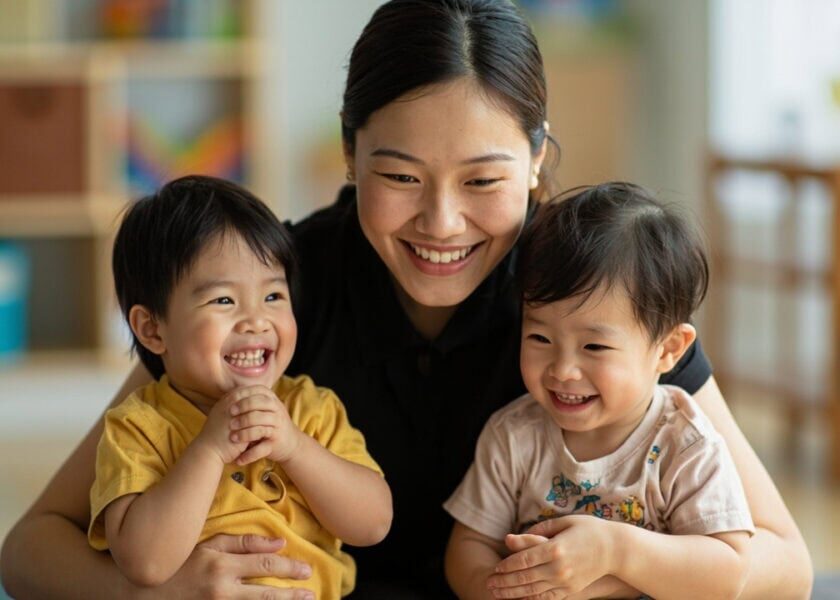
What Your Child Learns in the Hours You’re Not There
The Environment That Teaches: What Your Child’s Space Says to Them
The first thing you would notice, if you could observe that full day, is the light. Not harsh fluorescent office light, but something gentler. Natural light where possible, filtered through windows placed with intention. Light that shifts as the morning progresses, that tells a child—without words—that time is moving.
In quality infant care environments, even the lighting is a teacher. It communicates warmth, calm, the sense that this is a place designed for small humans and their still-developing senses.
You would notice the space itself. The way it is arranged not for adult convenience but for child movement. Low shelves that a newly walking toddler can reach, pull themselves up by, explore. Soft areas where children can sit with books or toys and feel contained within a gentle boundary. Wide pathways between play zones that allow running without collision, crawling without restriction—the full-body movement that young children require for their developing brains.
The materials around them matter too. You would see wooden toys alongside fabric ones, natural textures alongside smooth surfaces. You would notice the absence of overwhelming visual noise—the rows of plastic that often characterise less intentional environments. Instead, there is a curated simplicity that allows children to focus, to choose, to engage deeply rather than to be constantly stimulated into distraction.
This is not decoration. This is architecture. The physical environment of infant care is the silent teacher, the third educator in the room alongside the adults and the other children. It either supports or undermines the developmental work happening there.
At EduNanny Singapore, every element of our physical environment has been considered with intention. The placement of sleeping areas away from high-traffic zones, so that rest is protected. The separation of eating spaces from active play, so that meals are respected. The outdoor access we provide, even in Singapore’s climate, because children need to feel rain, hear birds, experience the texture of the world beyond air conditioning.
These are not luxuries. They are developmental necessities that we have chosen to prioritise because we understand that in the hours you cannot see, your child is not simply being watched. Your child is being formed by everything around them.
The Rhythm That Builds Security: How Predictable Patterns Create Confidence
The environment is only the first layer. The second thing you would observe, if you could follow your child through their day, is the rhythm.
This is something that separates genuine developmental care from mere supervision. In a quality infant care setting, the day has a pulse. There are predictable patterns that children learn to anticipate, and these patterns do something profound: they build security.
You would see this most clearly in the transitions. The moment when one activity ends and another begins. In a thoughtful environment, this transition is prepared for. There is a signal—a song, a phrase, a ritual—that tells children change is coming. There is a pacing that does not rush them from one thing to the next. There is a completion of one activity before the beginning of another, so that children learn that their play matters, that it can be returned to, that they are not constantly being yanked away from what they love.
Watch a child in a well-structured day, and you will see confidence emerge from this consistency. They begin to know what comes next. They begin to trust the sequence of their hours. And that trust—born not from the adults telling them everything will be fine, but from the actual lived experience of a predictable world—becomes the foundation for exploration, for curiosity, for the willingness to try new things.
This is the developmental work of rhythm that most parents never get to see. It happens quietly, across weeks and months. A child who arrived anxious at drop-off begins to walk in confidently. A child who resisted naptime begins to seek out the cot, because they know it will be there, that it will be safe, that sleep will come in its own time.
The rhythm is teaching them something that no amount of verbal reassurance can: that the world can be trusted, that their needs will be met, that they are held within something stable.
At EduNanny, our daily schedules are designed with this developmental function in mind. We are not just filling time. We are building sequences that teach children about the world and their place in it. Our Monday to Friday care blocks are structured with intentionality—rest periods that honour sleep science, meal times that allow children to eat at their own pace, outdoor moments that punctuate the day with sensory richness. Every transition, sometimes only seconds long, is an opportunity to reinforce that sense of safety and predictability that young children need most.
The People Who Matter: Caregiver Quality and Responsive Interaction
And then there are the people. The caregivers. The ones who make everything else possible or who can undermine it entirely.
This is where observation becomes most important, because the quality of caregiver interaction is the variable that matters most. Not the curriculum, not the materials, not even the environment—though all of these matter. What your child needs, in those hours you cannot see, is a human being who responds to them with attunement.
If you could observe the full day, you would watch these interactions unfold dozens of times:
- A caregiver on the floor, at the child’s level, following the child’s lead in play rather than directing it
- A caregiver narrating what a pre-verbal infant is looking at, building language through the simple act of naming experience
- A caregiver staying calm—truly calm—when a child is dysregulated, serving as a co-regulator, a living model of emotional steadiness
These are not scripted moments. They cannot be trained into someone who does not already possess deep patience and genuine care for children.
Our infant ratios—up to one caregiver for every three infants in our ECDA-supported Childminding Pilot—are designed precisely to allow for this kind of responsiveness. When a caregiver is responsible for fewer children, they can truly see each one. They can notice the subtle shift in mood that precedes a meltdown. They can give individual attention to the child who needs it, without abandoning the others.
You would also observe, if you were watching our full day, the communication we maintain with parents. Because we understand that the hours you cannot see should not remain mysterious. Through our communication practices and CCTV access where deployed, we work to close the gap between what happens here and what you know about it. Not because we have anything to hide—quite the opposite—but because we believe informed confidence is better than uninformed trust.
You deserve to know what your child’s day looks like. You deserve to see the rhythms, the interactions, the moments of discovery, the moments of struggle, the moments of comfort. That visibility is part of what we offer. That partnership between our caregivers and you is not an add-on; it is fundamental to how we understand our role.
The Learning That Looks Nothing Like Learning
There is a child at the sensory table, running water through their fingers. To the untrained eye, this is play. It is also one of the most powerful learning experiences available to a one-year-old.
They are learning about texture, temperature, cause and effect, the properties of liquid, the sensation of wet and dry. They are developing the nerve endings in their fingers that will later enable them to hold a pencil, to manipulate tools, to feed themselves with growing skill. They are in a state of flow, of deep engagement, of the kind of learning that cannot be forced and that does not look like school at all.
Or watch the children in the block area, building towers and knocking them down. This is mathematics. This is physics. This is learning about gravity, balance, spatial relationships, the relationship between effort and result. It is also emotional learning—about frustration when the tower falls, about persistence, about the satisfaction of starting over.
All of this is happening simultaneously, in a two-year-old who cannot yet tell you what they did today.
Or sit with a small group of infants during their morning read-aloud. They cannot yet understand the words. But they are learning something perhaps more important. They are learning that adults gather them for a special activity. They are learning that words come from books, that pictures have meanings, that the sound of a human voice reading is a source of pleasure. They are building the neural pathways that will eventually enable them to love reading themselves.
The investment is being made now, invisibly, in a brain that will carry these early associations forward for the rest of their lives.
This is the learning that happens in quality infant care. It is not worksheets. It is not flashcards. It is the deeper learning that happens through the body, through the senses, through relationship, through the enormous motivation all children have to understand their world.
At EduNanny, our approach to learning is grounded in this understanding. We do not separate care from education, because to a young child, there is no difference. Every interaction is an opportunity for development. Every moment of secure attachment is building the brain architecture that will enable future learning. Every experience of being seen, responded to, and supported is teaching a child that they are capable and worthy.
How Your Child Feels: The Question That Matters Most
Which brings us to what we consider the most important question a parent can ask—and one that most parents do not know to ask until they see it.
How does my child feel, in those hours away from me?
This is not about whether the child is having fun. It is not about whether they are smiling in every photograph or whether they resist drop-off or not. It is a deeper question:
- Is my child in an environment where they feel safe enough to explore?
- Is my child being seen for who they are, including their difficulties and their needs?
- Is my child being stretched—supported to try new things, to persist, to grow—without being pushed beyond what they can bear?
The answer to these questions lives in the child’s behaviour, over time.
A child who feels genuinely safe in their childcare environment will show it—not in the moment of drop-off (where separation anxiety can persist regardless of quality), but in the hours that follow. They will engage. They will be curious. They will play with depth and focus. They will show the energy of children who are not in constant survival mode.
A child who feels seen will show it too. They will develop what developmental psychologists call secure attachment—not just to their parents, but to the adults who care for them in their childcare setting. They will seek out their caregiver for comfort. They will show that caregiver their discoveries, their creations, their small triumphs. They will know, in their bodies and their hearts, that they matter to this person.
A child who is being appropriately challenged will show it in their growth. Not just physical growth, though that matters too. But cognitive growth, social growth, emotional growth. The child who arrived not yet walking begins to walk. The child who did not yet speak begins to find words. The child who struggled with sharing begins to negotiate, to wait, to take turns with growing grace.
This is what you would see, if you could observe the full day. You would see your child not merely being supervised, but being supported through one of the most rapid periods of human development. You would see the emotional architecture of their mind being built, one interaction at a time, one day at a time.
What Quality Looks Like: A Practical Framework for Evaluating Infant Care
Whether you are just beginning your search or are ready to evaluate what you have seen, here is a framework for recognising quality when you encounter it.
The Physical Environment
- Natural or warm lighting, not harsh fluorescents
- Child-height shelving and accessible materials
- Natural materials (wood, fabric) rather than overwhelming plastic
- Clear pathways for movement and exploration
- Designated areas for different activities (rest, meals, active play)
- Outdoor access or meaningful connection to nature
The Daily Rhythm
- Predictable sequence of activities that children can anticipate
- Honoured transitions with signals (songs, phrases) rather than abrupt changes
- Respect for each activity’s completion before moving on
- Rest periods that honour children’s individual sleep needs
- Meal times that allow unhurried eating
Caregiver Interactions
- Caregivers at child level, not always standing over children
- Responsiveness to individual children’s cues and moods
- Calm regulation when children are upset
- Language-rich interactions, even with pre-verbal children
- Individual attention possible due to low ratios
Learning Through Play
- Sensory experiences available (water, sand, textures)
- Open-ended materials (blocks, dress-up, art supplies)
- Time for uninterrupted play, not constant direction
- Books and stories woven throughout the day
- Opportunities for both independent and group exploration
Communication With Parents
- Regular updates on child’s day and development
- Welcoming of questions and observations
- Transparency about daily activities and rhythms
- Partnership approach rather than gatekeeping information
Questions to Ask During Your Visit
- Observe the environment: Is it designed for children or for adult convenience?
- Watch caregiver-child interactions: Are they warm? Responsive? At the child’s level?
- Ask about the daily rhythm: Can they explain why activities are sequenced as they are?
- Notice how staff respond to you: Do they welcome your questions or seem guarded?
- Ask about infant ratios: How many children per caregiver, especially for infants?
- Enquire about communication practices: How will you know what your child is doing each day?
EduNanny Singapore: Built for the Hours You Cannot See
We have described what quality infant care looks like. Now let us be clear about how EduNanny Singapore puts these principles into practice.
We are part of the ECDA Childminding Pilot, which means we operate within a framework that values home-based and community pathways alongside centre-based care. This gives families options that fit their circumstances.
We maintain the infant ratios—up to one caregiver for every three infants—that allow for genuine responsiveness. When a caregiver can truly see each child, they can notice the subtle shifts in mood, respond to individual needs, and provide the attunement that young children require.
We structure our weeks Monday through Friday with the kind of consistency that children need. The rhythm of the days is intentional, designed to build security through predictability.
We offer fee structures designed to be accessible, supporting the use of CDA and Baby Bonus funds, because we believe quality care should not only be available to those with unlimited resources.
We offer transparency—through our communication practices and CCTV access where deployed—as a core part of our approach. We want you to know what your child’s day looks like, not guess at it.
We have developed tools to support our partnership with parents. Our Thomas AI Chatbot is available to help parents navigate questions, from the practical to the developmental. It is not a replacement for human care or human conversation. It is an additional resource—a way to access information, to get answers, to feel supported in the ongoing work of parenting.
But beyond these specifics, what we offer is this: the chance for you to be an informed parent rather than an anxious one. The assurance that comes not from promises, but from the ability to understand what is happening in the hours you cannot attend. A partnership between our caregivers and you, because we believe that your role as a parent does not end at our door—it continues, and it is strengthened, when we share information honestly and work together in your child’s best interest.
You are making one of the most consequential decisions of your child’s early life. You are making it in a context of limited information, genuine anxiety, and often conflicting advice. You are making it while the stakes feel impossibly high and the options feel impossibly similar.
We want to tell you that you are right to feel the weight of this decision. You are right to ask questions, to visit facilities, to look for answers. You are right to want more than supervision. You are right to want your child to be in a place that honours their development, their security, their humanity.
So when you evaluate your options, we encourage you to carry something different than anxiety. Carry knowledge. Carry the understanding of what quality looks like—not just impressions, but the ability to read what is actually happening in a childcare environment.
Your child needs a beautiful environment, a consistent rhythm, responsive caregivers, rich learning through play, and the continuous experience of feeling safe, seen, and supported.
And know that this is what we have built at EduNanny Singapore. Not because it is perfect—nothing involving human beings and their development is ever perfect. But because it is intentional. Because it is grounded in genuine understanding of how children grow. Because the people who work here care about your child not as a responsibility but as a person, with all the complexity and potential that each small human carries.
The next time you walk your child through our door, we hope you will feel not uncertainty but clarity. Not hope alone, but informed confidence. Not the anxiety of not knowing, but the peace of understanding.
Because the best childcare is not a leap in the dark.
It is a place you can watch.
And when it is truly good, it is a place worth watching.
If you would like to learn more about how EduNanny Singapore approaches infant care and childminding, we invite you to reach out. We welcome your questions, your observations, and your desire to understand what quality care looks like.
Ready to explore your options? Contact EduNanny Singapore to schedule a conversation or visit. We are here to help you find clarity in this important decision.