What Your Child Is Showing You About Their Care
What Quality Childcare Actually Looks Like
If you are reading this between meetings or during a lunch break, here is what matters most:
- Children show you everything. Long before they have words, children communicate whether their care environment is supporting their growth. Your observations are valid data—not a replacement for professional insight, but a complement to it.
- Five areas to watch. Emotional regulation, social ease, language development, physical confidence, and sleep quality are the most reliable indicators of whether your child’s care environment is genuinely developmental.
- Adjustment is not the same as concern. A period of transition is expected when children begin new care. What matters is trajectory—whether difficulties are gradually lessening over time.
- Your intuition is a tool. When you feel something is off—or right—it is worth paying attention to. The best outcomes happen when parental observation and professional expertise work together.
- Observable quality is possible. In the right care setting, you can see development happening. Not perfectly, not dramatically, but consistently—and that is what matters.
The Language Your Child Is Already Speaking
The first thing to understand is that children are extraordinary communicators. Long before they have words for what they feel, they are showing you everything. Every expression, every transition, every response to being picked up or dropped off—these are not random behaviors. They are language. A language that tells you, more reliably than any report card or progress update, whether your child’s care environment is one where they can grow.
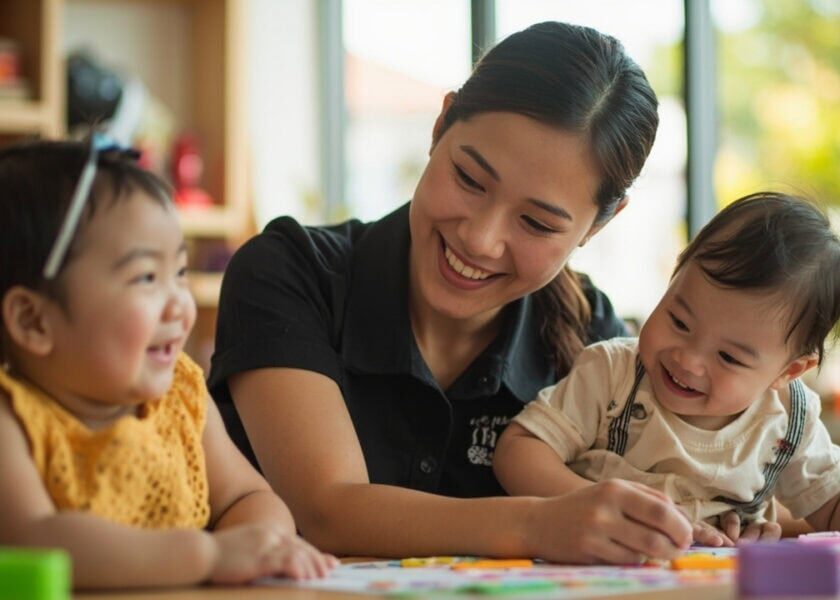
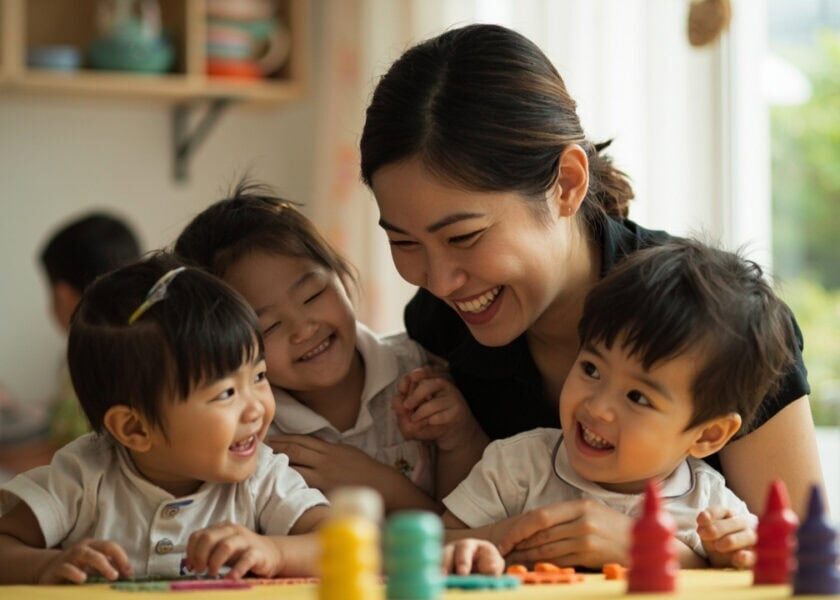
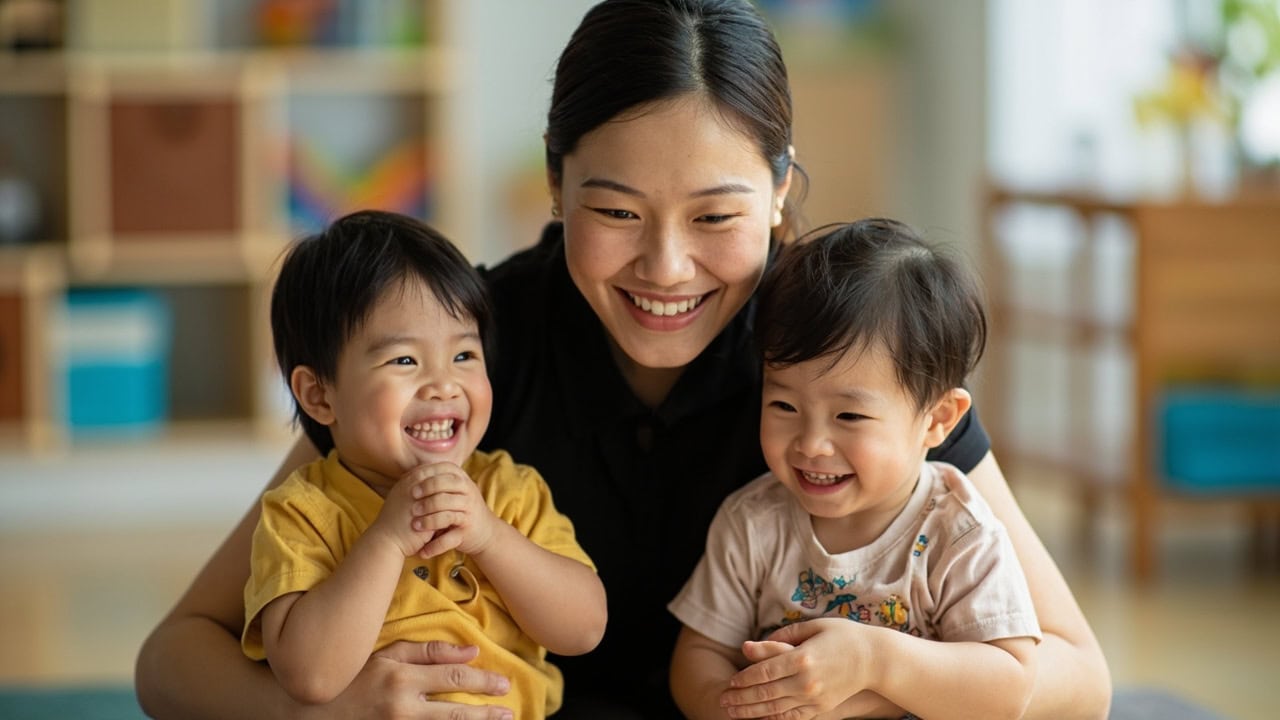
Watch a child who is thriving in their care environment and you will see something consistent. Not perfection—children are messy and complicated and exhausting and wonderful regardless of where they spend their days. But there is a quality to the way they move through the world after a day in good care. A readiness. An openness. They have been held in a secure enough place that they can afford to be curious. To reach for you without hesitation. To show you, without performance, exactly who they have become in the hours you were apart.
This is not sentiment. It is what thousands of parents and caregivers have observed, what good pediatric eyes recognize, what research on attachment and early development has consistently confirmed: children who are in environments that truly meet their needs come home different. Not dramatically different. Not in ways that would announce themselves to a stranger. But in ways that you would notice. That you do notice.
The question is whether you trust yourself to read it.
When you are new to quality childcare, when you have made a significant decision and committed resources and energy to it, there is a vulnerability in looking closely. It feels safer to defer to the experts, to wait for someone in authority to tell you whether things are going well.
And that is reasonable—professional observation matters, structured assessment matters, the trained eyes of experienced caregivers are invaluable. But here is what we have learned, watching tens of thousands of children across years of this work: the parent’s eye is not less reliable. It is differently reliable.
You see your child in a context no one else does. You know their baseline, their rhythms, their particular way of being in the world. You have the longitudinal data that no single observation can provide. When you pay attention to what your child shows you after each day in care, you are gathering evidence that no checklist can replicate.
Five Observable Signs That Your Child’s Care Is Working
There are consistent signals that emerge when a child’s care environment is genuinely supportive of their development. We can group them into categories not because children are categories, but because attention benefits from structure. Naming these things helps you notice them.
1. Emotional Regulation: The Capacity to Return to Baseline
Your child’s ability to manage big feelings over the course of a day is one of the most meaningful indicators of a nurturing care environment. A child in such a setting is building the neurological infrastructure for self-regulation every single day.
You may see this in how they handle frustration, how they transition between activities, how they respond when something does not go their way. Not an absence of struggle—children struggle constantly, and that is part of healthy development. But a capacity to return to baseline. To be upset and then recover. To cry and then be soothed. To feel disappointment and then move on.
The rhythm of dysregulation and recovery, repeated across days and weeks and months, is building something permanent in your child’s brain. When you see that rhythm in motion, you are watching development happen.
2. Social Ease: Comfort in the Social World
Your child’s relationship to other children and to adults outside the family is another reliable indicator. This is not about extroversion or popularity. Some thriving children are quiet observers; others are gregarious and bold.
What you are looking for is comfort. A willingness to engage. A growing confidence in navigating the social world. Consider these questions:
- Does your child approach other children, even tentatively?
- Do they respond to caregivers with warmth rather than consistent wariness?
- Are they beginning to notice other children, to be interested in them, to want to play alongside or with them?
These are signs that the care environment is providing a secure enough base for your child to reach outward.
3. Language: Communication Beyond Words
Language development is one of the most concrete ways to observe cognitive growth, and it happens continuously in environments where children are talked to, sung to, read to, and engaged with meaningfully.
Children in language-rich environments are always absorbing, even when their output seems minimal. You may notice your child using new words, or new combinations of words. You may notice them attempting to tell stories, to narrate their experience, to ask questions. You may notice them listening differently—more attentively, more responsively.
If your child is picking up vocabulary, developing more sophisticated comprehension, beginning to express ideas and emotions through words rather than only through behavior—that is meaningful evidence. That is your child’s mind expanding, and you are watching it happen.
4. Physical Confidence: Growing Mastery Over the Body
In quality care settings, children move. They run, climb, explore, fall, get up, try again. They develop coordination, balance, spatial awareness. They build the kinesthetic intelligence that underlies so much of later learning.
You may notice your child attempting new physical feats, showing pride in their growing abilities, moving through the world with a little more certainty than before. Physical confidence and cognitive development are deeply intertwined in early childhood. When your child is moving well, they are thinking well too.
5. Sleep: The Hidden Indicator
The relationship between sleep and development is profound and bidirectional. Children who are in emotionally healthy environments tend to sleep better—not perfectly, but better. And children who sleep well develop better.
When your child comes home from care and sleeps soundly, when nap times have become more consistent, when bedtime battles ease and your child settles into rest with greater peace—that is a sign. Sleep is where the brain consolidates learning, processes emotion, builds the capacity for the next day’s growth. When your child sleeps well after a day in care, it is one of the most reliable physiological indicators that the day was a good one.
Understanding Adjustment and Knowing When to Act
This is where parents often become anxious in unhelpful ways. There is a difference between adjustment and concern. Knowing the difference will save you from a great deal of unnecessary worry while ensuring that real problems do not go unaddressed.
What Normal Adjustment Looks Like
When a child begins in a new care environment, there is almost always an adjustment period. This is normal. Expected. Healthy. Your child is learning a new environment, forming new relationships, adapting to new routines.
During this period, you may see regression in some areas:
- A child who was sleeping through the night may start waking again
- A child who was using the potty may have accidents
- A child who was speaking confidently may become quieter or more clingy
These are not signs of a bad care environment. They are signs of a child processing change. A child who feels secure enough to show their stress is a child who is not shutting down. That is actually a good sign.
The adjustment period typically lasts anywhere from a few weeks to a few months, depending on the child, their age, their temperament, and the nature of the transition.
When Adjustment Becomes Concern
What matters during the adjustment period is not whether you see disruption—you almost certainly will. What matters is whether the disruption is gradually lessening. Whether your child is, over time, settling in. Whether the difficult behaviors are becoming less frequent and less intense. Whether the positive signs we discussed earlier are beginning to emerge alongside the adjustment struggle.
If, after a reasonable adjustment period, you are still seeing significant distress, these are not adjustment behaviors. These are quality concerns:
- Persistent aggression that does not decrease
- Complete withdrawal from interaction
- Failure to gain any ground in any developmental domain
- Physical signs of stress like weight loss or prolonged illness
Questions Worth Asking Your Provider
If you want to assess whether your child’s care is genuinely developmental—or if you are evaluating options—these questions can help:
- How do you handle transitions between activities? Can you give me an example of a difficult transition and how it was managed?
- What does a typical day’s routine look like, and how do you adapt it for individual children’s needs?
- How do you communicate with parents about their child’s engagement and development, not just meals and sleep?
- What does a difficult day look like for a child here? How do you support them?
- What is your caregiver-to-child ratio, and how does that affect the attention each child receives?
- How do you support language development in everyday interactions?
- How do you work with parents when they have concerns about their child’s adjustment or development?
The answers to these questions, combined with your own observations of your child’s behavior and development, will give you a clearer picture than any inspection or marketing material alone.
Quality Childcare in the Singapore Context
Singapore parents face a particular set of pressures. The cost of living, the demands of dual-income households, the complexity of extended family structures that are often not as extended as they once were, the high expectations placed on children from an early age—these pressures are real and they are not going away.
For many families, quality childcare is not a luxury. It is an operational necessity. The ability to work, to contribute, to build a life depends on having reliable, trustworthy care for young children.
But necessity and quality do not have to be in tension. The childcare that Singapore parents need and deserve is care that meets both criteria simultaneously—it must be accessible and reliable, yes, but it must also be genuinely developmental. It must see children as more than bodies to be supervised. It must invest in their growth.
What the ECDA Childminding Pilot Means for Families
The ECDA Childminding Pilot is designed to recognize and support home-based and community-based care pathways. When properly structured and resourced, these settings can offer something that large centre-based settings sometimes cannot: intimacy, flexibility, a family-like environment where children are known as individuals.
These pathways are not lesser options. For many families, particularly those with infants and toddlers, they are precisely the right option. The Pilot’s framework acknowledges this by creating standards, training pathways, and support structures that elevate the quality of home-based care across Singapore.
How EduNanny Approaches This Work
EduNanny is built on a conviction that every child in Singapore deserves care that is not just safe and convenient, but genuinely excellent. Care that meets them where they are. Care that sees them as individuals with their own temperaments, rhythms, and potential. Care that is warm and structured and responsive. Care that parents can trust, not because they have been told to trust, but because they can see it working.
Lower ratios, higher attention. In our infant care settings, we maintain ratios of up to one caregiver to three infants, because we know what the research confirms: children in lower-ratio environments receive more individual attention, form stronger attachments, and develop more securely.
Transparency as a foundation. We know that parents need to see. Not as an intrusion on our work, but as a fundamental part of it. Where deployed, our centres feature CCTV access so that parents can observe in real time. Our caregivers are trained to provide regular, detailed updates that go beyond the surface—not just what your child ate and slept, but how they engaged, what they explored, where they showed spark and where they needed support.
Affordability and accessibility. We have structured our pilot fees to be accessible to families who need quality care without the premium prices that often accompany it. CDA and Baby Bonus funding are usable for eligible families, because we believe financial constraints should not determine whether a child receives excellent early care.
Technology in service of connection. Our Thomas AI Chatbot is designed to make parenting and childminding easier—to answer questions, provide guidance, support the partnership between parents and caregivers, and ensure that the vast majority of daily concerns can be addressed quickly without requiring formal meetings or extended phone calls. Technology, used well, can enhance the human relationships that matter most.
For Parents Carrying Uncertainty
If you are a parent feeling uncertain about your child’s care, if you are carrying a question you do not know how to ask—we want you to know that the question is not a failure. The question is care. The question is love doing its work. And the answer, whatever it is, is worth having.
Recognizing quality is not doubt. It is not second-guessing. It is the most human and most important thing a parent can do.
More often than not, what you will find when you look closely is that things are good. That the care you have chosen is working. That your child is developing, growing, thriving in ways that you can see and measure and celebrate. This is not wishful thinking. This is the most common outcome when children are placed in quality care environments—which is why the question matters so much, and why the observation skills to answer it are so valuable.
When quality care is in place, children show it. They cannot help but show it. They are too young for sustained performance, too honest in their being for the signs to be hidden. The development happens. The growth is visible. The evidence accumulates.
And when you recognize it—truly recognize it, with your own eyes, with your own parental understanding—you are not just gaining reassurance. You are gaining something deeper. You are gaining the capacity to be present. To stop second-guessing and start being with your child. To receive their day and their stories and their growing selves without the interference of persistent doubt.
That is the gift that knowing how to read your child will give you. Not certainty about everything, but confidence about enough. The quiet confidence that comes from paying attention and finding good evidence. The confidence that allows you to relax into parenthood rather than bracing through it.
Begin the Conversation
We cannot remove all uncertainty from the experience of raising a child. That is not possible. But we can help you become a more skilled reader of your own child’s signals. We can provide the transparency that makes observation possible. We can offer the partnership, the communication, the shared attention to development that transforms a family’s relationship with their child’s care.
We can do this across Singapore, in home-based and community settings and centre-based settings, with ratios that prioritize your child’s individual attention, with caregivers who are trained and supported and committed to this work, with fee structures that make quality care accessible, with technology that serves connection rather than replacing it.
This is what EduNanny offers. Not a promise of perfection—no one can promise that, and anyone who does is not being honest with you. But a commitment to excellence, to partnership, to the kind of care that produces the observable results we have talked about today. The kind of care that you can see working in your own child, in your own home, in your own daily life.
Your child is showing you everything. We are here to help you read it, trust it, and celebrate it.
We are here to walk this path with you—not as a service provider only, but as partners in the most important work there is. The work of raising Singapore’s children. The work that begins in these early years and extends, in ways we can only begin to imagine, into the future your child will create.
To learn more about EduNanny’s approach to infant care and childminding, or to speak with our team about what sets our programme apart, we would be glad to hear from you.