The Standard That Makes Your Child Feel Truly Seen
“`html
The Question That Matters
There is a moment, familiar to every parent who has returned to work, when you hand your child to someone else and walk away. It happens in hallways and living rooms across Singapore, in early mornings and mid-mornings, in the quiet space between the goodbye kiss and the closing door.
In that moment, a question surfaces — not spoken aloud, often not even fully formed — but deeply present. A question that carries the weight of every parental instinct you have ever felt.
It is not: will my child be safe?
You have checked the credentials. You have walked the premises. You have asked about protocols and ratios and certifications. That question, you have answered.
The question that remains is something else entirely. It is this: will my child be seen?
Will someone notice when my daughter is frustrated before she can articulate it? Will someone recognize that my son needs a moment of quiet after too much stimulation? Will anyone read the subtle shift in his mood at the end of the day and understand what it means?
This is the quiet question that Singapore parents carry when they make the decision to entrust their child’s care to someone outside the family. It is not irrational. It is not melodramatic. It is, in fact, the most profound question a parent can ask — because it is a question about whether their child will be understood, not merely supervised.
What Science Has Come to Understand
In the first years of life, your child’s brain is not merely growing. It is being wired — specifically and irrevocably — for how human beings relate to one another. The neural pathways that govern trust, emotional regulation, social responsiveness, and secure attachment are constructed in these early years with a speed and a permanence that is extraordinary.
By the time a child is three years old, the foundational architecture of their relational life has already been largely established. This does not mean that relationships cannot heal or adapt later. They can. But it does mean that the first thousand days carry a weight that we are only beginning to fully appreciate.
When a child experiences consistent, responsive, attuned caregiving — when someone notices their distress and responds with warmth, when someone celebrates their discoveries with genuine delight, when someone creates a safe emotional base from which the child can venture out and return — that child is building something measurable in their brain.
They are creating what psychologists call internal working models: templates for what relationships feel like, how trust operates, and what they can expect from the people who care for them.
Here is the insight that changes everything: these relational skills are not only developed with parents. They are developed with any consistent, attuned caregiver who meets your child with presence and intention. The bond between a young child and a skilled, loving caregiver is not a substitute for the parent-child bond. It is not a compromise. It is a parallel developmental achievement — one that builds upon and enriches the attachment foundation your child already has with you.
Supervision Versus Attunement
So what does quality care look like in practice? How do we distinguish between an environment of ambient supervision and one where caregivers are intentional relational architects?
Consider two scenes.
Scene One
A caregiver finishes a task and glances toward the children. She notices that one child is standing at the edge of the play space, watching the others but not joining. She assumes the child is fine. She returns to what she was doing.
Scene Two
A caregiver finishes a task and looks toward the children with a different quality of attention. She sees the same child at the edge of the play space, and she reads something in his posture — a hesitation, a watching, a kind of wishful uncertainty.
She walks over. She does not pull him into the group or declare that he should play. Instead, she sits nearby and speaks softly about what she observes: the blocks the other children are building, the colors they are using, the sounds they are making. She narrates the scene in a way that invites rather than commands.
After a few minutes, the child moves closer. He picks up a block. He places it. He looks at her briefly, a flicker of sharing passing between them. And then he joins.
The Difference Between Presence and Connection
This is the difference between supervision and attunement. Between presence and connection.
The skilled caregiver is not merely in the room with your child. She is reading cues. She is interpreting signals. She is building trust cycles — small, repeated experiences of being understood, being responded to, being accompanied through moments of social uncertainty.
These trust cycles, accumulated over months and years, are the building blocks of what we call social confidence.
Social confidence is not extroversion. It is not a personality trait that some children have and others lack. It is a learnable skill, and it is learned in precisely these moments — in the thousands of micro-experiences where a child discovers that the world beyond their family is navigable, that other adults can be trusted, that social situations hold possibility rather than threat.
When your child’s caregiver approaches social moments with this kind of intentionality, something significant is happening. Your child is not just being watched. They are being taught — gently, implicitly, through lived experience — that relationships are rewarding, that others have interior lives worth noticing, that connection is something they can initiate and sustain.
How EduNanny Singapore Approaches Relational Care
EduNanny by BUTLER operates within the ECDA Childminding Pilot, and that context matters. The pilot reflects a thoughtful, structured approach to recognizing and professionalizing quality infant care in Singapore. It establishes standards, supports caregiver training, and creates pathways for families to access home-based care with confidence and clarity.
For parents navigating the reality of professional demands — the commute, the meetings, the responsibilities that do not pause for the early years — this matters. You should not have to choose between your career and your child’s relational development. EduNanny’s approach acknowledges that these are not in conflict when care is designed with the right values at its center.
A Partnership, Not a Transaction
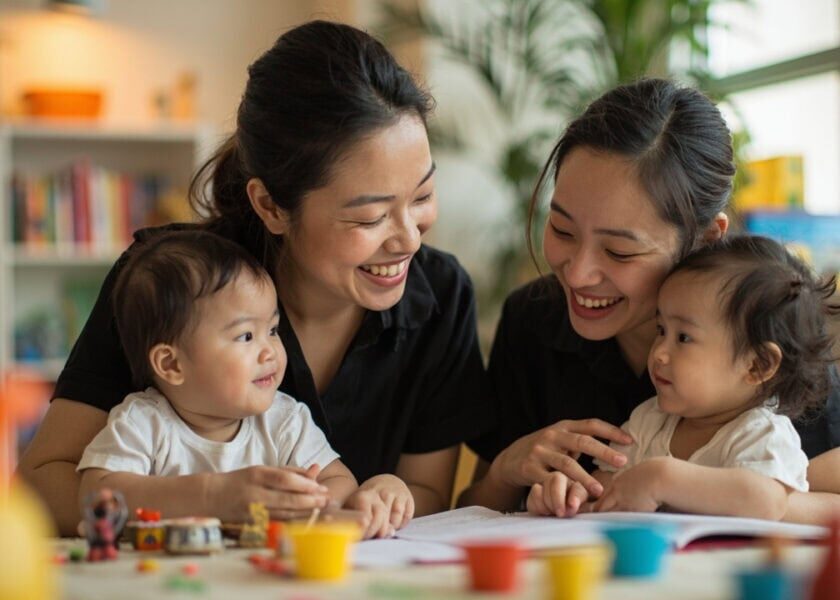
When you bring your child to an EduNanny caregiver, you are entering a partnership. Not a transaction where someone watches your child while you work, but a collaboration in your child’s emotional and social development. The caregiver becomes part of your child’s relational world — a world you are still very much present in, still very much shaping.
Ratios That Prioritize Connection
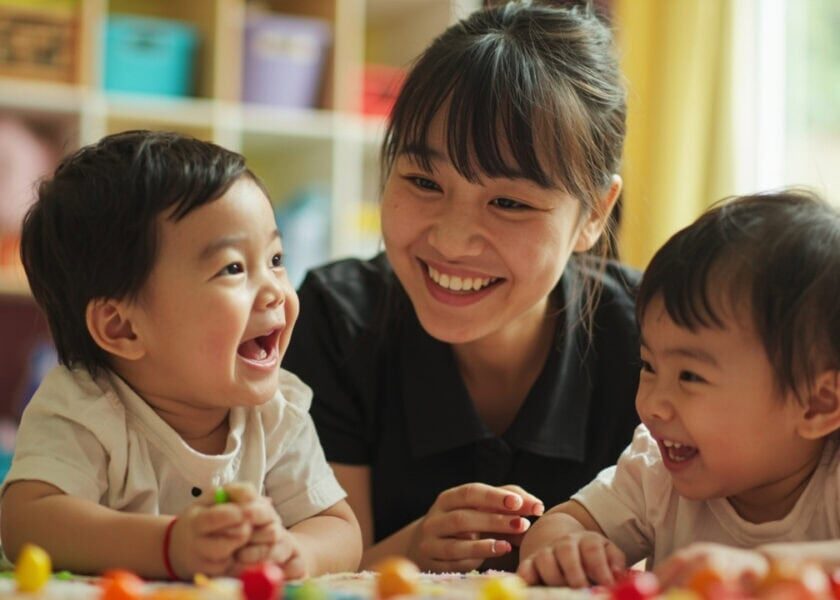
EduNanny maintains ratios that prioritize connection. With up to three infants for every caregiver in certain configurations, there is space for the kind of attunement we have been discussing — the reading of cues, the building of trust cycles, the quiet presence that makes a child feel truly seen. These ratios are not administrative conveniences. They are relational necessities.
Communication as Practice
Transparency is not a policy box to check. It is a practice. When parents understand what their child experienced during the day — not just the meals and the naps, but the moments of connection, the small social victories, the emotional texture of the hours spent apart — they can extend and reinforce those experiences at home.
They can ask the right questions. They can celebrate what happened. They can weave the childcare experience into the ongoing story of their child’s relational development rather than treating it as a separate chapter.
Technology in Service of Connection
The Thomas AI Chatbot represents a commitment to using technology in service of connection, not as a substitute for it. When parents can access information, ask questions, and stay engaged with their child’s day through thoughtful digital tools, the gap between home and childcare narrows. Communication becomes easier. Partnership becomes more real.
Signs Your Child Is Developing Well — and How to Choose Quality Care
You may be wondering, as a parent: how do I know if my child is developing these relational skills in their childcare setting? How do I read the signs? And if I am still evaluating options, what should I be looking for?
Signs to Watch For
- Recognition at arrival: Watch for how your child responds to their caregiver at the beginning of the day. Is there recognition? Warmth? A willingness to move toward rather than away? These are signs that a secure relational foundation has been established.
- How separation unfolds: Watch for how your child handles separation. Not the absence of any protest — some protest is developmentally normal — but whether the protest subsides into engagement, whether your child can be comforted, whether they can eventually settle into the care environment with trust.
- Social behavior elsewhere: Watch for social behavior in other settings. Is your child beginning to initiate with other children? To notice other people’s emotions? To show curiosity about relationships and connection? These are the downstream effects of the trust cycles built in quality care.
- Relational narratives: Watch for how your child talks about their day. Not just what happened, but how it felt. Children as young as two begin to have relational narratives — stories about who was kind to them, who they played with, who made them feel happy or safe. The richness and emotional accuracy of these narratives tells you something important about the relational environment your child is inhabiting.
- The bond with you remains strong: Watch, most importantly, for how your child returns to you. Does the bond you share remain strong? Does your child seek you out for comfort and connection at the end of the day? Does the presence of another caring adult in their life enhance rather than diminish the security they feel with you?
A child who can attach securely to a caregiver while remaining securely attached to their parents is a child whose relational world is expanding in a healthy way.
Questions to Ask a Potential Caregiver
- How do you respond when a child is struggling emotionally?
- How do you support a child who is hesitant to join group activities?
- What does a typical day look like in terms of caregiver-child interaction?
- How do you communicate with parents about their child’s emotional experiences?
- What training have you had in child development and attachment?
What to Observe During Visits
- Do caregivers get down to the child’s level when speaking with them?
- Do children seem at ease in the environment, or is there widespread distress?
- How do caregivers respond to children who are upset?
- Is there a sense of warmth and unhurried attention, or rushed efficiency?
- Do children show recognition of and affection toward their caregivers?
Addressing the Concerns You May Have
“Am I failing my child by returning to work?”
You are not failing your child by returning to work. You are not choosing career over connection. You are doing what millions of parents have done and will continue to do — finding a way to provide for your family while trusting that your love and your presence, even within the constraints of professional life, are enough.
But you are also making a choice — whether you realize it consciously or not — about the kind of care that will hold your child during the hours you are apart. And that choice matters. Not because your child’s wellbeing will be destroyed by an imperfect arrangement, but because the right arrangement can actively enhance what you are already giving your child at home.
“How will this affect my child’s long-term development?”
The relational skills your child develops in quality childcare — trust, social confidence, emotional regulation, the ability to connect with adults outside the family — these are not soft outcomes. They are the hard competencies that will determine how your child navigates school, friendships, challenges, and eventually their own adult relationships.
Research consistently shows that children who develop secure attachments in their early years — including attachments formed with non-parental caregivers — demonstrate better emotional regulation, stronger peer relationships, greater academic engagement, and higher self-esteem throughout their lives.
The connection skills built in quality childcare become the foundation for:
- Confidence in the classroom: Children who feel secure exploring relationships are better equipped to engage with learning.
- Empathy on the playground: Social confidence enables children to navigate friendships with warmth rather than anxiety.
- Resilience when things get hard: Securely attached children have internal resources to draw upon during challenges.
- Relational fluency for life: The ability to build and sustain meaningful connections becomes a lifelong asset.
The First Goodbye
The first time you hand your child to their EduNanny caregiver and see a genuine smile of recognition exchanged between them, you will know something important.
You will know that your child is in a place where they will be seen. Where they will be met with attunement and warmth. Where someone will read their cues, celebrate their discoveries, and build with them the relational skills that will shape everything that comes after.
That is not a compromise. That is a gift you are giving your child — the gift of a wider, more trusting, more connected world.
Caregivers at EduNanny understand that their role is not to replace you but to complement you. They see their bond with your child not as competition for your child’s affection but as an extension of the emotional security you are building together.
Monday to Friday care blocks provide the consistency that relational development requires. Children need repetition, predictability, the accumulated trust that comes from knowing that the same caring person will be there tomorrow and the day after.
And it is a gift you are giving yourself — the gift of returning to work with confidence, of knowing that the hours apart are not a loss but a collaboration, of trusting that the question you carry in that moment of goodbye has been answered with truth.
Your child will not only be safe.
Your child will be seen.
If you are considering childcare options in Singapore and would like to learn more about EduNanny’s approach to relational, development-focused care, we invite you to connect with our team.
Learn more about EduNanny Singapore · About our approach
“`