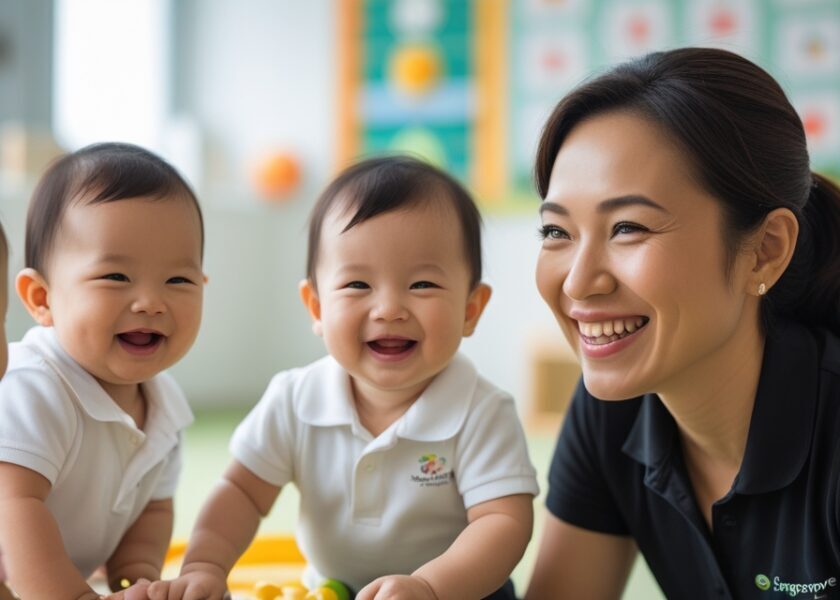
The Compounding Power of Your Child’s First Five Years
The Architecture Being Built Right Now
Let us start inside your child’s brain, because what is happening there is extraordinary—and Singapore parents deserve to know what the research actually says. Not in clinical terms, but in the language that matters to you: the language of your child, your family, your daily decisions about who will care for your little one while you work.
In the first years of life, your child’s brain is forming connections at a rate that will never be repeated. One million neural connections per second. That is not a metaphor. That is a measurement from decades of developmental neuroscience.
By the time your child turns three, their brain will have formed more connections than it will ever keep—more than it needs. The brain is building voraciously, laying down pathways and circuits with extraordinary speed, because these early years are not merely a period of growth. They are a period of construction.
The brain is building its own architecture, and the architect is not genes alone. The architect is experience.
This finding comes from decades of research—from the Harvard Center on the Developing Child, from the National Institute of Child Health and Human Development, from longitudinal studies tracked across decades and across countries. Singapore’s own A*STAR research on early childhood neurodevelopment has contributed to this understanding as well. What these institutions agree on is this: the relationships and environments a child experiences in the first five years do not merely influence development. They shape it.
Neural Pruning: How Experience Shapes the Brain
To understand how this works, you need to know about neural pruning. Think of it this way: the brain builds far more connections than it will ultimately need, and then it trims away the ones that are not used. The connections that fire together, wire together. The ones that do not fire—that are not reinforced through experience—gradually weaken and disappear.
This is not a passive process. It is shaped, moment by moment and day by day, by what your child experiences in the world you and their caregivers create around them.
Here is what this means in practice. A child who experiences warm, responsive care—who is soothed when distressed, who has their needs met with consistency, who hears language spoken to them and with them—that child’s brain is building and reinforcing the neural circuits for emotional regulation, for language, for trust, for the complex social intelligence that will make them a capable and confident human being.
The circuits that are used grow stronger. The ones that are not used are pruned away. This is why quality matters neurologically, not just emotionally.
Attachment: A Biological System, Not Sentiment
There is a second biological system at work here that deserves its own attention, because it is one of the most profound findings in developmental science. That is attachment—not as a sentimental idea, but as a biological system that shapes the architecture of your child’s brain in ways that persist long into adulthood.
Attachment begins at birth. It is not a feeling. It is a system—a finely tuned biological mechanism that evolved to keep children close to their caregivers so they could survive long enough to grow.
When a caregiver is consistently responsive to a child’s signals—the cry, the reach, the smile, the need—the child develops something called a secure base. This is not a metaphor for emotional closeness. It is a description of a neural and hormonal architecture that forms in the brain’s limbic system and prefrontal cortex—the regions responsible for emotional regulation, for managing stress, for delay of gratification, for the capacity to be soothed and to soothe others.
When a child has a secure base—when they know, at a deep biological level, that their caregiver is reliable, that they will return, that they are safe—that child can explore the world from a position of confidence. They can venture further, cognitively and physically. They can take in new information, engage with new people, manage the inevitable frustrations of childhood and learning, because their nervous system has been calibrated by thousands of consistent, responsive experiences that say: the world is safe enough. People can be trusted. I am capable.
The stress hormone cortisol, when managed properly in early childhood through secure attachment, does not damage the developing hippocampus the way chronic, unmitigated stress can. Children with secure attachments show measurably different brain development in the regions responsible for emotional intelligence and executive function—the skills we associate with resilience, with learning, with getting along with others.
For Singapore parents, this finding has a direct and practical implication. When you choose a childcare arrangement, you are not choosing between logistical options. You are choosing which biological system your child’s developing brain is being shaped by.
You are choosing whether the caregiver your child spends thousands of hours with in these critical years is someone who builds that secure base—someone whose consistent warmth and responsiveness is quietly and invisibly shaping your child’s capacity to trust, to regulate, to learn, to be apart from you and return to you with confidence.
This is the invisible curriculum, and it is being taught in every single interaction—or not.
Why Early Investment Compounds
This brings us to the third idea that changes everything: this is not an investment that stops paying returns when your child turns five. This is compounding work.
In finance, compounding means that returns on early investment build on themselves over time. The same principle operates in early brain development. The neural architecture built in the first thousand days creates the scaffolding for increasingly complex abilities.
- Language builds on the neural pathways laid down by early responsive interaction.
- Social-emotional intelligence builds on the secure base.
- Executive function—the ability to focus, to plan, to manage impulses—builds on the early development of the prefrontal cortex, which happens most rapidly in the first three years.
The research from longitudinal childhood studies is consistent across countries: children who experience quality early care show measurable advantages not only in the early years but in primary school—in language development, in social-emotional competence, in readiness to learn, in the ability to manage frustration and persist with challenging tasks.
- A child who builds strong neural architecture for emotional regulation in their first two years has a better foundation for attention and focus at age six.
- A child who builds secure attachment in the first three years has a better foundation for the complex social environments of primary school.
- A child who has been surrounded by rich language in infancy has neural pathways ready for the literacy demands of school.
The investment is not consumed. It compounds. For Singapore parents, this is perhaps the most clarifying reframe available. The question is not whether you can afford quality early care. The question is whether you can afford not to invest in it, given what you now know about what is being built during these years.
What You Are Actually Purchasing
And here is where we come to the decision itself—because knowing what is being built changes how you choose.
What are you actually purchasing when you choose quality early care?
You are not purchasing supervision. Supervision is what a CCTV camera does. What you are purchasing is the quality of the responsive interactions your child will experience—whether the caregiver is warm, whether they are consistent, whether they narrate your child’s world and validate their feelings and create the kind of predictable, safe emotional environment in which the brain builds well.
You are purchasing whether your child’s developing brain is being shaped by a caregiver who understands that:
- Every soothe is building a neural circuit for calm.
- Every language-rich conversation is building pathways for language and thought.
- Every consistent, loving response to your child’s needs is building a secure base that will carry them through decades of life.
You are purchasing whether your child is in an environment where they are truly known—where the person caring for them understands their rhythms, their preferences, their particular way of expressing need.
This is not an abstract ideal. This is a practical standard by which to evaluate any care arrangement, whether home-based or centre-based.
How to Recognise Quality Care
When you are evaluating childcare options, it can be difficult to know what to look for. The invisible work of early development is, by definition, hard to see. But there are observable indicators that tell you whether the invisible work is happening.
Signs of quality to look for
- Responsive interaction: Caregivers who respond to children’s cues promptly and warmly—not just when convenient, but consistently. Watch for eye contact, gentle physical comfort, and the way a caregiver speaks to a child who is upset.
- Language-rich environments: Caregivers who narrate what is happening, who name objects and feelings, who engage children in back-and-forth interaction rather than just directing them. In Singapore, this looks like caregivers who speak to your child in the languages your family uses at home.
- Consistency of relationship: Your child is known. The caregiver can tell you about your child’s particular temperament, favourite songs, current phase, the way they show when they are tired or hungry. This depth of knowledge does not happen in settings with high turnover or very large ratios.
- Predictable rhythm: Young children thrive with predictable daily routines. A quality caregiver understands that routine is not about control—it is about giving the developing brain the stability it needs to build safely.
- Calm in distress: Watch how caregivers handle a fussy or upset child. The ideal response is calm, warm, and prompt—not dismissive, not frantic, but genuinely soothing.
- Respect for the child’s pace: Quality care respects that every child is different. There is no pressure to conform to a group pace. Each child’s individual needs are accommodated.
Questions to ask any childcare provider
- How many children are in my child’s direct care at any one time?
- Will the same caregiver care for my child most days?
- What training have your caregivers received in child development?
- How do you communicate with parents about their child’s day and development?
- How do you handle a child who is upset or in distress?
- What does a typical day look like for a child in your care?
The answers to these questions will tell you whether the biological systems we have discussed—neural development, attachment, secure base formation—are being supported. These are not soft considerations. They are the architecture your child’s brain is building right now.
EduNanny: Built Around the Science
EduNanny Singapore, a service under the established name of BUTLER, was built with a different understanding. They are not simply offering childcare as a logistical solution. They are operating within the ECDA Childminding Pilot—a framework built on the understanding that quality early care is developmental, not merely supervisory.
Their approach reflects the science we have been discussing: the ratios, the training, the consistency of caregiver relationships, the warmth and intentionality of every interaction.
With up to one to three infants in EduNanny’s care, each child receives a quality of attention that larger settings cannot match. That ratio is not arbitrary. It is the ratio at which a caregiver can truly know each child—can notice the early signs of distress before they escalate, can respond with the warmth that builds a secure base, can engage in the language-rich interaction that builds neural pathways for language and thought.
One caregiver, a small number of children, every day. That is the architecture of responsive care in practice.
The philosophy behind the practice
But the most important thing EduNanny offers is not a feature. It is a philosophy.
Their caregivers are not simply filling a childcare role. They are trained to understand what they are doing—to know that when they respond to a fussy infant with calm warmth, they are not just soothing a cry. They are building a circuit in that child’s brain for emotional regulation.
When they narrate what a toddler is doing—”You are stacking the blocks. That is a tall tower!”—they are not just keeping the child entertained. They are building language pathways.
When they create the predictable daily rhythm that young children need, they are not just maintaining a routine. They are giving the developing brain the stability it requires to build safely.
EduNanny offers both home-based pathways—where a trained caregiver comes to your family—and centre-based options. Both are designed to meet families where they are, and both operate within the same evidence-based understanding of what quality early care does.
The pilot fee structures are designed with accessibility in mind. EduNanny works with CDA and Baby Bonus, making quality care not just a premium option but a realistic one for Singapore families across the island.
Addressing What Parents Really Worry About
“Will my child feel abandoned when I leave?”
Some separation anxiety is a normal and healthy part of development—it actually indicates that your child has formed a secure attachment with you. What matters is how the transition is handled and whether the alternative caregiver is warm and consistent.
In quality care, your child may protest briefly when you leave. But a warm, responsive caregiver will soothe them—and over days and weeks, your child will learn that you always return, and that this other person is safe too. This is exactly what secure attachment looks like in practice. It is not the absence of separation. It is the confidence to separate and reconnect.
“Is home-based care really as good as centre-based?”
The research does not support a simple answer to this question. What matters is not the setting but the quality of care within the setting. Small ratios, warm and trained caregivers, consistency, and language-rich interaction matter more than whether care happens in a home or a centre.
For infants and toddlers under two, the quality of individual attention is generally considered the more important factor—which is why small ratios matter so much.
“I feel guilty about going back to work. Does this harm my child?”
This question carries so much weight, and parents deserve a compassionate, evidence-based answer.
Quality matters more than quantity of time. What research consistently shows is that children thrive when they have at least one warm, responsive, consistent caregiver—and this can absolutely include grandparents, domestic helpers, or trained childcare providers, in addition to parents.
What does not serve children well is chaotic, unpredictable, or emotionally unavailable care—not because parents chose to work, but because the care itself was not meeting the child’s developmental needs. If the care arrangement you have chosen involves warm, responsive, consistent caregivers who understand what they are building, you are not harming your child. You are providing what they need.
The guilt you feel is often a sign of love, not failure. And the solution to that guilt is not to stay home if that is not right for your family—it is to choose the care arrangement that best supports your child’s development while you work.
“How do I know if the care is really good?”
Trust your observations. Does your child seem happy to see the caregiver? Do they show signs of a secure base—comfortable exploring the environment, able to be soothed when upset? Does the caregiver speak warmly and responsively to your child? Can they tell you something specific and personal about your child’s day?
These are the observable signs of the invisible work happening in your child’s brain.
What You Are Building
Here is what we want to leave you with, because this is the arc of everything we have covered.
You came in with a quiet question: Am I spending money on childcare, or am I investing in something much larger?
The science answers that question with remarkable clarity.
In the first five years, your child’s brain is building its architecture at a speed that will never be repeated. Every responsive interaction, every consistent act of care, every warm and timely response to your child’s needs is doing invisible neurological work.
It is building the circuits for emotional regulation.
It is building the secure base that makes exploration possible.
It is building the neural scaffolding that will carry your child through every year that follows—through primary school and friendships and disappointments and achievements and the long, complex work of becoming a capable, confident human being.
The quality of early care is not a soft consideration. It is a neurological one.
The caregiver who holds your infant is not just providing supervision. They are participating in the most important developmental work that will ever happen in your child’s life. The environment your child is in is not just a place they go while you work. It is the world that is shaping their brain’s architecture, one interaction at a time.
This knowledge does not create guilt. It creates clarity.
Because when you understand what is being built, the decision about childcare stops being about whether you can afford quality care and starts being about whether you understand what you are choosing for your child.
And once you understand that, the choice becomes not just affordable but urgent—not in a stressful way, but in the way that matters. The way that says: this is the foundation. I will build it well.
EduNanny Singapore was built for this moment—not the logistical moment of finding someone to watch your child, but the developmental one. They understand what early care does. They have built their approach around it. And they are here for every Singapore family who, having asked that quiet question and received an honest answer, chooses to invest in what matters most.
In the first five years, your child is building something extraordinary. They do not know it yet.
But you do now. And that understanding changes everything about how you choose, and why.
Ready to explore what quality early care looks like for your family? Connect with EduNanny Singapore to learn more about their home-based and centre-based options, or visit the ECDA Childminding Pilot page for details on their developmental approach.