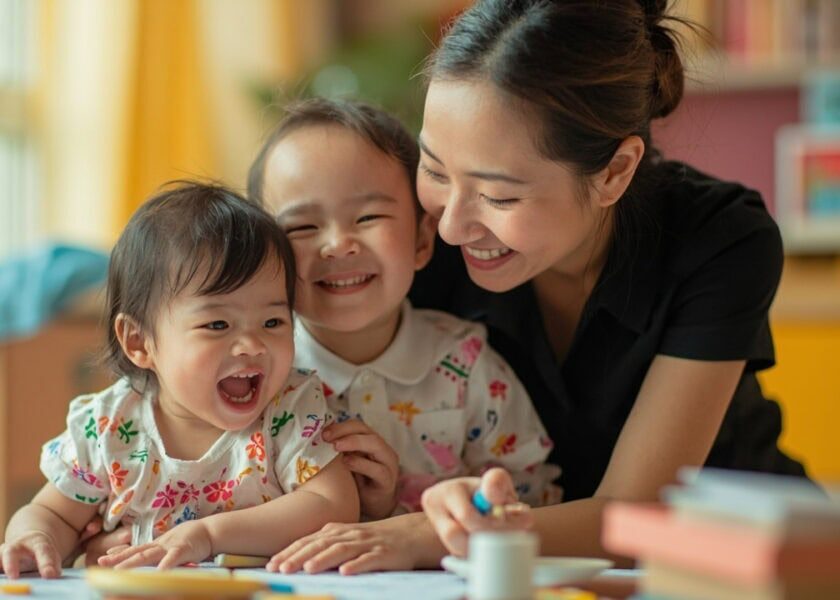
What Your Child Is Becoming: Understanding Early Development as a Singapore Parent
What Your Child Is Becoming: The Science of Early Development
When a child spends their early years in quality childcare, something remarkable happens every single day.
Their brain is building itself at a pace it will never again reach. Connections are forming between neurons at a rate that neuroscience has documented extensively across decades of research. Language is being absorbed—not just in explicit lessons, but in every conversation, every song, every moment of being spoken to with attention and warmth. Social intelligence is developing through daily interaction with peers and educators. Motor skills are refining through the simple, repeated act of reaching, grasping, crawling, walking, climbing. Emotional regulation is being learned through the experience of feeling big feelings and being met with calm, consistent responses.
This is not metaphor. It is developmental science, and it tells us that the early years are not simply a waiting period before “real life” begins. They are real life. They are the foundation upon which everything else is built.
Every day that your child spends in quality care, something meaningful is happening inside them. Growth is occurring—not just physical growth, though that is real too, but cognitive, emotional, social, and relational growth. The child who left you this morning is not the same child who will come home to you tonight.
This is not a burden to place upon you. It is an invitation—an invitation to notice, to become a student of your own child’s development, to move beyond the question “Was my child okay today?” to the richer question: What is my child becoming, and how can I understand and support that becoming?
The Four Domains of Growth: What Parents Need to Understand
Developmental growth in the early years does not happen in a single, undifferentiated stream. Researchers and educators have identified distinct domains that, while deeply interconnected, offer useful frameworks for understanding what your child is working on. You do not need a degree in child development to recognise these domains in your own child. You need willingness to pay attention.
Cognitive Development
In the cognitive domain, you are looking for signs of thinking that is becoming more complex:
- Object permanence—the understanding that things exist even when they cannot be seen. You hide a toy under a blanket and your baby searches for it. This represents a significant cognitive leap.
- Symbolic play—when your toddler takes a block and calls it a phone, or feeds a doll as if it were real. This is the beginning of abstract thinking.
- Problem-solving—your child is beginning to solve simple problems through trial and error, building the capacity for persistence that will serve them for a lifetime.
- Curiosity and questioning—the “why” phase is not just adorable; it is cognitive development at its most active. A child who asks constant questions is building their understanding of how the world works.
Language Development
In the language domain, you are looking for the progression from sounds to words to sentences to conversation. But you are also looking for the things that are harder to measure:
- Does your child seem to understand more than they can express?
- Are they beginning to follow two-step instructions?
- Do they use language to connect with you—not just to request things, but to share experiences?
- Do they show interest in books, in being read to, in the texture of language itself?
Language development in the early years is not about producing prodigies. It is about the emergence of communication as a tool for relationship.
Social-Emotional Development
In the social-emotional domain, you are looking for the foundations of human connection:
- Does your child show preference for certain people?
- Are they beginning to show awareness of others’ emotions?
- Do they develop the capacity to self-soothe, with support?
- Are they beginning to show empathy, even in its earliest and simplest forms?
- Are they developing a sense of security that allows them to explore, knowing they can return to a secure base?
Motor Development
In the motor domain, you are looking for the refinement of both gross and fine motor skills:
- Gross motor skills—large movements like crawling, walking, climbing, running
- Fine motor skills—smaller movements like picking up small objects, manipulating tools like crayons, spoons, and eventually pencils
You are also looking for the integration of motor and cognitive development—when your child begins to use their body to solve problems, to experiment, to learn about the physical world through movement.
Reading Your Child: Observation as an Act of Love
Here is where many parents feel stuck. They know, intellectually, that development is happening. But they do not always have a framework for seeing it, or for understanding what they are looking at when they observe their child in those precious hours between pickup and bedtime.
The transition moments offer more information than you might expect. How does your child respond when you arrive? Is there ease, or reluctance? Does your child initiate connection immediately, or need a moment to transition back to you? These are not problems to solve. They are information. They are your child’s way of telling you something about how they experienced the day.
Then there is what happens in the hours between pickup and bedtime. The dinner table conversation that is not really a conversation yet but is something—the way your toddler hands you a book with complete intention, the new sound they make when playing, the way they handle frustration differently than they did a month ago. These moments are data. They are evidence of the learning that occurred while you were apart.
A Framework for Observation
Observation, in this context, is not about clinical assessment or hypervigilant monitoring. It is about cultivating a quality of attention—slowing down enough in those after-care hours to actually see your child.
Ask yourself:
- What is my child gravitating toward? What toys, activities, or books capture their interest?
- How does my child approach challenges? With frustration? With persistence? With curiosity?
- What is my child trying to communicate, even before they have words?
- What seems easier for my child now than it was a month ago?
- What seems harder? Where do they need more support?
Trust that noticing. You know your child better than anyone. When you observe carefully and reflect on what you see, you are building understanding that no external assessment can replace.
One Truth Worth Holding Gently
Children develop on their own timelines. This is not a platitude; it is a developmental reality. One child will walk at ten months. Another will not walk until fifteen months. Both are within the range of typical development. One child will speak their first words at nine months. Another will not speak until after their first birthday. Both are fine.
The danger comes when we begin to compare—to measure our own child against other children, against averages, against expectations that do not account for the beautiful individuality of each human being.
Your child’s development is a story that is being written in real time. It has its own plot, its own rhythm, its own arc. Your job is not to accelerate that story or to compare it to other stories. Your job is to understand it, to witness it, and to support it.
Extending Your Child’s Development at Home
Understanding your child’s development is valuable in itself. But it becomes even more powerful when you can extend that development in your home environment—when the learning that happens in childcare can be continued, reinforced, and built upon in the hours you share together.
This does not require elaborate activities or expensive materials. It requires intention and presence.
If your child spent the day working on stacking blocks at childcare: consider providing opportunities at home to continue that exploration. Stack containers in the kitchen. Build with cardboard boxes. Find age-appropriate toys that extend the same spatial reasoning skills.
If they were engaged in sensory play: find safe ways to bring sensory exploration into your home environment. Water play in the basin. Playdough (even a simple homemade version). Rice or sand in a tray.
If they are developing language: narrate your daily life together. “I am washing the vegetables. I am cutting the carrot into pieces. Now I am putting the pieces into the pot.” This narration is not just filling silence. It is building language, concept by concept.
If they are developing independence: create space for them to practise. Let them try putting on their own shoes, even if it takes longer. Let them help carry small items. Praise the effort, not just the outcome.
These domains do not develop in isolation, of course. A child’s cognitive development affects their social-emotional development. Their motor skills open up new possibilities for exploration and learning. Language becomes the tool through which all other development is expressed and extended. Understanding this interconnection is part of understanding your child as a whole person—not a collection of milestones to be checked off.
The Partnership Between Parent and Childcare Provider
This is where the partnership between parent and childcare provider becomes essential—not as a marketing phrase, but as a living practice.
EduNanny was built on a particular belief, one we want to share with you plainly. We believe that parents are not passive recipients of childcare services. They are the primary architects of their child’s development, and our role is to support, inform, and empower that architecture.
This means that we are invested in your understanding as much as we are invested in your child’s care. Our job is not complete when we hand your child back to you at the end of the day. Our job is complete when you feel you understand your child’s day, when you have insight into what is developing, and when you know how to extend that development in your home environment.
This philosophy shapes everything about how EduNanny operates within the ECDA Childminding Pilot. We have chosen a model with ratios that allow for genuine attention—one educator for every three infants in our care. This is not a regulatory minimum; it is a design choice. It means more observation. More individual interaction. More capacity to notice and document the small moments of growth that might otherwise be missed.
Questions That Reveal a Genuine Partnership
Not all childcare providers offer this kind of communication. If you are evaluating options, here are the questions that reveal whether a provider is genuinely invested in keeping you informed:
- What did my child seem most engaged with today?
- What is my child curious about right now?
- What seems to challenge my child?
- How is my child relating to other children in the group?
- What new skill did my child attempt?
- How did my child respond to challenges or big feelings today?
- What can I do at home to support what my child is working on?
These are not intrusive questions. They are the questions of a parent who wants to understand. The right childcare partner will welcome them.
Addressing Common Concerns
“Will my child form a secure attachment if they spend their early years in childcare?”
Attachment is not a finite resource that gets divided. Children can form multiple secure attachments. They can have you at the centre of their relational world and still develop warm, supportive, nurturing relationships with skilled educators who see them, respond to them, and support their growth. This is not a threat to your role as parent. It is an enrichment of your child’s life.
“How do I know if my child is actually learning, not just being babysat?”
The question to ask is not whether your child is okay, but what they are learning. In quality care, the answer to “what did my child learn today” is always yes. Your child is always learning. The question is whether the programme creates the conditions for that learning to be visible, documented, and communicated to you.
“I feel guilty about leaving my child. Is that normal?”
It is entirely normal. It also does not need to define your experience. The love you have for your child and the desire to be present with them are beautiful things. When channelled into intentional engagement—asking questions, observing carefully, extending development at home, communicating with educators—that love becomes a powerful force for your child’s growth.
What EduNanny Offers Within the ECDA Childminding Pilot
We want to be direct about what we offer, because Singapore parents deserve clarity when making decisions about their children’s care.
Within the ECDA Childminding Pilot, EduNanny provides:
- Small group ratios—one educator for every three infants, allowing for genuine individualised attention
- Intentional observation and documentation—so that we can share meaningful insights with you about your child’s day
- Communication rhythms—designed to go beyond daily logistics into the substance of your child’s development
- Monday through Friday care blocks—structured around the realities of Singapore family life
- Flexible payment options—including CDA and Baby Bonus usability
- Home-based pathways—for families who prefer that arrangement
- Transparent operations—including transparency measures that provide additional assurance to parents
We are not a service that simply watches your child while you work. We know that many childcare providers can offer that. What we offer is something different: a genuine investment in your child’s development, and an investment in your capacity to understand and support that development.
Your Role in Your Child’s Development: Moving Forward
As you understand more about attachment and development, you can bring that understanding home. You can be intentional about the quality of presence you offer your child in the hours you have together. You can notice when your child needs connection and when they need space. You can learn to read their cues, to understand their temperament, to see them as the unique individual they are rather than as a generic “child” whose development should follow a universal template.
This is what it means to know your child. Not just to love them, though of course you love them—that goes without saying. But to truly understand them. To have insight into why they respond the way they do, what they need, what they are working on, what they are afraid of, what excites them, what makes them feel safe.
This kind of understanding does not come all at once. It comes through patient, ongoing attention. It comes through the accumulation of small observations over time. It comes through conversations with people who also know your child—who see them in different contexts, who have different windows into who they are becoming.
And this is the gift of the partnership we are offering. It is not that we will tell you everything—there is no childcare provider who can do that, because no one knows your child the way you do. But we can offer you pieces of the puzzle. We can help you see your child from another angle. We can support your understanding of what is happening in those hours when you are apart, so that when you come back together, you can meet your child where they are.
There is a word that captures what this is all about: attachment. In the context of early development, attachment is not a soft concept. It is a biological imperative. Children are wired for attachment. Their brains develop in response to the quality of their attachments. The security they feel—or do not feel—in their earliest relationships shapes the architecture of their minds in profound and lasting ways.
This is why the quality of your child’s relationships in childcare settings matters so much. Not because educators can replace parents—they cannot, and should not—but because children can form multiple secure attachments, and the experiences they have in quality care contribute to the people they are becoming.
The child who went to childcare this morning is changed. They are different in some small way than they were when they left your arms. They have learned something. They have grown. They have taken one more step along the path of becoming whoever they are going to be.
Your job, and ours, is to understand that path. To see it clearly. To support it well.
If you are looking for a childcare partner who sees parents as the primary architects of their child’s development—someone who will not just keep your child safe, but will actively invest in your understanding of what is happening and how you can extend it—EduNanny would welcome a conversation with you.
Tags: #SingaporeChildcare #InfantCareSG #ChildmindingSingapore #EarlyChildhoodDevelopment #EduNannySG #ECDAChildmindingPilot #SingaporeParents #ChildDevelopment #QualityChildcare #ParentingInSingapore