Beyond the Grandparents: How Singapore Parents Are Building Villages That Actually Work
Singapore Parents and the Quiet Exhaustion Nobody Names
There is a particular kind of tiredness that settles into Singapore parents that no one quite names. It is not the tiredness of sleepless nights, though that is real. It is not the fatigue of juggling work and parenting, though that is constant.
It is the exhaustion of doing something enormous—raising a child, building a person—while feeling, despite the presence of grandparents, extended family, and an entire household living under one roof, profoundly alone in the decisions that matter most.
You have held your child’s hand in the morning, kissed their forehead, and handed them to someone you trust. And then you have spent the rest of the day carrying a second weight: the mental load of wondering whether the afternoon will go well, whether the feeding schedule will be kept, whether the philosophy you are trying to nurture at home will be honored in your absence.
You have navigated conversations with grandparents who want to help but whose instincts, shaped by a different era, sometimes pull in directions you are not sure about. You have wondered whether accepting help means sacrificing consistency. You have wondered whether insisting on consistency means rejecting love.
This is the quiet tension that many Singapore families carry. And it is time we named it plainly—not to deepen your worry, but to point toward something different. Something that works.
The Village Is Not Found. It Is Built.
For generations, the village was supposed to be simple. Grandparents nearby. Extended family in the same town. A natural, organic web of care that raised children as a collective project.
For many families in Singapore, this village still exists in a physical sense—grandparents living down the hall or across the estate, cousins at the same hawker centre, relatives who show up with soup and unsolicited advice in equal measure. The architecture of the village is there.
But the village itself, the living, breathing, consistent village that a child can trust and grow within, requires something more than proximity. It requires intention. It requires design.
The village is not an accident of family structure. It is not a fortunate circumstance that some families have and others do not. The village is built. Deliberately. Carefully. With boundaries, with shared understanding, with a philosophy that holds it together.
The parents who understand this—who step back and ask not just “who will care for my child” but “what kind of environment do I want to build for my child, and who will help me anchor it”—these are the parents who create something remarkable. They create ecosystems of care that last through the toddler years, through the school years, through the moments of challenge and change.
They build something that does not fall apart when one piece shifts, because the pieces are connected by more than obligation. They are connected by purpose.
What This Approach Is—and Is Not
Before we go further, let us be clear about what this is not.
This is not about choosing between family and professional care. It is not about pitting grandparents against caregivers, or dismissing the wisdom of those who raised us in favor of newer methods. There is no single right way that fits every family.
This is about recognizing that professional care and family warmth do not have to be opposing forces. In fact, they become most powerful when they are brought into relationship with each other—when professional standards create a stable foundation that allows family warmth to flourish, rather than compete with it.
Consider a grandmother who wants to be involved. She wants to feed her grandchild, to put the child down for naps, to have those tender hours of connection that she remembers from raising her own children.
But she is also tired. She has her own life, her own health considerations, her own way of doing things that was formed thirty or forty years ago.
When professional care enters the picture—with clear rhythms, consistent practices, transparent communication—it does not replace the grandmother’s role. It defines it. It creates space for the grandmother to be present in the ways that matter most to her: the Sunday lunch, the school pickup, the bedtime story, the spontaneous visit that a child learns to anticipate with joy rather than anxiety because the child knows, deep in their body, that their world is stable.
The professional anchor does not diminish family involvement. It shapes it. It elevates it. It gives each person in the village a clear place to belong.
What a Working Village Actually Looks Like
When the village is built well, it looks like this:
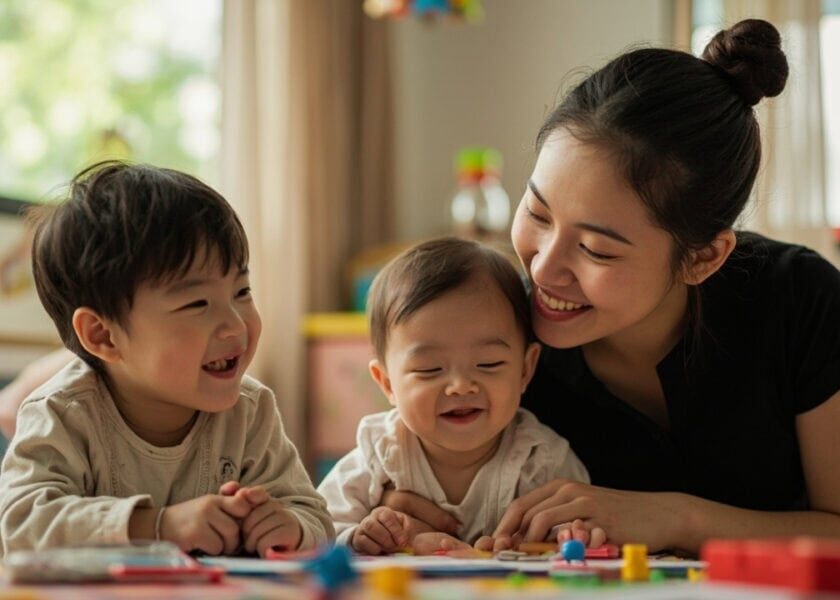
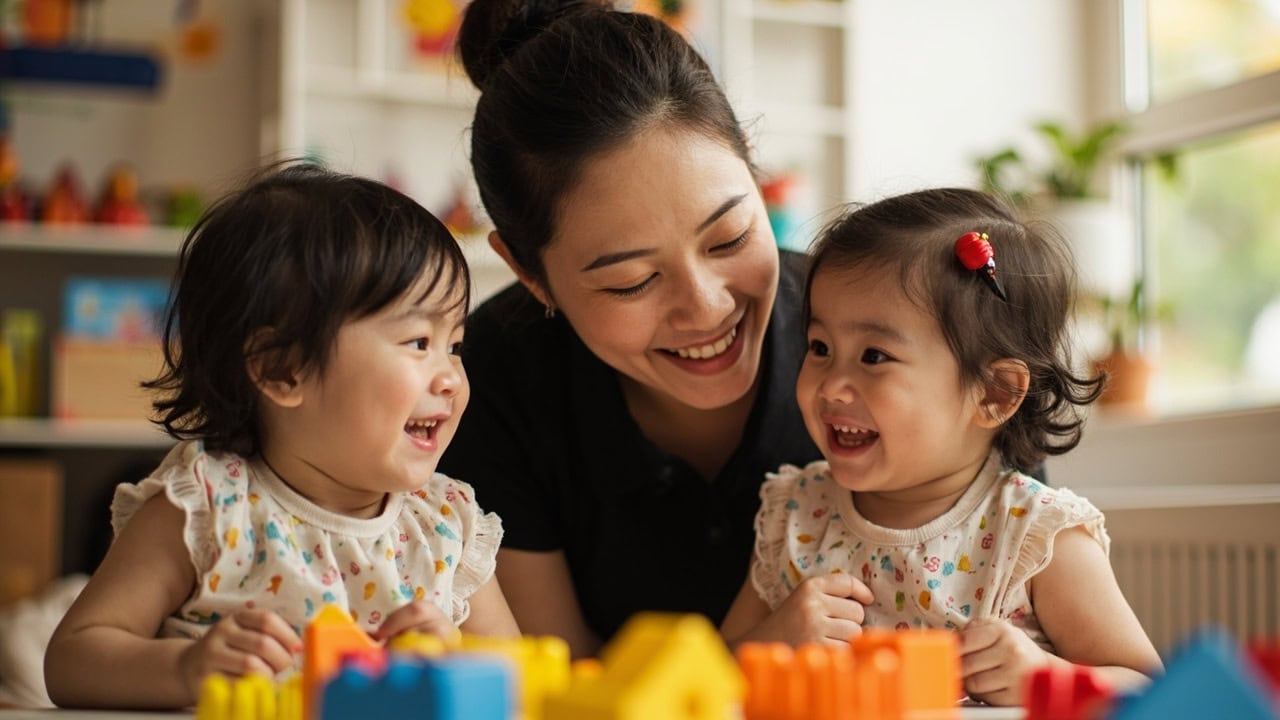
- A Monday morning where your child moves between care environments—the EduNanny caregiver in your home, the grandparents for a special afternoon visit—with a sense of security that does not waver.
- Consistent communication from your caregiver about how your child’s day is going, shared through tools designed for transparency. Notes that build a picture over time, so that you are not piecing together fragments but seeing the whole story of your child’s development.
- A grandmother who, freed from the pressure of being the primary daytime caregiver, can simply be a grandmother. Who arrives on a Wednesday afternoon with kaya toast and stories, and whose relationship with your child is about warmth and presence rather than obligation and exhaustion.
- A grandfather who can take your child to the park and back, confidently, because the rhythms of the day have been set elsewhere, and his role is simply joy.
- You, on a Friday evening, sitting down for dinner with your partner and realizing that you are not carrying the weight alone. That the village you built is holding with you. That the decisions you made have created something sustainable.
Quality Childminding: What It Actually Means
Not all professional care is created equal. When you evaluate an arrangement, it helps to know what quality actually means—not as a checklist, but as a set of principles.
Ratios That Matter
For infant care, the number of caregivers to children matters enormously. Smaller ratios mean your child is known, not just watched. In quality home-based care, up to one caregiver to three infants allows for genuine attention to your child’s rhythms, cues, and emerging personality.
This is not a luxury. In the early years, when your child’s brain is developing at a speed that will never be matched again, the quality of attention shapes the architecture of trust.
Consistency Over Time
Quality is not just about what happens in a single day. It is about whether the same person shows up, whether the same values are upheld, whether the relationship deepens over months rather than resetting every week.
Ask any caregiver or parent: trust is built through repetition. A village that works requires consistency that families can count on.
Communication as Foundation
When you are not in the room, you need to know what is happening—not in intrusive detail, but in enough clarity that your mind can rest. Daily updates, transparent notes, open channels for questions. This is not about surveillance. It is about partnership.
Structure That Creates Freedom
Counterintuitive as it may seem, strong structure gives everyone more freedom. When the rhythms of the day are clear, when the expectations are shared, then grandparents can grandparent without anxiety, parents can work without guilt, and children can explore without fear.
The structure is not a cage. It is scaffolding.
Addressing the Concerns That Are Real
You may have worried about involving grandparents, experienced moments of friction where your approach to feeding or sleep differs from what an older generation expects. You may have worried that accepting professional care means explaining yourself, defending your choices, or creating distance within your own family.
These concerns are not small. They are real. And they deserve a real answer: professional care, done well, does not create distance within families. It creates clarity. When the daytime rhythms and the developmental goals are held by a trained, consistent caregiver, every other person in the family is freed to be themselves.
Grandparents can grandparent. Aunts and uncles can aunt and uncle. The village becomes organized not by obligation or guilt, but by purpose. Each person knows their role. The caregiver holds the structure. The family holds the love.
Your child, at the center of this village, feels all of it—the professionalism and the warmth, the consistency and the chaos, the structure and the laughter. Your child feels held by a system, not just by individuals. And that is the difference between a village that exists and a village that functions.
EduNanny by BUTLER: The Anchor, Not the Whole Village
EduNanny by BUTLER is not simply a service that sends someone to care for your child. It is a partner in ecosystem design. We work within the ECDA Childminding Pilot because we believe in the model that allows professional, home-based care to sit alongside the other elements of your family’s village—grandparents, extended family, community connections, centre-based programs where they serve your family well.
We do not pretend that professional care is the only piece. We know it is one piece in a larger picture. And we have designed our approach to strengthen the whole picture, not to dominate it.
What We Offer
- Home-based care through trained, professional caregivers who understand that they are part of your family ecosystem, not separate from it.
- The structure of the ECDA Childminding Pilot, with its commitment to quality standards, thoughtful ratios, and proper training.
- Fee structures designed for sustainability, because arrangements that families cannot maintain do not build villages.
- Monday to Friday care blocks that give your family the rhythm it needs to plan, to coordinate, to breathe.
- CDA and Baby Bonus support, because the systems Singapore has put in place for families should serve families—and we want to make that easy.
- Regular communication—updates, transparency, a relationship with your caregiver built on mutual respect and shared purpose.
- Thomas AI Chatbot as a resource for the questions that come up between conversations, the small uncertainties you want to address quickly.
These are not features bolted on to impress. These are the elements that a well-designed ecosystem requires. They are practical. They are real. And they are built around a single truth: that your child’s care is not a product to be delivered. It is a relationship to be sustained. It is a village to be tended.
Questions to Ask Before You Choose
When you evaluate a childcare arrangement, ask yourself not just whether the caregiver is kind, not just whether the environment is clean, not just whether your child seems happy in the moment. Ask deeper questions:
- Does this arrangement help me build something—or just fill a gap?
- Does it create space for my family to grow into their roles?
- Will it still serve us in two years, in five years, as my child changes and my family’s needs change?
- Is this a piece I can trust to anchor my village, or a temporary solution that will require replacing?
- Does the provider see me as a customer to be satisfied or a partner to be equipped?
The Village Is Waiting to Be Built
The village your child grows up in will shape the person they become. Not because of any single caregiver, any single lesson, any single day. But because of the cumulative weight of being held by a system that works.
By people who communicate. By rhythms that do not shatter when one piece is removed. By love that has structure around it, so that it does not have to struggle to find its form.
EduNanny by BUTLER is here to be that anchor for your family. Not the only piece. Not the whole village. But the piece that helps the rest hold together. The piece that brings professional standards and family warmth into the same room and shows you that they were never enemies.
The piece that says: we see what you are trying to build, and we want to help you build it.
If you are ready to move from exhaustion to intention, from proximity to purpose, from hoping the village will work to building one that does—we are here.
This is the invitation. Not to find a caregiver. Not to hire a service. But to design your village. To name what you want it to be. To find the partners who share your vision and will work with you to make it real.
The architecture is waiting. The village is possible. And you are already, without knowing it, the kind of parent who builds things that last.
All that remains is to begin.
EduNanny by BUTLER offers thoughtful, development-oriented childminding grounded in professional standards and family warmth. We invite you to connect with us to explore how we can serve as the anchor in your family’s village.