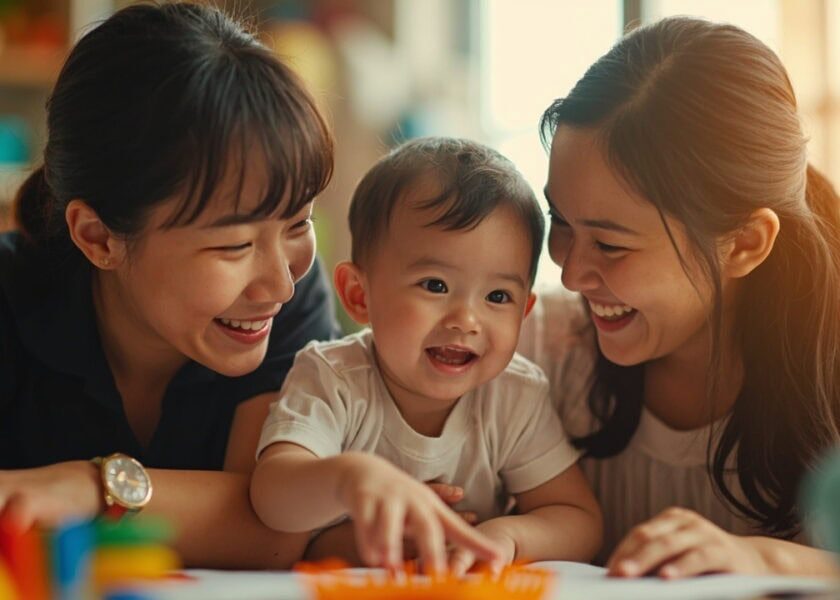
How Singapore Parents Spot Quality Childcare
What Your Child Experiences in Those Hours
You drop your child off at seven forty-five in the morning. The caregiver crouches to your child’s level and says good morning by name. She notices the small wooden truck your child is holding—a new addition to the morning ritual—and she asks about it. She does not ask you. She asks your child.
By speaking directly to your child, acknowledging his object of interest, and inviting him into conversation, the caregiver has done something neurologically significant. She has told your child’s brain: you exist, you matter, your world is worth discussing.
Then watch what happens when your child steps away from you toward the caregiver. There is a moment—sometimes two seconds, sometimes ten—when your child looks back. Not to see if you are leaving. He knows you are leaving. He is checking whether the caregiver noticed him looking.
And if she noticed—if she catches that glance and responds with a small nod, a wave, a steady presence—that glance becomes a bridge. It says: I see you looking. I will hold the space while you go.
This is the beginning of trust, not built on words, but on attention. This is the invisible curriculum of quality childcare. It is not written on any activity plan. It lives in glances like these, in the quality of a caregiver’s presence when no one is demonstrating anything, when no activity is formally underway.
In a quality childcare environment, the morning has a shape. Not a rigid schedule—children do not thrive under tyranny—but a reliable architecture.
There is an arrival routine. A transition into play. A moment when the caregiver gathers the children, not for a formal lesson, but for a breath. A pause. A song, perhaps, or a brief conversation about what the morning will hold.
This architecture matters more than most parents realize. Children, especially in the first three years, are meaning-makers. They are trying to understand the structure of the world. When a child knows that the morning always begins with a greeting, followed by free play, followed by a snack, followed by a group activity, something profound happens in their developing nervous system.
They begin to predict. They begin to anticipate. And anticipation, in a young child’s brain, is the foundation of security.
Security is not the absence of change. A child in quality care learns to navigate transitions because the transitions are reliable. She knows that after snack comes outdoor play, and after outdoor play comes story time. This predictability is not rigidity—it is scaffolding. It is the caregiver building a structure that the child’s mind can hold onto, so that within that structure, she can be free to explore, to experiment, to fail, to try again.
What to Look For
- Clear transitions between activities
- Caregivers using language to narrate what is coming next
- Children who appear oriented rather than lost
- A child who can invest energy in learning, not in worrying
The Invisible Curriculum of Quality
Children in the first three years of life learn through their bodies. They are not abstract thinkers yet. They are sensory creatures.
They learn about texture by touching everything. They learn about space by climbing, by falling and getting up. They learn about causality by making noise, by knocking things over, by watching what happens when they do.
A quality childcare day is rich with sensory and motor opportunity. It is not a day of sitting at tables doing worksheets. It is a day of sand play and water play and climbing and crawling and carrying heavy objects and getting messy and tasting new textures.
The caregiver is not merely supervising these experiences—she is facilitating them. She is noticing when a child is stuck and offering a subtle challenge. She is present when a child is frustrated, not to solve the problem, but to hold the feeling until the child can solve it herself.
In Singapore, this is especially important. Our children grow up in high-rise environments. They have less outdoor space than previous generations. They spend more time in strollers and car seats and inside air-conditioned rooms.
A quality childcare setting must be a counterweight to these constraints. It must be a place where children can move freely, where their bodies are not just contained but engaged, where mess is not a problem to be eliminated but a medium for learning.
What to Watch For
- Are there opportunities for gross motor play every day?
- Is outdoor space used meaningfully, or is it an afterthought?
- Are children allowed to get dirty?
- Are there sensory materials available—water, sand, playdough, natural objects?
Language and Learning in Ordinary Moments
The caregiver sits on the floor with three children. One is stacking blocks. One is pretending to feed a doll. One is watching a gecko on the window. The caregiver is not directing any of this. She is present, but she is not performing.
Then the child stacking blocks knocks over his tower and looks up, surprised by the sound.
“Oh,” the caregiver says. “That made a big sound, didn’t it?”
The child nods.
“What do you think made it fall?”
“Tower fell,” the child says.
“The tower fell because you bumped the table, or because of the way it was balanced? What do you think?”
This exchange lasted perhaps twenty seconds. It may not even have registered as significant. But consider what happened in those twenty seconds:
- The caregiver took a moment of incidental interest—the child’s surprise at his own creation falling—and transformed it into a question.
- She gave him agency. She invited him to theorize, to think, to construct a cause.
- She was not teaching him about gravity. She was teaching him that his observations matter, that his thinking is worth voicing, that an adult will take his ideas seriously.
Researchers call these serve-and-return interactions. The caregiver serves an invitation to engage; the child returns with a response; the caregiver serves again, building on what the child offered. In a quality childcare setting, these exchanges happen not during designated language time—they happen constantly.
- During snack, when the caregiver notices a child’s face and says, “You really liked that. You said mm.”
- During outdoor play, when she narrates what a child is doing back to him: “You’re pulling the wagon up the ramp. It stopped. You pushed harder. Now it’s moving.”
- During a diaper change, when she says, “We’re going to clean your hands now. Can you hold out your hands for me?”
Every one of these exchanges is a deposit in your child’s developing brain.
The reason this matters so much for Singapore parents is this: we live in a society that already values academic achievement highly. The pressure to perform, to accelerate, to prepare for Primary One starts early. But quality childcare understands that the foundation for all future learning is not a workbook. It is the daily accumulation of meaningful interaction—of being seen, heard, and responded to by attentive adults.
How to Read Quality When You Are Not in the Room
You cannot be there. You cannot watch every serve-and-return exchange. You cannot count every moment of attunement. So here is something practical: how you read quality from the outside.
Read the Caregiver’s Face at Pickup
Not the programmed smile. The real one.
- Is the caregiver animated when she describes something your child did?
- Does she volunteer a story without prompting?
- Does she seem genuinely interested in your child’s inner life, or is she performing information-sharing?
A caregiver who is genuinely engaged with your child will have stories—not reports, but stories. She will notice that your daughter has started saying “bought” instead of “got,” and she will find that interesting, not just noteworthy.
Read Your Child’s Behavior After Pickup
Not whether she cries at drop-off—many secure children cry at drop-off because they are transitioning and it is hard, not because they are unhappy.
Read whether she is regulated when you see her:
- Does she seem settled?
- Flat?
- Overwired?
A child who has spent the day in a quality environment will typically be either pleasantly tired or calm, depending on her temperament. A child who has spent the day in mere supervision may be either listless or erratic—not because caregivers were unkind, but because her nervous system was not being regulated by responsive interaction.
Read the Quality of Communication
- Is it specific?
- Does the caregiver tell you that your son spent twenty minutes today trying to fit circles into different-shaped holes, and that he finally succeeded after trying four different holes, and that he looked up at her when he did it?
- Or does the communication say, “Had a good day, did activities”?
Specificity is a proxy for attention. Where attention goes, quality follows.
What Quality Looks Like: A Summary
| Where to Look | What Quality Looks Like |
|---|---|
| The Doorway | Caregiver greets your child by name, speaks to your child, not about your child. Notices your child’s interests. Responds to your child’s glances with presence. |
| The Rhythm | Predictable transitions with caregiver narration. Children appear oriented, not lost. The morning has a shape that children can anticipate. |
| Language | Back-and-forth exchanges in ordinary moments. Caregiver transforms incidents into questions. Your child is invited to think, theorize, and speak. |
| Movement | Daily gross motor play. Outdoor space used meaningfully. Mess is allowed. Sensory materials are available—water, sand, playdough. |
| At Pickup | Caregiver has stories to share, not just reports. Your child is regulated—calm or pleasantly tired. Communication is specific and detailed. |
How EduNanny Supports Your Child’s Development
EduNanny operates as part of the ECDA Childminding Pilot, and this is not a bureaucratic detail. It is a philosophy.
The pilot represents Singapore’s recognition that families need choices—that a one-size-fits-all approach to childcare does not serve the diversity of how Singaporeans live and raise their children. EduNanny offers pathways that include home-based care, community settings, and centre-based environments, because the right setting depends on your child, your family, and your circumstances.
What remains constant across all EduNanny pathways is a commitment to ratios that allow for real attention.
For infants, the ratio is never more than one to three. That is not a marketing figure. It is a guarantee of presence. In a room where a caregiver is responsible for three infants or fewer, each child can be known. Each cry can be interpreted. Each moment of curiosity can be responded to.
There is no way to shortcut attention. It requires time, space, and numbers that make it possible.
EduNanny’s communication model captures the specificity we have been discussing. Parents receive regular updates that reflect what their child is thinking, feeling, and discovering—not just that she is safe.
This matters because the question you carry is not only “Is my child okay?” It is “Who is my child becoming while I am away?” Updates that answer both questions are updates worth having.
EduNanny also provides the Thomas AI Chatbot, available through the EduNanny platform, to support parents with developmental questions, behavioral concerns, and the everyday uncertainties of raising young children. This is not a replacement for professional advice, but it is a knowledgeable resource—helping parents feel less alone with their questions.
EduNanny understands the financial reality facing Singapore families. Within the pilot fee structures, care is structured to be accessible. CDA funds can be used, and Baby Bonus provisions apply. A system that is excellent but inaccessible serves no one. EduNanny’s design takes seriously the goal of making quality care a realistic option for families across Singapore.
Questions to Ask When Visiting a Childcare
When you visit a childcare environment—whether EduNanny or elsewhere—go beyond the tour. Ask these questions:
- What does a typical morning look like? (Listen for rhythm and transitions.)
- How do caregivers respond when a child is frustrated? (Listen for facilitation vs. solving.)
- What does outdoor time look like? How often? (Listen for daily opportunity vs. occasional.)
- How do you communicate with parents? (Listen for specificity vs. generic updates.)
- What is the infant-to-caregiver ratio? (EduNanny’s maximum is 1:3 for infants.)
Then watch. Watch how children move through the space. Watch whether caregivers are present or performing. Watch your child’s face when you arrive and when you leave.
You are not looking for perfection. You are looking for presence.
A Final Word
You are not just leaving your child for logistical reasons. You are leaving your child because you want her to have more than you can give in isolation. You want her to have peers, environment, stimulation, a trained and attentive adult who is present not because they love her—that love is yours—but because they are skilled at what they do.
You want quality care for your child. You want your child to be known, to be nurtured, to be in an environment that sees her potential and cultivates it. And you want that while you are also living your own life—contributing to your family, growing your career, or simply resting.
All of these desires are not in conflict. They are human.
What quality childcare offers—with its invisible curriculum of attunement and language and sensory engagement and emotional regulation—is not a compromise. It is not a necessary sacrifice you make while you are away. It is, when done well, a complement to what you provide at home.
Your child’s brain does not distinguish between learning at home and learning at childcare. It only distinguishes between experiences that are rich and responsive and experiences that are not. A quality childcare day is a day of growth, just as a quality weekend at home is a day of growth.
The caregivers are not substitutes for you. They are your partners in your child’s development.
When you drop your child off tomorrow, and you stand at that door with your keys in your hand, the question will still be there. But now you have a framework for answering it.
You can watch for the doorway moment. You can watch for the rhythm of the morning. You can notice whether your child’s caregiver speaks to your child, not about your child. You can read the quality of the updates you receive. You can observe whether children in the environment are regulated, engaged, and free to move.
These are not subjective impressions. They are observable markers of quality, and you can use them to evaluate any care environment—not because you are suspicious, but because you are informed.
You deserve to understand what your child is experiencing. And your child deserves parents who can recognize quality when they see it.
You chose that for her.
And that is not something to feel guilty about. That is something to feel proud of.
If you are ready to learn more about how EduNanny brings this invisible curriculum to life for your child, we would be glad to hear from you.