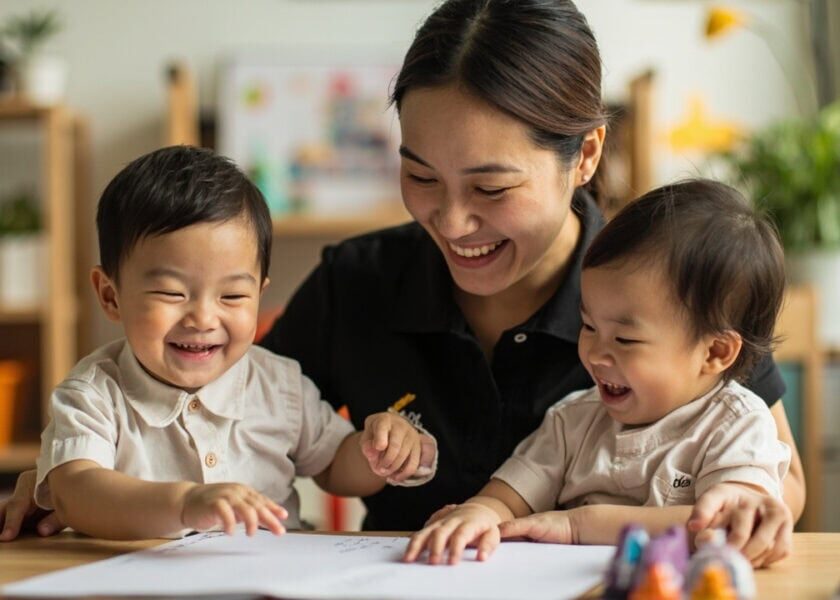
The Science of Secure Attachment for Modern Singapore Families
The Fear You Carry Is Real — And It Matters
This quiet anxiety has become one of the defining emotional experiences of modern parenting in Singapore. It lives beneath the practical decisions about childcare arrangements, beneath the school visits and trial sessions and careful comparisons of ratios and curricula. It is the weight that parents carry into those first drop-offs, the reason why a toddler’s tears at the gate can feel like an indictment.
I want to take this fear seriously — not dismiss it, not talk it away with hollow reassurances. Because the fear is real, and the answer to it matters more than any promotional message could.
Here is what I believe, and what we have designed our entire model around: that fear is not a sign that you are doing something wrong. It is a sign that you are paying attention. It is the voice of your attachment to your child, speaking loudly because it matters so much.
And when it is met with the right kind of childcare, that fear does not need to stay. It can be transformed.
What Science Tells Us About Attachment
The science of attachment has been building for decades, and its findings are both reassuring and counterintuitive.
When a child experiences consistent, responsive, warm care from a caregiver — whether that caregiver is a parent or someone else in a trusted role — they develop what researchers call secure attachment. This is not a vague or theoretical concept. It is a measurable pattern of emotional development that shapes how a child relates to the world, to others, and to themselves.
Here is the part that matters most for this conversation: secure attachment does not divide. It does not work like a pie, where every slice given to one person is a slice taken from another. Attachment is not a zero-sum relationship.
A child who feels emotionally safe with their caregiver does not, because of that safety, love their parent any less. In fact, the opposite is true.
What Secure Attachment Looks Like
A securely attached child carries a template forward into every relationship they will ever have. They have a working model for trust. They know what safety feels like, and so they can reach for it more readily, more confidently, more openly.
When you come home at the end of the day, a child who has been securely cared for is not confused by your return. They are not threatened by the presence of another adult who has loved them well. They are, in fact, more available for you — more ready to connect, more secure in reaching out, more able to trust that the people who love them will continue to do so.
This is the insight that changes everything. The anxiety you feel about childcare hours is, in a certain light, based on a misunderstanding of how attachment works. You are not losing your child to someone else. You are not creating a competitor for your bond. You are, potentially — if the care is good enough — giving your child a richer foundation for that bond to stand on.
What Quality Childminding Actually Looks Like
Let me be clear about something before we go further. I am not here to tell you that any childcare arrangement is interchangeable with your presence. It is not. You are your child’s parent. There is no caregiver, no programme, no philosophy that can replicate or replace what you bring.
The love you have for your child, the history you share, the biological and emotional continuity of your relationship — these are irreplaceable.
But the gap does not have to be a wound. When it is structured and supported in the right way, it can become something else entirely — a bridge.
The Elements That Matter Most
Not all childcare is created equal, and this matters enormously for your peace of mind. When parents ask what they should look for, these are the elements that research and experience tell us are most important:
- Responsiveness over ratios: A caregiver who notices the small things — the moment a child is about to tip from frustration into distress, the pause before a first word, the way a toddler’s play shifts when they are working through something — can respond. Responsiveness is not a luxury. It is the mechanism through which security is built.
- Consistency and continuity: Children build trust through predictability. When the same trusted adults show up, day after day, the world becomes a safer place for them.
- Warmth without intrusion: Quality care respects the child’s autonomy while providing emotional safety. It is present without being overwhelming.
- Communication that invites: The best caregivers do not just care for children; they create windows that keep parents connected to their child’s experience.
EduNanny’s Approach: Extension, Not Replacement
EduNanny Singapore operates within the ECDA Childminding Pilot — and this is not just a regulatory detail, it is foundational to who we are. The pilot represents a government-recognised commitment to raising the standard of home-based and community-based childminding in Singapore. It reflects a belief that families deserve more than just childcare. They deserve a partner.
There is a word we use often when we talk about what we do: extension.
We do not see ourselves as standing in your place. We see ourselves as extending your parenting into the hours when you are not there — and, just as importantly, extending your child’s experiences back into the home, in ways that give you language and tools and insight for your own relationship.
When your child learns something new at EduNanny — when they take their first confident step, when they discover how to stack blocks, when they respond to a story in a way that surprises even their caregiver — that moment is not locked inside our walls. It comes home with you.
Not as a report you have to read and file, but as a living piece of conversation. Today they really loved the rhyme we did. I wonder if you noticed the way they kept trying to say “ba-ba”?
These are not updates for their own sake. They are invitations — invitations for you to enter your child’s day, to see what they are discovering, to participate in it even though you were not there.
What EduNanny Does Differently
| Traditional Childcare | EduNanny’s Approach |
|---|---|
| Parent receives end-of-day report | Parent receives living conversation starters |
| Care is contained within centre hours | Learning extends into the home relationship |
| Parent manages behavioural issues alone at home | Educators share observations and strategies |
| Child’s day is opaque to parent | Parent remains a participant, not a bystander |
The Ratio That Makes It Possible
One of the ways we honour this commitment is through ratios that allow for genuine responsiveness. In our centre-based and home-based pathways, we maintain up to one caregiver for every three infants.
This is not a marketing figure. It is the operational heart of everything we do. When a caregiver is not managing six or eight or ten children at once, they can notice. They can respond. They can remember. They can tell you about it at the end of the day.
Building Security Over Time
One of the most consistent observations our educators make — and one that parents often report back to us with quiet relief — is the change they see in their child’s behaviour at home after a period at EduNanny.
Not the change that suggests the child prefers EduNanny, or that they are somehow more attached to their caregiver. The change that suggests they are more settled, more confident, more available for connection.
A child who feels safe does not need to spend their emotional energy on vigilance, on testing boundaries repeatedly, on clinging to one person because they are not sure anyone else will catch them.
A secure child has been caught. Repeatedly. By people who showed up.
And so they can relax. They can explore. They can direct their social energy outward — toward other children, toward new experiences, and yes, toward their parents, with whom they now feel safe enough to be fully themselves.
When you pick your child up at the end of the day and they run to you, not with anxiety but with the ease of someone who knows you will be there — that is not a sign that EduNanny has failed to bond with them. It is a sign that EduNanny has helped them learn what bonding looks like — and they are applying that lesson with you, the person they trust most.
The Triangle That Strengthens Every Side
We are not a place where your child goes and comes back somehow changed, as if by a machine. We are not a service that takes over during the hours you are away and returns a different child.
We are something more modest, and in that modesty, more honest: we are a support structure.
A triangle — parent, educator, child — in which every side strengthens the other two:
- The educator does not replace the parent.
- The parent does not delegate to the educator.
- They are in a relationship, in the truest sense, with the same goal: the wellbeing, the development, the emotional security of the child at the centre.
You are not a client dropping off a child and picking them up at the end of the day. You are a parent, and your parenting is the most important work that exists — and we are here to support it, not to compete with it.
For Singapore Parents: What EduNanny Offers
You need childcare because you need to work. Or because you need a break. Or because the village that used to surround your family has thinned out, and you are carrying more alone than your parents ever had to.
Whatever the reason, the need is real, and it is not a moral failing. It is a fact of modern life, and it deserves a response that is practical, affordable, and trustworthy.
What You Can Expect From Us
- ECDA Childminding Pilot participation: Government-recognised standards and oversight
- Accessible fee structures: Designed within the pilot framework for affordability
- CDA and Baby Bonus eligibility: Financial support for eligible families
- Monday through Friday care blocks: Reliability that matches your working week
- Transparent operations: Including measures like CCTV where deployed, not as surveillance, but as accountability — a commitment that says: what happens here, you can know about
These are not glamorous details. They are the unglamorous things that make it possible for you to trust us with the hours that matter most.
And trust, in this context, is not just a feeling. It is a structure. It is built through transparency, through communication that is honest and regular, through observation practices that keep you informed.
This is the adult version of what we offer your child: security through presence, through consistency, through the knowledge that someone is paying attention.
Ready to Take the Next Step?
If you are a parent who has felt the weight of this fear, I want you to hear this: you are not wrong to care so much.
The fact that you feel this anxiety is evidence that you are deeply, actively attached to your child. It is evidence that your relationship matters to you in a way that goes beyond obligation, beyond routine, beyond the logistics of feeding and sleeping and getting to school on time.
The care you feel is real. And the love that sits inside it is the same love that will make you a good parent to your child — including the hours when you are not physically with them.
What EduNanny offers is not a replacement for that love. It is a structure that protects it. It is a set of practices, a philosophy, a team of educators who are trained not just to care for your child but to care about your relationship with your child.
Every communication we send, every observation we make, every small moment we notice and pass on to you — these are not just updates. They are gifts to your relationship. They are ways of saying: this matters. You matter. The bond between you and your child is not something we are touching. It is something we are built to strengthen.
At the end of the day — literally, at the end of the day, when you pick your child up and they reach for you — what is it that you want for them?
Not just academically, not just in terms of milestones and school readiness. What do you want for them, deep down, in the part of yourself that is not worried about resumes and aggregate scores and the Singapore school system?
You want them to be happy. You want them to feel safe. You want them to know, in the marrow of their bones, that they are loved, and that the people who love them will not leave them.
That is the work of attachment.
That is the work that you are already doing, every day, simply by caring as much as you do.
The fear you feel is not a warning. It is a compass. It is pointing you toward what matters most — your child, and your bond with them.
If this resonates with you, we invite you to speak with our team about your family’s needs, arrange a visit to see our spaces, or book a trial session for your child.
Because your relationship with your child is not something to be delegated. It is something to be protected, strengthened, and celebrated — and we would be honoured to be part of that work alongside you.
EduNanny is a trusted Singapore childcare and childminding service operating within the ECDA Childminding Pilot. To learn more about our approach, visit about us or explore our full range of services.