What Every Parent Should Know About Baby Brain Development
Close Your Eyes. You Are Two Years Old.
Close your eyes for a moment. Imagine you are two years old.
You are standing in a room filled with light that slants through windows, and everything is new. The floor beneath your feet is cool and smooth, and you press your palms flat against it just to feel that strange sensation of solidity. Someone nearby is speaking, and you hear the rise and fall of their voice, but more than that, you hear the echo of it in the room, the way it bounces off surfaces and softens, the way it tells you something about how big this space is.
You reach for a wooden block and the weight of it surprises you—heavier than you expected—and the grain of the wood catches against your fingertips in a way that makes you hold on a little tighter. You bring it to your mouth because that is how you know things, by tasting them, by feeling the resistance of the surface against your tongue.
Someone kneels beside you and says your name, and the sound of it, spoken in that particular voice, registers somewhere deep in your chest as safety, as belonging.
Now open your eyes.
What you just imagined was not a random collection of pleasant moments. It was the precise architecture of a developing brain taking shape in real time.
For Singapore parents navigating the complex landscape of infant care and childminding, this image matters more than you might expect. Somewhere between the research papers and the school fees, between the headlines about brain development and the quiet ache of hours spent apart from your child, there is a gap that leaves many of us uncertain. We hear “play-based learning” and wonder what that actually means. We are told our children are building the architecture of their futures, and we want to believe it, but we cannot see it happening, and so we wonder: is this really working? Is this really worth it?
You are not alone in that wondering. And you deserve a real answer, not a platitude.
Here is what you need to know: Sensory experiences in the early years literally wire your child’s brain. The difference between quality care and incidental care is intentionality. Trained caregivers read behavior the way musicians read scores. Emotional regulation is built through co-regulation. And once you understand this framework, you become an informed observer who can evaluate any childcare environment with confidence.
The Science of Sensory Development: What Neuroscientists Know
For decades, researchers have been trying to answer one fundamental question: what makes a human brain capable of language, empathy, sustained attention, and the kind of flexible thinking that allows us to solve problems we have never encountered before?
The answer is not born in classrooms or workbooks or structured curricula. The answer is born in moments exactly like the one you imagined—in textures and temperatures, in the sound of a familiar voice, in the weight of a wooden block, in the feeling of being noticed and named and held with intention.
One Million New Connections Every Second
In the first three years of life, a child’s brain forms more than one million new neural connections every single second. That number is almost impossible to comprehend, but the implications are not.
It means that the experiences a young child has during this window are not incidental. They are not filler between infancy and preschool. They are the actual substance out of which cognition, emotional regulation, and social capacity are built.
The process begins with the senses. Before a child can think, they must feel. Before they can reason, they must perceive. The sensory systems are the brain’s first teachers, and every input they receive shapes the way neural circuits organize themselves for a lifetime of learning.
How Sensory Experiences Build Neural Architecture
Consider what happens when a baby reaches for a soft cloth and feels its texture against their cheek. The sensation travels through their nervous system and strengthens a specific pathway—a connection between touch receptors and the growing networks in the brain that will one day allow them to distinguish a friend’s hand from a stranger’s, to find comfort in a familiar blanket, to feel calm when they are held.
When a toddler listens to the sound of their own footsteps on different surfaces, the brain is cataloguing, comparing, building the auditory discrimination that will later allow them to hear the difference between similar sounds in language, to follow a conversation in a noisy classroom, to attend to one voice among many.
When a child moves their body through space—climbing, balancing, falling and getting up again—the brain is mapping the body in relation to its environment, building the proprioceptive awareness and vestibular sense that form the foundation of coordination, focus, and the ability to sit still in a chair when the body wants to move.
This is not metaphor. This is not poetic language for something that is actually happening somewhere else. The sensations your child experiences in the first thousand days of life are literally wiring their brain. The quality of those sensations, the richness of that sensory environment, and the responsiveness of the adults around them determine not just how much their brain develops but how it develops—which circuits strengthen and which remain underused, which pathways become automatic and which remain difficult to access later.
Why Intentional Environments and Trained Observers Matter
A child’s sensory environment does not organize itself optimally by accident. In any environment, a young child will have sensory experiences. They will touch things and hear things and move through space. But the difference between incidental sensory experience and intentional sensory development is the difference between a child left alone in a room and a child in an environment that has been thoughtfully designed, observed, and responsive to their developmental stage.
What Professional Sensory Design Looks Like
In quality infant and toddler care, nothing is random.
The materials on the shelf are not randomly selected; they are chosen for their sensory properties, their developmental appropriateness, their capacity to invite exploration at a level that challenges but does not frustrate. The routine is not arbitrary; it is structured around the neurological reality that young children need predictability to feel safe, and safety is the prerequisite for exploration.
The physical environment is arranged not simply for safety—though safety is essential—but for the kind of sensory richness that activates and strengthens the right circuits at the right time. The lighting, the acoustics, the temperature, the textures available to touch, the sounds available to hear, the scale of objects designed for small hands and growing bodies—all of it is intentional.
In Singapore, where many families live in compact HDB flats and high-rise condominiums, children often have limited space for the kind of large-motor exploration their bodies crave. A quality childcare environment compensates for this by providing safe, supervised opportunities for climbing, balancing, and moving in ways that apartment living makes difficult. This is not a luxury. It is a developmental necessity that professional care addresses.
Reading Behavior Like a Musical Score
This is where professional childcare provides something a non-professional environment cannot: the trained observer.
In the early years, a child cannot tell you what they are learning. They cannot say, “Today I mastered the concept of object permanence” or “I worked on my pincer grip.” They cannot narrate their own development because they do not yet have the language for it.
What they have instead is behavior. They have the way they reach for a toy, the way they react when a caregiver leaves the room, the way they settle when they are picked up, the way they begin to show preference for certain textures or sounds or movements.
A trained caregiver reads that behavior the way a musician reads a score:
- They see the child who is deliberately dropping objects and understand that this is not random play but the serious cognitive work of understanding gravity and object permanence.
- They notice the child who hesitates at the door and recognize the beginning of separation anxiety as a sign that attachment bonds are forming—not a problem to be suppressed but a developmental milestone to be honored with sensitive response.
- They observe the child who repeatedly seeks out the sandbox and understand that this is a child whose sensory processing system is seeking deep pressure input, and they respond by making sure that kind of input is available, in the right amounts, in the right way.
This is what professional training brings. Not just the knowledge of what children typically develop and when, but the skill of observation, the discipline of noticing, and the professional judgment to interpret what they see in the context of each child’s unique developmental trajectory. It is the difference between hearing music and understanding music. It is the difference between being present and being professionally present.
The Architecture of Emotional Regulation
And this professional presence extends to something else that matters enormously to the children in their care and to the parents who love them: emotional regulation.
Why Children Cannot Self-Regulate Alone
In the first three years of life, a child does not yet have the brain architecture for sustained emotional regulation. They cannot calm themselves down when they are upset. They cannot manage frustration or disappointment or fear without the external support of a responsive adult.
This is not a character flaw or a parenting failure. It is a neurological fact. The prefrontal cortex, which handles executive function and emotional regulation, does not fully mature until the mid-twenties, and in early childhood it is still under construction.
What bridges that gap is the caregiver. When a child has a tantrum and a trained caregiver responds with calm presence, with physical comfort when it is wanted, with a steady voice that signals safety, the child is not just being soothed in the moment. They are building an internal model of what it feels like to be regulated, and that model becomes the foundation for their own future capacity to self-regulate.
Every time a caregiver successfully co-regulates with a young child, they are quite literally building the neural circuits for emotional control that the child will use for the rest of their life.
Why Caregiver Ratios Matter So Much
This is why the ratio of caregivers to children matters so profoundly in infant and toddler care.
In an environment where one caregiver is responsible for six or eight or ten young children, the capacity for individualized co-regulation is simply not there. The child who is most dysregulated will get attention, because their distress is loud, but the child who is quietly struggling—the child who is on the edge of overwhelm but not yet expressing it—that child can easily be missed.
In an environment where the ratio is one to three, where the caregiver can truly observe and know each child in their care, the possibility for this kind of attuned responsiveness exists in a way that is not possible at higher ratios.
What Quality Childcare Actually Looks Like
There is a particular kind of ache that comes with being a working parent in the early years. It is the ache of missing—missing the moment when your child takes their first independent step, missing the small triumphs and the small struggles, missing the texture of their day.
You go to work and you do meaningful things and you contribute to the world in ways that matter, and at the same time, there is a small, persistent wondering in the back of your mind: what is happening while I am gone? Are they okay? Are they learning? Am I missing something that cannot be made up?
This wondering is not a sign of parental failure. It is a sign of parental love. And it is a question that deserves a real answer.
In quality care, your child is not just being kept safe and entertained while you are away. They are in an environment that has been designed to speak the language their brain is built to learn. They are with a caregiver who is trained to notice what you would notice if you were there, and to respond in ways that support the development of neural architecture, emotional regulation, and the foundational capacities that will determine so much of what comes later.
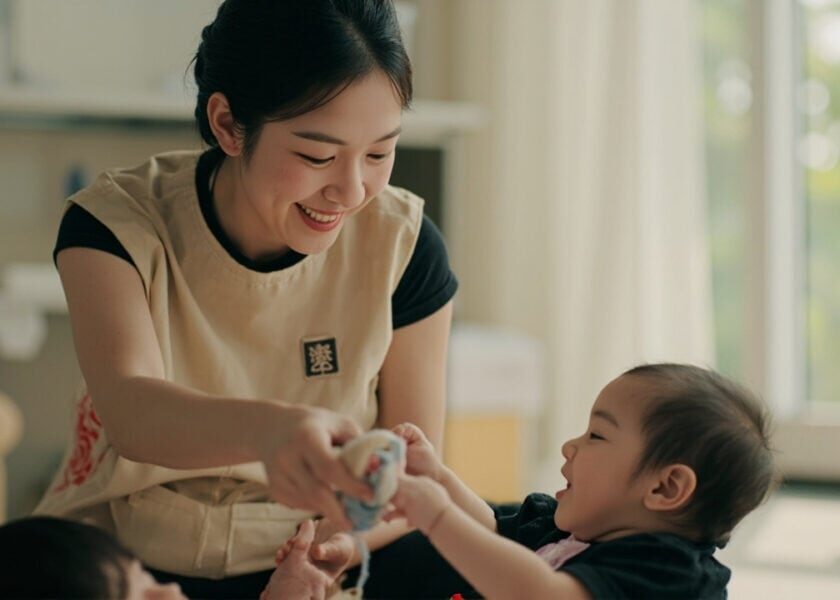
They are touching things that teach their hands about the world. They are hearing things that teach their ears to discriminate and categorize. They are moving in ways that build the body-brain connection that underlies coordination and focus. They are having moments of delight and moments of frustration and moments of deep connection with a caregiver who is attuned to them, and in all of these moments, their brain is doing the most important work of their entire lives.
Questions Every Parent Can Ask
Once you understand this framework, you become an informed observer. You develop what I would call a sensory literacy—the ability to look at any childcare environment and ask the right questions.
- Environmental quality: Is this environment rich in sensory experience? Are the materials varied in texture, weight, and complexity? Is there space for movement? Is the acoustics appropriate for young ears?
- Caregiver quality: Do the caregivers seem attentive not just to safety but to the quality of the children’s engagement? Do they kneel down to the children’s level? Do they narrate what they see the children doing? Do they seem calm and present rather than rushed and distracted? Can they articulate what children are learning through their play?
- Structural quality: What are the caregiver-to-child ratios, especially for infants? Is the routine structured around children’s developmental needs or adult convenience? How does the service handle communication with parents?
When you visit any potential childcare setting, try to see beyond the performance that providers often put on for tours. Ask to observe a classroom during activity time. Notice whether children seem engaged or merely occupied. Watch how caregivers interact with children who are struggling versus those who are content.
The best test is often the simplest: do the children look like they are doing meaningful work? Are they absorbed in what they are doing? Do they seek out caregivers for comfort or connection? Do they move through the space with confidence and curiosity?
The Connection to Later School Readiness
Children who have had rich sensory environments develop stronger foundations for attention and focus. When a child has built robust proprioceptive and vestibular systems through movement and exploration, sitting still in a chair becomes possible rather than physically uncomfortable. When a child has developed strong auditory discrimination through varied sound experiences, listening to a teacher in a noisy classroom becomes manageable. When a child has learned through co-regulation what it feels like to be calm, they have a reference point for managing their own emotional responses.
The play that might look effortless is actually the foundation for everything that comes after. The child stacking blocks is building spatial reasoning. The child mixing paints is learning about color and cause and effect. The child negotiating over a toy is developing the social skills that will underpin collaboration and conflict resolution for the rest of their life.
How EduNanny by BUTLER Approaches Professional Childminding
EduNanny by BUTLER was designed by people who understand that the early years are not a waiting room before real life begins. They are real life. They are, in fact, the most consequential years of human development, and they deserve to be treated with the seriousness and the professional intentionality that that significance demands.
The ECDA Childminding Pilot Framework
Developed under the ECDA Childminding Pilot, EduNanny provides intentionally structured care for Singapore families, with both home-based and centre-based pathways available. This gives families options that suit their circumstances while maintaining the quality standards that the pilot framework requires.
The infant ratios of up to one to three mean that your child’s caregiver knows them—truly knows them—the way a thoughtful parent would want their child to be known. The Monday to Friday care blocks are structured around the rhythms of family life in Singapore, and the fee structures are designed to be affordable within the pilot framework, with CDA and Baby Bonus funds usable to help ease the financial reality that many families face.
Built on the Principles Described
Every texture a child touches in an EduNanny setting is deliberate. Every sound they hear is considered. Every interaction with their caregiver is an opportunity for the kind of attuned response that builds emotional regulation, neural connectivity, and the secure attachment that research continues to show is the single greatest predictor of lifelong mental health and relationship quality.
Every moment of what might look like play is actually work—the most important work of early childhood—and it is happening with professional attention and care.
Because EduNanny understands that trust is built on transparency, communication is prioritized as a core part of the service. Where deployed, CCTV measures provide an additional layer of openness, not as surveillance but as reassurance, so that parents who spend their workday unable to see what is happening can return home with the knowledge that the door to their child’s day was never closed.
This is not just logistics. This is the practical translation of everything the science of early development tells us children need. The sensory environment, the trained observer, the responsive caregiver, the appropriate ratios, the transparent communication—all of it together is what professional childminding looks like when it is designed with intention around what children actually need in their earliest years.
The Confidence That Comes from Understanding
This is what I want you to take away from this article.
Not just a feeling of warmth about any particular childcare option, though I hope you feel that. I want you to take away something more enduring—a framework for understanding what your child needs, a vocabulary for evaluating whether they are getting it, and a confidence that the choice you are making, the difficult and beautiful and sometimes aching choice to entrust your child’s earliest years to professional care, is a choice grounded in science, in love, and in the knowledge that the brain your child is building right now is the brain they will use to think and to feel and to connect for the rest of their lives.
You are not missing their childhood while you are at work. You are building the foundation that makes their childhood possible.
In quality professional care, in an environment designed for that purpose, with caregivers trained to support that purpose, that building is happening with intention, with skill, and with profound respect for the extraordinary task that early childhood represents.
Your child’s senses are building their brain. Every touch, every sound, every movement is a message that says, grow. Develop. Become.
That knowledge is not a hope. It is a knowing. And your child’s brain is worth every deliberate sensory moment, every attentive caregiver, every intentional choice that quality care represents.
If you would like to explore how EduNanny by BUTLER applies these principles in practice for Singapore families, we welcome you to get in touch.
Learn more about who we are and what we offer.