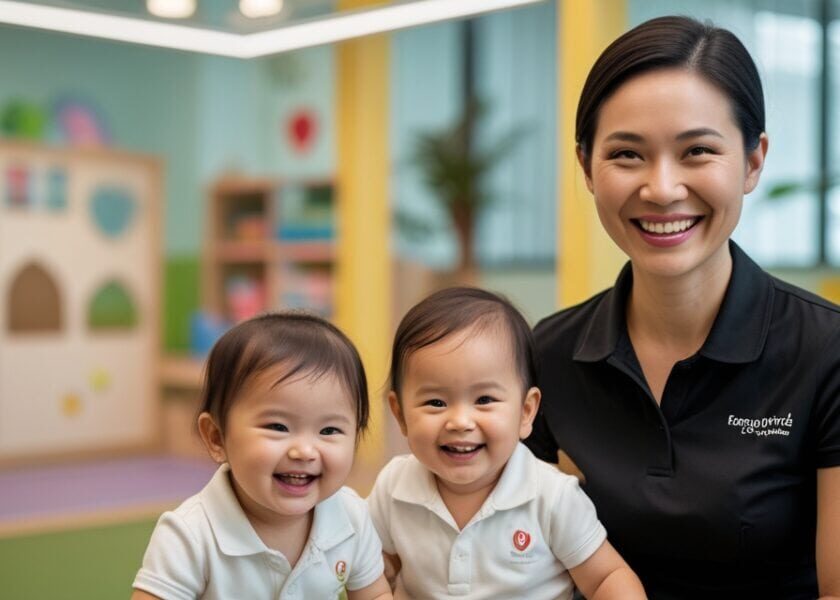
The Real Question Behind Singapore Parents’ Childcare Decision
The Question Beneath Every Enrollment Hesitation
Singapore parents care. Deeply, seriously, sometimes overwhelmingly. The kind of care that shows up in the books you read aloud at 2 a.m. The kind that researches, cross-references, asks other parents, and still lies awake wondering if the choice being made is the right one.
Singapore parents are not uncertain about whether their children need excellent care. They are uncertain about what it means about them — about their commitment, their presence, their identity as a parent — when they choose to seek that care beyond their own home.
The market has largely answered this uncertainty with two kinds of content.
The first tells you not to feel bad. That it is fine. That many families do it. That children are resilient. While all of that is true, it does not actually resolve the tension. It just softens it temporarily.
The second kind tells you to evaluate, measure, compare. Checklists for curriculum, ratios for staffing, accreditation for safety. While all of that is necessary, it also misses the deeper question entirely.
Because the question beneath every enrollment hesitation is not: Is this childcare good enough?
The question is: Will choosing this make me less of a parent, or will it make me a better one?
Why Singapore Parents Feel Caught in a Bind
Here is what we know about raising young children in Singapore. The cultural imagination offers parents two options.
The first is the village. Extended family, multigenerational closeness, the comfort of knowing your child is with people who share your blood and your history. Grandparents who remember what it was like when you were small. Continuity of language, values, and way of life passed down through generations.
The second is the institution. The centre, the classroom, the formal system with its routines and ratios and stranger caregivers. Structured environments designed for efficiency and scale.
For many families in Singapore, the village is not available in the way it once was — or never was at all. Relatives may live overseas. Work demands may have pulled families across borders. Housing arrangements may not allow for multigenerational living.
And the institution, while professional and structured, can feel like a place where your child becomes one of many, where the particularity of your family’s values and rhythms gets smoothed over for the sake of consistency.
So parents do what often feels like an impossible thing. They choose the best of the available options and then spend the next months quietly wondering if they made the right call. Wondering if there is a third way. Wondering if anyone really sees their child the way they do.
There is.
The First Thousand Days: Why This Decision Matters
Before we go further, let us be honest about what is actually at stake in the early years — not to create anxiety, but to honor the genuine weight of what is happening.
The first thousand days of a child’s life — from conception to roughly age three — are not simply a warm and blurry prologue to the real business of growing up. They are, in every meaningful sense, the foundation.
Neuroscience tells us this, and so does the experience of every parent who has watched their child develop preferences, fears, curiosities, and capacities that seemed to materialize from nowhere. The relational architecture being built during this time — the patterns of trust, responsiveness, and emotional attunement — is not something that can be deferred or revisited later. It is happening now. Every day. With whoever is present.
Which is precisely why the decision about who is present matters so much.
Here is where Singapore parents find themselves in a particular bind: you understand the stakes. You care deeply about getting this right. And yet the framework you have been given — village or institution, do-it-yourself or hand it over — does not reflect the reality of what excellent early care can actually be.
Beyond Supervision: What Genuine Partnership Looks Like
Most childcare arrangements offer supervision. Supervision is watching. It is keeping a child safe and occupied. It is a necessary function, and many arrangements provide it adequately.
But supervision is not partnership. Partnership means something more.
Partnership means the caregiver understands not just what your child needs to eat, but how your child experiences food. Not just what your child needs to learn, but how your child learns best. Not just that your child is having a good day, but what a good day looks like for your specific child — with their specific temperament, their specific preferences, their specific emerging self.
Here is the premise that partnership-model childcare is built on: the best childcare does not replace you. It extends you.
Think about what that means. When you hire a partner to help you build a home, you do not hand over your vision and expect someone else to execute it. You work together. You share your goals. You communicate your values. You check in, adjust, refine.
The partner brings expertise, capacity, and consistency. You bring the intimate knowledge of your own family, your own child, your own hopes for what this life together will become. The result is stronger than what either of you could produce alone.
That is what premium developmental childcare at its best can be. Not a place your child goes. Not a service your family consumes. But an extension of your parental intent — a carefully maintained environment where the things that matter most to you continue to matter, where the rhythms you have established at home are respected and built upon, where your child’s development is not parallel to yours but in conversation with it.
The Reframe That Changes Everything
The narrative that says choosing childcare support means you will see your child less, know your child less, be present for your child less — that narrative is built on a misunderstanding of what presence actually requires.
Presence is not proximity.
Presence is not the number of hours in the same room. Presence is the quality of attention. The quality of listening. The quality of showing up — emotionally, attentively, with your whole self — in the time you do have.
And here is a truth that many parents discover only after they have made the choice to partner with excellent care: when you are no longer running on empty, when you have genuine support that you trust, when your child’s days are filled with consistent, responsive, developmentally rich care — you have something precious to bring home.
Energy. Attention. The patience that comes from not being stretched beyond your limits. The joy that is possible when parenting is something you are doing, not something you are barely surviving.
Partnership-model childcare does not take you away from your child. It gives you back to your child.
How EduNanny by BUTLER Partners With Your Family
Now we want to share what this partnership looks like in practice — because philosophy, however sincere, is not enough. You need to know what it actually means when you choose a care arrangement that is built on these principles.
When a family engages with EduNanny by BUTLER, they are entering a structured, supported partnership designed with both rigor and responsiveness in mind.
Alignment With National Standards
EduNanny participates in the ECDA Childminding Pilot, which means its operations are aligned with national standards for quality and safety. This is a framework parents can understand and trust — not a standalone arrangement with no external accountability.
Pathways That Fit Your Life
Within this framework, EduNanny offers both home-based and community or centre-based pathways, recognizing that every family’s circumstances are different.
- Home-based care provides continuity and comfort — a trusted caregiver within your own space, maintaining the rhythms and familiarity your child already knows.
- Community or centre-based pathways offer enrichment and socialization that complements what happens at home.
The pathway matters less than the quality of the partnership — and EduNanny is designed to deliver that quality across both.
What the Ratios Actually Enable
The ratios within the infant care programme — up to one caregiver for every three infants — are not simply numbers on a page. They are the practical condition that makes genuine attention possible.
In an environment where a caregiver is responsible for three or fewer infants:
- Each child can be seen, known, and responded to as an individual
- Routines can be attuned to individual temperaments
- Development can be tracked with precision
- The kind of care that is described in philosophy can actually be delivered in practice
Communication That Keeps You Connected
Singapore parents often express a specific fear: that once their child is in care, they will be cut off from the texture of their child’s day. They will receive generic updates, formal reports, a version of their child’s life that feels curated and distant.
EduNanny’s approach operates differently. Regular, meaningful communication is built into the model — updates that go beyond the perfunctory to share what the child is exploring, how they are progressing, what moments of delight or difficulty occurred during the day. Where CCTV measures are deployed, parents have the option of direct insight into their child’s environment.
This is not about surveillance. It is about trust — and about giving parents the information they need to remain active partners in their child’s development even while they are apart.
Values Alignment
Every family has its own approach to feeding, sleeping, play, discipline, exposure, and routine. These are not arbitrary preferences — they are expressions of what parents believe matters for their child.
A partnership model does not impose a standard approach across all families. It asks what your goals are, what your child needs, what you value — and then builds the care around those answers.
This is a different kind of relationship than most parents have experienced with childcare arrangements. It requires more intentionality at the outset — more conversation, more clarity about expectations, more ongoing communication. But what it produces is worth it: a childcare experience that feels like an extension of home rather than a departure from it.
What to Look For When Choosing Premium Childcare
If you are ready to move from hesitation to intention, here is a practical framework for evaluating your options. These are the questions that separate genuine partnership from mere supervision.
| What to Evaluate | Questions to Ask |
|---|---|
| Ratios and Attention | How many children is each caregiver responsible for? Can each child genuinely be known as an individual? |
| Communication Systems | What kind of updates will I receive? How often? Will I feel connected to my child’s day, or distant from it? |
| Values Alignment | Does this arrangement ask about my family’s approach, or does it impose a standard? Can I share my goals and have them honored? |
| Training and Expertise | What is the caregivers’ training in early childhood development? How do they handle developmental milestones, feeding, sleeping, and emotional attunement? |
| Accountability and Standards | Is the arrangement aligned with recognized quality frameworks? Is there external oversight, or is it purely a private arrangement? |
| Pathway Flexibility | Does the arrangement adapt to my family’s needs — home-based or centre-based — or must I fit into a single model? |
| Transparency Measures | Are there measures in place that allow me to see and understand my child’s environment? Not to surveil, but to trust. |
The best childcare arrangement is the one that answers these questions in a way that feels like an extension of your own vision — not a compromise with it.
Addressing What Parents Actually Worry About
We want to address some of the concerns we hear most often from Singapore parents considering premium childcare. If any of these resonate with you, know that you are not alone — and that these concerns deserve honest answers.
“Will my child feel abandoned?”
Children are remarkably attuned to their parents’ emotional state. What they feel, more than anything else, is whether the adults around them are secure, present, and confident. When parents choose quality care from a place of clarity and trust — rather than anxiety and guilt — children absorb that security. The separation is a transition, not a trauma. With the right partnership in place, children thrive in the consistency and responsiveness that quality care provides.
“Will my child love the caregiver more than me?”
This fear is understandable, but it confuses attachment with replacement. Your child having another trusted adult in their life does not diminish your role — it expands the network of security around them. In fact, children who have consistent, quality care often show stronger attachment security with their parents, because they are not picking up on the exhaustion and strain that can come from parents being stretched too thin.
“What if the caregiver does not share my values?”
This is precisely why values alignment matters — and why the upfront investment in finding the right partnership is worth it. In a genuine partnership model, your values are not assumed to be the same as everyone else’s. They are sought out, understood, and built into the care plan. The right arrangement means your caregiver is serving your vision for your child, not imposing a standard approach.
“I should be able to do this on my own.”
The assumption that good parenting means doing everything alone — or feeling bad when you cannot — does not serve anyone. Not the parents. Not the children. Not the families trying to build something sustainable and joyful together.
The parents who build the strongest partnerships with quality care are not the ones who cared less. They are the ones who understood that a child’s healthy development requires skilled, consistent, emotionally intelligent support — and that choosing that support with intention is itself an act of excellent parenting.
The Courage to Choose Partnership
There is a particular kind of courage it takes to choose partnership-model childcare in Singapore.
It requires you to resist the narrative that says good parents do it all themselves. It requires you to reject the guilt that is so often weaponized against parents who seek support. It requires you to believe, at a foundational level, that you know what is best for your child — and that partnering with people who can deliver on that vision is not a compromise but a commitment.
The best parents we know are not the ones who never ask for help. They are the ones who ask for help with discernment. Who choose their partners carefully. Who do the work of finding care that aligns with their values, not simply care that is available.
The decision to choose premium childcare is not a concession to circumstances. It is not a compromise with guilt. It is not an admission that you are less devoted, less present, or less committed than parents who do it differently.
The decision to choose premium childcare — to choose it thoughtfully, to choose a partner who shares your vision, to choose infrastructure over improvisation — is one of the most deliberate expressions of parental love that exists.
It says: I take this responsibility seriously enough to build the right support around it.
It says: my child deserves more than what I alone can sustain without erosion.
It says: I am going to be the kind of parent who shows up — fully, attentively, with presence to spare — and I am going to make the choices that make that possible.
That is not weakness. That is wisdom. That is strength. That is love, expressed in the language of practical decisions and trusted partnerships.
Ready to Choose Partnership Over Improvisation?
EduNanny by BUTLER exists for parents who have made that decision — or who are considering making it with clarity rather than guilt.
We are not here to replace you. We are here to extend you. To be the thoughtful infrastructure that your parenting vision deserves. To bring expertise, consistency, and genuine partnership to the most important work there is: caring for a child during the years when everything is being formed.
We know that Singapore parents are doing hard things. Long work hours. Compressed timelines. Family structures that look different than they did a generation ago.
What serves everyone — parents, children, and families building something sustainable and joyful together — is a model of childcare that is honest about what parents need, respectful of what children require, and confident enough to say plainly: partnership is not a compromise. Partnership is the answer.
We are building that answer here, in Singapore, for families who are ready to choose it. With structure and accountability through the ECDA Childminding Pilot. With quality standards that make the ratios, the training, and the communication practices real and verifiable. With pathways — home-based and community or centre-based — that give families options that fit their lives. With transparency measures that build trust. With support for CDA and Baby Bonus where applicable, so that financial considerations do not become barriers to the partnership you deserve.
If you are reading these words and feeling the weight of a decision that has felt too heavy to make — or too frightening to even approach — we want you to know something.
You are already the kind of parent this decision assumes you are.
You care. You think carefully. You want the best for your child. And wanting the best sometimes means building the right support around the love you already have.
That is not something to feel guilty about. That is something to trust.
EduNanny by BUTLER is here for parents who are ready to choose partnership over improvisation. Who are ready to move from hesitation to intention. Who are ready to stop asking whether they should feel bad and start asking what the right choice actually looks like.
The right choice is the one made with care. The right choice is the one made with trust. The right choice is the one that says: I see what my child needs, and I am going to build it — with help, with partnership, with the kind of clarity that comes from knowing your own values.
That choice is yours.
And if you are ready to make it — or to learn what it looks like to make it well — we are here. Extending what you have already started. Partnering with the vision you have already built.
The best childcare does not replace you. It partners with you.
And you — the parent who has gotten this far, who has read these words and felt their weight and considered their truth — you are exactly the parent who knows how to choose that.
About EduNanny by BUTLER
EduNanny by BUTLER is a premium developmental childcare and childminding service built on partnership, trust, and the belief that excellent early care strengthens families rather than replacing them. Operating within the ECDA Childminding Pilot framework, EduNanny offers both home-based and centre-based pathways designed to align with your family’s values, rhythms, and goals.
Learn more about who we are or connect with our team to explore what partnership looks like for your family.